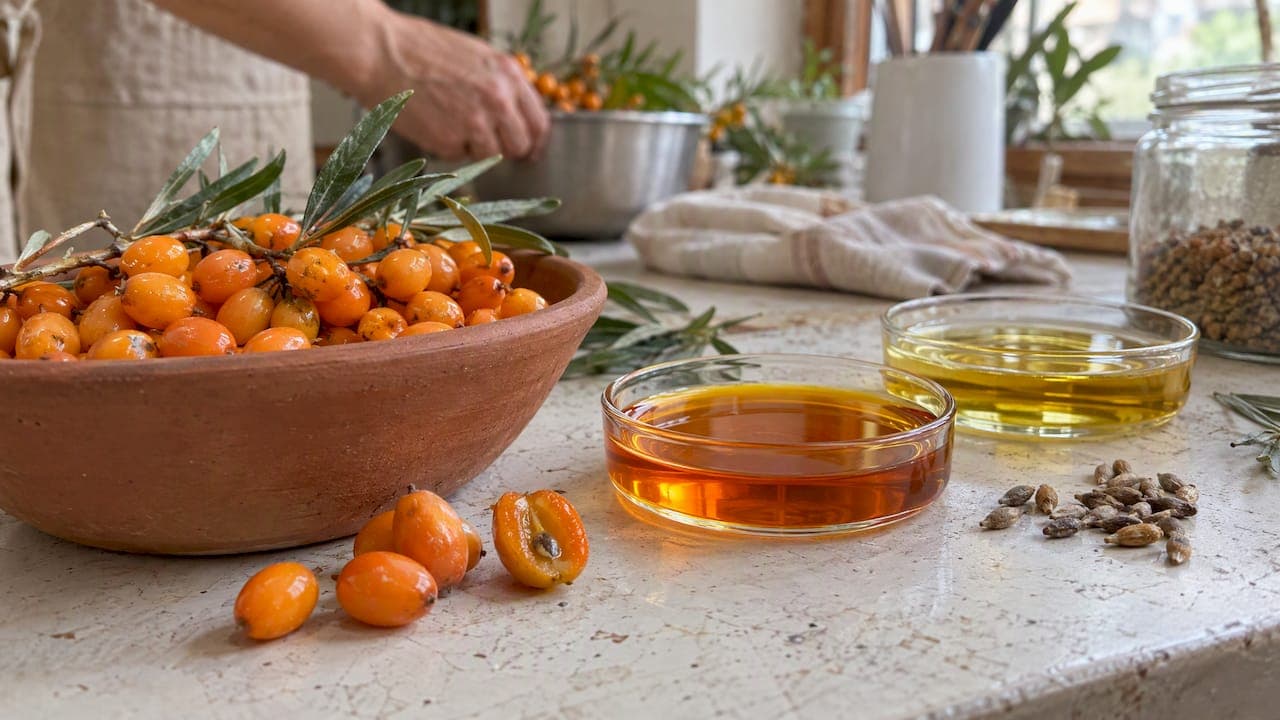
Sea buckthorn oil is rich in fatty acids, carotenoids and vitamin E. Small clinical trials link it to better skin texture, less dry-eye discomfort and improved cholesterol numbers. The evidence is real but early. Most trials are small, many use oral supplements, and some uses have no proven benefit. This guide separates what studies found from what is still unproven, and explains how to use the oil on skin.
TL;DR
- Sea buckthorn oil comes from the berry's pulp or its seeds. The two oils have different fatty acid profiles.
- Oral trials report better skin texture, less dry-eye discomfort and better lipid numbers. Most studies are small.
- Lab work suggests the seed oil may support skin hydration and defend against UV-driven oxidative stress. Topical human data is thinner.
- The oil is not a meaningful vitamin C source. The berries are. Do not expect the oil to behave like a vitamin C serum.
- Talk to a doctor first if you take blood thinners, are pregnant or breastfeeding, or have surgery planned.
Table of Contents
- What sea buckthorn oil is
- Benefits at a glance: how strong is the evidence?
- Sea buckthorn oil for skin
- Seed oil vs. fruit (pulp) oil
- Does sea buckthorn oil contain vitamin C?
- Other benefits studied
- Side effects and who should be careful
- Our perspective
- How to use sea buckthorn oil on your skin
- Build a simple routine with Yuka+Face
- FAQ
- Sources
What sea buckthorn oil is
Sea buckthorn (Hippophae rhamnoides) is a hardy shrub with orange berries. Two oils come from it. Pulp oil is pressed or extracted from the fruit flesh. Seed oil comes from the seeds.
Both oils are used in skincare and in oral supplements. They are not interchangeable. Labels often say only "sea buckthorn oil," so check whether a product uses fruit oil, seed oil or a blend.
A 2019 review of the oil's fatty acids notes that research is limited. Many findings concern isolated fatty acids rather than the whole oil. More work is needed to confirm clinical uses and how the compounds work together. Keep that in mind through the rest of this guide.
Benefits at a glance: how strong is the evidence?
| Claimed benefit | What the research found | Strength |
|---|---|---|
| Skin texture and pores | 12-week oral trial in women 45+ reported measured gains | Early, one product |
| Skin hydration | Lab study on skin cells and reconstructed skin | Preliminary |
| UV protection | Cell and lab data on antioxidant pathways | Preliminary |
| Dry eye | 3-month placebo-controlled trial, 100 adults | Moderate, small |
| Vaginal dryness | 3-month placebo-controlled trial, postmenopausal women | Moderate, small |
| Cholesterol and triglycerides | Meta-analysis of 15 trials | Moderate, high variability |
| Blood sugar, blood pressure, BMI | No overall effect in the same meta-analysis | Not supported |
| Eczema | Benefit not established | Not supported |
The sections below explain each row.
Sea buckthorn oil for skin
This is the most searched use, and the one the Yuka+Face audience cares about most.
Texture, pores and collagen
A 12-week randomized, double-blind study gave women aged 45 and older 500 mg per day of a sea buckthorn oil supplement. Instrument measurements showed facial skin texture improved by 14.1% and pore count by 14.6%, with a 10% increase in collagen density. The same trial reported relief from dry eyes and vulvar dryness, plus higher HDL cholesterol.

Two cautions apply. The participants swallowed the oil. Nothing here shows the same result from a face oil. And this is one trial of one branded ingredient. It is encouraging, not settled.
Hydration
In a lab study, researchers treated human skin cells and a reconstructed epidermis with 10 μg/mL of seed oil extract. Two genes tied to water movement and hyaluronic acid production, AQP3 and HAS2, showed increased expression. The authors suggest this may improve skin hydration.
That is a mechanism, not a result on real faces. It does fit what formulators already see: the oil's fatty acids help soften skin and slow water loss. If you have dry or compromised skin, our guide to ingredients that support barrier recovery covers the wider picture.
Sun-exposed and aging skin
A 2025 review of sea buckthorn in skin and mucosal health reports that the seed oil may act as a natural photoprotective agent. It appears to reduce UV-triggered oxidative stress through the Nrf2 antioxidant pathway.
This does not replace sunscreen. It points to a possible supporting role for antioxidant-rich oils in a routine. For mature skin more broadly, see our practical guide to caring for mature skin.
Eczema and other skin conditions
The U.S. National Center for Complementary and Integrative Health states that sea buckthorn oil's benefit for eczema has not been established. The limited studies are generally small and not well designed. If you have eczema, psoriasis or another diagnosed condition, a dermatologist should guide treatment. Do not swap a prescribed treatment for a plant oil.
Seed oil vs. fruit (pulp) oil
The two oils differ in composition, and that affects how each is used.
- Pulp (fruit) oil is particularly high in palmitoleic acid (omega-7) and carotenoids. Palmitoleic acid is studied as a topical agent for skin tissue and wound healing. Carotenoids give the oil its deep orange color.
- Seed oil provides a balanced 1:1 ratio of linolenic acid (omega-3) to linoleic acid (omega-6), according to the same review. It is typically lighter in color.
In practice, pulp oil tends to be used where richness and repair are the goal. Seed oil tends to be used where a balanced, lighter feel is wanted. The studies above are not interchangeable either: the hydration work used seed oil extract, while the oral texture trial used a specific supplement product.
Pulp oil's carotenoids can stain. Expect orange tint on fingers, pillowcases and light fabrics when it is used undiluted. Formulated products usually contain a small share of it for that reason.

Does sea buckthorn oil contain vitamin C?
The berries do. The oil is a different matter.
Vitamin C is water-soluble, and the oil is made of fats. The berries are a rich source, with roughly 695 mg per 100 g, higher than many common citrus fruits. Content varies by variety. One study reported up to 1080.30 mg per 100 g in the sinensis subspecies.
Those figures describe the fruit. Pressed oil is a fat extract, so you should not count on it for vitamin C. What the oil does carry is fat-soluble content: fatty acids, carotenoids and vitamin E. Product pages that credit the oil with a vitamin C dose should be read skeptically.
If vitamin C is your goal in skincare, look for a formula built around it. Our Vitamin C Cleansing Oil is one example of that approach. Our guide to vitamin-rich oils for radiant skin compares other options.
Other benefits studied
Most of the research on non-skin uses involves oral oil. These are not topical benefits.
Dry eyes
In a 2010 double-blind randomized trial, 100 adults with dry-eye symptoms took 2 g per day of sea buckthorn oil or a placebo oil for three months. Eighty-six finished. The sea buckthorn group had a smaller seasonal rise in tear-film osmolarity and better symptoms.
Vaginal dryness
A three-month trial gave 98 postmenopausal women 3 g per day of sea buckthorn or placebo oil. Improvement in vaginal epithelium integrity was more likely with sea buckthorn (odds ratio 3.1). The vaginal health index result was only a trend. The trial measured tissue integrity, and it does not make claims about hormone levels. If you are weighing it for menopause symptoms, discuss it with your clinician.
Cholesterol and heart markers
A 2022 meta-analysis of 15 randomized trials found that sea buckthorn supplementation reduced triglycerides, total cholesterol and LDL, and raised HDL. Lipid reductions appeared only in people with abnormal lipid metabolism. There was no overall effect on blood sugar, blood pressure or BMI. Heterogeneity was high, and the authors call for more clinical studies.
A smaller 30-day trial in India used 0.75 mL per day of seed oil in 74 participants with high blood pressure or cholesterol and 32 healthy participants. It reported lower blood pressure and improved lipid markers in the affected groups. Treat it as a single, short study. The larger meta-analysis found no overall blood pressure effect.
None of this makes the oil a treatment for heart disease. Cholesterol and blood pressure management belongs with your physician.
Side effects and who should be careful
"Natural" does not mean risk-free. NCCIH makes the point directly: natural does not mean safe. Supplements can cause side effects or interact with medicines.
What to know:
- Common reactions. Reported effects include stomach discomfort and allergic reactions.
- Blood thinners. The same source says sea buckthorn may interact with them. If you take warfarin or similar drugs, ask your doctor or pharmacist before using oral products.
- Surgery. If you have a procedure scheduled, tell your surgeon about any supplement you take.
- Pregnancy and breastfeeding. There is no research on whether sea buckthorn oil is safe in either situation. Ask your obstetrician or midwife before using oral products.
- Topical use. Patch test any new oil. Apply a small amount to your inner forearm and wait 24 hours. Stop if you see redness, itching or swelling. Allergies to the plant or to other oils in a blend are possible.
The trials above ran for up to three months. Long-term safety of daily oral use is less well documented.
Our perspective
We formulate for sensitive, dry and maturing skin. Our approach is simple: short ingredient lists, vegan and cruelty-free formulas, and routines that protect the skin barrier first.
Sea buckthorn oil fits the interest in antioxidant-rich botanicals. We read the research the way we want customers to read it. The skin findings are promising, but most come from oral supplements or lab models. A face oil is a different delivery route, and we do not claim the oral results carry over.
We also see a pattern in how people shop for oils. They look for one hero ingredient and expect a fast change. Skin responds better to a consistent routine: cleanse gently, hydrate, moisturize, protect from the sun. An oil is one layer, not the whole plan. If an ingredient is strongly colored or potent, start small and patch test.
If you are new to oils, begin with the basics in our guide to face oil benefits, types and use.
— Kelly
How to use sea buckthorn oil on your skin
- Patch test first. Inner forearm, 24 hours.
- Choose the right oil. Pulp oil is richer and stains. Seed oil is lighter. A formulated product with a small share is the easiest start.
- Apply to clean, slightly damp skin. A few drops are enough. Press, do not rub.
- Seal with a moisturizer if your skin is dry, or use the oil as the last step at night.
- Use sunscreen by day. Antioxidant oils do not replace it.
- Give it time. Judge a new product over several weeks, not several days.
Order matters when you layer. Our guide on how to apply facial oils walks through the sequence. Our piece on moisturizing vs. hydrating explains why oil alone does not hydrate.
Also read the label. Look for the plant's Latin name, Hippophae rhamnoides, whether it is seed or fruit oil, and where it sits in the ingredient list. Fragrance or dyes added to a "sea buckthorn" product are worth noticing if your skin is reactive.
Build a simple routine with Yuka+Face
If you want a barrier-first routine with plant-based, vegan, cruelty-free formulas, start with our shop for cleansers, toners, serums and oils. For dry skin, see the moisturizers and masks. Our Hydrating Power Moisturizer is a good starting layer for dry or maturing skin.
FAQ
What are the negative side effects of sea buckthorn oil?
Reported effects include stomach discomfort and allergic reactions. It may also interact with blood thinners. On skin, redness or itching can occur, so patch test first.
Who should not take sea buckthorn oil?
People on blood-thinning medication, those with surgery scheduled, and anyone pregnant or breastfeeding should talk to a clinician first. Safety in pregnancy and breastfeeding has not been studied. People with a plant allergy should also avoid it.
Does sea buckthorn raise estrogen?
The trial on postmenopausal women measured vaginal tissue integrity, not hormone levels, and reported improved epithelium integrity. We found no source here showing that the oil raises estrogen. If you have a hormone-sensitive condition, ask your clinician before taking it.
What happens if you take sea buckthorn every day for 30 days?
One 30-day trial gave 0.75 mL per day of seed oil to healthy people and to people with high blood pressure or cholesterol. It reported improved blood pressure and lipid markers in the affected groups. It is a single small study, so results are not guaranteed. Check with your doctor before starting a daily supplement.
Is sea buckthorn oil good for skin?
The early evidence is promising for texture and hydration, but much of it is from oral trials and lab work. It may suit dry or mature skin as one part of a routine. It has not been shown to treat eczema.
Sources
- NCCIH: Skin Conditions at a Glance
- Oral sea buckthorn oil and tear film osmolarity (PubMed)
- Sea buckthorn oil intake and vaginal atrophy (PubMed)
- Sea buckthorn effects on lipids, glucose and blood pressure: meta-analysis (PubMed)
- Seabuckthorn seed oil and cardiovascular risk factors (PubMed)
- The impact of oral sea-buckthorn oil on skin and blood markers
- Unsaturated fatty acid-enriched extract from Hippophae (Wiley)
- The role of sea buckthorn in skin and mucosal health (PMC)
- Sea buckthorn oil fatty acids and human health (PMC)
- Hippophae rhamnoides L.: a potential source of nutrients
- Comparative assessment of sea buckthorn functional components (PMC)
- Sea Buckthorn Benefits for Skin, Heart Health, and Inflammation (News-Medical)
- Sea buckthorn oil benefits (Medical News Today)