
Yes, rosehip oil helps most skin types. It hydrates, supports the skin barrier, and can modestly soften fine lines and dark spots with regular use. It works best for dry, sensitive, or aging skin, and acne-prone users should patch-test first. Apply two to four drops as the last step in your routine, after serums and before or mixed into moisturizer.
TL;DR:
- Rosehip oil’s carotenoid content, especially when cold-pressed and unrefined, significantly influences its effectiveness in improving skin texture and reducing signs of aging.
- For best results, apply two to four drops as the final step in your nighttime routine, after serums and moisturizers, and never before active treatments like retinoids or acids.
- Patch testing is essential before face application, and oil should be stored in dark glass bottles and refrigerated to maintain potency.
- Clinical evidence shows visible skin improvements within five weeks, but results vary depending on the oil’s quality and skin type.
- Rosehip oil is supportive and low-risk but not a substitute for prescription retinoids for deep wrinkles or hyperpigmentation.
Table of Contents
- What Rosehip Oil Actually Does for Facial Skin
- How to Use Rosehip Oil on Your Face the Right Way
- What the Research and Dermatologists Actually Say
- Safety, Side Effects, and What Not to Mix With Rosehip Oil
- Choosing and Storing Rosehip Oil So It Actually Works
- Kelly's Tips From Yuka+Face: Small Rituals, Common Mistakes
- A Rosehip Oil Worth Trusting for Your Routine
- Sources
- FAQ
What Rosehip Oil Actually Does for Facial Skin
Rosehip oil comes from the seeds of the Rosa canina plant, and its benefits trace back to a specific chemical profile: high levels of linoleic and alpha-linolenic acid (essential fatty acids your skin cannot produce on its own), plus carotenoids and vitamins A, C, and E that act as antioxidants. Cleveland Clinic dermatology guidance describes it as a supportive topical agent that can moisturize, calm inflammation, and improve overall skin appearance.
The fatty acids reinforce the lipid layer that keeps moisture in and irritants out. That's the hydration and barrier-support piece. The vitamin A content gives rosehip oil a mild, retinoid-adjacent effect on cell turnover, which is why people associate it with anti-aging results, though it works far more slowly and gently than a prescription retinoid.
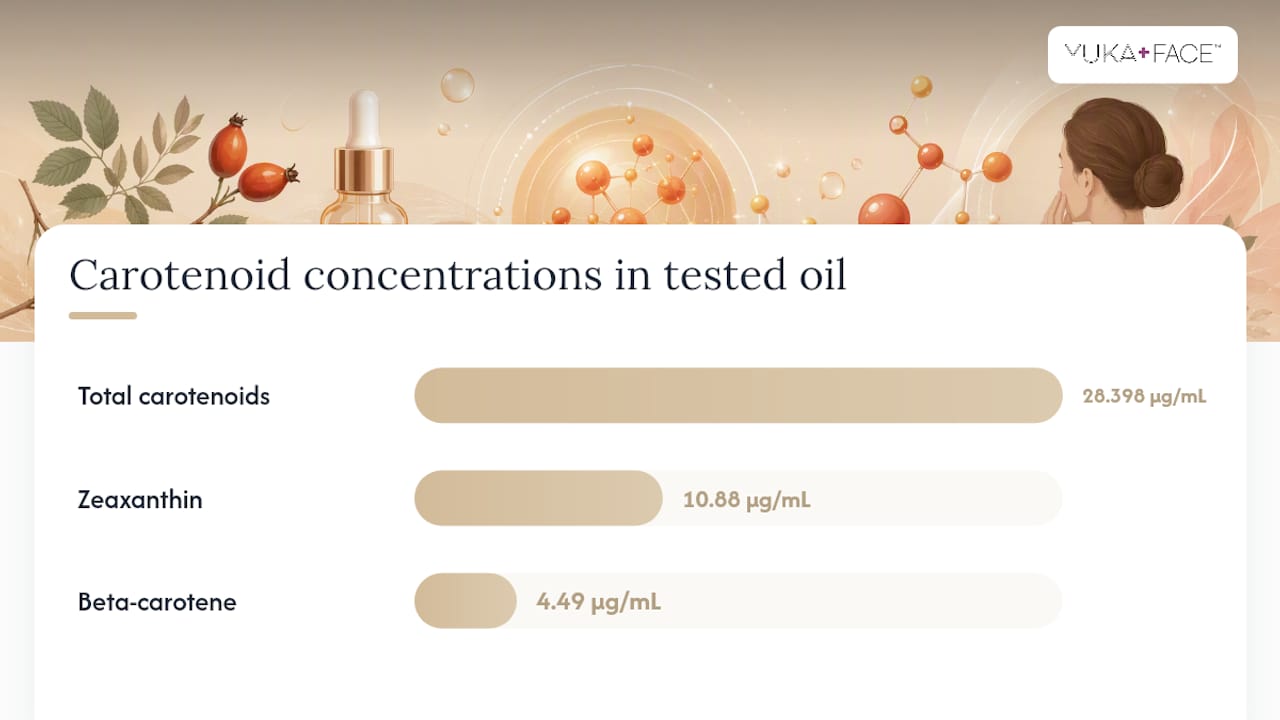
Clinical evidence backs some of this up, but keep expectations grounded. A 2025 pilot study of cold-pressed Rosa canina seed oil tracked 27 participants using the oil daily for five weeks and found measurable improvements in wrinkle visibility, skin texture, and some pigment scores. The tested oil carried a total carotenoid content of 28.398 μg/mL, including 4.49 μg/mL of beta-carotene and 10.88 μg/mL of zeaxanthin, a detail that matters because product quality varies widely and low-carotenoid oils likely deliver less.
Here's what rosehip oil is realistically good for:
- Softening rough texture and dry patches within a few weeks
- Supporting barrier repair after over-exfoliation or winter dryness
- Modestly fading post-acne marks and sun spots over one to three months
- Providing antioxidant support alongside (never instead of) daily sunscreen
Statistic to remember: the pilot study's five-week timeline is a useful benchmark. If you're not seeing any change in texture or hydration by week six or seven, the product you're using may lack the carotenoid concentration that drove those results.
How to Use Rosehip Oil on Your Face the Right Way
Skipping the patch test is the most common mistake people make with any new facial oil. Apply a small drop to your inner forearm, leave it uncovered, and wait 24 to 48 hours to check for redness, itching, or swelling before you put it anywhere near your face.
Once you've cleared that step, the order you apply it in matters more than most people realize.
- Cleanse first to remove makeup, sunscreen, and daily buildup.
- Apply any water-based treatments, like a hydrating toner or essence.
- Layer on serums, since oils sit on top of skin and can block thinner formulas from absorbing if applied too early.
- Follow with moisturizer, or mix a couple of drops of rosehip oil directly into your moisturizer for one combined step.
- Finish with two to four drops of rosehip oil pressed gently into skin, or apply it as the final layer if you skip mixing it in.
Once or twice daily is enough. Dry or cold climates may call for the higher end of that range, while oilier skin often does fine with a nightly application only. If you use retinoids, AHAs, or BHAs, alternate nights rather than stacking rosehip oil on top of a strong active. Rosehip oil is not a retinol substitute and pairing it with one on the same night raises irritation risk without adding benefit.
Overnight use is generally fine for most skin types, since rosehip oil absorbs slowly and works while you sleep. If you're testing a new active alongside it (a new exfoliant, for instance) apply the oil on off-nights until you know how your skin reacts.
Pro Tip: Warm the oil between your palms for a few seconds before applying. It spreads more evenly and absorbs faster, so you use less product per application.
Daytime routines still need sunscreen regardless of how many antioxidants your oil contains. For a full walkthrough of oil layering order, see how to apply facial oils for glowing, hydrated skin.
What the Research and Dermatologists Actually Say
The strongest available evidence is the MDPI pilot study referenced above: 27 participants, five weeks, daily topical application, with improvements recorded in wrinkle scores, UV spot visibility, and erythema. That's a meaningful signal, but a 27-person pilot is not a large-scale trial, and results depend heavily on the specific oil's carotenoid content, which most commercial bottles don't disclose on the label.
Cleveland Clinic's dermatology team frames rosehip oil clearly: it's a supportive, adjunct product, not a replacement for prescription-strength retinoids. That distinction matters if you're managing deep wrinkles or clinical hyperpigmentation, where a dermatologist-prescribed treatment will outperform any oil.
A few honest gaps in the evidence:
- Many supporting studies test oral supplementation rather than topical use, so results don't always translate directly.
- Formulation differences (seed oil versus pulp extract, refined versus cold-pressed) change outcomes, and most consumer research doesn't control for this.
- Sample sizes across rosehip oil studies remain small, which limits how confidently anyone can generalize the results.
The practical takeaway: treat rosehip oil as a steady, low-risk addition to your routine, not a fast fix.
Safety, Side Effects, and What Not to Mix With Rosehip Oil
Rosehip oil is well tolerated by most people, but allergic contact dermatitis can happen. Watch for redness, itching, small bumps, or swelling in the days after you start using it, and stop immediately if any of these appear.
Comedogenicity concerns are mostly overblown for rosehip oil specifically. It's lighter than many carrier oils and rated fairly low on the pore-clogging scale, but if you have very acne-prone skin, introduce it slowly. Start with every other night for two weeks before moving to daily use.
A few mixing rules worth remembering:
- Apply oils last. Putting rosehip oil on before serums or vitamin C creates a barrier that blocks their absorption.
- Space it from strong actives. Alternate nights with retinoids or exfoliating acids rather than layering them together.
- Vitamin C pairs fine in the same routine, but apply your vitamin C serum first, then seal with rosehip oil later.
- If irritation persists beyond the patch-test window into regular use, discontinue and consult a dermatologist.
Choosing and Storing Rosehip Oil So It Actually Works
Refined versions lose much of the carotenoid content that drove results in clinical testing, and added fragrance increases irritation risk for sensitive skin.
Packaging matters more than most buyers realize. Rosehip oil is highly susceptible to photo-oxidation, and light exposure degrades its active compounds fast. Amber or dark glass with a tight cap slows that breakdown significantly; a clear plastic bottle sitting on a sunny bathroom shelf will lose potency within weeks.
- Choose amber glass over clear plastic or glass every time.
- Check for a batch date or expiration window on the label.
- Refrigerate after opening to extend usable life, especially in warm climates.
- Smell and look before each use: a sour or "crayon-like" odor and a darkened color both signal rancidity.
Buying signal to remember: the pilot study's oil tested at 28.398 μg/mL total carotenoids. Few labels list this number, but "cold-pressed," "unrefined," and "seed oil" (not pulp extract) are the closest proxies you'll find at retail.
Kelly's Tips From Yuka+Face: Small Rituals, Common Mistakes
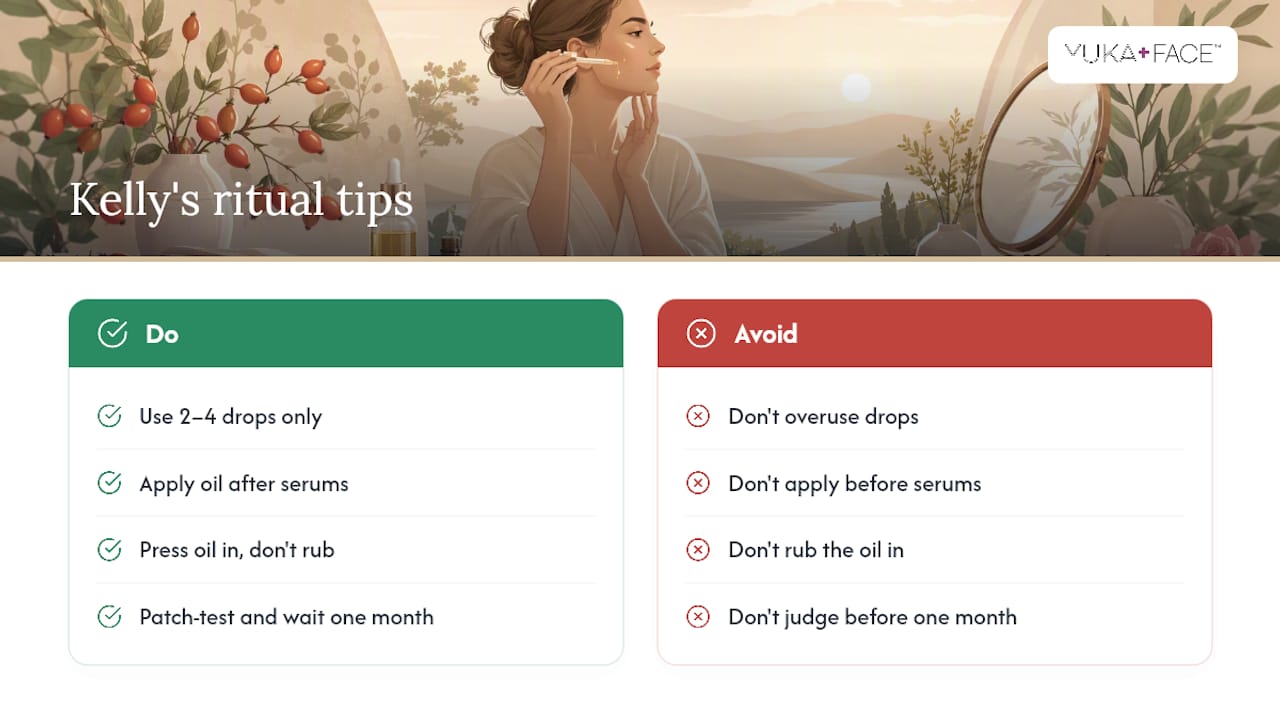
The most common mistake I see is overuse. People assume more drops mean faster results, but two to four is genuinely enough. Applying rosehip oil before your serums, instead of after, is the second most common error, and it quietly cancels out whatever active you paid for.
My own evening ritual is simple: cleanse, treat, moisturize, then two drops of rosehip oil pressed in, never rubbed. It's the same layering logic behind how Yuka+Face approaches facial oils: botanical ingredients, used with intention, not stacked on top of each other hoping for a faster fix. Patch-test everything new, and give any oil a full month before judging whether it's working.
— Kelly
A Rosehip Oil Worth Trusting for Your Routine
Yuka+Face's rosehip oil is formulated to meet the exact standards this guide walks through: cold-pressed extraction, a minimal ingredient list, and amber glass packaging to protect the carotenoids that make rosehip oil worth using in the first place. It's 100% natural, vegan, and cruelty-free, in keeping with the Yuka+Face approach to vegan skincare.

Use it the same way outlined above: two to four drops pressed into skin as the final step of your evening routine, after serums and moisturizer. If you're building out a full ritual around it, the Yuka+Face guide to hydration and restoration walks through how to sequence it with the rest of your products. Start there, patch-test on your forearm first, and give it a few weeks before you judge the results.
FAQ
Is rosehip oil good for the face?
Yes, for most skin types. It supports hydration and barrier repair, and a small 2025 pilot study found modest improvements in wrinkle visibility and texture after five weeks of daily use.
What should you not mix with rosehip oil?
Avoid applying it before serums or vitamin C, since oils block absorption when layered underneath. Alternate nights with retinoids or exfoliating acids rather than using them together.
Can I leave rosehip oil on my face overnight?
Yes, overnight application is fine for most people and is when many use it, since the oil absorbs slowly. Skip it on nights you're introducing a new strong active until you know how your skin reacts.
Is rosehip oil better than retinol?
No. Dermatologists consider rosehip oil an adjunct, not a replacement, for prescription-strength retinoids. It works more gently and slowly, which makes it a good option for sensitive skin that can't tolerate retinol.