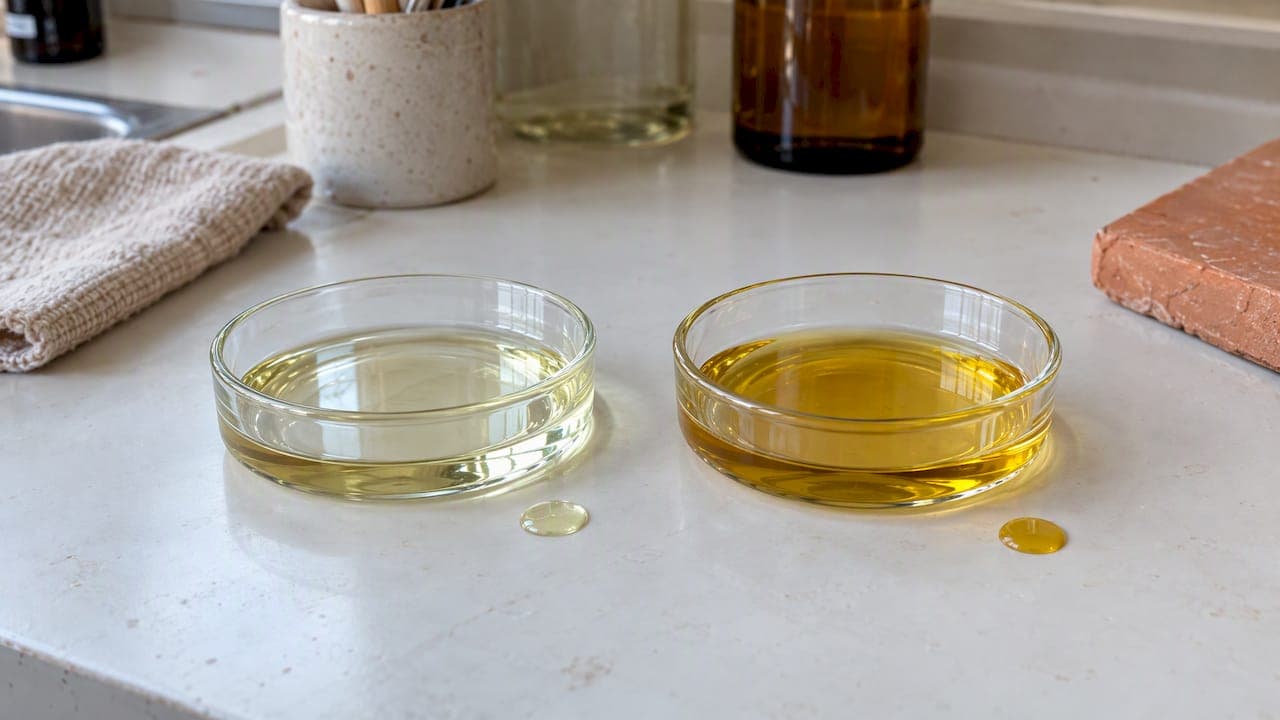
Jojoba suits oily, combination and acne-prone skin. Argan suits dry, mature or damaged skin. Jojoba is a liquid wax that resembles skin's own sebum. Argan is a conventional plant oil, rich in oleic and linoleic acids, with a softer, more cushioned feel. Both are good facial oils. They do different jobs.
Below: the chemistry, the skin-type match, how to use each, and how both compare with marula, rosehip and squalane.
TL;DR
- Jojoba is a liquid wax with a structure close to human sebum. It feels light and is usually the better pick for oily or combination skin.
- Argan is a triglyceride oil with oleic and linoleic acids and vitamin E. It feels richer and fits dry or mature skin.
- Skin type decides, not marketing. Patch test either oil first.
- Apply to damp skin after cleansing to seal in hydration.
- Check the full ingredient list of a finished product, not just the headline oil.
Table of Contents
- Jojoba and argan at a glance
- What makes jojoba different
- What makes argan different
- Jojoba vs argan by skin type
- How to patch test
- How to use either oil
- Face or hair?
- How marula, rosehip and squalane compare
- What the evidence does not show
- Our perspective
- Shop Yuka+Face oils and routines
- FAQ
- Sources
Jojoba and argan at a glance
| Jojoba | Argan | |
|---|---|---|
| Type | Liquid wax (wax esters) | Triglyceride oil |
| Source | Jojoba plant seed | Argan tree kernel |
| Main components | Wax esters, sterols, vitamins | Oleic and linoleic acids, tocopherols, polyphenols |
| Feel | Light, drier finish | Richer, more cushioned |
| Best match | Oily, combination, acne-prone | Dry, mature, damaged |
| Typical role | Balancing, lightweight moisture | Nourishing, softening, elasticity |
The rest of this article explains each row.
What makes jojoba different
Jojoba oil is not an oil in the strict chemical sense. A 2024 review describes it as a liquid wax made of over 98% wax esters, a structure that mirrors human sebum. That is why it is often better tolerated by oily and acne-prone skin than triglyceride oils.
In practice:
- It sits on skin as a thin, flexible layer.
- It rarely feels heavy.
- It is stable. Research notes high oxidative stability, so it resists going rancid.
The American Academy of Dermatology lists jojoba oil among ingredients to look for in moisturizers for dry skin, next to glycerin, hyaluronic acid and dimethicone. It also calls jojoba a good hydrating ingredient in winter skin care.
The Cleveland Clinic says jojoba has been touted for moisturizing skin and softening fine lines. Treat anti-wrinkle claims with care. Most evidence is about moisture and barrier support, not reversing lines.
What makes argan different

Argan oil is a classic triglyceride oil. A review of cosmetic oils describes it as rich in linoleic and oleic acids. These give a softer, more cushioned feel than jojoba's lighter finish.
Other facts:
- It has roughly 80% mono-unsaturated and 20% saturated fatty acids, plus tocopherols and polyphenols.
- Studies report improved skin elasticity and hydration through barrier restoration.
- It has long been used traditionally in Northwest Africa for cosmetic purposes, and it is rich in vitamin E, oleic acid and linoleic acid.
This profile explains why argan is usually matched with dry, mature or damaged skin that needs nourishment.
Jojoba vs argan by skin type

Oily and combination skin
Jojoba is the usual first choice. It is lightweight and non-comedogenic in most sources, so it adds moisture without a heavy layer. The AAD describes it as hydrating and not typically pore-clogging.
Comedogenic ratings differ from one list to the next. Use them as a guide only. Your own skin is the real test.
Dry and mature skin
Argan is the better fit. The fatty acid profile gives a richer, more cushioned feel. Research on plant oils also supports its role in improving elasticity and hydration.
Sensitive skin
Neither oil is automatically safe. Both are natural, and natural does not mean non-reactive. Choose fragrance-free products, as the AAD advises for dry, sensitive skin, and patch test first. If you have eczema, rosacea or a history of reactions, ask a dermatologist before adding a new oil.
Acne-prone skin
Jojoba has more support here. The research on plant oils points to barrier repair in conditions such as acne and seborrheic dermatitis. Acne has many causes, so an oil is a supporting step. It does not replace treatment from a dermatologist.
How to patch test
The Healthline guide to jojoba advises a patch test before first use of any cosmetic product, even one called hypoallergenic.
- Apply a small amount to the inner forearm.
- Wait 24 hours.
- If you see redness, itching or swelling, do not use it on your face.
- If skin stays calm, try a few drops on a small area of the face before using it more widely.
Seek medical care for any severe reaction.
How to use either oil
The research summary on both oils points the same way: oils work best on damp skin right after cleansing, because they help seal in hydration already there.
A simple order:
- Cleanse.
- Tone or mist, leaving skin slightly damp.
- Apply 2 to 4 drops of oil.
- Press in. Do not rub.
- Follow with SPF in the morning.
Oil locks in water. It does not add much itself. For a fuller method, see our guide on how to apply facial oils. If you layer humectants, see hyaluronic acid with oil for the order.
Face or hair?
Many searches for this comparison are about hair. The same logic carries over. Jojoba is lighter and often used for scalp balance. Argan is richer and used for dryness and shine. For a salon view on hair, see this guide to nourishing hair oils. This article stays focused on the face.
How marula, rosehip and squalane compare
Readers who compare these two often compare others too. A short orientation, based on general cosmetic chemistry rather than clinical trials:
- Rosehip: high in linoleic acid. Often chosen for dry skin and for a lighter, drier feel than richer oils.
- Marula: high in oleic acid, so it feels richer. Some sources call it slightly comedogenic, and the evidence is thin. Be careful if you are very acne-prone.
- Squalane: a stable, lightweight emollient, often used by people who dislike the feel of oils.
- Jojoba vs rosehip: jojoba for balance and a light finish, rosehip for a different fatty acid profile.
- Marula vs argan: both are rich. Argan has more published research behind it.
No single oil wins for everyone. Comparison tables online can mislead, since most oil studies are small.
What the evidence does not show
Be skeptical of strong claims. Clinical trials on cosmetic oils are often limited or use blends. One example: a study in 20 healthy volunteers found a sebum-regulating effect from a cream with argan oil, saw palmetto and sesame. The result came from a combination, not argan alone.
So:
- Do not expect an oil to treat a skin condition.
- Judge a product by the full formula.
- Give any new product several weeks before judging it.
If you are pregnant or planning to be, ACOG advises looking for products free of phthalates and parabens. Both oils are natural, but check the full ingredient list of the finished product. Ask your OB-GYN about anything specific. For background on preservatives, see our piece on parabens in skincare.
Our perspective
We make vegan, cruelty-free, natural skincare with short ingredient lists. Our view on oils is simple.
- Match the oil to skin type. Jojoba for oily and combination skin. Argan for dry and mature skin.
- Start with one product. We suggest switching one item at a time, as in our natural skincare for beginners guide.
- Read the label. "Natural" on a front panel is not a guarantee. Our article on natural vs synthetic skincare explains why.
- Keep routines simple. Fewer steps make it easier to see what works.
For more on choosing types, see our face oil guide.
— Kelly
Shop Yuka+Face oils and routines
Looking for a facial oil in a simple routine? Browse Vitamin C Glow Oil, the Vitamin C Cleansing Oil, or the full range of cleansers, toners, serums and oils in the shop. Dry skin? See moisturizers and masks.
FAQ
Is jojoba or argan better for oily skin?
Jojoba is usually the better match. It is a liquid wax that resembles sebum and feels light. Patch test first, since any oil can bother some skin.
Is jojoba or argan better for dry or mature skin?
Argan generally fits better. Its oleic and linoleic acids give a richer, more cushioned feel, and studies link it to better elasticity and hydration. Jojoba still works if you prefer a lighter finish.
Can I use jojoba and argan together?
Yes, many people do. A common approach is jojoba in the morning for a light finish and argan at night for more nourishment. Introduce one at a time so you can tell which one causes a reaction.
Is jojoba oil safe during pregnancy?
There is no specific guidance in our sources against jojoba or argan. ACOG does advise checking finished products for phthalates and parabens. Ask your OB-GYN or midwife about any product you are unsure of.
Sources
- A Comprehensive Review of Plant-Based Cosmetic Oils (PMC)
- Anti-Inflammatory and Skin Barrier Repair Effects of Topical Application of Some Plant Oils (PMC)
- The Importance of Argan Oil in Medicine and Cosmetology (PMC)
- Update on argan oil (MDedge)
- Dermatologists' top tips for relieving dry skin (AAD)
- Your winter skin survival kit (AAD)
- 6 Skin and Hair Benefits of Jojoba Oil (Cleveland Clinic)
- Jojoba Oil for Face (Healthline)
- Reducing Prenatal Exposure to Toxic Environmental Agents (ACOG)