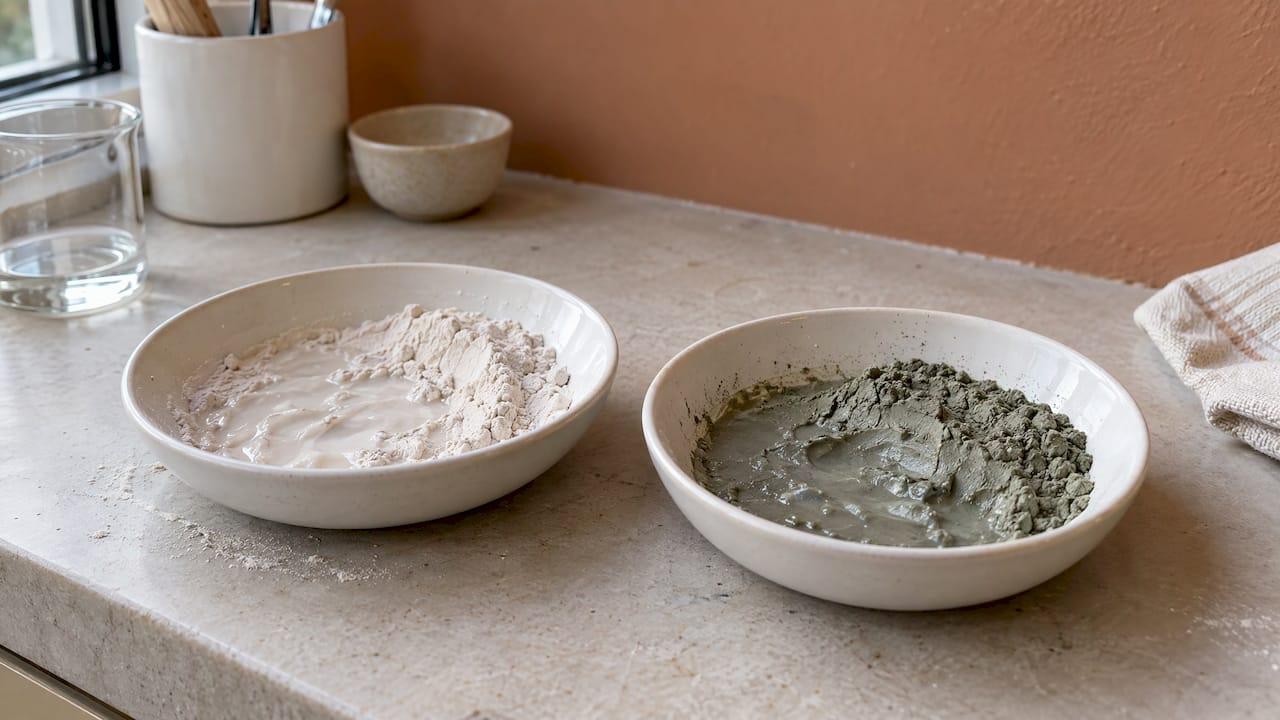
Kaolin is the milder clay. It absorbs oil without stripping, so it suits dry, normal and sensitive skin. Bentonite is the stronger clay. It swells, absorbs more and pulls harder on oil, so it suits oily and acne-prone skin. The rest of this guide covers why they behave differently, how to choose, how to use each one, and what the safety data says.
TL;DR
- Kaolin is mild, does not swell in water and works for most skin types, including sensitive skin.
- Bentonite swells, absorbs far more and is best kept for oily or acne-prone skin.
- Use any clay mask 1 to 2 times a week, for 5 to 10 minutes, on cleansed skin, and follow with moisturizer.
- Patch test on the inner forearm before the first full-face application.
- Both clays are rated safe in cosmetics by the CIR Expert Panel, except in products that may be inhaled.
Table of Contents
- Kaolin vs bentonite at a glance
- Why the two clays behave differently
- What kaolin does for skin
- What bentonite does for skin
- Which clay for which skin type
- Can you use kaolin every day?
- How to use a clay mask
- Patch test before the first full application
- Safety: what the regulators say
- A cleaner way to stack clay with the rest of your routine
- Substitutes if you cannot find kaolin
- Our perspective
- Build your routine with Yuka+Face
- FAQ
- Sources
Kaolin vs bentonite at a glance
| Kaolin | Bentonite | |
|---|---|---|
| Main mineral | Kaolinite | Montmorillonite (a smectite) |
| Origin | Formed by rock weathering | Formed from volcanic ash |
| Behavior in water | Does not swell | Swells and forms a gel |
| Oil absorption | Moderate | High |
| Feel on skin | Gentle, soft | Strong, can feel tight |
| Typical skin type | Dry, normal, sensitive, combination | Oily, acne-prone |
| Typical use | Everyday-style gentle masks, cleansers | Occasional deep-clean masks |
The sections below explain each row.
Why the two clays behave differently
The difference starts at the mineral level. The World Health Organization's environmental health review describes bentonite as a rock made mainly of montmorillonite, formed from volcanic ash. It can form gels with water, absorb large quantities of water and has a high cation exchange capacity. Kaolin's main component is kaolinite, which forms through rock weathering and has only some cation exchange capacity.
The structure explains the swelling. Kaolinite has a tight, two-layer structure, so it does not shrink when dry or swell when wet. Smectite minerals, the type found in bentonite, have a three-layer structure that lets water move between the layers. Bentonite swells when wet and shrinks when dry.
The numbers point the same way. A study of South African clays found that bentonite had a larger surface area and more exchangeable cations than kaolin. Its cation exchange capacity was 78 cmol(+)/kg, against 13 for kaolin. That is a lab measurement of raw clay, not a skin test, but it shows why bentonite feels more intense.
In practice, you get this:
- Kaolin sits on the skin, absorbs some oil and lifts surface debris. It stays soft and spreadable.
- Bentonite swells into a thick, slippery paste, holds a lot of water and oil, and tightens as it dries.
What kaolin does for skin
Kaolin is one of the most common clay ingredients in cosmetics. The CIR Expert Panel's 2023 review of clays reports that kaolin has the most reported uses in cosmetic products, 787 in total. For leave-on face and neck products, its highest reported use concentration is 16%.
Why formulators use it so widely:
- It controls shine without leaving skin feeling tight. Health.com notes that kaolin masks control sebum without excessively drying the skin and are typically milder than bentonite.
- It fits dry and sensitive skin better than stronger clays. Board-certified dermatologist Sonia Badreshia-Bansal, MD, told Allure that kaolin is the most gentle clay and works well for sensitive or dry skin because it absorbs oil without being overly stripping.
- It is easy to build into creamy masks, cleansers and powders because it does not swell.
Kaolin also comes in colors, such as white and pink. Color comes from trace minerals. White kaolin is generally described as the gentlest, while other colors can feel a little more absorbent. If you have reactive skin, start with white.
Our own pore-care article on minimizing pores with bakuchiol and kaolin shows how kaolin can sit inside a gentle routine without harsh actives.
What bentonite does for skin
Bentonite is the heavier hitter. Health.com describes it as extremely absorbent, with volcanic ash origins, and says it can help oily skin. Dr. Badreshia-Bansal says bentonite is stronger and usually best for oily or acne-prone skin, since it can draw out excess sebum and impurities more deeply.
The CIR review ranks bentonite second for reported cosmetic uses, with 221, and lists a maximum reported use of 8% in face and neck leave-on products. The lower use level fits the stronger effect: formulators use less of it.
A dermatologist quoted by Byrdie says bentonite may be especially beneficial for oily or acne-prone skin, but can be too drying for dry or sensitive skin. She advises avoiding it with flaky skin, eczema or psoriasis. Reserve it for oilier skin.

A word on evidence. A 2023 study reported by Health.com found that kaolin and bentonite clay masks reduced the appearance of skin flaws and discomfort, and participants also had fewer breakouts. Clay masks reliably reduce visible shine for a few hours. Treat them as a way to manage oil and look matte, and pair them with a consistent routine for longer-term results.
Which clay for which skin type
| Skin type | Better starting clay | Why |
|---|---|---|
| Dry | Kaolin, white | Absorbs surface oil without stripping; keep the mask time short |
| Sensitive | Kaolin, white | Mildest option; patch test first |
| Normal | Kaolin | Maintenance masking once a week |
| Combination | Kaolin all over, bentonite on the T-zone only | Matches strength to the oilier areas |
| Oily | Bentonite or a kaolin and bentonite blend | Stronger oil absorption |
| Acne-prone | Bentonite, used 1 to 2 times a week | Draws out more sebum; avoid over-use |
| Mature | Kaolin | Gentle cleansing that leaves skin comfortable |
The combination row is a common routine, not a rule. Many people multi-mask: a stronger clay where skin is oily, a gentler one on the cheeks.
If oil control is your main concern, our guide to clay masks for oily skin covers how to absorb oil without stressing your barrier. For a wider view of mask categories, see types of facial masks by skin concern.
Can you use kaolin every day?
Most clay mask guidance does not suggest daily use. Health.com recommends limiting clay masks to 1 to 2 times a week to avoid irritation. People with dry or sensitive skin should be especially careful, because clay masks can be drying for some skin types.
Kaolin is gentler than bentonite, but the same weekly limit is the safe starting point. Kaolin in a wash-off cleanser or in a leave-on product at low levels is a different matter from a full mask left to dry. Formulas are built for their intended use, so follow the directions on the product.
How to use a clay mask
- Cleanse first. Remove makeup and sunscreen so the clay can work on skin, not on residue.
- Apply a thin, even layer. A thick layer does not work better. It dries unevenly and pulls more.
- Set a timer. Health.com suggests letting the mask dry for 5 to 10 minutes, or removing it sooner if your skin is dry.
- Rinse with warm water. Do not scrub. If the mask has dried hard, soften it with a damp cloth first.
- Moisturize. Apply a moisturizer straight after. Clay removes oil and surface debris, and skin needs hydration back.
Bentonite tends to tighten faster as it dries. Do not leave it until it cracks. Rinse when it is just starting to dry at the edges.
Patch test before the first full application
Byrdie recommends a small patch test on the inner forearm before applying bentonite to the whole face, and stopping if irritation occurs. The same step makes sense for kaolin, especially if you have sensitive skin or are trying a new brand. Our guide to patch testing skincare explains where to test and how long to wait.
See a board-certified dermatologist before using clay if you have eczema, psoriasis, rosacea or active, painful acne. They can tell you whether a clay mask fits your treatment plan.
Safety: what the regulators say
The CIR Expert Panel for Cosmetic Safety concluded in March 2023 that kaolin is safe in cosmetics at present practices of use and concentration. It reached the same conclusion for seven other naturally sourced clay ingredients, including bentonite. The exception: the data are insufficient to call these clays safe in products that may be incidentally inhaled. That is why loose clay powder should be mixed carefully and not shaken into the air.
Byrdie also notes that topical use of bentonite is much less likely to cause problems than ingestion. Face clays are for the skin. Do not swallow them.
Clays are natural minerals, so quality varies by supplier. Buy finished skincare from brands that test their products and state their ingredients plainly, rather than mixing unlabeled powders from unknown sources.
A cleaner way to stack clay with the rest of your routine
Clay is one step. What goes around it matters:
- Before: a gentle cleanser, so the mask works on clean skin. Our double cleansing guide walks through the order.
- After: a moisturizer. Our piece on moisturizing vs. hydrating helps you pick between a humectant-rich gel and a richer cream.
- Exfoliation: do not mask and exfoliate on the same day. The safe exfoliation schedules by skin type show how to space them out.
Mineral-based care is a wider theme in skincare. If you are curious about other minerals, this overview of Dead Sea minerals in skincare covers what they are used for.
Substitutes if you cannot find kaolin
The closest swap is another kaolin: pink or rose kaolin is a kaolin variant and behaves much like white. If you need a stronger pull, a small amount of a smectite clay such as bentonite or French green clay gives more absorption, but it brings the drier feel with it. Use a shorter mask time and moisturize after.
For non-clay options, a charcoal mask is the usual alternative for oil and pore care. Our article on the benefits of a charcoal mask explains what it does, and an enzyme face mask is a gentler route when you want smoother texture without a drying finish.
Our perspective
Clay is a good example of a simple idea done well. The question is rarely whether to use clay. It is which clay, how strong and how often.
We build Yuka+Face around short, transparent ingredient lists and barrier repair. For most skin, that means starting gentle. A mild mask used consistently, with a good moisturizer after, does more for skin comfort than a harsh mask used in bursts.
Our formulas are vegan, cruelty-free and designed for all skin types and ages. We make products for sensitive, oily, dry and mature skin, and we think the best routine matches each step to what your skin needs today, not to a trend.
If you are unsure, begin with the milder option, patch test, and build from there.
Kelly
Build your routine with Yuka+Face
Clay is one step in a full routine. Our range covers cleansers, toners, serums, oils, moisturizers and masks, all vegan and cruelty-free, for sensitive, oily, dry and mature skin. Browse the full shop or start with a mask and a moisturizer from the moisturizers and masks collection. For oily or congested skin, the Detox Charcoal Mask is one place to start.
Gift cards are available from $50 in the shop.
FAQ
Which is better, kaolin or bentonite?
Neither is better for everyone. Kaolin is gentler and suits dry, normal and sensitive skin. Bentonite absorbs more and suits oily or acne-prone skin. If you are unsure, start with kaolin and move to bentonite only if your skin tolerates it and still feels oily.
Can I use kaolin clay on my face every day?
Masks are generally recommended 1 to 2 times a week, and that includes kaolin. Daily use of a full mask can leave skin dry or irritated. Kaolin in a rinse-off cleanser or a formulated leave-on product follows the directions on that product.
Is bentonite clay safe for the face?
The CIR Expert Panel found bentonite safe in cosmetics at current use levels, except in products that may be inhaled. People with dry skin, sensitive skin, eczema or psoriasis are usually advised to avoid it. Patch test on your inner forearm first.
What is a good substitute for kaolin clay?
Pink or rose kaolin is the closest swap, as it is a kaolin variant. For a stronger effect, French green clay or bentonite absorbs more, with a drier feel. Shorten the mask time and follow with moisturizer.
Can I mix kaolin and bentonite?
Yes, and many masks do. A blend gives you the smooth feel of kaolin with some of the stronger oil absorption of bentonite. It suits combination skin, but dry or sensitive skin does better with kaolin alone.
Sources
- Bentonite, Kaolin and Selected Clay Minerals (EHC 231), WHO
- What is clay? Science Learning Hub
- Characterization of South African Bentonite and Kaolin Clays
- These Clay Masks Deep-Clean Pores Like a Vacuum, Allure
- Clay Mask Benefits and Tips for Clear, Healthy Skin, Health.com
- Bentonite Clay for Skin: Benefits and How to Use, Byrdie
- Amended Safety Assessment of Naturally-Sourced Clays as Used in Cosmetics, CIR