
Most faces do best with exfoliation 1 to 3 times per week, and bodies can often handle the same range or slightly more. The rule that matters more than any number: start conservative and adjust based on how your skin reacts. If it stings, flakes, or stays red, stop and pull back.
This range comes from dermatology guidance repeated across major sources, including the American Academy of Dermatology and dermatologists interviewed by Prevention. Skin type, method strength, and current barrier health all shift where you land within that range. Nobody's schedule stays fixed forever, either. What worked in July might irritate you in January.
Key Takeaways
Safe exfoliation frequency depends on skin type and method strength, but starting at 1 to 2 times weekly and adjusting based on your skin's actual reaction works for nearly everyone.
| Point | Details |
|---|---|
| Start conservative | Begin at once or twice weekly regardless of skin type, then increase only after several irritation-free weeks. |
| Listen to your skin | Current reaction matters more than any fixed skin-type label; skip exfoliation entirely if skin looks or feels irritated. |
| Separate strong actives | Never combine retinoids, benzoyl peroxide, or strong acids on the same night to avoid compounding irritation. |
| Sunscreen is non-negotiable | Exfoliated skin is more vulnerable to UV damage, so daily broad-spectrum SPF matters every morning after exfoliating. |
| Yuka+Face fits gentle routines | Yuka+Face's low-concentration, enzyme-forward exfoliant is built for the twice-weekly starting schedules recommended for sensitive and first-time exfoliating skin. |
Where to Read More on Skin Barrier Care
The claims in this article draw on dermatology-focused sources worth bookmarking if you want to dig deeper into your specific situation.
- American Academy of Dermatology: Safely exfoliate at home for method-specific safety guidance and pigmentation risk.
- Prevention: How often should you exfoliate your face? for dermatologist-sourced frequency ranges by skin type.
- Healthline: Are you over-exfoliating? for a full symptom checklist and recovery framework.
- Byrdie: How often should I exfoliate my face? for sample routine structures like the acid-serum-plus-weekly-mask approach.
- Westlake Dermatology: Over-exfoliation for recovery timelines and severity distinctions.
If your symptoms are mild (some flaking, occasional tightness), self-care with a simplified routine usually resolves things within days. If symptoms are severe, painful, or last longer than two weeks, see a dermatologist rather than continuing to self-treat.
Table of Contents
- How Often to Exfoliate Face vs. Body Skin
- Exfoliation Frequency by Skin Type
- Chemical vs. Mechanical Exfoliation: Which Changes Your Schedule
- When to Exfoliate: Timing and Product Interactions
- Signs of Over-Exfoliation and How to Recover
- Building Your Exfoliation Routine: Sample Weekly Schedules
- When Not to Exfoliate
- Choosing Gentle, Natural Exfoliants: What Actually Matters
- Sources
- FAQ
How Often to Exfoliate Face vs. Body Skin
Facial skin is thinner and more exposed to daily aggressors like sunscreen, makeup, and pollution, so it typically needs gentler, less frequent treatment than skin on your arms, legs, or back. Body skin is thicker in most areas and can often tolerate the same frequency as your face or a bit more, according to Healthline's guidance on body exfoliation.

That said, treat your neck, chest, and décolletage like facial skin. These areas are thinner than the rest of your body and show irritation just as easily as your cheeks do.
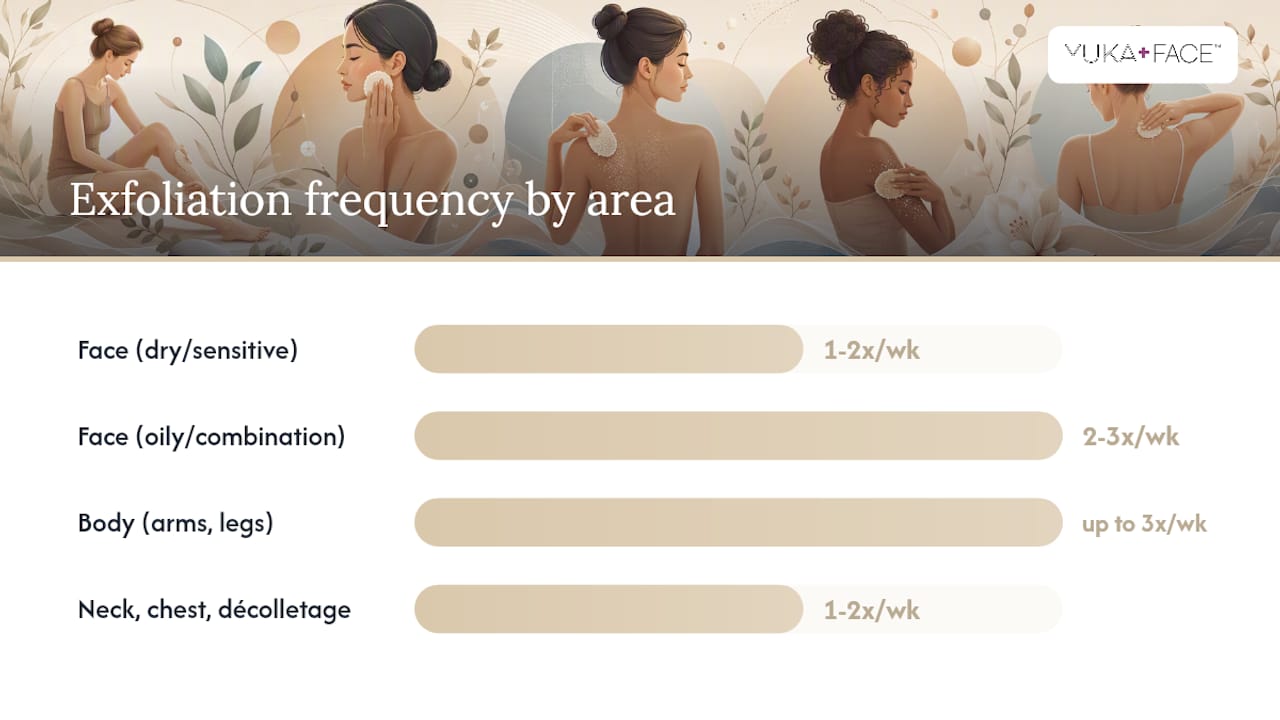
| Area | Typical frequency | Preferred methods | Common risks |
|---|---|---|---|
| Face (dry/sensitive) | about once or twice weekly | Lactic acid, enzyme exfoliants | Redness, stinging, barrier disruption |
| Face (oily/combination) | around two to three times weekly | Salicylic acid (BHA), gentle AHA | Overdrying, sensitization if overused |
| Body (arms, legs) | up to about two to three times weekly | Scrubs, body brushes, AHA lotions | Micro-tears from rough scrubs |
| Neck, chest, décolletage | roughly once or twice weekly | Gentle AHA, enzyme masks | Same as facial skin: irritation, dryness |
Pro Tip: If you deal with keratosis pilaris (those small rough bumps on the backs of arms or thighs), you can often exfoliate that specific area more frequently than the rest of your body, since the buildup there is thicker and more stubborn.
Exfoliation Frequency by Skin Type
Your skin type is your starting point, not a life sentence. Watch how your skin responds over the first several weeks and adjust from there.
- Sensitive skin: Start at once weekly with an enzyme exfoliant or low-percentage lactic acid. Skip physical scrubs entirely; the mechanical friction tends to aggravate reactive skin faster than any acid does.
- Dry or mature skin: Once to twice weekly works for most people. Pair exfoliation with a richer moisturizer immediately after, since dry skin has less oil to buffer the process.
- Normal skin: Two times weekly is a reasonable default, with room to experiment slightly upward if your skin tolerates it without tightness or flaking.
- Combination skin: Treat oilier zones (usually the T-zone) at the higher end, around 2 to 3 times weekly, while keeping drier cheeks closer to once or twice.
- Oily or acne-prone skin: Salicylic acid (BHA) at 2 to 3 times weekly tends to work well because it cuts through oil and unclogs pores, per Healthline's frequency guidance. Some people tolerate low-strength BHA daily, but this is usually after a gradual buildup rather than a starting frequency.
- Darker skin tones: Go slower with any method, chemical or mechanical, because aggressive exfoliation raises the risk of post-inflammatory hyperpigmentation, according to the AAD. Once weekly is a safer opening frequency, with gradual increases only if there's zero visible irritation.
If you use prescription retinoids, have active rosacea, or are treating breakouts with medical-grade acne treatment, cut your independent exfoliation frequency down or eliminate it until you've talked to whoever prescribed those treatments. Retinoids already speed up cell turnover; stacking a separate exfoliant on top is often redundant at best and damaging at worst.
Pro Tip: Patch test any new exfoliant on your inner forearm for 24 hours before using it on your face. If nothing happens there, apply it to one small facial area (like your jawline) for one use, wait 48 hours, and only then work it into your full routine.
Chemical vs. Mechanical Exfoliation: Which Changes Your Schedule
Mechanical exfoliants (scrubs, brushes, cleansing tools) physically slough off dead skin cells through friction. Chemical exfoliants (AHAs, BHAs, PHAs, and enzymes) dissolve the bonds between dead skin cells using acids or enzymes, no scrubbing required.
The strength of the formula matters more than the category. Concentration and pH both determine how aggressively a product works, which is why two products in the same category can call for wildly different schedules.
- Enzyme exfoliants (papaya, pineapple, pumpkin-derived): Gentlest option, suitable for daily use in some formulations, though 2 to 3 times weekly is more typical.
- Lactic acid (AHA): Larger molecule size makes it gentler than glycolic acid; good starting point for dry or sensitive skin at 1 to 2 times weekly.
- Glycolic acid (AHA): Smaller molecules penetrate deeper and work faster, so most people cap use at 2 to 3 times weekly.
- Salicylic acid (BHA): Oil-soluble, so it gets into pores; a strong fit for oily and acne-prone skin at 2 to 3 times weekly.
- Physical scrubs: Reserve for body skin or occasional facial use (once weekly at most), since gritty particles can create micro-tears that acids don't.
Avoid using a strong mechanical scrub and a chemical acid on the same area during the same routine. Combining friction with active acid exposure compounds irritation instead of doubling results, and it's one of the fastest routes to a compromised barrier.
Pro Tip: *If you're not sure how strong a product is, check the ingredient list order and any listed percentage.
When to Exfoliate: Timing and Product Interactions
Layering too many active ingredients in one routine is the single most common way people accidentally over-exfoliate. Retinoids, benzoyl peroxide, vitamin C, and acid exfoliants all increase cell turnover or irritation potential, and stacking several on the same night multiplies that effect rather than just adding to it.
- Retinoids and acids: Use on separate nights. Retinol on Monday, Wednesday, Friday; your acid exfoliant on the other nights, for example.
- Vitamin C and acids: Vitamin C works best at a low pH, similar to many acids, so layering them can cause more irritation than benefit. Many people apply vitamin C in the morning and save acids for evening.
- Benzoyl peroxide and chemical exfoliants: Both are drying on their own; combined, they frequently overwhelm the skin barrier. Alternate days rather than using both together.
- Physical scrubs and any active: Never scrub right before or after applying a strong acid or retinoid. Give your skin a full rinse-and-dry cycle between the two, or better yet, use them on different days entirely.
Exfoliated skin loses part of its outer protective layer temporarily, which means it's more vulnerable to UV damage than usual. Daily broad-spectrum sunscreen isn't optional after exfoliating; it's the single step that protects the investment you just made in smoother skin. A morning routine built around SPF matters even more on days you've exfoliated the night before.
Most dermatologists lean toward evening exfoliation for acid-based products, since many acids increase photosensitivity and morning application means hours of sun exposure on freshly treated skin before SPF has a chance to fully do its job. Enzyme exfoliants and gentle physical methods are more flexible and work reasonably well in either morning or evening routines.
Signs of Over-Exfoliation and How to Recover
Your skin sends warning signals before real damage sets in, and catching them early is the difference between a two-day recovery and a three-week one.
Persistent redness that doesn't fade within an hour, burning or stinging when you apply products you've used for months without issue, visible flaky or peeling patches, sudden breakouts in areas that were previously clear, and a tight, papery texture that feels different from your normal skin. Any one of these lasting more than a day or two signals it's time to stop.
That description matches what clinicians commonly report, according to Healthline's breakdown of over-exfoliation symptoms. One counterintuitive twist: over-exfoliated skin sometimes produces more oil, not less, as it tries to compensate for a damaged barrier. That can trick you into thinking you need to exfoliate more, when the opposite is true.
Recovery starts with stopping every active ingredient, not just the obvious exfoliant. Retinoids, benzoyl peroxide, and acid-based serums or cleansers all count, and many people don't realize a "brightening" toner or a foaming cleanser has salicylic acid quietly built in. Simplify your entire routine down to a gentle cleanser, a barrier-supporting moisturizer, and daily SPF, then leave it there until your skin returns to its normal baseline texture and tolerance.
- Stop all exfoliating products immediately, including hidden actives in cleansers and toners.
- Switch to a fragrance-free, non-foaming cleanser and a rich, barrier-repairing moisturizer.
- Apply broad-spectrum sunscreen every single morning without exception during recovery.
- Wait until redness, flaking, and sensitivity fully resolve before reintroducing anything active.
- Reintroduce exfoliation at half your previous frequency, then rebuild slowly from there.
Mild irritation often clears within days, but more significant barrier damage can take several weeks to fully heal. If redness, burning, or breakouts persist longer than a week or two despite simplifying your routine, or if you notice signs of infection like warmth, swelling, or pus, see a dermatologist. Bring a list of every product you've used in the past month, including the exact actives and how often you applied them, since that detail helps a clinician pinpoint the cause faster than a general description of "irritated skin."
Building Your Exfoliation Routine: Sample Weekly Schedules
Starting low and slow isn't caution for caution's sake. It's how you find your actual tolerance instead of guessing and paying for it later.
- Week 1 to 2: Exfoliate once, patch test first, and watch for any redness or tightness over the following 48 hours.
- Week 3 to 4: If no irritation appeared, increase to twice weekly, still on non-consecutive days.
- Week 5 to 6: If your skin tolerates twice weekly with no issues, consider a third weekly session, but only for oilier or more resilient skin types.
- Week 7 to 8: Settle into your sustainable frequency and build the rest of your routine (retinoids, vitamin C, moisturizer) around it, keeping actives on separate nights.
| Skin type/goal | Sun/Mon | Tue/Wed | Thu/Fri | Sat |
|---|---|---|---|---|
| Sensitive face | Rest | Enzyme exfoliant | Rest | Rest |
| Normal face | Rest | Lactic acid serum | Rest | Lactic acid serum |
| Oily/acne-prone face | Rest | BHA cleanser | Rest | BHA cleanser |
| Body care | Body scrub | Rest | Body scrub | Rest |
Before increasing frequency at any stage, run through a short checklist: no lingering redness from the last session, no stinging when you apply your regular moisturizer, and no new breakouts or rough patches. If any of those show up, hold your current frequency for another two weeks before trying to increase again, and consider dropping back down if symptoms escalate.
Pro Tip: Keep a simple note on your phone logging what you used and when. Patterns that feel invisible day to day (like breakouts showing up two days after you use a specific product) become obvious once you can scroll back through a written log.
When Not to Exfoliate
A handful of situations call for skipping exfoliation entirely, regardless of your usual schedule.
- Sunburned skin: Wait until peeling and redness fully resolve. Exfoliating sunburned skin strips away skin that's already trying to protect itself.
- Open cuts, active breakouts with broken skin, or infections: Exfoliation spreads bacteria and delays healing in these cases.
- Immediately after professional peels or laser treatments: Your provider will give you a specific timeline, but it's typically at least a week or two before any independent exfoliation resumes.
- During flares of eczema, rosacea, or severe inflammatory acne: Exfoliation tends to worsen inflammation rather than help it during an active flare.
- Right after starting a new prescription retinoid or medical acne treatment: Give your skin several weeks to adjust before adding anything else active.
Seasonal shifts matter too. Cold, dry months typically call for pulling back frequency since the air itself is already stripping moisture from your skin, while warmer, humid months sometimes allow a slight increase if your skin tolerates it well. Adjusting your summer skincare routine to account for more sun exposure and sweat is worth doing alongside any frequency changes.
Choosing Gentle, Natural Exfoliants: What Actually Matters
Marketing language on exfoliant packaging rarely tells you what you actually need to know. The formula's pH and active concentration matter far more than words like "gentle" or "purifying" printed on the front.
- Check the pH: AHAs and BHAs work best at a lower pH (around 3 to 4), but a lower pH also means more potential irritation. Formulas closer to neutral pH are gentler but slower acting.
- Check the concentration: A product listing its percentage transparently (5% lactic acid, 2% salicylic acid) lets you compare products honestly. If a brand hides its percentage, treat it as a lower-strength formula until proven otherwise.
- Look for barrier-supporting ingredients: Ceramides, hyaluronic acid, and squalane alongside an active exfoliant help offset the moisture loss that comes with regular exfoliation.
- Match the active to your skin type: Lactic acid or enzymes for dry and sensitive skin, salicylic acid for oily and acne-prone skin, glycolic acid for more resilient normal skin chasing texture improvement.
- Favor lower starting concentrations, always: You can always increase strength later. You can't undo irritation from starting too strong.
Yuka+Face builds its exfoliating formulas around this same logic: vegan, natural ingredient sourcing paired with concentrations designed for gradual introduction rather than aggressive results. A cruelty-free approach doesn't automatically mean gentle, but it does mean fewer synthetic irritants layered into the formula in the first place, which matters when you're trying to identify what's actually causing a reaction.
For anyone rebuilding a compromised barrier after over-exfoliation, adding a nutraceutical approach that supports skin cell repair from the inside can complement topical barrier care, though it's not a substitute for simplifying your actual product routine first.
Pro Tip: If two products list the same active ingredient at what claims to be the same percentage, the one with a lower pH will generally feel stronger. When in doubt, patch test both before committing to your regular rotation.
A Conservative Approach Serves You Better Long-Term
The guidance in this article leans deliberately conservative, and that's intentional. Skin tolerance builds slowly, and the cost of rushing (a compromised barrier, weeks of recovery, sensitized skin that reacts to everything) far outweighs the cost of a few extra weeks spent at a lower frequency. Prioritizing barrier health over speed isn't a compromise; it's the actual strategy that gets you to smoother, brighter skin faster in the long run, because you never lose weeks to repair.
Yuka+Face's philosophy starts from that same place: formulas designed to work with your skin's own pace rather than forcing results. If you're unsure where to start, a simple patch test this week is a better first move than committing to a full routine overnight.
A Gentle Exfoliant Built for Gradual Routines
Yuka+Face's facial exfoliant is formulated as a low-concentration, enzyme-forward option designed to fit into the once-to-twice-weekly starting schedules outlined above, particularly for sensitive, dry, or first-time exfoliating skin. Used twice weekly in the evening, followed by a barrier-supporting moisturizer, it fits directly into the "Week 1 to 2" onboarding schedule without requiring you to guess at concentration or pH.

As the publisher of this article and the maker of this product, Yuka+Face has an obvious interest in your choice, and that's worth stating plainly. The frequency guidance above applies regardless of which brand you choose; it's based on dermatology-backed ranges, not on selling a specific product. If you want to see how this exfoliant fits into a full hydration and barrier-restoration routine, that's the next page to check.
Sources
- Safely exfoliate at home — AAD
- How Often Should You Exfoliate Your Face? Dermatologists Explain
- Are You Over-Exfoliating? How to Tell & Reverse the Damage
- How Often Should I Exfoliate My Face? Dermatologists Weigh In — Byrdie
- Over-Exfoliation — Westlake Dermatology
FAQ
How often do dermatologists recommend exfoliating?
Most dermatologists recommend exfoliating the face 1 to 3 times per week, with dry and sensitive skin at the lower end and oily or acne-prone skin tolerating the higher end of that range.
Is it OK to exfoliate daily?
Daily exfoliation isn't recommended for most skin types because it raises the risk of barrier damage; some oily skin types can tolerate a low-strength BHA daily, but only after a slow, gradual buildup.
Is exfoliating three times a week too much?
For oily or acne-prone skin, three times weekly is often within the safe range, but for dry, sensitive, or mature skin, it can be too frequent and lead to irritation.
Should you exfoliate at night or in the morning?
Evening exfoliation is generally preferred for acid-based products since many acids increase sun sensitivity, and applying sunscreen the next morning protects freshly exfoliated skin through the day.
How do I know if I'm over-exfoliating?
Watch for persistent redness, burning or stinging with products you normally tolerate, flaky patches, sudden breakouts, and a tight or papery texture. Any of these lasting more than a day or two signals it's time to stop.