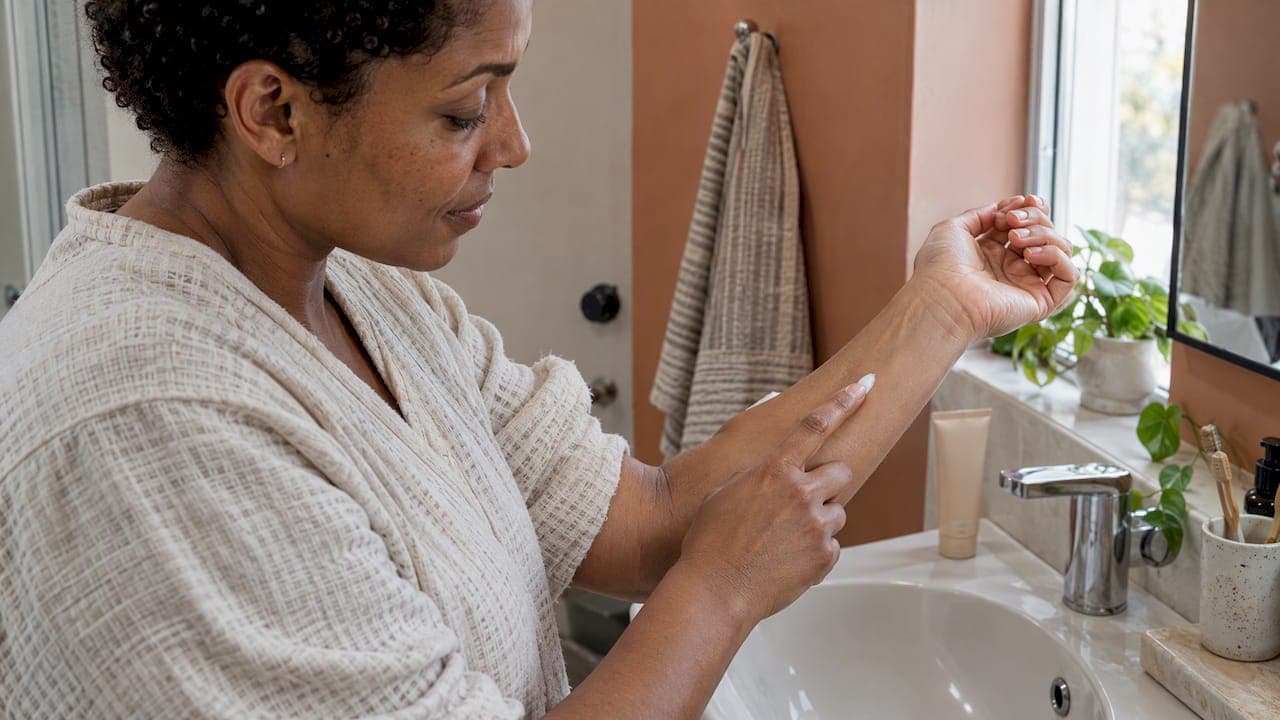
To patch test a skincare product, apply a small amount to a quarter-sized spot on your inner forearm or the bend of your elbow. Repeat twice a day for 7 to 10 days, then check for redness, itching, swelling or bumps. Healthline's self-test guide describes this exact method. If nothing appears, you can usually add the product to your routine. If something does, wash it off and stop using it.
The rest of this guide covers the details: where to test, why the wait matters, what counts as a reaction, and what to do when sensitive skin makes a standard test unreliable.
TL;DR
- Test one new product at a time on a quarter-sized spot of inner forearm or elbow bend.
- Apply twice daily for 7 to 10 days. Allergic reactions can show up days later, so a quick 24-hour test is not enough.
- Wash off and stop at the first sign of itching, burning, swelling or a rash.
- With eczema, very sensitive skin or a history of allergic reactions, ask a board-certified dermatologist before testing at home.
- A home test lowers risk. It does not prove a product is safe, and it is not the same as clinical patch testing.
Table of Contents
- What a skincare patch test is
- Home test versus clinical patch test
- How to patch test skincare at home, step by step
- What counts as a reaction
- If you get a reaction
- Patch testing for sensitive skin
- What a home patch test can and cannot tell you
- Mistakes that make patch tests useless
- Our perspective
- Test your next product with Yuka+Face
- Frequently asked questions
- Sources
What a skincare patch test is
A patch test is a small, controlled trial of a product on a limited area of skin. The goal is to see whether the product causes irritation or an allergic reaction before you put it on your whole face.
Two different things can happen:
- Irritant reaction. The product damages or inflames the skin directly. This can appear fast, often within hours, and is more likely if the skin barrier is already compromised.
- Allergic contact dermatitis. The immune system reacts to an ingredient. Medical News Today explains that this is a delayed reaction that can take a few days to appear, which is why it recommends testing for at least 7 days before full use.
That delay is the main reason a one-night dab behind the ear is a weak test. If you had a reaction the next morning, you would learn something. If you had nothing at 24 hours, you would have learned very little.
Home test versus clinical patch test
The term "patch test" covers two different procedures, and the search results mix them.
| Home skincare patch test | Clinical patch test | |
|---|---|---|
| Who does it | You | A dermatologist or allergist |
| What is tested | One finished product you plan to use | A panel of standardized allergens |
| Duration | 7 to 10 days of twice-daily application | Patches stay on about 48 hours, with readings after |
| Purpose | Screen a product before regular use | Diagnose the cause of allergic contact dermatitis |
| Result | A reasonable signal | A diagnosis |
The FDA describes the clinical version: a physician places a small amount of an allergen on the skin, covers it for 48 hours, and inspects it at 72 to 96 hours to diagnose contact dermatitis. The allergy and immunology professional bodies add that a clinical test is removed and read at about 48 hours, with a second reading 3 to 7 days after application. Their 2015 practice parameter calls patch testing the gold standard for confirming allergic contact dermatitis.
So if you have had repeated rashes and cannot tell what causes them, a home test is the wrong tool. A clinical test can identify the specific ingredient, and then you can avoid it across every product.
How to patch test skincare at home, step by step
- Start with clean, healthy skin. Do not test on skin that is already broken out, sunburned, peeling or inflamed. A reaction there tells you nothing reliable.
- Choose one product. If you test a new cleanser, toner and serum together, you cannot tell which one caused a reaction. Test each separately.
- Pick the spot. Choose an area about the size of a quarter where the product will not be rubbed off or washed away often. Healthline lists the inner forearm and the bend of the elbow.
- Apply a normal amount. Use a thickness similar to what you would use on your face.
- Repeat twice a day for 7 to 10 days. The same source gives this timing. Keep the spot unwashed by other products where possible.
- Check daily. Look at the spot in good light and note any change. A quick photo each day makes small changes easier to see.
- Decide. No reaction after the full period means you can usually introduce the product. Any reaction means stop.
Where to patch test
The inner forearm is the usual choice because the skin is thin, easy to see and easy to leave alone. The elbow bend works for the same reasons. Avoid places that rub against clothing, such as the waist, or that get washed constantly, such as the back of the hand.
Some people prefer a spot closer to where the product will actually go, such as the jawline or just behind the ear. Facial skin can react differently from forearm skin, and the face is the area you care about. If you choose the jaw or the area behind the ear, keep the spot small, keep it away from the eyes, and remember that a reaction on the face is more visible and harder to hide. When in doubt, start on the forearm, then move to a small facial area if the forearm stays clear.

How long and how often
For most people, the practical answer is twice daily for 7 to 10 days. That window covers both the quick irritant reactions and many of the slower allergic ones. Cutting it to a single application is the most common mistake.
Rinse-off products need a small adjustment. A cleanser or a mask is not meant to stay on, so apply it for the contact time shown in its directions, then rinse. Leave-on products such as serums, oils and moisturizers are applied and left on.

What counts as a reaction
Stop and wash the area with plain water if you notice any of the following:
- Redness that spreads or deepens
- Itching or burning
- Swelling
- Bumps, blisters or hives
- Dry, scaly or cracked patches
- Pain or a sensation of heat
Mild, brief tingling can come from active ingredients, but it is not something to push through. If a spot is uncomfortable, treat that as a no for now.
Note that redness is harder to see on deeper skin tones. The allergy specialists point out that patch test results can be harder to interpret in skin of color because reading a weak positive depends on spotting erythema. If this applies to you, rely on touch and symptoms too: itching, warmth, texture changes, and darkening or rough patches, and compare the test spot with untouched skin next to it.
If you get a reaction
- Wash the area gently with cool water and mild cleanser, then pat dry.
- Stop using the product. Do not try it again "just to be sure" on the face.
- Keep notes: product name, full ingredient list, when the reaction started and what it looked like.
- Avoid adding new products to the area while it settles.
Medical News Today advises contacting a dermatologist when irritation develops, particularly if the reaction is severe and a cool compress or petroleum jelly does not give relief. Get urgent care for facial swelling, trouble breathing or a rash that spreads quickly.
When you see a specialist, bring your records. The ACAAI suggests that you record your activities and list items that touched your skin in the two days before symptoms began. Add the product labels. That history helps an allergist choose what to test.
Patch testing for sensitive skin
Sensitive skin is not a medical diagnosis, and the label on a bottle does not settle it. The FDA notes that there is no federal standard or definition for terms like hypoallergenic or fragrance-free, so the ingredient list is the only reliable guide. The same page says fragrance ingredients may not be listed individually and can appear simply as "fragrance" or "perfume".
If your skin is reactive, a few adjustments help:
- Read the label first. Short ingredient lists leave fewer variables. If fragrance is a known trigger, see our guide to a fragrance-free routine for sensitive skin.
- Check for essential oils. Natural does not mean non-reactive. Our article on essential oil reactions and safety steps covers the data.
- Test longer. Some people with sensitive skin do well with the full 10 days or beyond. Dermatologists sometimes recommend a more prolonged testing period, such as once daily for up to four weeks, for people with conditions like eczema. That advice comes with a clinician, not from a general guide.
- Do not test on active eczema. The FDA notes that for individuals with active eczema or dermatitis at the test site, physician-led patch testing may not be specific enough. Choose clear skin, and talk to a board-certified dermatologist if you have eczema.
- Introduce products slowly. One new product at a time, with a gap before the next.
For skin that is already irritated, our list of calming skincare ingredients for irritated skin and our piece on natural skincare for eczema are useful next steps.
What a home patch test can and cannot tell you
It can:
- Flag a product that irritates your skin quickly
- Catch many delayed allergic reactions if you wait the full period
- Keep a bad reaction to a small, hidden area instead of your face
It cannot:
- Guarantee safety. People can develop new allergies over time. In eyelid dermatitis, specialists say that repeat patch testing is reasonable when it recurs despite avoiding a known allergen.
- Identify which ingredient caused a reaction. Only clinical testing does that.
- Predict how your face will respond to every active over months, for example how a product behaves with retinoids or exfoliating acids.
So a clear patch test means "low risk," not "no risk." Keep watching your skin during the first weeks of use.
Mistakes that make patch tests useless
- Testing several products at once. You will not know which one is responsible.
- Stopping after one night. Delayed reactions need days.
- Testing on a spot you wash or rub. The product disappears and so does the signal.
- Using a different amount than usual. Too little can hide a reaction. Too much is not how you will use it.
- Ignoring mild symptoms. Itching on day four is a result.
- Skipping the test because a label says natural, organic or hypoallergenic. Plant ingredients can be allergens too, and as noted above, "hypoallergenic" has no federal definition. Our comparison of natural and synthetic skincare explains why labels only go so far.
Our perspective
We make vegan, cruelty-free, natural skincare for all skin types and ages, with short, transparent ingredient lists. We still tell people to patch test, including with our own products.
Our view is simple. A plant-based formula is not exempt from reactions. Botanical ingredients, essential oils and fragrance compounds can trigger sensitive skin, and short ingredient lists help mainly because there are fewer unknowns to track. That is the idea behind our "unbothered skin" approach: fewer steps, fewer variables, easier to tell what is working.
Three habits we recommend:
- Add one product at a time and leave a gap before the next.
- Read the full ingredient list before buying, not only the front label.
- Treat any itching or burning on the test spot as a reason to stop.
If you have eczema, a history of contact allergies or a reaction that keeps coming back, see a dermatologist. A clinical test can give you answers that no home routine can.
— Kelly
Test your next product with Yuka+Face
If you are building a routine around sensitive skin, start with one step. A cleanser such as the B3 Gentle Cleanser or the Lavender Essence Balancing Toner is a simple first test, and the full range of cleansers, toners, serums and oils is on the Yuka+Face shop page. Every formula is vegan and cruelty-free, and the ingredient lists are short enough to read before you test. Gift cards start at $50.

Frequently asked questions
How do you do a patch test for skincare?
Apply a small amount of the product to a quarter-sized spot on your inner forearm or elbow bend. Repeat twice a day for 7 to 10 days, using a normal amount. Check for redness, itching, swelling or bumps, and wash the product off if any appear.
Does patch testing skincare work?
It works as a screen. It can catch irritation and many allergic reactions on a small area before you use the product on your face. It does not guarantee safety, and it cannot name the exact ingredient responsible. For that, you need clinical patch testing with a dermatologist or allergist.
How long should you patch test a skincare product?
Seven to 10 days is the usual guideline, with application twice a day. Allergic reactions can be delayed by several days, so one overnight test is not enough. If you have eczema or very reactive skin, a dermatologist may suggest a longer period.
Where should you patch test a skincare product?
Use the inner forearm or the bend of the elbow. Pick a spot that will not be rubbed by clothing or washed often. Once the forearm is clear, some people test a small area along the jawline before using the product on the whole face.
Is a patch test for sensitive skin different?
The method is the same, but the caution is higher. Read the ingredient list first, test one product at a time, and avoid testing on active eczema or inflamed skin. If you have eczema or a history of allergic reactions, ask a board-certified dermatologist how long to test.
Sources
- How to Perform a Self Skin Patch Test and Products to Avoid, Healthline
- How to perform a patch test for skincare products, Medical News Today
- Allergens in Cosmetics, FDA
- Standards for prick skin testing and patch testing, AAAAI
- Contact Dermatitis: A Practice Parameter Update 2015, AAAAI
- Eyelid contact dermatitis, AAAAI
- Contact dermatitis, ACAAI
- Children with eczema and allergic reactions, American Academy of Dermatology