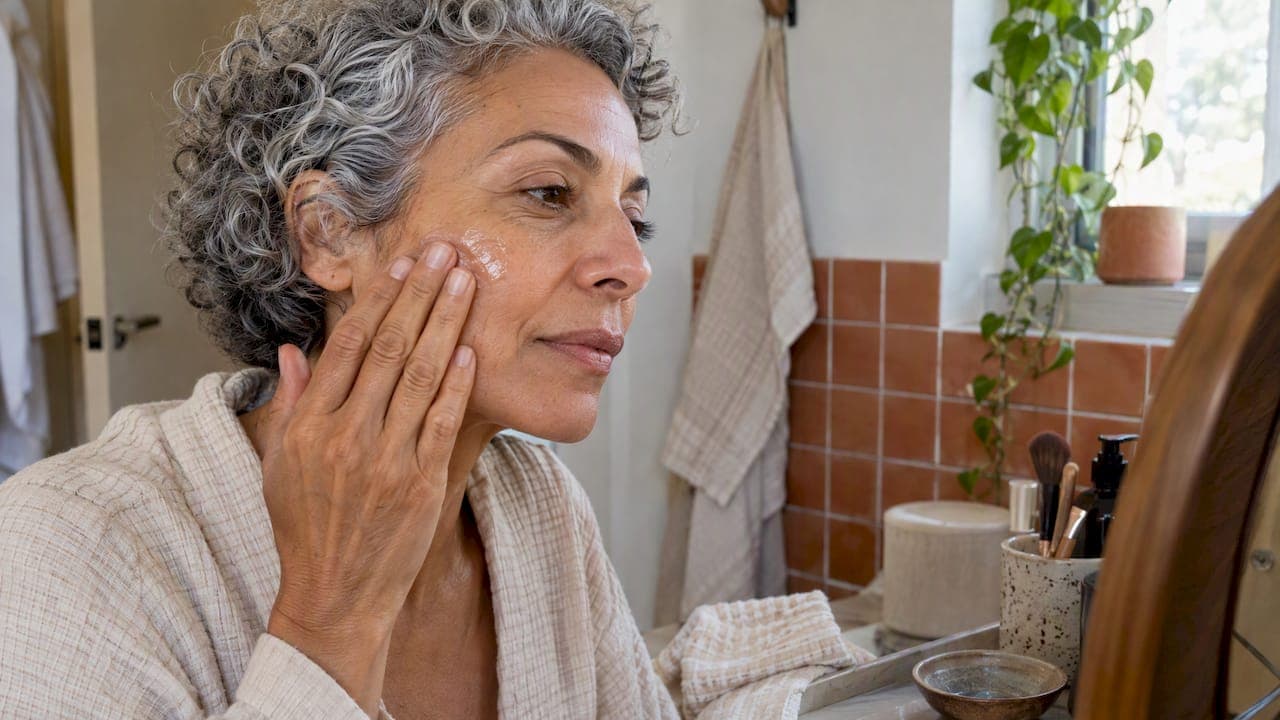
Aloe vera gel is generally well tolerated on the face, and it works best as a light, water-rich soother for dry, warm or irritated skin. It is not a proven treatment for acne, eczema or dark spots. This guide covers what the evidence supports, how to apply it, how to patch-test it, and when a formulated product makes more sense than gel from a plant.
TL;DR
- Topical aloe gel is generally well tolerated, according to the National Center for Complementary and Integrative Health. Small studies point to benefits for burns and, alongside other treatments, for acne.
- Evidence for eczema, psoriasis and hyperpigmentation is thin. Treat aloe as a soothing step, not a treatment.
- Patch-test on the inner wrist for 24 hours before putting it on your face. Allergic reactions and burning can happen.
- Keep overnight use minimal. Leaving gel on can dry the skin.
- Fresh plant gel and a formulated product are different things. Formulated products add preservation, stability and labeling.
Table of Contents
- What aloe vera does on facial skin
- Aloe benefits for skin: what is supported and what is not
- Aloe for irritated skin and sunburn
- Can aloe vera help with hyperpigmentation?
- How to use aloe vera gel on your face
- Patch test first, and know the side effects
- Fresh plant gel or a formulated product
- Our perspective
- Choosing spa and retail skincare lines that use aloe
- Shop Yuka+Face for hydration and barrier care
- FAQ
- Sources
What aloe vera does on facial skin
Aloe gel is the clear, watery tissue inside the leaf. It is mostly water, which is why it feels cool and light. On skin, that translates into a short-term hydrating and soothing effect. It is a humectant-style ingredient: it helps skin hold water, but it does not seal that water in the way an oil or a richer cream does.
That difference matters. If your skin feels tight, a layer of gel can feel comfortable right away. An hour later, without a moisturizer over it, the skin may feel the same or drier. Our guide on moisturizing vs. hydrating explains why both steps matter.
The clinical record is modest. The NCCIH reports that topical aloe gel is generally well tolerated, that small studies suggest it may improve acne when combined with other treatments, and that it may speed burn healing and reduce burn-related pain. It also says there is not enough reliable information to say whether it helps eczema. The New Zealand dermatology resource DermNet adds that aloe vera's use in conventional medicine has not been thoroughly established.
A systematic review of complementary treatments for acne, atopic dermatitis and psoriasis reached a similar conclusion. It found insufficient evidence for the efficacy of those approaches and called for further studies on efficacy and safety.

Aloe benefits for skin: what is supported and what is not
Most pages on this topic list a long run of benefits. Here is a more careful sort.
| Claim | What the sources support | How to treat it |
|---|---|---|
| Soothes minor sunburn | The American Academy of Dermatology says a moisturizer containing aloe vera or soy may help soothe sunburned skin | Reasonable comfort measure |
| Helps burns heal | NCCIH: small studies suggest faster healing and less pain | Mild burns only; see a clinician for serious ones |
| Helps acne | NCCIH: may help when combined with other treatments | Not a stand-alone acne plan |
| Helps eczema | NCCIH: not enough reliable information | Do not rely on it |
| Hydrates | Water-rich gel feels hydrating; no strong trials needed for this basic effect | Pair with a moisturizer |
| Fades dark spots | No solid clinical evidence found | Do not expect results |
Aloe for irritated skin and sunburn
This is where aloe earns its reputation. Cool, watery gel feels good on skin that is warm, tight or red from sun or dryness. The AAD's sun-safety guidance suggests a cool bath or shower, leaving a little water on the skin, and then applying a moisturizer to trap it. A moisturizer containing aloe vera or soy may help soothe sunburned skin. The AAD also advises against "-caine" products such as benzocaine on sunburn, because they can irritate the skin or cause an allergic reaction.
Two cautions for the face:
- Sunburn that blisters, covers a large area, or comes with fever, chills or severe pain needs a clinician, not a gel.
- Redness that does not settle in a few days, spreads, or itches intensely may be a reaction to the product itself. Stop using it and have a dermatologist look at it.
For a wider list of options beyond aloe, see our roundup of calming skincare ingredients for irritated skin. If your concern is eczema, read natural skincare for eczema first, and talk to a doctor about what is driving it.
Can aloe vera help with hyperpigmentation?
Short answer: probably not in any way you would notice. Laboratory work has looked at compounds found in aloe that interact with melanin production, and that is the source of the claim. Laboratory results do not equal visible fading on a face. We did not find reliable clinical evidence that aloe gel on its own fades dark spots or melasma, so we do not promise it.
What does work for uneven tone is mostly unglamorous: daily sunscreen, patience, and ingredients with clinical backing, chosen with a dermatologist for stubborn or hormonal pigmentation. Aloe can play a supporting role by keeping skin comfortable while you use those actives. If you use a prescription retinoid, read about tretinoin and sun sensitivity so you know why sun protection and gentle layering matter.
How to use aloe vera gel on your face
As a short mask
Medical News Today describes a simple method: apply a small amount of aloe gel to the face, leave it on for 5 to 10 minutes, then rinse. Steps:
- Cleanse and pat the skin damp.
- Apply a thin, even layer. A pea-to-nickel-size amount covers most faces.
- Avoid the eye area and any broken or cracked skin.
- After 5 to 10 minutes, rinse with lukewarm water.
- Apply a moisturizer while the skin is still slightly damp.
As a layer under moisturizer
A thin layer of gel after cleansing and toning, followed by a moisturizer, is the most practical daily use. Gel adds water. The moisturizer keeps it there. If you are building a routine, our morning skin care routine shows where each step sits.

Can aloe replace your moisturizer?
For most people, no. Gel can be enough for very oily skin in humid weather. Dry, mature or barrier-damaged skin usually needs lipids as well, which gel does not supply. If your skin feels tight, add a cream rather than more gel.
Can you leave it on overnight?
You can, but it may backfire. The Mayo Clinic notes that leaving aloe vera gel on the face overnight may dry the skin. Medical News Today likewise says overnight use is possible but advises minimal amounts. If you try it, use a very thin layer and put a moisturizer over it. Stop if you wake up with tightness, flaking or redness.
Patch test first, and know the side effects
Natural does not mean non-reactive. DermNet lists allergic contact dermatitis, contact urticaria (hives) and burning discomfort as possible reactions to topical aloe vera gel.
A patch test takes a day and avoids a bad week:
- Put a small amount on the inner wrist.
- Leave it for 24 hours, as Medical News Today recommends, without washing the area.
- Check for redness, itching, swelling, bumps or burning.
- Any reaction means no facial use. Wash the spot and stop.
Medical News Today also advises speaking with a doctor before using aloe as a complementary approach to a skin condition. That is sensible advice if you already have eczema, rosacea, active acne under treatment, or use prescription topicals.
Keep it on the skin
The NCCIH separates topical gel from products taken by mouth. Oral aloe latex can cause abdominal pain, cramps and diarrhea. Oral aloe leaf extracts have been linked to cases of acute hepatitis, and non-decolorized whole-leaf extract is classified as a possible human carcinogen. The NCCIH also notes that overuse of aloe latex may raise the risk of side effects from cardiac glycosides such as digoxin. None of this is a reason to fear a face gel. It is a reason not to swallow aloe preparations as a skincare shortcut, and to ask a pharmacist or doctor if you take medication.
Fresh plant gel or a formulated product
You can use gel from an aloe plant or buy bottled gel. Each has trade-offs.
Fresh gel
- Medical News Today says to drain the yellow latex from the cut leaf, wash the gel carefully, and refrigerate it for up to two weeks or freeze it.
- It has no preservative system, so it spoils. Discard it if it smells off or changes color.
- Strength and cleanliness vary from leaf to leaf.
Bottled or formulated products
- They are made to stay stable and to resist microbial growth. One academic study of cosmetic emulsions tested preservative effectiveness and tracked skin hydration, transepidermal water loss and pH, which are the kinds of checks a well-made formula should pass.
- Read the label. Aloe is often listed as aloe barbadensis leaf juice or leaf extract. Position in the list gives a rough idea of how much is in the formula.
- Check for added fragrance, alcohol and dyes, which are common irritants in products sold as "aloe gel".
A bottle of bright green gel is not always mostly aloe. Look at the whole ingredient list, not just the front label.
Our perspective
We see aloe as a good supporting ingredient and a poor miracle claim. It is a comfort step. It adds water, feels calm on warm skin, and sits well in simple routines. It does not replace barrier care, sun protection or medical treatment.
That view shapes how we make skincare. Our formulas are vegan, cruelty-free and built on short, transparent ingredient lists, because shorter lists make it easier to see what touches your skin and easier to trace a reaction. Botanical does not mean harmless, and we ask the same questions of a plant extract that we ask of any other ingredient: what does it do, how much is needed, and how does it behave on sensitive skin?
Our plant-based skincare guide and our piece on the real role of organic ingredients go deeper on that approach. The short version: use fewer products, choose them with care, and let the skin barrier recover.
— Kelly
Choosing spa and retail skincare lines that use aloe
Estheticians, spa directors and boutique buyers face a different question: which lines are worth stocking? Aloe on the label is a start, not a standard. Ask a brand about these points.
- Sensitization testing. Botanical extracts can be sensitizers. A 2022 academic paper on skin sensitization describes a battery of in vitro tests used to assess this potential, and reports that some tested botanical extracts were skin sensitizers. Ask what safety assessment a line has done for its plant ingredients.
- Preservation and stability. Water-rich aloe products need a sound preservation system. Ask how it is verified.
- Label compliance. Products sold in the United States must meet labeling rules. The FDA has issued warning letters where labels lacked required information, such as a domestic address or telephone number for adverse-event reports on certain drug products.
- Ingredient transparency. Full lists, with no hidden fragrance blends, make it easier for a treatment room to match products to clients.
- Ethical claims with proof. Cruelty-free and vegan claims are stronger when backed by a third-party certification. Ours is Leaping Bunny.
- Fit for sensitive and reactive clients. Ask which concerns the line was designed for, and whether it avoids common irritants.
If parabens come up in client conversations, our article on what parabens in skincare mean lays out the evidence plainly. For clients with very different skin types, see these examples of inclusive skincare.
Shop Yuka+Face for hydration and barrier care
If you want hydration without a long ingredient list, start with the basics: a gentle cleanser, a toner, a serum and a moisturizer. Browse cleansers, toners, serums and oils, or go straight to moisturizers and masks for dry skin. The Hydrating Power Moisturizer is a good place to begin if gel alone leaves your skin tight. Check each product page for the full ingredient list before you buy, especially if you have known sensitivities. Spa, hotel and boutique buyers can use the same shop to see the range.
FAQ
Is using aloe vera on your face good?
For most people it is fine and pleasant, as long as a patch test goes well. The NCCIH says topical aloe gel is generally well tolerated. Its benefits are mostly soothing and hydrating, not corrective.
Can aloe vera gel be used as a moisturizer?
It can add water to the skin, but it lacks the oils that hold that water in. Use it as a layer under a moisturizer. Very oily skin may manage with gel alone in warm, humid weather.
Is aloe gel for the face safe to use every day?
A thin layer once or twice a day is how most people use it. Stop if you notice dryness, stinging or redness. Allergic contact dermatitis and hives are documented, so patch-test first.
Is aloe good for irritated skin?
It can calm the feeling of warm, tight skin, including mild sunburn, according to the AAD. It is not a cure for a rash. Persistent, spreading or very itchy irritation should be checked by a dermatologist.
Can I use the gel straight from my plant?
Yes, if you drain the yellow latex and wash the gel well. Refrigerate it for up to two weeks or freeze it, as Medical News Today advises. Patch-test it as you would any new product.
Sources
- Aloe Vera: Usefulness and Safety, NCCIH
- Aloe vera and the skin, DermNet
- Complementary and alternative medicine treatments for acne, atopic dermatitis and psoriasis
- American Academy of Dermatology sun protection guidance
- Aloe vera for face: Uses and benefits, Medical News Today
- Aloe, Mayo Clinic
- Formulating sustainable emulsions: mandelic acid and essential oils
- Strategy to Avoid Skin Sensitization
- Tretinoin and sun sensitivity