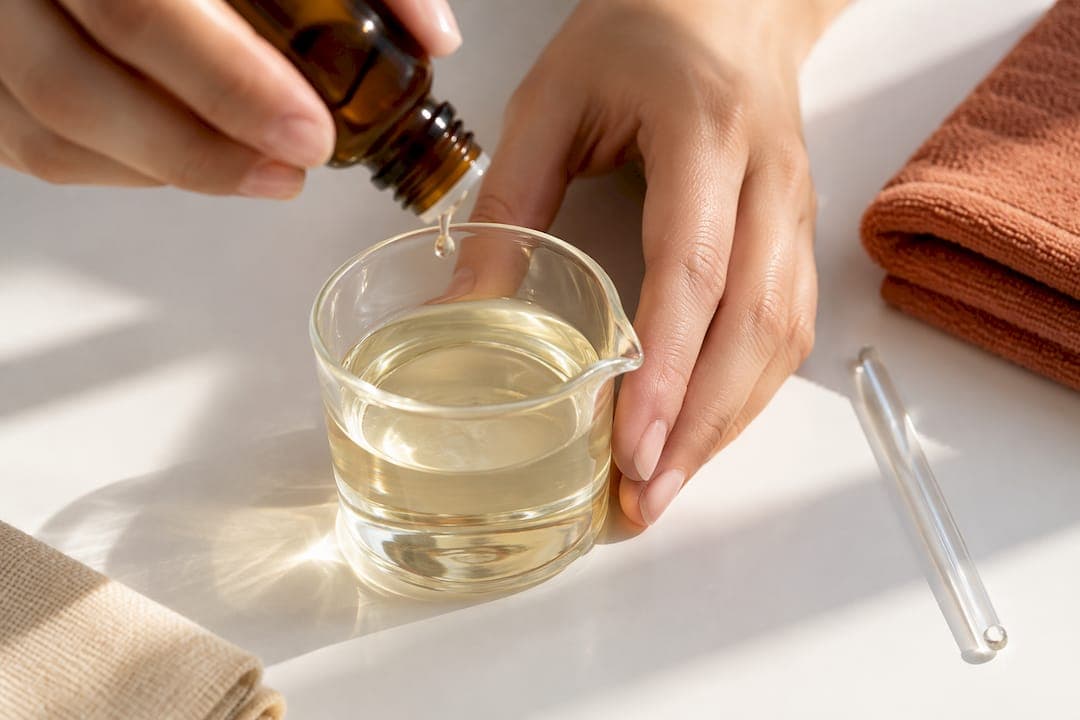
Fragrance-free is the safer default for sensitive skin, dermatitis-prone clients, and most professional spa services. Essential oils offer real botanical benefits and aroma, but they carry measurable sensitization risk, so they belong in a routine only when labeling is clear, dilution is conservative, and the product hasn't oxidized on a shelf too long. Buyers should stock fragrance-free basics as their core line and treat essential oil aromatherapy products as a limited, clearly labeled category.
TL;DR:
- Fragrance-free products are safer for sensitive skin and dermatitis-prone clients because they contain no added fragrance ingredients or masking agents.
- Essential oils pose measurable allergy and sensitization risks, especially when oxidized or used in high concentrations, even in natural formulations.
- US law allows manufacturers to label products as fragrance-free without requiring proof, so buyers should demand full ingredient lists, expiration dates, and proper packaging.
- Patch testing and conservative dilution (around 0.5% to 1%) are crucial steps to safely incorporate essential oils into facial products.
- Stocking limited, clearly labeled essential oil lines and emphasizing fragrance-free basics reduce the risk of allergic reactions and improve client safety.
Table of Contents
- Fragrance-Free vs Essential Oils: What the Labels Actually Mean
- The Clinical Evidence on Allergy and Sensitization Risk
- What "Fragrance-Free" Actually Guarantees Under U.S. Law
- A Buyer's Checklist: Consumers, Estheticians, and Spa Owners
- Safe Use for Essential Oils: Dilution, Testing, and Shelf Life
- Kelly's Perspective: Why "Natural" Isn't the Finish Line
- Where to Start With Yuka+Face
- Sources
- FAQ
Fragrance-Free vs Essential Oils: What the Labels Actually Mean
"Fragrance-free" means no fragrance ingredients were added, including masking agents. "Unscented" is a different animal entirely. Unscented products often contain a masking fragrance designed to neutralize the smell of other ingredients, which means they can still trigger a reaction in someone who reacts to fragrance chemicals. A Stanford resource on hypoallergenic skincare specifically warns against treating the two terms as interchangeable.
"Natural" is a marketing word, not a safety claim. Essential oils are natural in the sense that they come from plants, but they are chemically complex volatile compounds, often containing dozens of individual constituents. Limonene and linalool, common in citrus and lavender oils, are two of the most frequently cited sensitizers in contact dermatitis research.
When you're scanning an ingredient list, a few red flags matter more than others:
- The word "fragrance" or "parfum" appearing alone, with no further disclosure of what's inside it.
- Broad botanical names ("citrus oil," "flower extract") with no species or concentration listed.
- "Natural fragrance" used as if it were automatically gentler than a synthetic one.
- No expiration or batch date on a product containing essential oils.
The Clinical Evidence on Allergy and Sensitization Risk
The idea that natural ingredients are inherently gentler doesn't hold up under testing. A Stanford Medicine analysis of products marketed as natural found that more than 94% contained at least one known contact allergen, and fragrance mix was the single most common one, showing up in 36.6% of the products tested. Ninety percent contained an ingredient that ranks among the top 100 most clinically prevalent allergens dermatologists test for.
By the numbers: In a large European patch-test dataset, a notable proportion of tested patients reacted to at least one essential oil, and several individual oils crossed the 1% positivity threshold on their own.
That data, drawn from a retrospective IVDK analysis of essential oil sensitization, identified specific offenders:
- Ylang ylang oil showed a measurable positive reaction rate in testing.
- Lemongrass oil showed a measurable positive reaction rate in testing.
- Jasmine and sandalwood oils showed positive reaction rates above 1%.
- Tea tree oil (Melaleuca alternifolia): flagged separately in North American data as a notable cause of clinically relevant reactions.
A separate North American patch-test analysis found something clinicians consider a real diagnostic problem: standard fragrance mix screening tests don't reliably catch tea tree oil sensitization. A client can test negative on a routine fragrance panel and still be reacting to the essential oil in her serum.
Occupational exposure compounds the issue. Masseurs and cosmeticians who handle essential oils daily show elevated sensitization rates in clinic data, which is exactly why spas with EO-heavy service menus should track staff exposure the same way they track client reactions. Oxidized oils make everything worse. Fresh linalool and limonene are mild; oxidized, they break down into hydroperoxides that are considerably more potent as sensitizers, according to DermNet NZ's review of limonene and linalool allergy.

What "Fragrance-Free" Actually Guarantees Under U.S. Law
Here's the part that surprises most buyers: fragrance-free and hypoallergenic aren't legally defined terms in the United States. The FDA's guidance on fragrances in cosmetics confirms that manufacturers can list an entire complex mixture as simply "fragrance" or "parfum," protecting the formula as a trade secret. No federal standard forces a brand to prove a "fragrance-free" claim before printing it on a bottle.
That gap puts the burden of verification on the buyer. A few practical steps close most of it:
- Ask suppliers for a full constituent list, not just the marketing label, especially for anything listing essential oils.
- When a product does contain essential oils, prefer ones that name the single species used (lavender, tea tree) rather than vague "essential oil blend" language.
- Require a lot of number and expiration date on every EO-containing product you stock.
- Check that packaging is opaque and airtight. Light and air exposure accelerate the oxidation that makes oils more allergenic.
- Keep a written disclaimer for clients explaining that "natural" doesn't mean allergen-free, which also reduces liability if a reaction occurs.
A Buyer's Checklist: Consumers, Estheticians, and Spa Owners
The right choice depends less on personal preference and more on a short decision sequence. Start with client sensitivity: known dermatitis history or unknown skin means fragrance-free, full stop. Next, consider service type. A leave-on facial serum carries more sensitization risk over time than a rinse-off cleanser, so reserve essential oils for the categories where exposure is brief. Finally, check the product itself: is the labeling specific, is the packaging airtight, and does the supplier have safety data sheets on file?
For estheticians and boutique or spa buyers stocking shelves, the checklist looks like this:
- Build your core inventory around fragrance-free routines for sensitive skin that you can recommend to any client without hesitation.
- Limit essential oil aromatherapy products to a small, clearly labeled line rather than blending EOs into every service product.
- Confirm each EO product lists a low suggested dilution, not a vague "infused with" claim.
- Require expiry dates and safety data sheets from every EO supplier before it goes on your shelf.
- Set up an in-spa patch-test protocol and train staff to log reactions and use client disclosure forms, a practice outlined in Yuka+Face's guide to caring for sensitive skin.
Pro Tip: Ask every EO supplier one direct question: "What's your maximum recommended facial dilution, and how do you package against oxidation?" A supplier who can't answer both parts clearly probably hasn't thought through the safety side of their own product.
Safe Use for Essential Oils: Dilution, Testing, and Shelf Life
If you're going to use essential oils on the face at all, dilution is where most of the risk gets managed. Clinician-informed guidance from Yuka+Face recommends starting around 0.5% to 1% dilution for facial application, a conservative range that lowers the odds of triggering a reaction while still delivering the oil's aromatic or botanical benefit.
A simple in-spa patch test catches most problems before they reach a client's whole face:
- Apply a pea-size amount of the finished product to a discreet patch of skin, typically the inner forearm.
- Cover it and leave it undisturbed.
- Check at 48 hours, then again at 96 hours, since essential oil reactions are often delayed rather than immediate.
- Log any redness, itching, or bumps in a client file, and refer to a dermatologist for formal patch testing if a reaction shows up.
Shelf life matters as much as the initial formula. Oxidized essential oils generate the hydroperoxides responsible for a large share of contact reactions, so airtight, opaque packaging and a formula that includes an antioxidant like vitamin E genuinely reduce risk over the product's life. Rotate EO stock on a conservative schedule and never sell or use an opened bottle past the manufacturer's recommended window.
Pro Tip: Date every opened essential oil bottle the day you crack the seal, not the day you bought it. Oxidation starts on first exposure to air, and that date is the one that actually matters for safety.

Kelly's Perspective: Why "Natural" Isn't the Finish Line
I default to fragrance-free for anyone with sensitive skin or an unknown reaction history, and I use essential oils sparingly even when I trust the formula. The instinct to treat "plant-derived" as synonymous with "safe" is understandable, but the patch-test data doesn't support it. Yuka+Face builds around that reality: short ingredient lists, transparent labeling, and conservative dilution when essential oils appear in a formula at all. If you're a professional buyer weighing whether to add an EO line to your shelf, request full formulation and safety details before you commit inventory to it.
— Kelly
Where to Start With Yuka+Face
Yuka+Face gives you a shorter path to the same decision this article just walked through: skip the guesswork on ingredient lists and start with formulas built to be transparent from the start. Every product is vegan, cruelty-free, and formulated with a short, readable ingredient list, so you're not decoding a "fragrance" blend to figure out what you're putting on your skin or your clients' skin.
If you're a consumer rebuilding a routine around sensitive skin, the organic skincare line is the natural starting point. If you're an esthetician or spa buyer evaluating what to stock, browse the full shop for both fragrance-free basics and clearly labeled formulas, or check the moisturizer and mask category if dry or reactive skin is your primary concern. Request professional or wholesale details directly through the site to compare formulation specifics before you commit shelf space.
Sources
- Are 'natural' skin products irritating your skin? — Stanford Medicine
- Fragrances in cosmetics — U.S. Food & Drug Administration
- Frequency of sensitization to essential oils (IVDK retrospective analysis) — PubMed
- Patch-test findings for essential oils and fragrance markers — PubMed (NACDG/IVDK analysis)
FAQ
Is Fragrance-Free Always Better Than Products With Essential Oils?
For sensitive, reactive, or unknown skin types, yes, fragrance-free is the lower-risk choice. Essential oils can still be appropriate in well-labeled, properly diluted products for skin that has tolerated them before.
Are Essential Oils Safe for Daily Facial Use?
Essential oils can be used safely on the face at low concentrations, typically around 0.5% to 1% dilution as a conservative professional starting point. Daily use still carries more cumulative exposure risk than occasional use, so patch testing first matters.
What's the Difference Between "Unscented" and "Fragrance-Free"?
"Fragrance-free" means no fragrance ingredients, including masking agents, were added at all. "Unscented" products often contain a masking fragrance to cancel out other odors, which can still cause reactions in fragrance-sensitive people.
Does Yuka+Face Sell Fragrance-Free Products?
Yuka+Face offers fragrance-free basics alongside formulas that use clearly labeled, conservatively dosed essential oils, all built around short, transparent ingredient lists. Current product details and pricing are available directly on the Yuka+Face shop.
How Common Are Essential Oil Allergies?
Large patch-test datasets show 8.3% of tested patients react to at least one essential oil, with certain oils like ylang ylang and lemongrass showing positivity rates above 1% on their own. Rates run even higher among people who handle essential oils occupationally, such as massage therapists and cosmeticians.