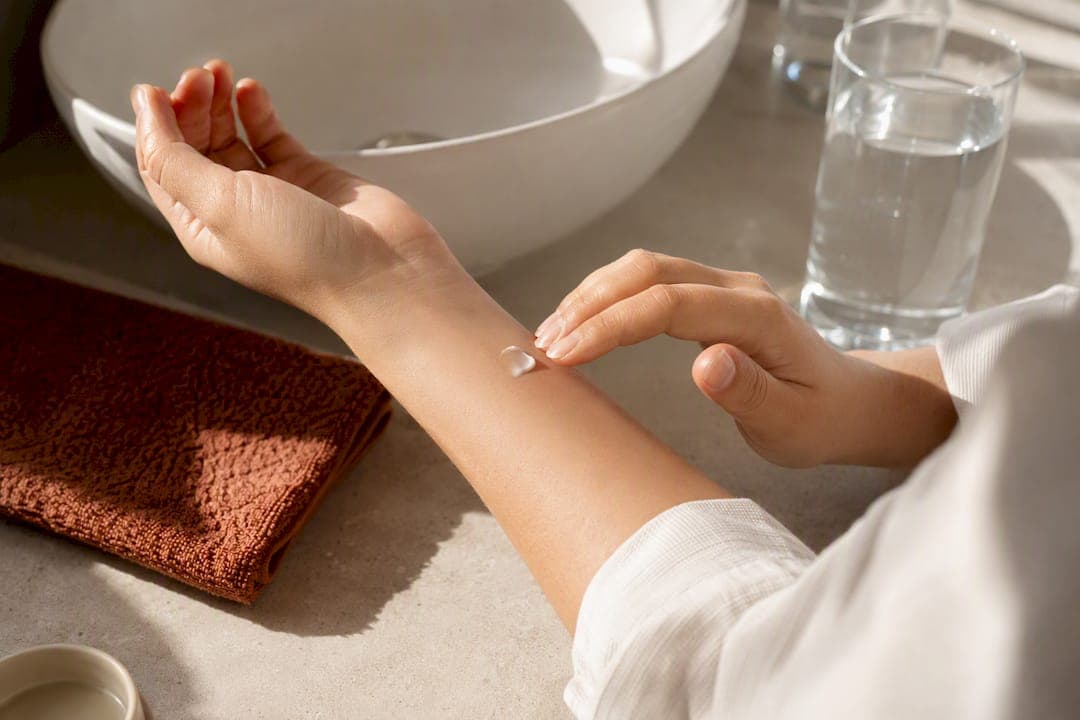
Yes, choosing fragrance-free skincare is the most reliable first step for reducing irritation if your skin reacts to scented products. Stop using fragranced cleansers and moisturizers now, replace them with a simple fragrance-free cleanser and moisturizer, and patch-test each new item before applying it to your face. Most people notice less redness and stinging within days to a few weeks.
TL;DR:
- Fragrance-free products should be prioritized, as "unscented" formulas may still contain masking agents that irritate sensitive skin.
- Always check for "fragrance" or "parfum" in ingredients, and be cautious of natural scent ingredients like essential oils which can also trigger reactions.
- Building a routine with simple, barrier-supporting products and patch-testing each new item minimizes irritation risks and reveals specific triggers more efficiently.
- Natural fragrances from botanical extracts are not inherently safer than synthetic ones, and both can cause allergic contact dermatitis; ingredient transparency is essential.
- Switching to a fragrance-free routine typically shows improvement within one to two weeks, but persistent irritation beyond four weeks requires professional dermatological evaluation.
Table of Contents
- Why Fragrance Irritates Sensitive Skin
- How to Spot Hidden Fragrance on a Label
- Building a Fragrance-Free Routine by Product Category
- A Simple Routine and Patch-Test Protocol You Can Start Today
- Where Yuka+Face Fits Into a Fragrance-Free Routine
- Fragrance-Free vs. Unscented: The Mix-Up That Costs People Weeks of Trial and Error
- Natural Fragrance Allergens vs. Synthetic Fragrance: What's Actually the Difference
- What Sensitive Skin Actually Needs, and What the Industry Gets Wrong
- Try a Fragrance-Free Routine Built on Botanical Science
- Sources
- FAQ
Why Fragrance Irritates Sensitive Skin
Fragrance, whether synthetic or plant-derived, ranks among the most common triggers of allergic contact dermatitis and everyday irritation. Dermatologists point to added scent as a top reason sensitive skin flares after a product switch, which is exactly why fragrance-free formulas get recommended so consistently for reactive skin.
The mechanism is straightforward. Fragrance compounds are small molecules designed to volatilize and reach your nose. That same property lets them penetrate skin and provoke an immune response in people whose barrier is already compromised. Once the barrier is inflamed, everything else you put on top, sunscreen, actives, even water, stings more than it should.
Essential oils have been linked to contact dermatitis in some users, which means "natural" scent is not automatically gentler.
What changes when you cut fragrance:
- Redness and stinging often ease within one to two weeks of consistent use
- Flaking and tightness typically improve as the barrier stabilizes
- Breakouts tied to irritation, not clogged pores, tend to calm down first
If irritation persists past three to four weeks despite a fragrance-free routine, or if you see swelling, blistering, or spreading rash, see a dermatologist. Persistent reactions can point to a specific allergen unrelated to fragrance, and a patch test administered by a professional will identify it faster than trial and error at home.
How to Spot Hidden Fragrance on a Label
"Fragrance-free" and "unscented" are not the same claim, and mixing them up is where most people get burned. Beauty experts specifically favor "fragrance-free" over "unscented," because unscented products often contain masking agents, extra ingredients added purely to cancel out the smell of other components, and those masking agents can irritate skin just as easily as the scent they're covering.
Run every new product through this order of checks before it touches your face:
- Scan the ingredient list for "fragrance" or "parfum." These umbrella terms can legally hide dozens of unlisted aroma chemicals.
- Look for essential oils and botanical extracts used for scent, things like lavender, citrus peel, or rosemary oil. They read as natural, but they carry real allergen potential.
- Watch for "masking fragrance" or "parfum masquant." This is a red flag specific to unscented products.
- Confirm the front-of-package claim says "fragrance-free," not just "unscented" or "natural scent." The wording matters more than marketers want you to think.
- Check for a recognized acceptance seal, like the National Eczema Association's product approval, when you want a second layer of verification beyond the label.
Ingredient transparency matters most with leave-on products like moisturizers and serums, since they stay on skin far longer than a cleanser you rinse off in seconds. The EPA's Safer Choice program outlines how complex fragrance formulations can be, and why a clean label claim should hold up to scrutiny rather than rely on a single buzzword.
Pro Tip: Keep a note on your phone listing every ingredient that's ever caused a reaction. Pull it up in the store or before checkout online. It takes ten seconds and saves you from repeating a bad reaction with a product that hides the same trigger under a different name.
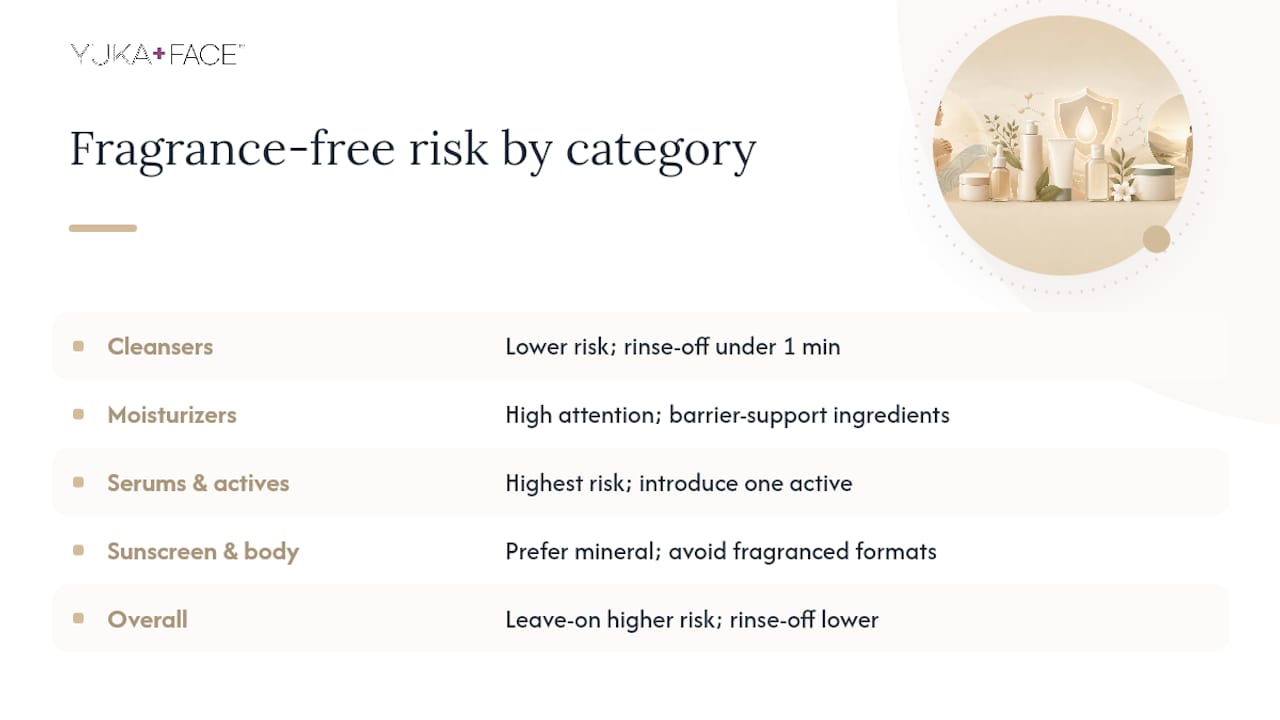
Building a Fragrance-Free Routine by Product Category
Not every product category carries the same risk, and knowing where to focus your scrutiny saves you time. Leave-on products deserve the most attention; rinse-off products give you a little more room.
Cleansers. Look for low-foam or cream formulas with mild surfactants rather than sulfate-heavy foaming washes. Sensitive skin does better with a cleanser that removes dirt and oil without stripping the barrier in the process. Since cleanser sits on skin for under a minute, it's a lower-stakes place to start experimenting if you're new to fragrance-free shopping.
Moisturizers. This is where ingredient quality counts most. Prioritize barrier-supporting ingredients like ceramides, niacinamide, and hyaluronic acid, and check whether the formula is occlusive enough for your skin's dryness level. CeraVe's fragrance-free Moisturizing Cream is a widely cited example of this ingredient profile, ceramides paired with hyaluronic acid, and it's worth using as a benchmark when comparing labels, not necessarily the product itself.
Serums and actives. Retinoids, vitamin C, and exfoliating acids are already potential irritants on their own, so layering them under a fragranced moisturizer compounds the risk. Introduce one active at a time, at the lowest concentration available, and give your skin two full weeks before judging whether it's tolerated.
Sunscreen and body care. Mineral sunscreens in fragrance-free formats reduce the odds of a reaction on skin that's already reactive from sun exposure or heat. The same logic applies to body lotion and wash, since large surface area contact means more opportunity for a mild irritant to become a visible one.
A Simple Routine and Patch-Test Protocol You Can Start Today
Building a gentle, fragrance-free routine doesn't require a ten-step regimen. It requires the right order and patience while your skin adjusts.
Morning and evening order:
- Cleanse with a fragrance-free formula suited to your skin type.
- Apply any treatment or active product, if you're using one, to clean, dry skin.
- Moisturize to lock in hydration and support the skin barrier.
- In the morning, finish with a fragrance-free mineral sunscreen.
How to patch test:
- Apply a small amount of the new product to your inner forearm or behind your ear.
- Leave it undisturbed for 48 hours, avoiding water and soap on that spot.
- Check for redness, itching, or bumps at the 24 and 48 hour marks.
- If skin looks clear, it's reasonable to introduce the product to your face at low frequency.
Pro Tip: When switching your whole routine, swap one product at a time rather than replacing everything at once. Dermatologists recommend this staggered approach specifically because it isolates which product is responsible if a reaction shows up. Give each swap about two weeks before adding the next. If irritation persists after a full transition, the trigger may not be fragrance at all, and that's the point to loop in a dermatologist.
Where Yuka+Face Fits Into a Fragrance-Free Routine
Some brands build formulas around botanical research paired with scientific formulation, and offer product ranges that are vegan, cruelty-free, and made without the synthetic filler ingredients that tend to accompany added fragrance. That positioning lines up directly with the label-reading checklist above: fewer unnecessary additives means fewer opportunities for a hidden irritant to sneak into your routine.
Here's how A brand's approach may map to what you should look for on any label:
- Formulated with natural ingredients rather than synthetic fillers or masking agents
- Vegan and cruelty-free across the product range
- Built on botanical research combined with expert formulation
- Designed for all skin types and ages, including reactive and sensitive skin
| What to check on a label | What comparable brands may offer |
|---|---|
| No hidden "fragrance" or "parfum" fillers | Natural formulations, minimal synthetic additives |
| Vegan, cruelty-free sourcing | Vegan and cruelty-free formulations |
| Barrier-supporting approach | Botanical ingredients paired with scientific formulation |
| Suitable for reactive or sensitive skin | Designed for all skin types and ages |
Even with a brand built around natural formulation, patch-test any new product before adding it to your daily routine. That single habit protects you regardless of which company made the bottle.
Fragrance-Free vs. Unscented: The Mix-Up That Costs People Weeks of Trial and Error
The biggest misconception is treating "fragrance-free" and "unscented" as interchangeable. They're not, and confusing them is probably the single most common reason someone switches products expecting relief and doesn't get it.
"Fragrance-free" means no fragrance ingredients were added at all, full stop. "Unscented" means the product may still contain fragrance compounds, they've just been counteracted with a masking agent so you can't smell them. That masking agent is still a chemical additive sitting on your skin, and it can trigger the exact same irritation that a straightforward fragrance would.
A second misconception: people assume "natural" or "plant-derived" scent is automatically safer than a synthetic one. It isn't. A rose extract added purely for aroma behaves the same way on reactive skin as a lab-made fragrance compound designed to smell like roses. The origin of the molecule doesn't change how your immune system responds to it.
A third one worth naming: some assume fragrance-free products are less effective or feel less "premium" because they lack a spa-like scent. Efficacy comes from active ingredients, ceramides, humectants, barrier lipids, not from how a product smells. A completely odorless moisturizer can outperform a heavily scented one on every measurable skin outcome.
Natural Fragrance Allergens vs. Synthetic Fragrance: What's Actually the Difference
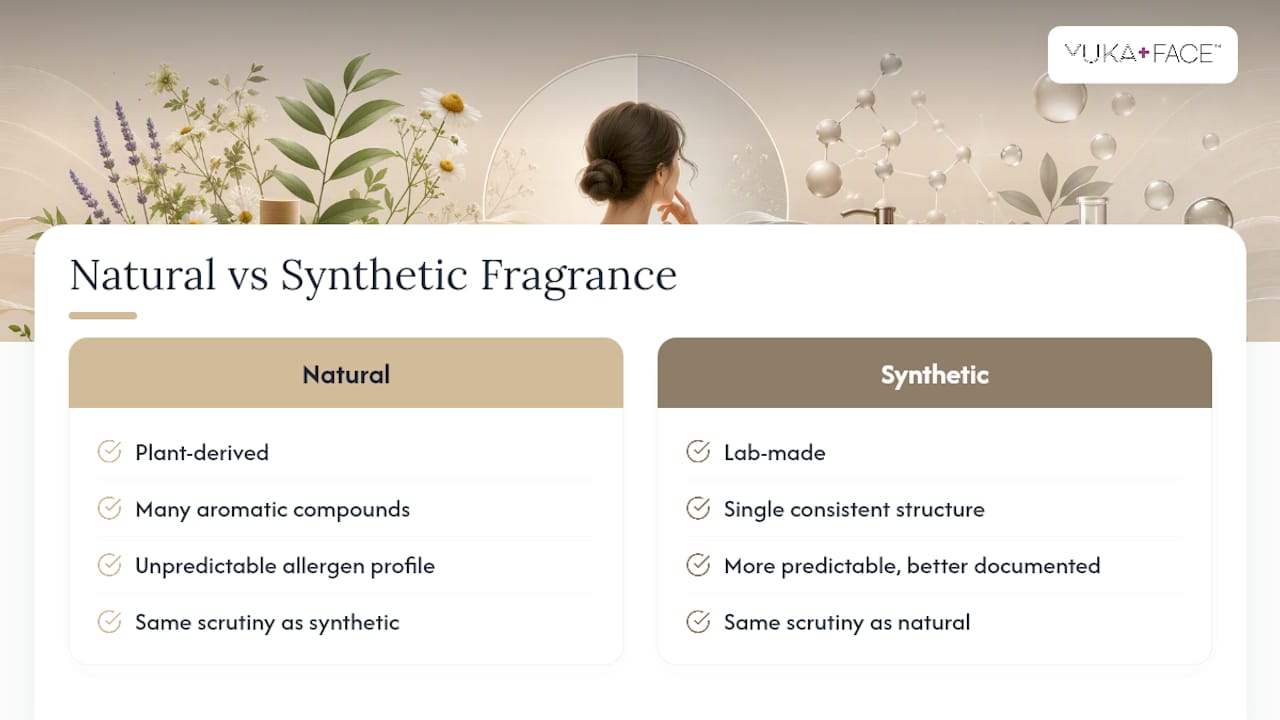
Natural doesn't mean hypoallergenic, and the ingredient list for a "naturally scented" product often reads more complex than a synthetic one, not less. Essential oils and botanical extracts used for scent contain dozens of individual aromatic compounds, each one a potential allergen on its own. A single drop of lavender oil, for example, includes compounds like linalool and limonene, both recognized contact allergens that show up on standardized patch-test panels used by dermatologists.
Synthetic fragrance compounds, by contrast, are usually manufactured to a single, consistent chemical structure. That doesn't make them inherently safer, they're still fragrance and still a common irritant, but it does mean the allergen profile is more predictable and better documented across large-scale testing.
The practical takeaway: don't assume a product is gentler because its scent comes from a plant rather than a lab. If you're formulating your own understanding of "natural skincare," recognize that natural facial oils and botanical extracts can carry their own irritation risk for reactive skin, even when every ingredient on the label sounds wholesome. The same caution applies outside skincare, too. Essential oils used in other personal care contexts carry comparable allergen considerations, which is a useful reminder that "essential oil" and "gentle" aren't synonyms in any category.
If you're building a fragrance-free routine specifically to avoid allergens, treat "natural fragrance" with the same scrutiny you'd give a synthetic one. The ingredient list, not the marketing language, is what tells you the real story.
What Sensitive Skin Actually Needs, and What the Industry Gets Wrong
Most skincare advice treats fragrance-free as a downgrade, something you settle for once your skin has already "ruined" the fun stuff. That framing is backwards. Fragrance adds nothing to how a product performs. It exists purely for sensory appeal, and it's the single easiest variable to remove from a routine without sacrificing a single active benefit.
The conventional advice also oversells complexity. Multi-step routines with ten products increase your exposure to potential irritants with every added step, fragrance-free or not. Simpler is safer, and simpler is where most sensitive skin should start.
What actually deserves priority: a clean label you can read in under thirty seconds, ingredients that support the barrier rather than just perfume it, and the discipline to patch-test before committing your whole face to something new. That's it. It's not glamorous advice, but it's the advice that holds up under actual irritation, not the advice that sells the best on a shelf.
If there's one thing the research backs unambiguously, it's this: the absence of fragrance is not the absence of effectiveness. A well-formulated, botanically grounded product without added scent can do everything a fragranced one claims to, minus the risk.
— Kelly
Try a Fragrance-Free Routine Built on Botanical Science
Some skincare lines offer fragrance-friendly alternatives to conventional products without asking you to trade natural ingredients for synthetic fillers. These formulas may be vegan, cruelty-free, and built on botanical research paired with scientific formulation, so it is possible to find options that balance natural and effectiveness.
If you've followed the checklist and routine above, the next step is simple: pick one product, start with a moisturizer since that's where barrier-supporting ingredients matter most, and patch-test it before working it into your daily routine. Yuka+Face's guidance on when to use each step of a vegan skincare routine walks through exactly how to sequence a new product into what you're already doing, and the brand's take on aging without chasing anti-aging trends is worth a read if you're rethinking your whole approach to sensitive, reactive skin rather than just swapping one product.
Sources
- Dealing With Inflammation? Swap Your Scented Moisturizer for a Fragrance-Free Formula | Allure
- Safer Choice criteria for fragrance-free products | EPA
FAQ
What Skincare Brands Are Fragrance-Free?
Several brands offer fragrance-free lines, including formulas built around ceramides and barrier-support ingredients like the one found in CeraVe's Moisturizing Cream; Yuka+Face's botanical, vegan formulations are also made without added fragrance ingredients.
Is Fragrance-Free Better for Skin?
For sensitive or reactive skin, yes. Fragrance, whether synthetic or plant-derived, is one of the most common triggers of irritation and allergic contact dermatitis, so removing it usually reduces flare-ups.
What Is the Best Fragrance-Free Moisturizer?
The best option depends on your skin's specific needs, but look for one with barrier-supporting ingredients like ceramides, niacinamide, or hyaluronic acid, and confirm the ingredient list has no added "fragrance" or "parfum" listed.
Is CeraVe a Fragrance-Free Lotion?
Yes, CeraVe's Moisturizing Cream is formulated without added fragrance and is commonly recommended for dry, sensitive skin because of its ceramide and hyaluronic acid content.
How Long Does It Take to See Results After Switching?
Most people notice reduced redness and irritation within one to two weeks of consistent fragrance-free use, though persistent reactions beyond three to four weeks warrant a dermatologist visit.