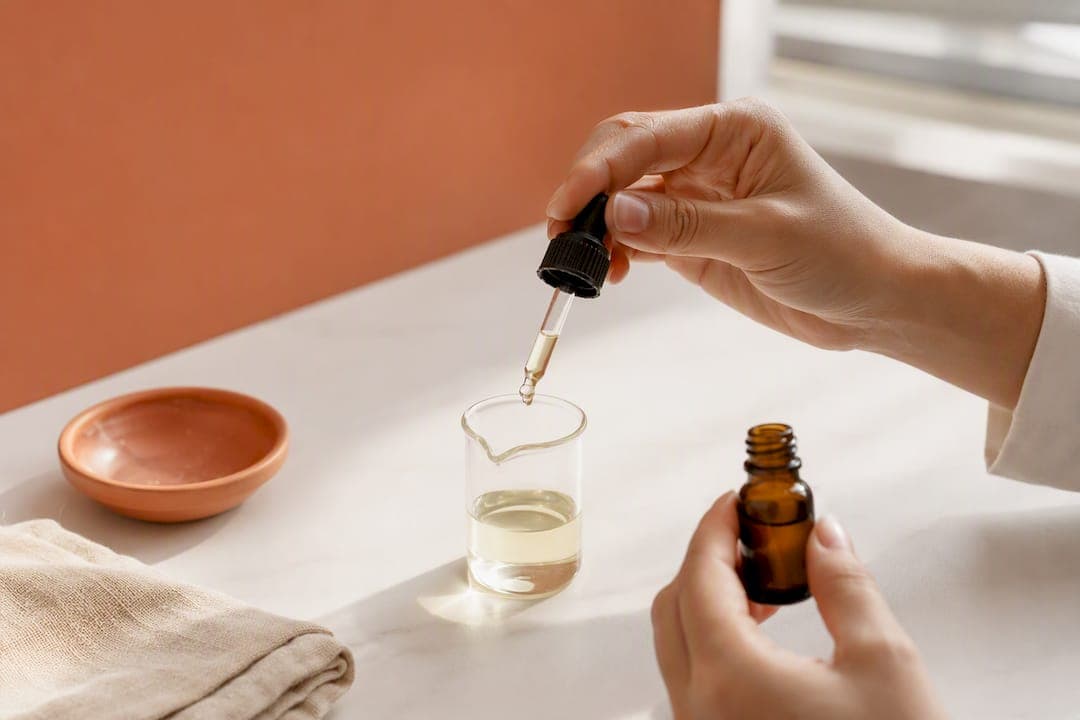
Limited aromatherapy and properly diluted topical use can be done cautiously during pregnancy, but three rules are non-negotiable: never ingest essential oils, favor inhalation over skin application, and dilute anything topical to pregnancy-safe strength. Talk to your OB or midwife before starting. Which specific oils you reach for, and how you use them, changes by trimester and by what you're treating.
TL;DR:
- Inhalation of essential oils is safer than topical application during pregnancy, with dilution kept around 1% to minimize absorption risks.
- Commonly regarded lower-risk oils for pregnancy include lavender, lemon, and ginger, but their effect depends on proper method and individual response.
- Oils like pennyroyal, camphor, wintergreen, and clary sage pose documented risks and should never be ingested or applied near mucous membranes.
- Patch testing and simple inhalation tests are recommended to check personal tolerance before using any essential oil in pregnancy.
- Using pre-formulated pregnancy-safe skincare products offers botanicals at consistent concentrations, reducing the need for dilution and minimizing risks.
Table of Contents
- Pregnancy Safe Essential Oils: What's Commonly Regarded as Lower-Risk
- Essential Oils to Avoid During Pregnancy
- How to Use Essential Oils Safely During Pregnancy
- When to Skip Aromatherapy Entirely
- Choosing Quality Oils When Purity Isn't Guaranteed
- What the Research Actually Shows
- A Measured Take on Aromatherapy in Pregnancy
- A Gentler Way to Bring Botanicals Into Your Routine
- Sources
- FAQ
Pregnancy Safe Essential Oils: What's Commonly Regarded as Lower-Risk
Not every oil carries the same risk profile, and the "safer" list is really a shortlist of oils with a longer track record of cautious use rather than a guarantee. Lavender and rose oils have shown some ability to ease anxiety and improve sleep in small studies, which is why they show up so often in labor and postpartum aromatherapy protocols.
Here's a working list, organized by what each oil tends to help with:
- Lavender — anxiety, sleep, general tension. Inhale from a tissue or diffuse briefly; diluted 1% for a shoulder or neck rub.
- Roman or German chamomile — mild anxiety, muscle tension. Best inhaled; gentle enough for a diluted footbath in most cases.
- Lemon — nausea. Sniff directly from the bottle or a cotton ball; a randomized trial found it reduced nausea and vomiting over several days without reported adverse effects.
- Ginger — nausea, digestive discomfort. Inhalation first; some people tolerate a heavily diluted belly rub.
- Frankincense — grounding, stress. Diffuse in short sessions or inhale from a tissue.
- Rose — anxiety, low mood, labor support. Inhalation is preferred given its potency and cost.
- Geranium — hormonal mood swings, mild skin support. Use diluted and only after a patch test.
- Cardamom — nausea, appetite. Inhalation only.
- Peppermint — headache, nausea, but use cautiously. It's on the watch list for skin reactions, so patch test before any topical use and skip it near the face while breastfeeding is anticipated.
Before trying anything new, do a simple tolerance check: put one drop on a tissue, hold it 12 inches away, and breathe normally for a minute. If you feel headachy, nauseated, or lightheaded, stop and try a different oil later. Pregnancy sharpens your sense of smell, so what worked before conception might feel overwhelming now.
Essential Oils to Avoid During Pregnancy
Some oils belong on a strict avoid list, and the reasons matter because they explain why "natural" doesn't mean "harmless." Pennyroyal, camphor, wintergreen, and thuja are commonly flagged by clinicians because they carry documented risks specific to pregnancy.
- Pennyroyal — historically used to induce miscarriage; contains compounds toxic to the liver.
- Camphor — can cross into the bloodstream quickly and has been linked to seizures in high doses.
- Wintergreen — high in methyl salicylate, chemically similar to aspirin, and carries salicylate toxicity risk.
- Clary sage — believed to stimulate uterine contractions, so it's typically avoided until labor is desired.
- Cinnamon bark and clove — strong skin irritants with phenol compounds that can trigger significant skin reactions.
- Thuja, tansy, mugwort, and wormwood — all associated with uterine-stimulating or neurotoxic effects in traditional and clinical literature.
- Birch, hyssop, aniseed, and basil (estragole type) — round out the commonly cited avoid list for similar toxicity concerns.
None of these should ever be ingested, and none belong anywhere near mucous membranes, whether that's a diffuser blend inhaled directly or a lip balm. If a product doesn't list its ingredients by full botanical name, treat it as an unknown and skip it.
How to Use Essential Oils Safely During Pregnancy
Safe use comes down to method, dose, and duration, in that order. Inhalation is considered the lower-risk route because it limits how much of the oil actually reaches your bloodstream compared to topical application.
- Start with inhalation. Put one drop on a tissue or cotton ball and breathe it in for a few minutes, or run a portable diffuser for 10 to 15 minutes at a time in a well-ventilated room.
- Dilute anything topical to roughly 1%. That works out to about one drop of essential oil per teaspoon (5 mL) of carrier oil; for practical dilution examples and carrier-oil guidance, see how to safely dilute essential oils for hair. Professional aromatherapy guidance allows dilution up to around 2% during active labor, but not before.
- Keep blends simple. Limit yourself to three oils or fewer in any single blend, so if a reaction shows up, you can actually trace which oil caused it.
- Mind the room, not just the bottle. A diffuser running all day in a small nursery exposes pets and other household members too, so rotate oils and cap sessions rather than leaving it on continuously.
- Skip the bath if your membranes have ruptured. Otherwise, two or three drops mixed into a dispersant (not straight into bathwater) is the outer limit for a footbath or soak.
- Patch test before any topical use. Apply diluted oil to a small area of your inner arm and wait 24 hours. Stop immediately if you notice rash, swelling, cramping, nausea, or dizziness, and mention it at your next appointment.
Pro Tip: Keep a simple note on your phone with the oil name, dilution, and how you felt afterward. It sounds like overkill until your provider asks exactly what you used and when.
When to Skip Aromatherapy Entirely
Many clinicians advise avoiding unnecessary exposures during the first trimester, when organ development is most active, even for oils generally considered lower-risk later on. Aromatherapy is also typically off the table if you have epilepsy, severe asthma, major cardiac disease, or liver or kidney disease, since these conditions can affect how your body processes and clears the compounds in essential oils.
Stop and call your provider right away if you notice:
- Uterine cramping or tightening after use
- Sudden breathlessness or wheezing
- A severe headache that doesn't resolve
- Widespread rash or hives
Choosing Quality Oils When Purity Isn't Guaranteed
The FDA does not regulate essential oils sold for aromatherapy, so two bottles labeled "lavender" can vary wildly in strength and purity. That gap is exactly why the Latin botanical name on the label matters more than the marketing copy.
- Buy single-ingredient oils rather than proprietary blends with undisclosed fillers.
- Ask the seller for a GC/MS batch report, the standard lab test that confirms what's actually in the bottle.
- Choose a gentle carrier oil like grapeseed or jojoba, and have a backup ready if you have a nut allergy, since almond and other nut-derived carriers are common.
- Store bottles away from heat and sunlight, and keep caps tight since oxidation changes an oil's chemistry over time.
- Skip sun exposure for several hours after applying citrus oils topically. They're photosensitizing and can leave patches of hyperpigmentation.
What the Research Actually Shows
The evidence base here is smaller than most people assume. One randomized trial found lemon aromatherapy reduced nausea and vomiting over several days compared to placebo, and separate studies point to lavender and rose easing anxiety during labor. Neither result is huge, and sample sizes in this field tend to be small.
What the numbers say: Professional guidance generally caps topical dilution at a low percentage during pregnancy, rising to a somewhat higher dilution once labor begins, with diffuser sessions kept to short durations at a stretch.
Essential oil compounds do cross the placenta, and long-term safety data simply doesn't exist at the scale researchers would want. That gap is the entire reason inhalation-first, low-dilution guidance exists. Treat every recommendation here as a starting point for a conversation with your OB or midwife, not a substitute for one.
A Measured Take on Aromatherapy in Pregnancy
Aromatherapy during pregnancy gets marketed as either completely harmless or vaguely dangerous, and both framings miss the point. The honest position sits in the middle: inhalation of a well-chosen oil, in short sessions, is a reasonable way to manage nausea or anxiety, but it's not a treatment plan and it's not risk-free just because it's plant-derived.
What gets lost in most consumer guides is how much the method matters more than the oil itself. A tissue and a few careful breaths is a completely different exposure than a heavily scented lotion applied daily to a growing belly. At Yuka+Face, that distinction shapes how we think about botanicals generally: test the compound, respect the dose, and never assume "natural" means "unregulated is fine." If you want topical botanical options that skip the guesswork, our pregnancy-safe skincare guide walks through trimester-specific ingredients we've formulated around, rather than left to chance.
— Kelly
A Gentler Way to Bring Botanicals Into Your Routine
If aromatherapy feels like more risk than you want to take on right now, there's another way to get the benefits of plant-based ingredients without measuring drops or wondering about dilution math. Yuka+Face formulates skincare with tested botanicals at fixed, consistent concentrations, so you're not guessing what strength you're applying or whether a blend has changed batch to batch.

That consistency matters more during pregnancy, not less. Rather than diluting oils yourself, you can reach for a pregnancy-conscious vegan skincare routine already built around ingredients that skip the harsher, more irritating compounds altogether. This isn't a substitute for your clinician's advice on aromatherapy specifically, but it is a straightforward way to keep botanicals in your routine without the same level of caution required for essential oils. Browse the Yuka+Face skincare guide to see which products fit your stage of pregnancy, and check with your provider on anything applied near sensitive or changing skin.
Sources
- Essential Oils and Pregnancy Safety — Mayo Clinic Health System
- Essential oils for pregnancy: What's safe and what to avoid — Healthline
- Evidence on essential oils during pregnancy, birth, and postpartum — Evidence Based Birth
FAQ
Which essential oils should be avoided during pregnancy?
Pennyroyal, camphor, wintergreen, clary sage, cinnamon bark, clove, thuja, tansy, mugwort, and wormwood are among the oils most consistently flagged for uterine-stimulating or toxic effects.
What scents should I avoid while pregnant?
Beyond the strict avoid-list oils, many people find strong or synthetic fragrances harder to tolerate as pregnancy heightens smell sensitivity, so easing into any new scent with a tissue test is worth doing regardless of the oil.
Is it safe to eat hummus during pregnancy?
Store-bought hummus is generally considered safe since it's made from cooked chickpeas and pasteurized ingredients; concerns some people raise usually relate to raw tahini or unpasteurized additions rather than the chickpeas themselves.
Which essential oil is not recommended for use during pregnancy?
Clary sage is one of the most frequently named oils to avoid before labor because of its association with stimulating uterine contractions.
Can I diffuse essential oils every day while pregnant?
Daily diffusing isn't automatically unsafe, but sessions should stay short (10 to 15 minutes), the oil should be one from a lower-risk list like lavender or lemon, and you should watch for headaches or nausea that signal overexposure.