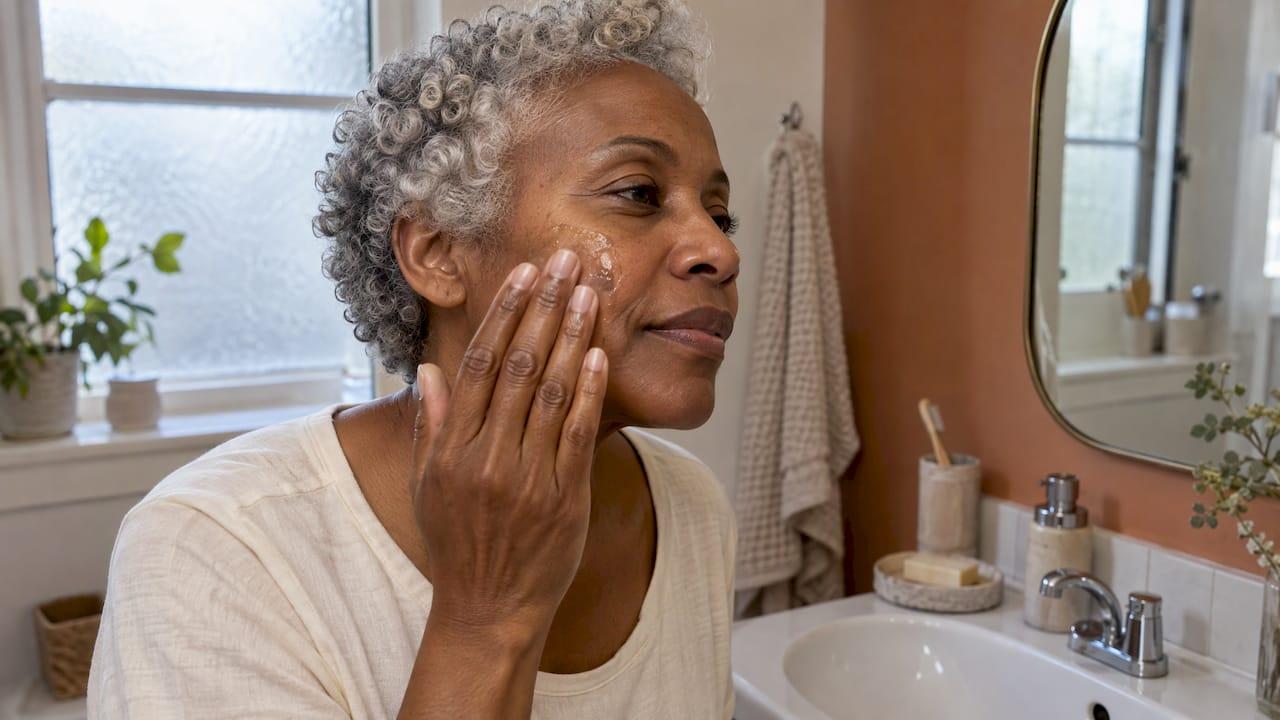
Mature skin benefits from exfoliation when it is gentle and infrequent. Favor mild chemical exfoliants such as lactic or mandelic acid, enzymes or PHAs. Use them once or twice a week at most. Follow every session with moisturizer, and wear sunscreen every day. This guide covers what to choose, how to apply it, how often, and when to stop.
TL;DR
- Cell turnover slows with age. Gentle exfoliation helps with dullness, rough texture and dry patches.
- Mild chemical exfoliants (lactic acid, mandelic acid, enzymes, PHAs) are the usual pick for mature, dry or sensitive skin. Abrasive scrubs are the usual thing to avoid.
- Start with once a week. Do not go beyond once or twice a week, and go slower if your skin is dry or sensitive.
- Moisturize right after and use sunscreen daily.
- Redness, chapping or stinging means stop actives for at least a week. See a dermatologist first if you have rosacea or inflammatory acne.
Table of Contents
- Why mature skin needs a different approach
- What exfoliation can and cannot do
- Chemical vs. physical exfoliation
- How to choose an exfoliant for your skin
- How to exfoliate mature skin at home
- How often to exfoliate
- Signs you are exfoliating too much
- Support the barrier around every exfoliation
- When to ask a dermatologist first
- Perspective
- Build a gentle routine with Yuka+Face
- FAQ
- Sources
Why mature skin needs a different approach
Skin sheds its top layer of dead cells all the time. This process is called desquamation. Experts note that it slows with age, which contributes to dry patches, fine lines, wrinkles and uneven pigment.
When dead cells stay on the surface, the complexion can look dull and uneven. Gentle exfoliation removes those cells, leaves skin smoother and more radiant, and may encourage collagen production.
Set realistic expectations. Dr. Rachel Reynolds says in Harvard Health that exfoliation can improve luster but will not fix wrinkles. Skin also needs time to repair between sessions.
So the goal for mature skin is not strength. The goal is a steady, low-irritation routine that supports a healthy barrier.
What exfoliation can and cannot do
| Can help with | Cannot do |
|---|---|
| Dull, tired-looking complexion | Remove wrinkles |
| Rough or uneven texture | Replace moisturizer or sunscreen |
| Dry, flaky patches | Work faster when used more often |
| Better absorption feel from products that follow | Repair a damaged barrier |
More frequent exfoliation does not mean better results. Overdoing it can cause irritant contact dermatitis, which can look red, angry and chapped.
Chemical vs. physical exfoliation
There are two families of exfoliants.
- Physical (mechanical): a tool such as a brush, pad or sponge, or a scrub, physically removes dead skin cells.
- Chemical: acids or enzymes loosen the bonds between dead cells so they shed.
For mature, dry or sensitive skin, dermatologists recommend mild chemical exfoliants such as lactic or mandelic acid, enzyme options such as papaya or pineapple, and PHAs. The same source suggests pairing them with hydrating ingredients like ceramides or hyaluronic acid.
The same dermatologists advise against abrasive scrubs for mature skin, because they can be too harsh and unpredictable. Drs. Garshick and Hartman add in Allure that rough physical exfoliants can worsen sensitivity and redness. They can also tug at the skin, which may lead to wrinkling or loose skin.

That does not rule out physical exfoliation for everyone. It means technique matters. Light pressure, short contact time and a low frequency are the rules. More on that below.
Ingredient guide
| Ingredient type | Examples | Where it fits |
|---|---|---|
| Mild alpha hydroxy acids | Lactic acid, mandelic acid | Dry, dull or sensitive mature skin |
| Enzymes | Papaya, pineapple | Skin that reacts to acids |
| PHAs | Gluconolactone and similar | The gentlest chemical route |
| Stronger acids | Glycolic acid | Sun-damaged or uneven-toned skin, at low strength |
| Hydrating partners | Ceramides, hyaluronic acid | Used alongside any exfoliant |
AHAs like glycolic acid can help improve uneven skin tone and brightening on sun-damaged skin, but they are a step up in strength. Start mild and move up only if your skin stays calm.
How to choose an exfoliant for your skin
Start with how your skin behaves, not with the product.
- Dry or sensitive skin: choose lactic acid, mandelic acid, enzymes or PHAs. Expect to exfoliate once a week or less.
- Dull skin with uneven tone: a mild acid is a good starting point. Consistency counts for more than strength.
- Combination or oily areas: keep the gentle approach. Treat the oilier zones, such as the nose and chin, with a bit more attention rather than raising strength across the whole face.
- Already using retinol or vitamin C: treat these as actives too. Count them when you plan exfoliation days.
Strength matters for over-the-counter acids. A professional source on evaluating exfoliation says over-the-counter chemical products should stay at a low concentration, no higher than 10% glycolic acid or 2% salicylic acid.
Check the label for the acid and its percentage. Skip any product with a high concentration, however it is marketed.
For a wider look at product types, see our guide to facial exfoliation products.
How to exfoliate mature skin at home
The American Academy of Dermatology gives simple technique guidance. Apply a scrub or chemical exfoliator gently, in small circular motions, for about 30 seconds. Rinse with lukewarm water. Then apply moisturizer right away to keep skin healthy and hydrated.
In practice:
- Cleanse first. Remove makeup, sunscreen and oil so the exfoliant works on skin, not residue. Our guide to double cleansing explains the order.
- Apply a thin layer. Use fingertips and light pressure. Skip the eye area.
- Keep time short. About 30 seconds for a scrub or wash-off product. Follow the label for leave-on formulas.
- Rinse with lukewarm water. Hot water adds to dryness.
- Pat dry and moisturize. Do this immediately.
- Protect in the morning. Moisturize and use sunscreen every day, including on days you exfoliate.
Evening is a simple default
Many people exfoliate at night, then moisturize, so skin has hours to settle before sun exposure. The Google question "what is the best time to exfoliate" has no single right answer. What matters is that sunscreen goes on the next morning and that you do not stack several actives in one session.
How often to exfoliate
The short answer is once or twice a week. Dr. Yanke, quoted by Cleveland Clinic, recommends exfoliating the face once or twice a week. Sensitive or dry skin may need less. Overdoing it can cause redness, irritation or cracked skin.
A workable plan for mature skin:
| Week | Frequency | Notes |
|---|---|---|
| 1 to 2 | Once a week | Observe how skin feels the next day |
| 3 to 4 | Once a week, or twice if skin is calm | Add a second session only if there is no stinging or redness |
| Ongoing | Once or twice a week | Drop back when skin feels tight or looks flushed |
Dermatologist David Kim calls building a routine a "marathon, not a race" in Wirecutter. He advises following your skin's lead instead of planning an ambitious schedule in advance.
For schedules by skin type, read our guide on how often to exfoliate.
Signs you are exfoliating too much
Watch for:
- Redness or a flushed look that lasts
- Stinging when you apply ordinary products
- Chapped, flaky or cracked patches
- Skin that feels tight right after cleansing
If these show up, the recommended response, per Wirecutter, is to stop all active treatments, including exfoliants, vitamin C and retinol. Go back to a basic routine of cleanser, moisturizer and sunscreen for at least one week. Let the skin recover.
Then restart at a lower frequency. If irritation returns, talk to a dermatologist.
Support the barrier around every exfoliation
Exfoliation removes the top layer of cells, so the barrier underneath needs support. Hydrating, barrier-friendly products matter as much as the exfoliant itself.
A good barrier repair skincare routine pairs exfoliation with simple hydrating steps. Our own reading list covers the same ground:
- How to maintain a healthy skin barrier
- Ceramides in skincare
- Ingredients that support barrier recovery
- Moisturizing vs. hydrating
A simple weekly pattern might look like this:
- Exfoliation night: cleanse, exfoliate, moisturize. Nothing else active.
- Other nights: cleanse, hydrate, moisturize. Use any retinol on a separate night.
- Every morning: cleanse or rinse, moisturize, sunscreen.
Keeping actives on separate nights makes it easier to spot what your skin does not like.
When to ask a dermatologist first
Some conditions call for a professional opinion before you exfoliate. Per dermatology guidance, consult a dermatologist first if you have inflammatory acne, rosacea, herpes simplex, molluscum contagiosum or warts. They can review your medical history and recommend options.
Also see a dermatologist if irritation does not clear after a week of basic care, or if you use prescription topicals and are unsure how they combine with exfoliants.
Perspective
Mature skin does not need more force. It needs consistency, hydration and a barrier that stays calm.
Our philosophy is simple: short ingredient lists, plant-based and vegan formulas, and routines that skip the extra steps. We call it unbothered skin. For exfoliation, that means a light touch, a low frequency and a moisturizer every time.
We design our range for all skin types and ages. We believe aging can be radiant, and the antioxidants, vitamins and essential oils in our formulas are meant to support that. Exfoliate gently, hydrate well and let the skin lead.
Kelly
Build a gentle routine with Yuka+Face
Our vegan, cruelty-free, Leaping Bunny certified formulas are made for all skin types and ages, with short, transparent ingredient lists.

For exfoliation days, our Exfoliating Face Polish is part of the range. Use light pressure, about 30 seconds and lukewarm water, as described above.
For the steps around it, browse cleansers, toners and serums, or moisturizers and masks. The Hydrating Power Moisturizer is a natural step to follow exfoliation. For more on aging skin, see our practical guide to mature skin care.
FAQ
What is the best exfoliant for mature skin?
For most mature skin, a mild chemical exfoliant is the usual choice. Dermatologists point to lactic acid, mandelic acid, enzymes and PHAs for mature, dry or sensitive skin. Pair it with ceramides or hyaluronic acid, and avoid abrasive scrubs.
Can I exfoliate every day after 50?
Daily exfoliation is not advised. The usual guidance is once or twice a week, and less if your skin is dry or sensitive. Start once a week and add a session only if skin stays calm.
Should I use a scrub or an acid?
Acids and enzymes are generally gentler on mature skin than scrubs. Dermatologists quoted by Allure say rough physical exfoliants can worsen redness and sensitivity. If you use a scrub, apply it gently with small circles for about 30 seconds.
What should I do after exfoliating?
Rinse with lukewarm water and apply moisturizer right away, as the AAD advises. Use sunscreen every day, including the morning after you exfoliate.
What if my skin turns red or stings?
Stop exfoliants, vitamin C and retinol. Use only cleanser, moisturizer and sunscreen for at least a week, per Wirecutter. If it does not settle, see a dermatologist.
Sources
- 10 Best Exfoliators for Mature Skin, SELF
- 8 Best Exfoliators for Mature Skin, Allure
- 5 Ways to Exfoliate Your Skin Without Irritation, Cleveland Clinic
- How To Exfoliate Safely and Effectively, Cleveland Clinic
- Have you exfoliated lately? Harvard Health
- How to safely exfoliate at home, American Academy of Dermatology
- Evaluate Before You Exfoliate, Newswise
- How to Exfoliate Without Burning (or Scrubbing) Your Face, Wirecutter
- Cedars-Sinai