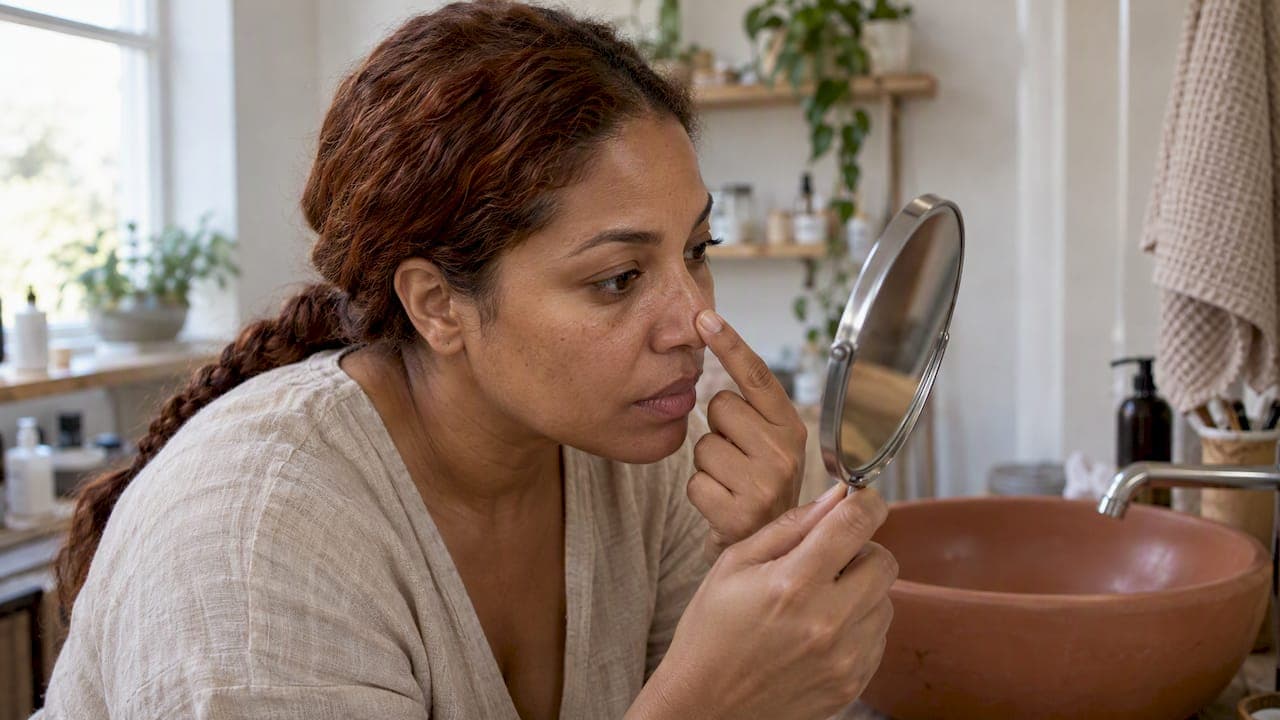
Natural blackhead removal comes down to three things: gentle daily cleansing, non-comedogenic products, and patience. Scrubbing, squeezing, lemon juice and toothpaste do not clear blackheads. They irritate skin and can make pores look worse.
This guide covers what a blackhead is, which natural options are reasonable, what the evidence says about popular home remedies, and a simple routine. It also covers when a dermatologist or licensed esthetician is the better choice.
TL;DR
- A blackhead is a clogged pore, not dirt. Its dark color comes from oxidation, so scrubbing does not remove it.
- Gentle cleansing, non-comedogenic products and clay-type masks fit a natural routine. They support clearer pores but are not a medical treatment.
- Skip toothpaste, lemon juice, baking soda and squeezing. Dermatologists advise against all of them.
- Allow 6 to 8 weeks with one product before judging it.
- Persistent or inflamed breakouts call for a dermatologist. Extraction belongs in a professional setting.
Table of Contents
- What a blackhead actually is
- What natural can and cannot do
- Natural options compared
- Home remedies to skip
- A simple natural routine for clogged pores
- Choosing cleansers for clogged pores
- Choosing masks to unclog pores
- Our perspective
- Yuka+Face products for a pore-friendly routine
- How long results take
- Ingredients worth knowing
- When to see a professional
- FAQ
- Sources
What a blackhead actually is
A blackhead forms when excess oil and dead skin cells build up inside a pore. The pore stays open at the surface. The American Academy of Dermatology (AAD) describes blackheads as a type of acne that develops this way.
The dark color is not dirt. It is a chemical reaction between the pore buildup and oxygen, much like a cut apple turning brown. This matters for one reason: if the dark spot is not dirt, hard scrubbing cannot lift it out. Scrubbing only damages the skin barrier.

Blackheads show up most on the nose, chin and forehead. These areas have more oil glands. The goal of any routine is to keep pores from clogging and to loosen what is already there, without stripping the skin.
What natural can and cannot do
Natural does not mean harmless, and it does not mean effective. The FDA states that natural labels on cosmetics do not guarantee safety. Many botanical ingredients can irritate or cause reactions. The same page explains that a product marketed to treat acne is regulated as a drug, not a cosmetic.
That has a practical meaning for readers. A cleanser, toner or mask labeled as a cosmetic is for cleansing and care. It can keep skin balanced and pores less likely to clog. It is not a replacement for a proven acne active.
The ingredients with the strongest clinical backing are not all plant-based. According to the AAD's adult acne guidance, the recommended over-the-counter actives include:
- Salicylic acid. Unclogs pores and exfoliates. It works best on whiteheads and blackheads.
- Adapalene. A retinoid that helps clear blackheads, whiteheads and pimples.
- Benzoyl peroxide. Best for mild pimples. Starting at 2.5% helps avoid dryness and burning. It bleaches fabric, so white towels and pillowcases are safer.
Azelaic acid is another option with a plant-friendly profile. Yuka+Face covers its uses, strengths and routine placement in a separate guide.
The honest summary: a natural routine is a good base. Stubborn blackheads may need one proven active added to it, ideally after a conversation with a dermatologist.
Natural options compared
| Method | What it does | Evidence and cautions |
|---|---|---|
| Gentle daily cleansing | Removes oil, sunscreen and makeup before they settle in pores | Low risk. Use a non-stripping formula, twice a day at most |
| Non-comedogenic products | Formulated not to clog pores | AAD advises them for avoiding clogged pores |
| Clay or kaolin masks | Absorb surface oil | Use once or twice a week. Overuse dries skin |
| Oil cleansing | Dissolves oil and makeup residue | Rinse fully. Suits many skin types, but patch test first |
| Tea tree oil (5%) | Antimicrobial | One small trial compared it with 5% benzoyl peroxide. It worked more slowly and can irritate |
| Steam | Softens the skin | Short sessions only. Hot water can aggravate sensitive skin |
| Lemon, baking soda, toothpaste | Marketed as DIY fixes | Avoid. See below |
| Squeezing | Forces contents out | Avoid. Can cause scarring and infection |
Home remedies to skip
Search results for this topic are full of kitchen remedies. Several are risky.
Toothpaste
The AAD is blunt on this one. Toothpaste is not an effective acne treatment. Ingredients such as baking soda, flavoring and color can irritate skin. Toothpaste belongs on teeth.
Lemon juice
Lemon juice is highly acidic. Healthline notes that it can upset the skin's natural pH and cause damage. Irritation, dryness and sun sensitivity are the usual results. A brightening fruit acid in a formulated product is a different thing from raw juice on the face.
Baking soda scrubs
Baking soda is alkaline and gritty. Both properties push the skin barrier the wrong way. A compromised barrier produces more redness and often more oil, not fewer blackheads.
Squeezing and picking
Popping a blackhead can push bacteria deeper into the pore. The AAD says squeezing can lead to infection or permanent scarring. Extraction is a job for a professional with the right tools and technique.
Harsh physical scrubs
Because the dark color is oxidation and not dirt, a scrub has nothing to remove. It strips oil, which can trigger more oil production. Gentle cleansing does the same job with less damage.
A simple natural routine for clogged pores
Keep it short. Premature layering is a common cause of irritation. The AAD advises using a chosen product for 6 to 8 weeks before judging results or adding new steps.
Morning
- Rinse with water or use a gentle cleanser.
- Apply a balancing toner if skin feels tight or oily.
- Apply a lightweight, non-comedogenic moisturizer.
- Finish with sunscreen.
Evening
- Remove sunscreen and makeup with a cleansing oil or balm. Rinse fully.
- Follow with a gentle water-based cleanser.
- Apply a serum if needed.
- Moisturize.
Once or twice a week
Use a clay-based mask on the oilier zones, usually the nose and chin. Leave it on for the time stated on the label. Do not let it dry until it cracks. Moisturize afterward.
Patch test first
Apply any new product to a small area, such as the jawline or behind the ear, for a few days. This matters more with essential oils and botanical extracts, since natural ingredients can still irritate.
Choosing cleansers for clogged pores
A good cleanser for blackhead-prone skin does a few simple things:
- Removes oil and residue without leaving skin squeaky or tight
- Carries a short ingredient list
- Avoids heavy fragrance and harsh surfactants
- Is labeled non-comedogenic where possible
Tight skin after washing is a warning sign. It means the barrier is being stripped. Skin that feels stripped tends to overproduce oil.
Oil cleansers surprise many people with oily skin. Oil dissolves oil and sunscreen well. Rinsed properly and followed by a water-based wash, it is a reasonable step for double cleansing. Those who prefer a single step can use a gentle gel or cream cleanser instead.
Calming ingredients matter too, because blackhead-prone skin is often over-treated. The list of evidence-backed calming ingredients is a useful guide for irritated skin. For preventing the problem in the first place, see these practical tips on avoiding irritation.
Choosing masks to unclog pores
Masks help with surface oil and a congested look. They do not reach deep into the pore. Realistic expectations keep skin healthier.
What to look for:
- Kaolin or other mild clays. Gentler than bentonite for most skin.
- Hydrating ingredients alongside the clay. These limit dryness.
- No physical grit. Skip masks with crushed shells or seeds.
How often: once or twice a week is enough. More often tends to dry out skin and may cause breakouts. Dry skin types can alternate with a hydrating mask instead.
For more on this approach, Yuka+Face explains how to minimize pores with bakuchiol and kaolin. A separate piece covers large pores and natural approaches. Clogged pores can expand and look larger, so the two problems are connected.
Our perspective
We make skincare that is vegan, cruelty-free and plant-based. We also think natural skincare should be honest about its limits.
Blackheads are a pore problem, and pores respond to consistency. In our experience, the most common mistake is doing too much: three exfoliants, a scrub, a mask and a new serum in one week. The skin barrier takes the hit, and the blackheads stay.
Our approach is the opposite. Short ingredient lists. Few steps. One change at a time. We call it the unbothered skin philosophy. A cleanser that cleans without stripping, a toner that balances, a moisturizer that keeps the barrier intact. That is the foundation.
We also do not claim that a botanical cleanser or mask treats acne. Cosmetics support skin. They do not replace medical treatment. When blackheads are persistent, a dermatologist can prescribe or recommend a proven active, and a natural routine can sit alongside it to keep skin comfortable.
If a change is planned, our guide to switching to natural skincare one product at a time lays out a gradual way to do it.
— Kelly
Yuka+Face products for a pore-friendly routine
Yuka+Face makes vegan, cruelty-free skincare in cleansers, toners, serums, oils, moisturizers and masks. For the cleansing steps above, these are good starting points:
- Cleansing Duo: a two-step cleanse.
- Vitamin C Cleansing Oil: the oil step for removing sunscreen and makeup.
- B3 Gentle Cleanser: a gentle everyday wash.
- Lavender Essence Balancing Toner: a toner to follow cleansing.
Browse the full range of cleansers, toners, serums and oils. Moisturizers and masks are on the moisturizer and mask page. Gift cards start from $50.
These products are cosmetics for cleansing and care. They are not intended to treat acne.
How long results take
Blackheads do not clear overnight. The AAD notes that acne treatments need consistent daily use. Fewer breakouts typically appear after 4 to 8 weeks, and full clearing can take up to 16 weeks.
A reasonable timeline for a natural routine:
| Weeks | What to expect |
|---|---|
| 1 to 2 | Skin adjusts. Less tightness and shine if the cleanser is gentle |
| 3 to 4 | Pores may look less congested. Do not add new steps yet |
| 6 to 8 | Judge the routine. Keep it, or change one thing |
| 12 to 16 | Look for lasting change. If none, see a dermatologist |
Change one product at a time. Changing several makes it impossible to know what helped and what irritated.
Ingredients worth knowing
Fermented plant extracts and essential oils get a lot of attention. Evidence varies widely. One eight-week split-face trial compared a fermented Chamaecyparis obtusa extract with 5% tea tree oil on acne. The fermented extract reduced inflammatory acne by 65.3%, against 38.2% for tea tree oil. The study looked at inflammatory acne, not blackheads alone, but it shows that natural options differ a great deal in results.
Salicylic acid is the best-supported ingredient for blackheads specifically. Higher-strength peels exist too. A comparison of mandelic acid and salicylic acid peels in mild to moderate acne tested 45% mandelic acid against 30% salicylic acid. Peels at these strengths are professional treatments, not home products.
On ingredient safety more broadly, one example: Yuka+Face has looked at what the evidence says about parabens. For readers sorting out labels, the guide to the role of organic ingredients is also worth reading.

When to see a professional
See a board-certified dermatologist if:
- Blackheads persist after 8 to 12 weeks of a steady routine
- Breakouts become painful, red or swollen
- Skin scars or darkens after blemishes
- Products cause burning, rash or peeling
A licensed esthetician can perform extractions safely. Do not attempt them at home with metal tools or fingernails. The AAD discourages squeezing because of infection and scarring risk.
A dermatologist can also recommend a retinoid or other active, then advise how to fit it with a gentle natural routine.
FAQ
What is the best way to get rid of blackheads?
The best-supported at-home options are over-the-counter salicylic acid or adapalene, used consistently. A gentle cleansing routine supports them. Results take 4 to 8 weeks or longer, so a dermatologist can help if progress stalls.
Can toothpaste remove blackheads?
No. The AAD says toothpaste is not an effective acne treatment. Its ingredients, including baking soda and flavoring, can irritate skin. Use proven actives instead.
Can lemon remove blackheads?
Lemon juice is not recommended. It is highly acidic and can disrupt the skin's pH, leading to irritation, dryness and sun sensitivity. Gentle cleansing and non-comedogenic products are safer.
How often should a pore-clearing mask be used?
Once or twice a week is enough for most skin. More frequent use can dry out the skin and trigger more oil. Skip the mask if skin is red, stinging or peeling.
Sources
- Adult acne treatment dermatologists recommend (AAD)
- Acne: Signs and symptoms (AAD)
- What can treat large facial pores? (AAD)
- How to Unclog Pores: Safe Methods, What to Avoid, and More (Healthline)
- Aromatherapy (FDA)
- A comparative study of tea-tree oil versus benzoylperoxide in the treatment of acne (PubMed)
- Lactobacillus-fermented Chamaecyparis obtusa versus tea tree oil for acne, eight-week split-face study (PubMed)
- 45% mandelic acid versus 30% salicylic acid peels in acne vulgaris (PubMed)