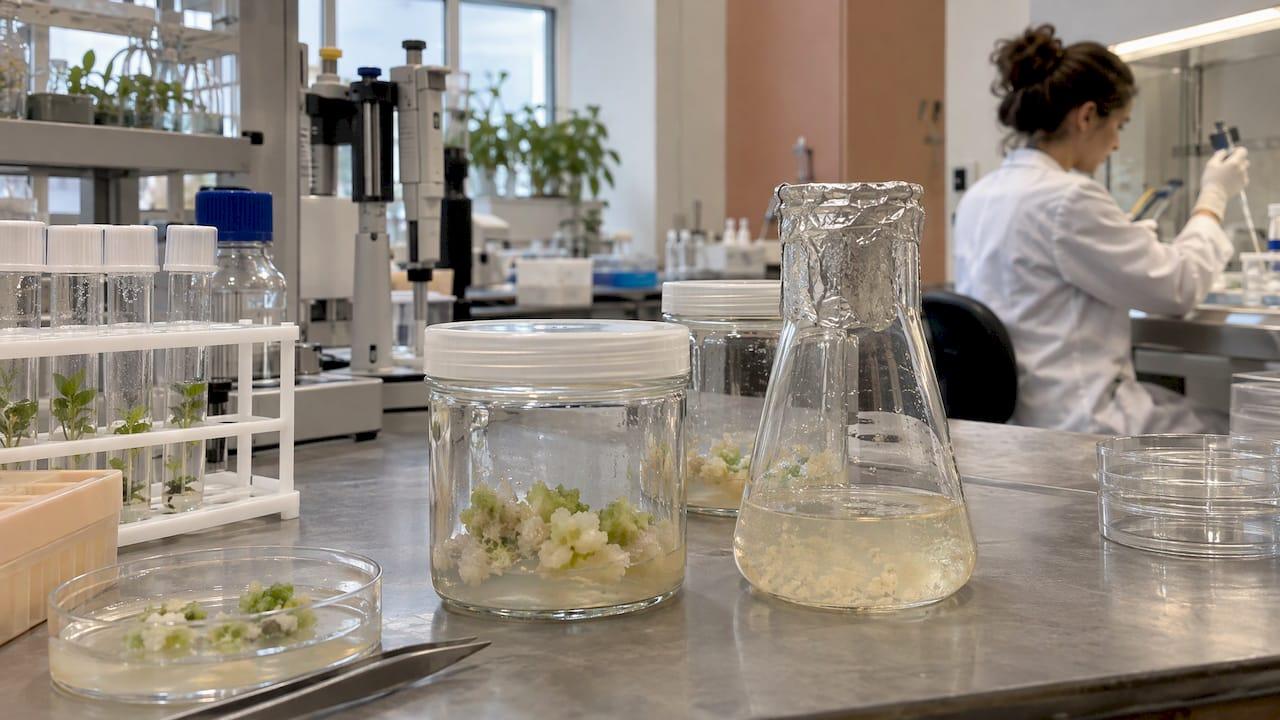
Plant stem cell skincare uses extracts made from cultured plant cells, most often grown in a lab from plants such as apple, and added to serums and creams as a plant-derived active. The extract works as an ingredient, in the same way an antioxidant or botanical extract does. It does not work as living cells that rebuild skin. That distinction helps estheticians, spa buyers and boutique retailers choose products, write accurate claims and explain them to clients. At Yuka+Face we build routines around short, transparent ingredient lists, plant antioxidants and barrier support, and the evidence below shows why that approach holds up.
TL;DR
- "Plant stem cells" on a label usually means an extract from cultured plant cells, not live cells.
- A 2025 review describes a 2% cultured apple cell extract cream that reduced crow's feet wrinkle depth by 8% at 2 weeks and 15% at 4 weeks in a 20-person trial.
- A 2024 meta-analysis of randomized trials found plant-extract skincare improved hydration and elasticity, with no adverse events reported in six of eight studies.
- Plant extracts have a good safety record, so sensitive skin does well with them. The label and the claims on it deserve a careful read.
- Short ingredient lists with antioxidants, plant ceramides and peptides cover the same ground in a clear, easy-to-explain way.
Table of Contents
- What "plant stem cell" means on a label
- What the studies report
- Plant stem cell serum, cream and apple versions compared
- Sensitive skin and plant extracts
- Reading the label and the claims
- What to look for in a plant-based routine
- Yuka+Face for plant-based routines
- FAQ
- Sources
What "plant stem cell" means on a label
In a lab, plant cells can be grown in a vessel from a small piece of tissue. The usual product is a mass of cells called callus, or a cell suspension, or cultured roots. A review of plant cell culture technology explains that these cultures are often dedifferentiated cells, meaning cells that have returned to an unspecialized state, and that they can yield extracts used as cosmetic ingredients. The same review notes that cells grown this way can be propagated under good manufacturing practice and give a clean, phytochemically uniform biomass.
That uniformity matters to a professional buyer. A field-grown plant changes with soil, weather and harvest. A culture grown under controlled conditions delivers a consistent extract from batch to batch.
A February 2025 review of plant stem cells in the cosmetic industry adds the point to remember. The ingredient name refers to a primitive cell extract. Cosmetic companies use extracts, not live stem cells, and live plant cell cultures are not used in finished cosmetics. So when a serum says "plant stem cell," read it as "extract from cultured plant cells."

Why live cells are not in the jar
A May 2026 review of stem cells in cosmetic applications states that viable stem cells cannot survive standard cosmetic processing with preservatives, emulsifiers and long-term storage, and that intact cells cannot cross the skin barrier. A 2017 review of plant stem cells in cosmetics reaches the same description: formulations contain extracts, and the benefits come from the antioxidants and active compounds in them.
This is a useful frame for clients. The question to ask of any plant stem cell serum is which plant compounds it delivers and how the formula supports them.
What the studies report
The research on plant cell extracts is mostly about what the compounds do on the skin surface and in the upper layers. Three bodies of work stand out.
Apple cell extract and fine lines
Apple is the best-known source. The 2017 review by Trehan and colleagues describes work by the ingredient maker Mibelle on a 2% extract from the Uttwiler Spätlauber apple, a Swiss variety, delivered in lecithin liposomes. In lab tests the extract reversed signs of aging in human fibroblasts, the cells that make collagen, and it increased the lifespan of isolated human hair follicles (Plant stem cells in cosmetics: current trends and future directions).
In people, the 2025 review reports a trial of a cream with 2% cultured apple cell extract (PhytoCellTec Malus domestica). Twenty people applied it twice daily to the crow's feet area. Wrinkle depth, measured with an optical system called PRIMOS, fell 8% after two weeks and 15% after four weeks (Plant Stem Cells in Cosmetic Industry).

Two things help you read that result. It is a small trial, and it measures a cosmetic outcome, the look of fine lines. That is the right way to describe it to a client: visible smoothing of fine lines over a few weeks of daily use.
Meristem cell serums and collagen markers
A September 2024 clinical study followed 104 pre-, peri- and post-menopausal women who used serums with meristem cell actives from edelweiss (Leontopodium alpinum), butterfly bush (Buddleja davidii), Centella asiatica and Echinacea angustifolia daily for one month. Meristem cells come from the growing tips of a plant. The products were well tolerated by all participants, with no adverse reactions. Researchers reported statistically significant increases in dermal collagen content and network structure, and a rise in hydroxyproline, a collagen marker, in 12 skin biopsies.
For spa and medspa professionals, this is the study to know for sensitive, mature clients: safe in every participant and a measurable collagen signal after one month of daily use.
Plant extracts as a group
A December 2024 systematic review and meta-analysis of randomized controlled trials looked at topical plant-based products overall. It found significant improvements in skin hydration and elasticity, and reductions in melanin and redness (erythema), compared with other products. Transepidermal water loss, the water that escapes through the skin, did not differ significantly. Elasticity gains were significant in treatments of eight weeks or less, and six of the eight studies reported no adverse events.
The takeaway is practical. Plant actives have a record of improving hydration, elasticity and tone over weeks of consistent use. That matches how a routine works: steady daily application, not a single treatment.
Plant stem cell serum, cream and apple versions compared
| Format | What it usually delivers | Where it fits in a routine |
|---|---|---|
| Serum | Higher concentration of cultured-cell extract in a light base | After toner, before moisturizer |
| Cream | Extract with emollients and oils for comfort and barrier support | Last step, morning and night |
| Apple cell extract products | Extract from apple cell culture, often at 2% in studied formulas | Targeted to fine lines such as crow's feet |
| Meristem-based serums | Extracts from the growing tips of plants such as Centella or echinacea | Mature or tone-concerned skin |
The format sets how long the product stays on the skin and how it feels. The extract and its concentration set what it can do.
Sensitive skin and plant extracts
Sensitive skin is the group that benefits most from knowing what is in a product. A July 2021 review in PMC notes that plant extracts cause no serious side effects. The 2024 meta-analysis and the 104-woman study above both reported products that were well tolerated.
For safe use, follow the same routine you would for any new active:
- Introduce one new product at a time, so you know what you are reacting to.
- Apply a small amount to the jawline or inner forearm for a day before facial use, and watch for redness, stinging or itching.
- Start every other day for the first week, then move to daily.
- Pair the active with a barrier-supporting moisturizer. Our guide to plant ceramides explains how they support the skin barrier.
- Anyone with a known plant allergy, eczema, rosacea or a history of reactions to botanical extracts should check the full ingredient list against their triggers and see a dermatologist before adding a new active.
Professionals can use the same steps as a client handout for retail and treatment-room sales.
Reading the label and the claims
This section is for estheticians, spa owners and retail buyers who need to speak about these products accurately.
The price gap is about marketing. The 2021 review gives an example: a tomato antioxidant cream at $10 can be sold as a "stem cell" antioxidant cream for $50, with the same basic ingredients. Evaluate the formula, not the term.
Check what the extract is. A good label names the plant source, such as Malus domestica for apple, and sits in a formula with a short, readable list.
Mind the claim language. In the United States, cosmetics do not need FDA premarket approval, but what a product claims determines how it is classed. As Scientific American reported in 2012, claims such as boosting gene activity or improving the condition of stem cells put certain products in the category of unapproved drugs. The safe wording for cosmetics describes appearance: smoother-looking skin, hydrated skin, softened fine lines. Words like "regenerate" or "repair tissue" describe biological activity beyond what cosmetics may claim.
Check what is behind the plant extract. The active compounds in these extracts are mostly antioxidants and plant metabolites. Our guides on antioxidants for skin health and the role of antioxidants in aging cover which ones have evidence and how to use them.
Keep expectations to weeks. The studies above measure results at two to eight weeks of daily use. That is the time frame to give clients.
What to look for in a plant-based routine
Plant stem cell extracts are one way to bring plant compounds to the skin. The same goals can be reached with ingredients whose action is well described and easy to explain:
- Plant antioxidants such as vitamin C and botanical extracts, which protect against oxidative stress from UV and pollution. Our natural anti-aging ingredients guide groups them by results in 4 to 12 weeks.
- Plant ceramides, which support the barrier so that hydration stays in.
- Peptides, short chains of amino acids used for the look of firmness. See our page on peptides in organic skincare.
- Hydration and moisture in the right order. The difference between the two is covered in moisturizing vs. hydrating.
For a wider view of how plant-based formulas are built into steps, read plant-based skincare: steps and evidence-based benefits and skin rejuvenation products that actually work. Readers comparing finished formulas can also look at plant-extract anti-aging moisturizers with retinol, ceramides and peptides to see how these actives are combined in one cream.
Yuka+Face for plant-based routines
Yuka+Face makes vegan, cruelty-free, natural skincare for all skin types and ages, with certified organic formulas and short, transparent ingredient lists. The range covers cleansers, toners, serums, oils, moisturizers and masks, with routines built for hydration, barrier repair, sensitive skin, fine lines and dark spots. The brand is Leaping Bunny certified.
For fine lines and the eye area, the Bright Eyes Peptide Serum is the place to start. The Vitamin C Cleansing Oil and the B3 Gentle Cleanser set up a gentle first step for sensitive skin. Moisturizers and masks are on the dry skin page, and the full range is in the shop.
Estheticians and spa and boutique retailers who want to stock the range, or who want to give a client a gift, can use the Yuka+Face gift card, available from $50.
Our view on plant-derived actives
We formulate around one idea: skin does well when the routine is simple and the ingredient list is readable. Plant stem cell extracts are one more botanical active, and the research behind them describes antioxidants and plant compounds working at the surface of the skin.
That is where our work sits too. We use vegan, certified organic plant ingredients, antioxidants, peptides and barrier-supporting oils, in short formulas that an esthetician can explain in a minute and a client with sensitive skin can read in full. We call this the unbothered skin philosophy: a few well-chosen steps, used every day.
The evidence supports that way of working. Studies of plant-based products point to better hydration, elasticity and tone over weeks of steady use, and to products that people tolerate well. We build routines for that time frame.
Kelly
FAQ
Are plant stem cells in skincare real stem cells?
The ingredient comes from plant cells grown in culture, and what goes into a finished product is an extract of those cells. Published reviews describe cosmetics as containing extracts, not live stem cells. The benefits come from the plant compounds in the extract.
What are the benefits of plant stem cells for skin?
Studies report improved hydration, elasticity and tone from plant-based products. A 2% apple cell extract cream reduced crow's feet wrinkle depth by 15% after four weeks in a 20-person trial. Results are measured over weeks of daily use and describe the look of the skin.
Is plant stem cell serum safe for sensitive skin?
Plant extracts are reported to cause no serious side effects, and the 104-woman meristem serum study found all participants tolerated the products well. Introduce one new product at a time and patch test first. If you have a plant allergy, eczema or rosacea, check the full ingredient list and see a dermatologist before adding it.
Is apple stem cell skincare worth trying?
Apple cell extract has the most published data of the group, including the 2% cream trial and lab work on the Swiss Uttwiler Spätlauber apple. It suits clients focused on fine lines around the eyes. Look for the plant source on the label and for formulas with short ingredient lists.
Sources
- Plant cell culture as emerging technology for production of active cosmetic ingredients
- Plant Stem Cells in Cosmetic Industry
- Plant stem cells in cosmetics: current trends and future directions
- Stem Cells in Cosmetic Applications: Advancements
- Effects of Plant Meristem-Cell-Based Cosmetics on skin
- Efficacy and Safety of Topical Application of Plant-Based products
- Stem cells and the pursuit of youth, a tale of limitless potential
- In the Flesh: The Embedded Dangers of Untested Stem Cell Cosmetics