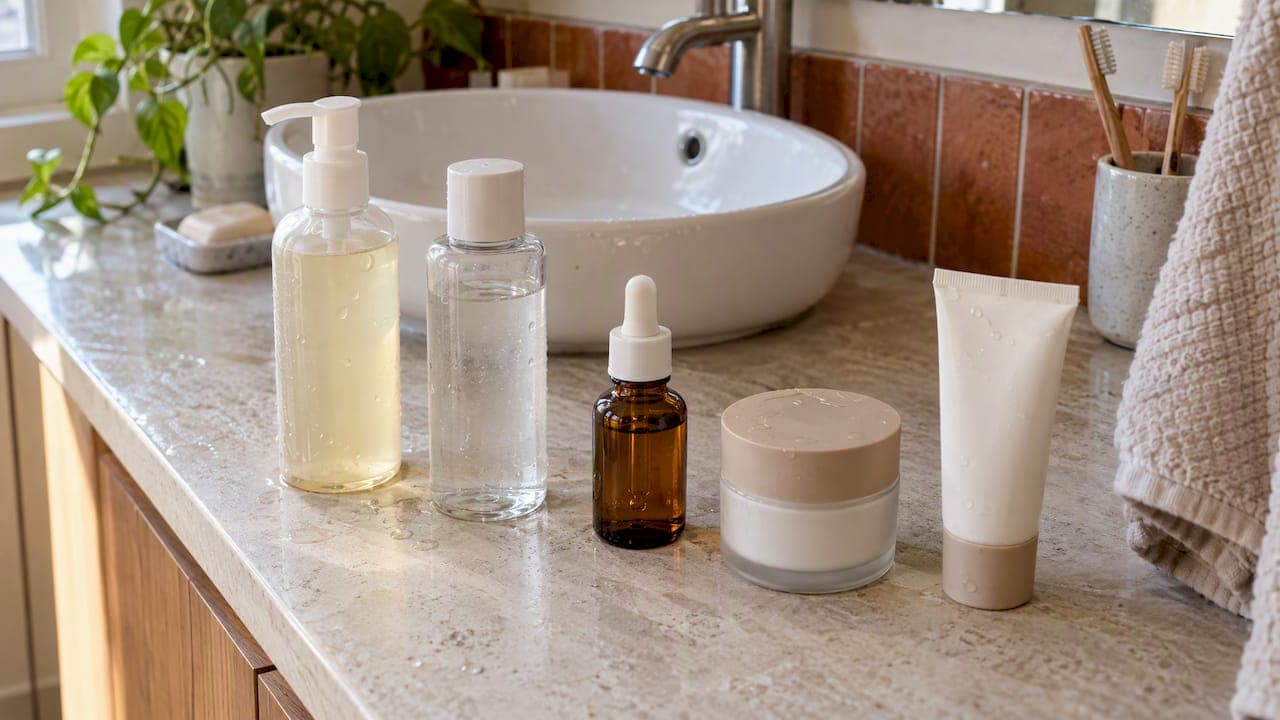
The order of skincare products follows one rule: thinnest to thickest, with sunscreen last in the morning. Cleanse first, then toner, then serum, then moisturizer, then oil if used. Sunscreen goes on top by day. The sequence is the same for every skin type. What changes is how many steps you use.
This guide gives the full order for morning and night. It also answers the common questions: toner before or after serum, serum before moisturizer, where oil, masks, eye cream and retinoids fit, and how to shorten the routine for sensitive skin.
TL;DR
- Order: cleanser, toner, serum, eye cream (optional), moisturizer, face oil (optional), sunscreen (morning only).
- Toner goes before serum. Serum goes before moisturizer. Oil goes after moisturizer.
- Treatments such as retinoids go on right after cleansing, per dermatologist guidance. Vitamin A products are a night step.
- Sensitive skin needs fewer steps, not more. Cleanser, moisturizer and sunscreen is a complete routine.
- Masks and exfoliators are weekly steps. They go after cleansing and before toner.
Table of Contents
- The correct order of skincare products, step by step
- Morning skincare order
- Evening skincare order
- Where retinoids and other treatments fit
- Quick answers to the order questions
- How to adjust the order for sensitive skin
- Common mistakes
- Perspective
- Build your routine with Yuka+Face
- FAQ
- Sources
The correct order of skincare products, step by step
Most routines come down to the same sequence. Each step has one job, and each layer must be able to reach the skin. Water-based and lightweight products go first. Creams and oils go later, because they form a layer that blocks what is applied after them.
| Step | Product | Morning | Night |
|---|---|---|---|
| 1 | Cleanser | Yes | Yes (oil cleanser first if wearing sunscreen or makeup) |
| 2 | Exfoliator or mask | No | 1 to 3 times a week |
| 3 | Toner or essence | Optional | Optional |
| 4 | Serum or treatment | Antioxidant serum | Active serum or retinoid |
| 5 | Eye cream | Optional | Optional |
| 6 | Moisturizer | Yes | Yes |
| 7 | Face oil | Optional | Optional |
| 8 | Sunscreen | Yes, always last | No |
A 2025 review of skin routines lists the same core: cleanse, an active serum if used, optional eye cream, moisturizer and sunscreen in the morning, with vitamin A products at night. Everything beyond that is an add-on.
Step 1: Cleanser
Cleansing comes first because everything after it needs clean skin. Use a gentle cleanser and pat dry, as the American Academy of Dermatology advises.
At night, many people double cleanse: an oil-based cleanser to lift sunscreen and makeup, then a water-based cleanser. Our double cleansing guide covers the method. The Vitamin C Cleansing Oil and B3 Gentle Cleanser are built for that two-step pairing.
In the morning, a single gentle cleanse or a water rinse is enough for many skin types.
Step 2: Exfoliator or mask (weekly)
Exfoliators and masks are not daily steps. On the nights you use them, they come right after cleansing and before toner and serum. The skin is clean, so the mask makes full contact. Rinse off, pat dry, then continue.
Mask before or after serum? Before. A rinse-off mask goes on right after cleansing, then serum and moisturizer follow to replace what the mask took off. A leave-on sleeping mask is the exception: it works as a moisturizer, so it goes last.
Step 3: Toner or essence
Toner before or after serum? Before. A toner is thin and water-based. Put it on after cleansing, while skin is still slightly damp, and it prepares skin for the serum. Applied after a serum, it would dilute the serum, and a moisturizer would sit on top of it.
Toner is optional. Skip it in the morning if you want a shorter routine. If you use one, choose a hydrating formula. The Lavender Essence Balancing Toner is one example.
Step 4: Serum or treatment
Serums are concentrated formulas for a specific goal: hydration, brightness, firmness or dark spots. They are lightweight, so they go before moisturizer.
The usual split:
- Morning: an antioxidant serum such as vitamin C, which sits under sunscreen.
- Night: a repair or active serum, such as a peptide serum, or a retinoid.
If you use more than one serum, apply the thinnest first. Using one serum at a time is a sound choice. Our peptides in organic skincare article explains where peptide formulas fit.
Step 5: Eye cream
Eye cream is optional. It goes after serum and before moisturizer, since eye creams are usually richer than serums but lighter than a face cream. Dermatologists suggest using the ring finger, the weakest finger, so you do not pull the delicate skin. A light eye serum, like the Bright Eyes Peptide Serum, takes the place of both steps for many people.
Step 6: Moisturizer
Moisturizer seals in what you have applied. It goes after serums and eye products. Moisturize in the morning and at night, whatever your skin type. Oily skin needs a lighter gel or lotion, not no moisturizer.
Our layering guide suggests waiting 30 to 60 seconds between serum and moisturizer, so the serum settles before the next layer.
Step 7: Face oil
Oil before or after moisturizer? After, in most cases. Oil is an occlusive layer. It slows water loss and holds the moisturizer in. Under a cream, it blocks the cream from reaching the skin. Dry skin can use two or three drops pressed over the moisturizer at night. Oily skin can skip oil or use it only on dry patches.
There is one exception. Mixing one drop of oil into a moisturizer, or using a light oil as the only moisturizer, is also fine. Face oil vs cream is a question of texture: a cream adds water and softness, an oil seals. Many routines use both. The Vitamin C Glow Oil fits this last step.

Step 8: Sunscreen (morning only)
Sunscreen is the final skincare step in the morning. It forms a film on the surface, so nothing goes over it except makeup. Dermatologists place it with moisturizer, before makeup, as in the AAD order. If your moisturizer already contains SPF, you can combine those two steps. Our aging skin routine puts SPF 30 or higher first, then adds retinoids slowly. Do not forget the neck: see the neck skincare routine.
Morning skincare order
Morning is about protection.
- Rinse or cleanse gently.
- Toner, if you use one.
- Antioxidant serum, such as vitamin C.
- Eye cream, if you use one.
- Moisturizer.
- Sunscreen.
Six steps is the maximum. Three (cleanser, moisturizer, sunscreen) is enough. Our morning skincare checklist and the morning skin care routine article go deeper into each step.
Evening skincare order
Night is about cleaning and repair, because skin is not exposed to UV.
- Oil cleanser, to remove sunscreen and makeup.
- Water-based cleanser.
- Exfoliator or mask, on the nights you use one.
- Toner, if you use one.
- Serum or retinoid.
- Eye cream.
- Moisturizer.
- Face oil, if skin is dry.
See the evening skincare ritual for pacing and habits.
Where retinoids and other treatments fit
The AAD tells readers to apply medication or other treatment right after cleansing, before moisturizer. Prescription products follow the instructions of the prescriber, so ask your dermatologist if the order they gave you differs.
For over-the-counter retinol, GoodRx's retinol guide says to apply it after cleansing once skin is fully dry, then moisturizer. It also says to start once or twice a week, use it at night only, and pair it with moisturizer because retinoids can cause dryness and irritation. Because retinoids can make skin more sensitive to sun, sunscreen the next morning matters.

A simple way to combine actives: vitamin C in the morning, retinol at night. That keeps them from competing for the same step.
Quick answers to the order questions
| Question | Answer |
|---|---|
| Toner before or after serum? | Before |
| Serum or moisturizer first? | Serum first |
| Oil before or after moisturizer? | After |
| Mask before or after serum? | Before, for rinse-off masks |
| Eye cream before or after moisturizer? | Before |
| Sunscreen before or after moisturizer? | After |
| Retinoid before or after moisturizer? | Before, right after cleansing |
How to adjust the order for sensitive skin
Sensitive skin responds to fewer products. Each added step is another chance for irritation, and a long routine makes it hard to tell which product caused it.
- Start with three steps: gentle cleanser, moisturizer, sunscreen. Add one product at a time, a week or two apart.
- Choose fragrance-free. The AAD recommends fragrance-free, not just unscented, for skin that reacts. Its rosacea guidance also says to choose a cream over a lotion or gel, and to avoid astringents and toners. If your skin reacts easily, skip toner until you know it is tolerated.
- Test new products. Try a small area before the face.
- Keep actives separate. Use one active at a time, on alternating nights.
- See a dermatologist if you have rosacea, eczema or persistent redness. They can tailor the sequence to the condition.
Our minimal skincare routine and the starter routine show how short a complete routine can be. For teens, the 3 step teen routine does the same.
Common mistakes
- Heavy before light. A cream applied before a serum stops the serum from absorbing.
- Sunscreen under moisturizer. Sunscreen goes on top.
- Too many actives at once. Stacking acids, retinoids and vitamin C is the fastest way to irritation.
- Rubbing. Pat products in. Press, do not drag.
- Changing everything at once. Introduce one new product at a time.
Perspective
We build routines around one idea: fewer steps, short ingredient lists, and the right order. Order matters because every layer meets the skin in turn. A thin serum placed under a cream can reach the skin. The same serum placed over a cream mostly stays on the surface.
That is why our range is organized by step: cleansers, toners, serums, oils, moisturizers and masks. Each is formulated to take one place in the sequence. Our formulas are vegan, cruelty-free and designed for all skin types and ages, with a focus on barrier support and sensitive skin.
Our approach is what we call unbothered skin. Choose a few well-made products, use them in the correct order, and do it consistently. A three-step routine used every day is worth more than a twelve-step routine used when time allows.
Kelly
Build your routine with Yuka+Face
Yuka+Face makes vegan, cruelty-free skincare for each step in this order: cleansers, toners, serums, oils, moisturizers and masks. Start with a cleanser and a moisturizer, then add a serum. Browse the full shop or see moisturizers and masks for dry skin.

Gift cards start at $50 on the shop page. For a wider look at plant-based formulas, read our guide to vegan skincare.
FAQ
What is the correct order of skincare products?
Cleanser, toner, serum, eye cream, moisturizer, face oil, then sunscreen in the morning. The principle is thinnest to thickest. Treatments such as retinoids go on directly after cleansing.
Do I apply serum or moisturizer first?
Serum first. Serums are lightweight and need direct contact with the skin. Moisturizer then seals them in. Wait a short time between the two so the serum can settle.
Does toner go before or after serum?
Before. A toner is thin and water-based, so it prepares skin for the serum. If you have rosacea or very reactive skin, the AAD advises avoiding toners and astringents, so a gentle cleanser and moisturizer may be enough.
Is the order the same morning and night?
The order is the same, but the products differ. Mornings use an antioxidant serum and finish with sunscreen. Nights add an oil cleanser, masks or exfoliators, and retinoids. Sunscreen is not needed at night.
How many products do I actually need?
Three: cleanser, moisturizer and sunscreen. Add a serum for a specific concern. More steps help only if your skin tolerates them and you will use them consistently.
Sources
- AAD: Should I apply my skin care products in a certain order?
- AAD: 7 rosacea skin care tips dermatologists recommend
- GoodRx: When to use retinol and how to use it
- Is There an Ideal Skin Routine? (ASCPD, 2025)