Fair trade ingredients are raw materials bought under a certified set of trading rules. The rules include a minimum price, an extra premium paid to the producer community, and audited working conditions. In skincare this most often applies to shea butter, cocoa butter and plant oils. A fair trade claim is only as strong as the certifier behind it. This guide explains what each label verifies, where shea fits in, and how to read an ingredient claim on a product page.
TL;DR
- Fair trade certification verifies trading terms between buyer and producer: a price floor, a community premium and audited conditions. It is not an organic, vegan or cruelty-free claim.
- In the US, the main programs are Fair Trade USA and Fairtrade International. Each sets its own rules for how much certified content a product needs.
- Shea butter is the best-known fair trade skincare ingredient. Research shows certification helps, and also shows that producer returns vary.
- A named certifier, a percentage and a specific ingredient make a claim checkable. "Ethically sourced" alone does not.
Table of Contents
- What fair trade means for skincare ingredients
- What certification verifies
- Label types and how much fair trade content is required
- Fair trade shea butter
- Other skincare ingredients where fair trade can apply
- How to check a fair trade ingredient claim
- Our perspective
- Shop vegan, cruelty-free, organic skincare
- FAQ
- Sources
What fair trade means for skincare ingredients
Fair trade began with food. Coffee, cocoa and bananas came first. Cosmetics followed because many skincare ingredients are agricultural crops: butters, oils, sugars, flowers and botanical extracts.
In skincare, "fair trade" refers to how a crop was bought. It does not describe how the finished product performs. It does not describe how the crop was grown or processed either.
Fair Trade USA describes its standards as covering a guaranteed minimum price, safe working conditions, elimination of forced and child labor, fair compensation, environmental protections and traceability. It also lists additional compensation through community development funds.
The term is used in two ways, and they should be kept apart:
- Certified fair trade. A third-party program audits the supply chain and licenses the label.
- Fair trade as a general description. A brand uses the words to describe its own buying practice, with no outside license.
Only the first can be checked against a public standard.
What certification verifies
Two programs matter most to US shoppers.
Fair Trade USA
Fair Trade USA's Agricultural Production Standard, effective January 1, 2022, sets out several requirements:
- Minimum prices and the Fair Trade Premium for certified products, shea included, are set by Fair Trade USA.
- Those figures are published in its Price and Premium Database.
- A Fair Trade Premium Plan must be developed and updated every year before the premium is spent.
Brands and traders have separate obligations. Under the Trade Standard, a licensed trader must:
- pay the premium and the minimum prices;
- keep products traceable through regular transaction reporting;
- comply with applicable labor and environmental laws.
Fairtrade International
Fairtrade International runs the Fairtrade Mark. Its label guide says a cosmetic carrying the mark alongside the words "contains Fairtrade ingredients" has sourced every ingredient available as Fairtrade according to Fairtrade Standards.
Its cosmetics formulation policy goes further. Any ingredient for which a Fairtrade standard exists must come from Fairtrade certified producers. Licensees are expected to use the highest possible levels of Fairtrade ingredients.
What a certificate does not tell you
A certificate confirms that trading conditions were met when the audit took place. It does not confirm:
- how the ingredient was processed;
- which cooperative produced a given batch;
- whether the formula is organic, vegan or cruelty-free.
Those are separate claims with separate certifiers. The certification checker on our blog covers how to verify each one. The cruelty-free and vegan guide covers the animal-related labels.
Label types and how much fair trade content is required
A "fair trade" label on a bottle can mean very different things. The percentages decide which one it is.
| Label | What it signals | Minimum certified content |
|---|---|---|
| Full Fair Trade Certified label (Fair Trade USA) | Whole product made from certified content | 100 percent |
| Ingredients label (Fair Trade USA) | Named ingredients certified within a multi-ingredient product | At least 20 percent certified content, 100 percent certification of any certified ingredient used, and certification of all certifiable ingredients when commercially available |
| Fairtrade Mark on a composite product (Fairtrade International) | Product with several Fairtrade ingredients | 20 percent total Fairtrade content, though many companies go higher |
| White Ingredient Mark (Fairtrade International) | One named ingredient is Fairtrade sourced | Applies to the ingredient on the tab |
The Fairtrade guide notes that detailed information sits on the back of the pack. Skincare formulas are composite products. A moisturizer might contain one certified butter and a long list of other ingredients. The label then speaks for the butter, not for the whole jar.
Leave-on and wash-off products
Fairtrade International splits cosmetics into two categories, each with its own minimum Fairtrade content:
- Category 1, leave-on: lotions, creams, butters, balms, oils, scrubs and masks.
- Category 2, wash-off: shampoos, conditioners, bath gels, soaps, toothpaste and perfume.
Most facial skincare falls in the first group. A serum, an oil or a mask is judged by the leave-on rule.
Fair trade shea butter

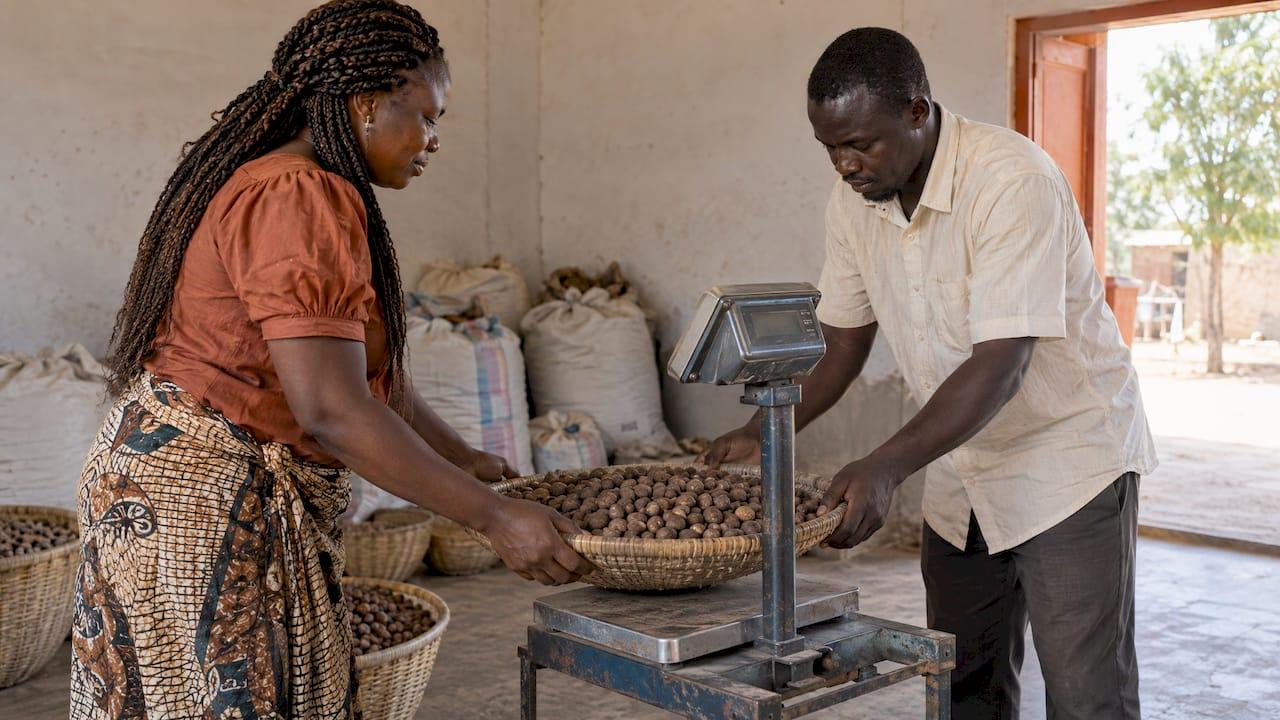
Shea butter is the ingredient most people mean when they search for fair trade in skincare. Shea trees grow across the West African savanna. The nuts are traditionally gathered and processed by women, and the butter is then sold into the cosmetics trade.
Three things explain why shea became the standard example.
- The workforce is mostly women's cooperatives. Certification premiums can reach groups that have limited access to other income.
- Demand comes from abroad. The butter is sold to buyers in Europe and North America, so buyer terms matter a great deal.
- Programs have scaled. A 2020 INSEAD Knowledge article reports that one supplier-led program in Burkina Faso grew from around 2,000 women to more than 50,000 by 2015. By June 2020 it had more than 300,000 women enrolled across Burkina Faso, Ghana, Ivory Coast and Nigeria. In a survey, 73 percent of enrollees said rocket stoves saved them time.
Certification also opens markets. A UNDP report from Northern Ghana describes a women's shea organization that gained Ecocert fair trade certification so it could sell shea products internationally. Its members include 244 shea producers and 3,000 shea pickers across 14 communities in the Kumbungu district.
A balanced reading of the evidence
The academic record is more mixed than marketing is. A 2013 peer-reviewed study in Sociologia Ruralis by Elias and Saussey looked at fair trade shea butter made by women in Burkina Faso. The butter is sold in Europe and North America as an exotic, traditional and ethical product. The authors found that the low returns to producers raise questions about how far fairness and solidarity actually reach.

The practical conclusion is that certification is a floor, not a ceiling. It sets a minimum price and a premium that must be spent on a plan. How much a given community gains still depends on volumes, processing and buyer commitments over time. Buyers who want the strongest sourcing look for a certifier plus details about the specific cooperative.
For how shea behaves on the skin, including the difference from cocoa butter, see our shea versus cocoa butter comparison.
Other skincare ingredients where fair trade can apply
Fair trade standards are written for crops and commodities. In skincare, the ingredients that most often fit that description are:
- shea butter;
- cocoa butter;
- plant oils;
- sugars used in scrubs;
- flowers and herbs used in extracts.
Whether a given ingredient is available as certified depends on the supply chain. The Fairtrade cosmetics policy ties its rule to this availability: only ingredients for which a Fairtrade standard exists must come from certified producers. A formula can therefore carry a fair trade claim for one butter and make no claim about the rest.
This is why the ingredient list matters more than the front label. A short list is easier to audit. Each item can be matched to a certificate, an organic seal or a plain description. Our post on organic ingredients in skincare explains how the same logic applies to organic claims.
How to check a fair trade ingredient claim
A claim is credible when it can be traced to a named program. Use this checklist.
- Find the certifier. Look for the Fair Trade Certified label, the Fairtrade Mark or a named cooperative certification. A phrase with no logo is a description, not a certificate.
- Read the scope. Is the claim about the whole product or one ingredient? The white Ingredient Mark and the Fair Trade USA Ingredients label cover named ingredients only.
- Check the percentage. The label may state how much of the product is certified. Compare it with the thresholds in the table above.
- Search the license. Fair Trade USA and Fairtrade International both operate licensing systems for brands and traders. A brand that holds a license can show its certificate on request.
- Look for supplier detail. The cooperative name, the country and the year of purchase make a claim specific.
- Treat vague wording with care. Terms such as "ethically sourced" or "sustainably harvested" have no single standard behind them unless a certifier is named. They are a prompt to look for more detail.
Our ethical sourcing buyer's guide goes through the same questions for the full supply chain. The overview of ethical skincare puts them alongside packaging and animal testing.
Fair trade next to other claims
A product can carry several seals. Each answers a different question:
| Claim | Question it answers |
|---|---|
| Fair trade | How was the ingredient bought, and what did producers receive? |
| Organic | How was the crop grown? |
| Vegan | Does the formula contain animal-derived ingredients? |
| Cruelty-free | Was the product or its ingredients tested on animals? |
Cruelty-free verification has its own steps. See how to verify cruelty-free certification.
Our perspective
Fair trade asks a fair question: who grew the ingredient, and what did they receive for it? We think shoppers should keep asking it.
We also think the question works best when the answer is easy to find. Our formulas are vegan, cruelty-free and built on certified organic ingredients, with short, transparent ingredient lists. We hold Leaping Bunny certification. A short list lets a shopper read every ingredient and look up each claim attached to it.
Our approach is the unbothered skin philosophy: fewer steps, fewer ingredients, a clear purpose for each. Barrier repair and sensitive skin guide the formulas. That focus keeps the list short and the sourcing questions manageable.
Skincare is a chain of choices, from the farm to the jar to the package. Certifications are useful tools at each stage. They are strongest when a shopper knows which question each one answers.
We build for all skin types and ages, with plant-based ingredients that respect people, animals and the planet. Clear labeling is part of that.
Kelly
Shop vegan, cruelty-free, organic skincare
Yuka+Face makes vegan, cruelty-free, natural skincare with short ingredient lists. The range covers cleansers, toners, serums, oils, moisturizers and masks, for all skin types and ages.
Browse the full range in the Yuka+Face shop. For dry skin, see the moisturizers and masks. Gift cards start from $50.
FAQ
Is fair trade the same as organic?
No. Fair trade covers the terms of trade: minimum price, community premium and working conditions. Organic covers how the crop was grown. A product can hold one, both or neither, and each needs its own certificate.
What makes shea butter fair trade?
The shea must be bought from certified producer groups under the program's rules. For Fair Trade USA, that means set minimum prices and a premium that is spent under an annual plan. Buyers and traders must also report transactions so products stay traceable.
Does a fair trade label mean every ingredient in the product is fair trade?
Not necessarily. A Fair Trade USA Ingredients label requires at least 20 percent certified content, and the Fairtrade Mark on composite products has the same 20 percent minimum. Full-label products must be 100 percent certified. Check whether the label names the ingredient or covers the whole product.
How can a shopper confirm a fair trade claim?
Look for a named certifier and its logo, then read the ingredient list for which items are covered. Fair Trade USA and Fairtrade International both license brands, so a genuine license holder can be verified through the program. A claim with no certifier named is a description only.
Are fair trade and cruelty-free the same thing?
No. Fair trade concerns people and trading terms. Cruelty-free concerns animal testing. Leaping Bunny is an example of a cruelty-free program, and it is separate from fair trade programs.
Sources
- Fair Trade USA, Agricultural Production Standard
- Fair Trade USA, brand and trader licensing
- Fair Trade USA, Fair Trade Certified sourcing program
- Fairtrade International, how the label works
- Fairtrade International, cosmetics and personal care formulation policy
- 3BL Media, Fair Trade USA redesigned certification label
- Sociologia Ruralis, study of fair trade shea butter in Burkina Faso
- INSEAD Knowledge, transforming a supply chain into a social enterprise
- UNDP Ghana, women shea producers and international certification