
Ethical sourcing means selecting raw materials, processing methods, packaging, and supplier practices that meet defined standards for labor rights, environmental stewardship, animal welfare, and supply-chain transparency. For natural, vegan, and cruelty-free skincare buyers, that definition has direct implications: it determines whether an ingredient was harvested without child labor, whether a botanical extract was processed without harming ecosystems, and whether a cruelty-free claim holds at every supplier tier, not just at the finished-product stage.
Key signals of an ethical sourcing program:
- A published supplier code of conduct with social and environmental clauses
- Third-party certifications such as Fair Trade USA, Leaping Bunny, or USDA Organic
- Regular supplier audits with corrective-action records
- Publicly available supply-chain data or a transparency report
Table of Contents
- What does ethical sourcing cover across a skincare supply chain?
- Core principles: how to judge whether sourcing is ethical
- How do brands prove ethical sourcing?
- How to spot greenwashing in ethical sourcing claims
- What ethical sourcing looks like inside credible skincare companies
- Practical steps for assessing ethical sourcing on labels and brand pages
- How ethical sourcing affects formulation and efficacy
- Key Takeaways
- The case for taking sourcing seriously
- Yuka+Face: natural, cruelty-free, and vegan skincare
- Useful sources
- FAQ
What does ethical sourcing cover across a skincare supply chain?
A skincare product passes through several distinct stages before it reaches you, and responsible sourcing applies at every one of them.
Raw material farming and harvest. Botanical ingredients like shea butter, palm oil, and mica originate at farms, cooperatives, or mines. Labor conditions, land rights, and environmental practices at this stage carry the highest risk.
Ingredient processing and extraction. A grower may meet fair-labor standards while a downstream processor uses unsafe solvents or dumps wastewater. Processing facilities need their own audits.
Formulation and contract manufacturing. The brand or its toll manufacturer combines ingredients. Ethical sourcing here covers worker safety, waste management, and ingredient traceability into the finished formula.
Packaging. Materials sourced from certified forests, recycled streams, or responsibly managed suppliers reduce the environmental footprint of the final product.
Distribution and logistics. Carbon footprint, freight conditions, and regional compliance round out the chain.
"Ethical sourcing is not just an initial procurement step but an ongoing oversight process — communicating expectations and the plan for reporting and oversight ensures the whole supply chain is on the same page." — FSC
Ingredient-level risks make this concrete. Mica, used in luminizing skincare products, has documented child-labor risks in certain mining regions. Palm oil, common in emollients and cleansers, is linked to deforestation when sourced outside RSPO-certified channels. Shea butter cooperative pay structures vary widely, and without traceability data, a brand cannot confirm that farmers received fair compensation. Understanding the full lifecycle of sustainable beauty helps connect these supply-chain stages to the products on your shelf.
Core principles: how to judge whether sourcing is ethical
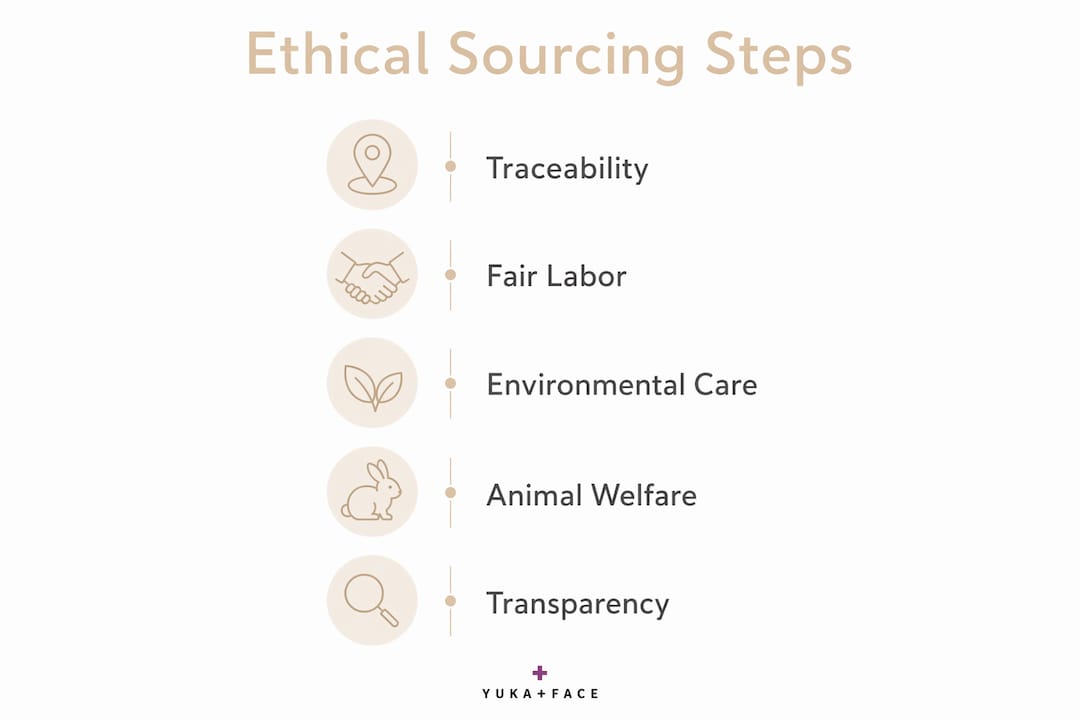
Traceability and chain of custody. A brand should be able to name the country of origin for each key ingredient and, ideally, the specific farm or cooperative. Without that data, no other claim is verifiable.
Fair labor and living wages. This covers safe working conditions, freedom of association, and pay above subsistence level. For skincare, it applies most critically to agricultural workers and mine laborers.
Environmental stewardship. Regenerative farming, responsible water use, and minimal chemical runoff protect the ecosystems that produce botanical actives. Sustainable sourcing practices also protect long-term ingredient availability.

Animal welfare. Cruelty-free status must extend to ingredient suppliers, not just the brand's own lab. Leaping Bunny certification covers the full supply chain for animal-testing prohibitions.
Transparency and governance. Published sourcing policies, audit results, and supplier lists are the evidence layer. Without them, ethical claims rest on marketing copy alone.
Ethical sourcing practices also carry real costs. Certified ingredients command price premiums. Third-party audits require fees and staff time. Supplier development programs add overhead. When a natural skincare product costs more than a conventional alternative, a portion of that difference often funds these mechanisms. Proactive ethical sourcing generally delivers long-term operational gains and stronger consumer trust compared to reactive programs that respond only after a crisis.
How do brands prove ethical sourcing?
Certifications vary significantly in scope. The table below maps the most common ones to what they actually cover.
| Certification | What it covers | What it doesn't cover |
|---|---|---|
| Fair Trade USA | Fair wages, safe conditions, community premiums for farmers and workers | Environmental practices, animal testing |
| USDA Organic | Organic farming standards, no synthetic pesticides | Labor rights, animal testing, packaging |
| Leaping Bunny | No animal testing at any supply-chain tier | Organic status, labor rights, environmental impact |
| RSPO | Sustainable palm oil production, deforestation controls | Other ingredients, labor rights beyond minimum standards |
| B Corp | Holistic corporate social and environmental performance | Ingredient-level traceability, specific supply-chain audits |
| COSMOS | Natural and organic cosmetic ingredient and formulation standards | Labor rights, animal testing beyond EU law |
| Rainforest Alliance | Forest and farm sustainability, biodiversity, worker welfare | Animal testing, packaging, non-agricultural inputs |
Beyond certifications, credible brands publish supplier lists or regional sourcing maps, share third-party audit summaries, use chain-of-custody systems to track ingredients from origin to formula, and conduct independent lab testing on finished products. A supplier code of conduct with explicit contractual clauses is a stronger signal than a general mission statement.
Pro Tip: When reading a brand's transparency report, look for audit frequency (annual is the minimum), corrective-action records (problems found and fixed are a good sign, not a red flag), and whether supplier names or at least regions are disclosed. A report that lists only positive outcomes with no corrective actions is likely incomplete.
How to spot greenwashing in ethical sourcing claims
Vague language is the most common pattern. "Ethically sourced ingredients" printed on packaging with no supporting data is a marketing claim, not a verified standard. The same applies to "sustainably harvested" or "responsibly produced" without a named certifier or audit.
"There is no single globally codified standard of 'ethical' — companies typically publish their own supplier code of conduct and monitoring approach, and that is often more indicative than a single marketing claim." — IBM
Red flags to watch for:
- No published sourcing policy or supplier code of conduct on the brand's website
- A single certification applied to the whole product line when it only covers one ingredient
- Photo-based storytelling (farm imagery, community photos) without traceable supplier data
- Inconsistent country-of-origin claims across product pages
- Refusal to share audit results or corrective-action records when asked directly
Research shows consumers favor proactive sourcing programs over reactive ones. Brands that respond to sourcing scandals with sudden transparency are viewed as less credible than those with sustained, documented programs. Knowing how "clean beauty" claims overlap with and differ from ethical sourcing claims helps cut through the noise — the clean beauty guide at Yuka+Face covers that distinction.
What ethical sourcing looks like inside credible skincare companies
A genuine program follows a clear sequence. It starts with a written policy that sets non-negotiable social and environmental standards. Supplier selection then screens candidates against those criteria before any contract is signed. Contracts include explicit clauses covering labor rights, environmental compliance, and audit access.
"Supply-chain experts identify improved resiliency as the biggest long-term business benefit of ethical sourcing: visibility into suppliers reduces blind spots and enables faster pivots during disruptions." — TechTarget
Ongoing monitoring uses scheduled audits and unannounced spot checks. When audits surface problems, a corrective-action plan with deadlines replaces the supplier only as a last resort. Proactive programs go further: they invest in supplier capacity building, offering training, financing, or technical support so suppliers can meet higher standards over time.
This approach differs sharply from reactive programs that add audits only after a public incident. Proactive supplier partnerships also improve supply continuity: a brand with deep visibility into its ingredient origins can pivot faster when a harvest fails or a region faces instability.
Practical steps for assessing ethical sourcing on labels and brand pages
- Check certified seals. Look for Fair Trade USA, Leaping Bunny, USDA Organic, RSPO, COSMOS, or Rainforest Alliance logos and verify them on the certifier's public database.
- Read the sourcing policy. A credible policy names specific standards, audit frequency, and corrective-action processes.
- Ask for country of origin. Email the brand: "Can you confirm the country of origin for [ingredient]?" A specific answer signals real traceability.
- Look for supplier transparency. Published supplier lists or regional sourcing maps are a strong indicator of an integrated program.
- Prefer brands with independent audits. Self-reported data is weaker than third-party audit summaries.
On price: a higher price is a credible premium when it correlates with named certifications, published audits, and traceable ingredients. A markup with no supporting documentation is not. The sustainable skincare routine guide offers practical help connecting these sourcing checks to daily product choices.
How ethical sourcing affects formulation and efficacy
Ethically sourced ingredients tend to be higher quality at the point of formulation. Organic-certified botanicals, harvested under controlled conditions with no synthetic pesticide residue, deliver cleaner active profiles. Shea butter from certified cooperatives is often less refined than commodity-grade alternatives, preserving more of its natural fatty acids and vitamins. Mica sourced through verified, responsibly managed supply chains avoids contamination from unregulated mining sites.
The traceability that ethical sourcing requires also gives formulators better data. Knowing the exact origin and processing method of an extract allows a brand to select the batch with the highest active concentration rather than accepting whatever commodity supply is cheapest. That specificity translates directly into more consistent product performance.
Key Takeaways
Ethical sourcing for skincare covers every supply-chain stage from raw material farming through packaging, and the strongest proof is a combination of named certifications, third-party audits, and published supplier data.
| Point | Details |
|---|---|
| Definition scope | Ethical sourcing covers raw materials, processing, formulation, packaging, and supplier practices. |
| Top trust signals | Look for Fair Trade USA, Leaping Bunny, USDA Organic, RSPO, COSMOS, and published audit records. |
| Top red flag | Vague claims like "ethically sourced" with no certifier, audit, or country-of-origin data. |
| Buyer's top action | Verify certifications on the certifier's public database and ask brands directly for country-of-origin data. |
| Yuka+Face | Yuka+Face products are 100% natural, cruelty-free, and vegan, with sourcing commitments grounded in those standards. |
The case for taking sourcing seriously
Ethical sourcing gets treated as a marketing checkbox far too often. The brands that do it well rarely lead with it in advertising. They publish corrective-action records, name their supplier regions, and update their transparency reports annually, even when the updates include problems found and fixed.
The conventional wisdom says consumers can't tell the difference between a certified program and a well-designed label. That's wrong. Shoppers who know to check the Leaping Bunny database, cross-reference RSPO membership, or simply email a brand for country-of-origin data can separate genuine programs from surface-level claims in under five minutes.
The deeper point: ethical sourcing is not just about values alignment. It produces better ingredients, more consistent formulas, and brands with the supply-chain resilience to keep delivering those formulas when commodity markets shift. For natural and vegan skincare specifically, where ingredient quality is the product, sourcing integrity and formulation quality are the same thing.
Yuka+Face: natural, cruelty-free, and vegan skincare
Yuka+Face products are 100% natural, cruelty-free, and vegan, formulated for all skin types and ages using botanical actives selected for both efficacy and sourcing integrity. Every product reflects a commitment to ingredients that are kind to skin and to the planet.
Explore the vegan skincare guide to see how Yuka+Face applies these sourcing principles across its full product range, from cleansers and serums to multi-step routines.
Useful sources
- Fair Trade USA — Certifies fair wages, safe conditions, and community premiums for farmers and workers.
- USDA Organic — Sets organic farming standards covering pesticide use and agricultural practices.
- Leaping Bunny — Certifies no animal testing at any supply-chain tier, not just the finished product.
- RSPO — Roundtable on Sustainable Palm Oil; certifies sustainable palm oil production and deforestation controls.
- B Corp — Certifies holistic corporate social and environmental performance across business operations.
- COSMOS — Sets natural and organic standards for cosmetic ingredients and formulations.
- Rainforest Alliance — Certifies farm and forest sustainability, biodiversity protection, and worker welfare.
- CIPS Ethical Sourcing — Procurement guidance on supplier codes of conduct, risk analysis, and worksite assessments.
- FSC Ethical Sourcing Guide — Explains chain-of-custody certification and the difference between ethical, sustainable, and responsible sourcing.
Note on certification scope: each certification covers a defined set of criteria. A Leaping Bunny seal does not confirm organic farming; a USDA Organic seal does not confirm cruelty-free testing practices. Always check what a specific certification covers before treating it as proof of a broader ethical claim.
FAQ
What is ethical sourcing in skincare?
Ethical sourcing in skincare means selecting ingredients, processing methods, and packaging that meet defined standards for labor rights, environmental stewardship, animal welfare, and supply-chain transparency across every supplier tier.
Which certifications matter most for vegan, cruelty-free skincare?
Leaping Bunny covers animal-testing prohibitions across the full supply chain; Fair Trade USA addresses fair labor and wages; USDA Organic covers farming practices; RSPO applies specifically to palm oil. No single certification covers all criteria.
How can you tell if an ethical sourcing claim is genuine?
Look for a published supplier code of conduct, third-party audit records with corrective-action notes, and named certifications you can verify on the certifier's public database. Vague claims with no supporting documentation are a red flag.
Does ethical sourcing affect product quality?
Yes. Certified organic botanicals and traceable ingredients typically deliver cleaner active profiles and more consistent potency, giving formulators better data for selecting high-quality batches.
Why do ethically sourced skincare products sometimes cost more?
Certified ingredients carry price premiums, and third-party audits, supplier development programs, and traceability systems all add cost. A higher price tied to named certifications and published audits reflects those real investments.