
The main cruelty-free certifiers to know are Leaping Bunny (Cruelty Free International), PETA, The Vegan Society, and NSF. Confirming a claim takes one step: search the brand on the certifier's official database and check that the program enforces supplier-level checks or independent audits, not just a company promise. A logo alone proves nothing without that backing.
TL;DR:
- The strongest certifications, like Leaping Bunny, require a fixed animal testing cut-off date, supplier-level verification, and independent audits, ensuring ongoing compliance.
- Product-level certifications, such as Vegan Society, only verify that specific items contain no animal ingredients and were not tested on animals, not the entire brand.
- Certification processes demand you verify claims through official databases, clear policies on supplier declarations, and licensed logos to distinguish credible marks from fakes.
- Certifications influence industry practices by pressuring ingredient suppliers to document animal-testing histories, but a missing logo does not prove a brand is not tested on animals.
- Variations in legal bans and certification standards across regions mean a brand's certification may not reflect its practices everywhere, especially when navigating markets like China or the European Union.
Table of Contents
- What Cruelty-Free Certification Actually Covers
- Fixed Cut-Off Dates, Audits, and Why the Details Matter
- How to Verify a Cruelty-Free Claim Before You Buy
- How Brands Get Certified: The Application Process
- Where Cruelty-Free Certification Came From
- Does Certification Actually Change Anything?
- Cruelty-Free vs. Vegan: Two Different Questions
- Cruelty-Free Standards Around the World
- What Critics Point to in Cruelty-Free Certification
- Where Cruelty-Free Certification Is Headed
- Yuka+Face's View on What Certification Should Prove
- Where to Verify Certification Claims Directly
- Sources
- FAQ
What Cruelty-Free Certification Actually Covers
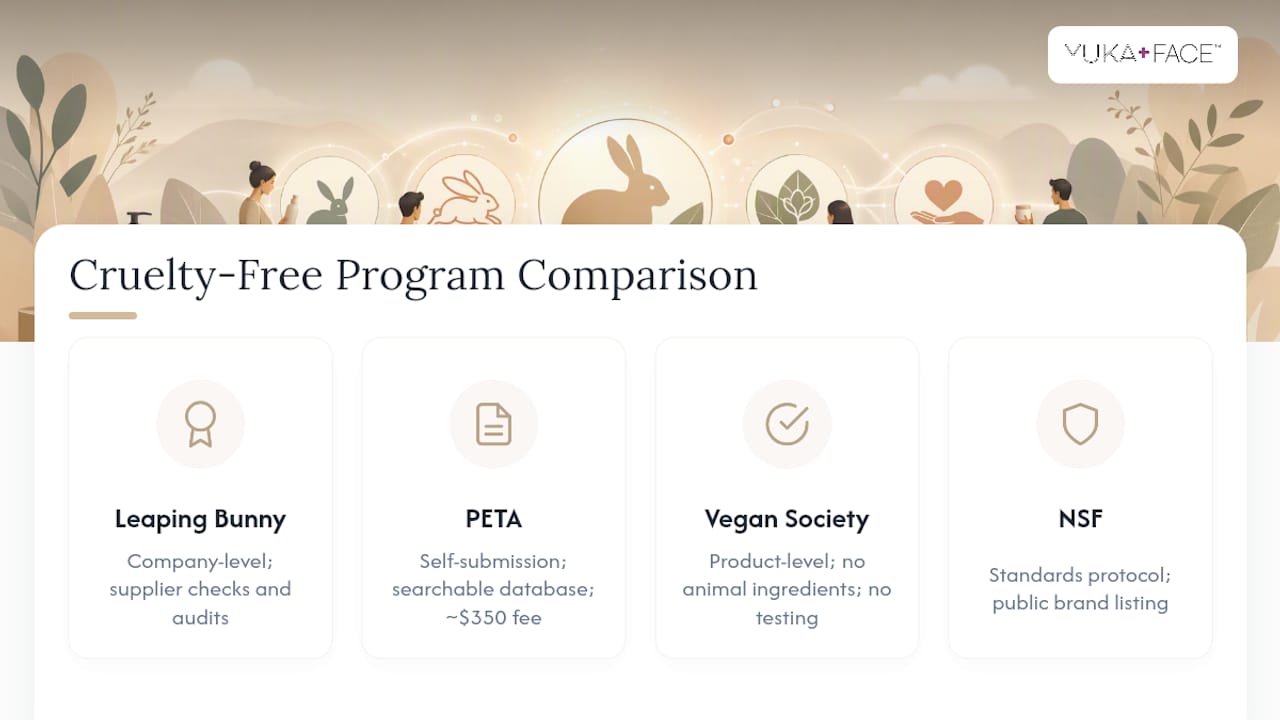
Four programs dominate this space, and each verifies something slightly different.
Leaping Bunny, run by Cruelty Free International, is a company-level standard. That means a certified brand has committed for its entire product line, not just the item you're holding. The program requires a fixed cut-off date, a supplier monitoring system that reaches down to individual ingredient manufacturers, and independent audits to confirm ongoing compliance. It carries broad recognition across North America and Europe.
PETA's Ultimate Cruelty-Free List works differently. Companies self-submit a statement declaring that neither they nor their suppliers test on animals, and PETA maintains a searchable database of the results. PETA offers two designations: animal test–free, and animal test–free plus vegan. Brands can license the bunny logo for a one-time fee, historically near three hundred fifty dollars.
The Vegan Society certifies at the product level rather than the company level. A product bearing its trademark must contain no animal-derived ingredients and must not have been tested on animals, which makes it the most complete option for shoppers who care about both issues at once. A brand can carry Vegan Society certification on one serum while another product in the same line goes uncertified.
NSF Cruelty-Free Certification brings a standards-organization approach with a documented protocol. NSF can pair its cruelty-free review with NSF Vegan Certification, and its process emphasizes public listing so shoppers can verify a claim without guesswork.
Each program publishes its criteria and brand lists publicly. If a certifier can't point you to a page listing exactly what it checks, treat the "certification" with suspicion.
Fixed Cut-Off Dates, Audits, and Why the Details Matter
Not all cruelty-free labels carry equal weight, and the differences show up in three specific places.
The fixed cut-off date is the single strongest signal of rigor. This is the date after which a brand and its ingredient suppliers must not have conducted or commissioned any animal testing. Leaping Bunny requires it explicitly, and Cruelty Free International's Approval Programme treats it as non-negotiable, because a cut-off date closes off the most common evasion: a company that quietly tested a decade ago and now claims cruelty-free status simply by not testing today.
Supplier verification depth separates strong programs from weak ones. Some certifications only ask the finished-product manufacturer to sign a declaration. The stronger ones, including Leaping Bunny, trace commitments down to ingredient manufacturers, which is a meaningfully harder bar to clear because raw-material suppliers are where animal testing most often hides.
Independent audits and renewal cadence tell you whether a certification is a one-time checkbox or an ongoing obligation. Programs requiring annual recommitment and third-party verification catch policy drift; those relying on a single sign-off at enrollment do not.
- Company-level certification (Leaping Bunny) covers an entire brand, including future product launches.
- Product-level certification (The Vegan Society) covers only the specific SKU bearing the mark.
- A parent company can hold a certified subsidiary brand while other divisions test on animals elsewhere, so company ownership always deserves a second look.
Here's the gap that trips up a lot of shoppers: a legal ban on cosmetic animal testing is not the same as certification. Bans frequently carry exemptions for ingredients also used in pharmaceuticals, or for testing required by another country's regulator. Reputable certifications are built specifically to close those loopholes, which is why "legal in this market" and "cruelty-free certified" are two different claims entirely.
How to Verify a Cruelty-Free Claim Before You Buy
Checking a claim takes minutes once you know where to look.
- Search the official database. Leaping Bunny, PETA's Ultimate Cruelty-Free List, and NSF each maintain a public, searchable list. If the brand isn't listed, the logo on the package means less than it looks like.
- Look for a published cut-off date and supplier policy on the brand's own site. Trustworthy brands link directly back to the certifier's criteria rather than just posting a logo image.
- Confirm the logo is licensed, not lifted. A licensed logo typically links to or references the certifying body by name.
- Read the language carefully. Watch for phrases like "finished product not tested on animals" (which ignores ingredient-level testing) or "except where required by law" (which can quietly permit testing in certain markets).
Pro Tip: If a brand's cruelty-free page never mentions a cut-off date or a supplier declaration process, that omission is itself useful information. Credible policies name their standard specifically.
PETA has flagged that, because no universal legal definition of "cruelty-free" exists, self-declared claims without third-party listing are the biggest red flag in the category. When in doubt, cross-reference two databases rather than one, and skim a brand's own cruelty-free routine guidance for what credible sourcing language actually looks like.
How Brands Get Certified: The Application Process
Getting certified is less about paperwork volume and more about supplier coordination, which is almost always the longest phase.
The typical path starts with requesting the certifier's application pack, which lays out exact documentation requirements: full ingredient lists, supplier attestations, standard operating procedures, and safety-data provenance for raw materials. Brands then need to centralize every supplier contact into one compliance folder, because each ingredient manufacturer has to sign a declaration confirming no animal testing occurred after the brand's chosen cut-off date.
- Set the fixed cut-off date first; every other document depends on it.
- Collect signed supplier declarations from ingredient manufacturers, not just finished-product contract manufacturers.
- Submit documentation and prepare for a scheduled audit.
- Budget for annual renewal, since most credible programs require it rather than a one-time sign-off.
Costs vary by certifier and are sometimes published, sometimes not. PETA has historically listed a one-time logo licensing fee near $350; other programs price audits and renewals differently and don't always publish figures publicly. Supplier outreach is consistently the bottleneck, with response and audit scheduling commonly taking several weeks depending on supplier count and the certifier's queue.
Pro Tip: Start supplier outreach the same week you decide to pursue certification, not after your application is drafted. It's the slowest variable in the whole timeline, and brand teams that wait lose months. Brands building out a full sourcing policy may also find it useful to review broader ethical sourcing practices before submitting supplier documentation.
Where Cruelty-Free Certification Came From
The modern cruelty-free movement traces back to growing public objection to animal testing in cosmetics during the 1980s, when consumer advocacy groups began pushing brands to formally commit against it. PETA launched its cruelty-free list in that era, initially as a straightforward company pledge system with little independent verification behind it.
The credibility gap in self-declared claims became obvious fast. Multiple animal-protection groups in the UK and Europe, recognizing that a pledge without a fixed date or supplier check meant almost nothing, eventually consolidated their separate cruelty-free logos into a single unified standard: what became the Leaping Bunny program under Cruelty Free International. That consolidation mattered because it replaced a patchwork of inconsistent regional logos with one recognizable, audited mark.
The Vegan Society took a parallel but distinct path, extending its long-standing vegan trademark (originally focused on food) into cosmetics and personal care once demand grew for products that were both untested and free of animal-derived ingredients.
NSF's entry came later, applying an existing standards-organization model, the same kind used across food safety and water treatment, to cruelty-free verification. That shift signaled something important: cruelty-free claims had moved from advocacy-group territory into the same rigorous, protocol-driven certification space as other consumer-safety standards.
Does Certification Actually Change Anything?
Certification's biggest real-world effect isn't the logo. It's the supply-chain pressure it puts on ingredient manufacturers, who now have to maintain and produce documentation for multiple downstream brand customers asking the same question: has this material been tested on animals recently, and can you prove it?
That pressure compounds. When a raw-material supplier commits to a cut-off date for one client, that same documentation covers every other brand using the same supplier, which is part of why the ingredient side of the industry has shifted faster than finished-product marketing might suggest.
On the shopper side, certification changes buying behavior mostly by removing ambiguity rather than by manufacturing new demand. Consumers who already care about animal testing get a fast, low-effort way to confirm a claim instead of trusting marketing copy, and that speed matters. A shopper standing in an aisle or scrolling a product page isn't going to research a brand's testing history from scratch; a recognizable, database-backed logo turns a research task into a five-second check.
The limitation is real too: certification only reaches brands that choose to apply. Plenty of companies that genuinely don't test on animals never bother pursuing formal certification, which means the absence of a logo isn't proof of animal testing, just proof that a brand hasn't gone through the verification process.
Cruelty-Free vs. Vegan: Two Different Questions
These two labels get treated as synonyms constantly, and that's a mistake worth correcting directly.
Cruelty-free addresses only one question: was this tested on animals, at any stage, by the brand or its suppliers? A product can be fully cruelty-free and still contain animal-derived ingredients like beeswax, lanolin, or carmine.
Vegan addresses ingredients, not testing. A product can be labeled vegan because it contains no animal-derived materials, while still theoretically having been tested on animals somewhere in its supply chain, unless the certifying body requires both.
The Vegan Society is the exception that collapses both questions into one certification, since its product-level standard requires both no animal-derived ingredients and no animal testing for the specific certified product. PETA offers a similar combined option through its "animal test–free and vegan" designation, but treats it as a separate tier from its standard cruelty-free listing.
For shoppers, the practical takeaway is simple: don't assume one label implies the other. A "vegan" sticker says nothing about testing history unless it's paired with a cruelty-free claim, and a "cruelty-free" sticker says nothing about the ingredient list unless it's paired with a vegan claim. Checking both, separately, is the only way to know you're getting what you think you're getting.
Cruelty-Free Standards Around the World
Recognition of cruelty-free certification is uneven globally, and that unevenness affects both shoppers and brands trying to sell across borders.
The European Union banned cosmetic animal testing and the sale of animal-tested cosmetics outright, which gives European consumers a legal floor that many other markets lack. But a legal ban doesn't equal certification. It just means testing can't legally happen for cosmetics sold there, while certifications like Leaping Bunny still verify supplier-level practices that a ban alone doesn't touch.
The United States has no federal law banning cosmetic animal testing, though it isn't legally required either. That gap is exactly why certification carries more practical weight for American shoppers than it does in markets with stricter legal baselines. China has historically required animal testing for certain imported cosmetics sold domestically, which has created friction for cruelty-free brands weighing whether to enter that market at all, since selling there could undercut a certification elsewhere.
This patchwork means a brand certified by Leaping Bunny or PETA in one country isn't automatically operating under the same legal cover everywhere it ships. Certification, unlike national law, travels with the brand regardless of jurisdiction, which is a big part of why global brands lean on it rather than relying solely on whatever local testing law happens to say.
What Critics Point to in Cruelty-Free Certification
The system isn't without friction, and shoppers researching this topic deserve the honest version.
The biggest recurring criticism is inconsistency in verification depth. Some cruelty-free logos require nothing more than a signed company declaration with no supplier audit at all, while others, like Leaping Bunny, demand ingredient-level tracing and independent verification. Both end up displaying a rabbit logo on packaging, and most shoppers can't tell the difference at a glance.
Parent-company ownership creates a second, thornier problem. A certified brand can be owned by a parent company that tests on animals through other subsidiaries or in other markets, which raises a fair question about whether buying the certified brand meaningfully avoids supporting animal testing at the corporate level. Certifications typically apply to the specific brand entity, not the entire ownership structure.
Regulatory conflict adds another layer. Brands selling into China have historically faced a choice between market access and cruelty-free certification, since import testing requirements there could void certification standards built around never testing. That's forced some certified brands to either skip that market or restructure their entry to avoid triggering testing requirements.
Finally, "cruelty-free" itself has no single legal definition anywhere, which is precisely why certification exists as a private, opt-in system rather than a regulated claim. That absence of a legal standard is the root cause of most of the confusion shoppers run into.
Where Cruelty-Free Certification Is Headed
Certification is moving toward tighter integration with animal testing alternatives, and that shift is reshaping what "verification" even means.
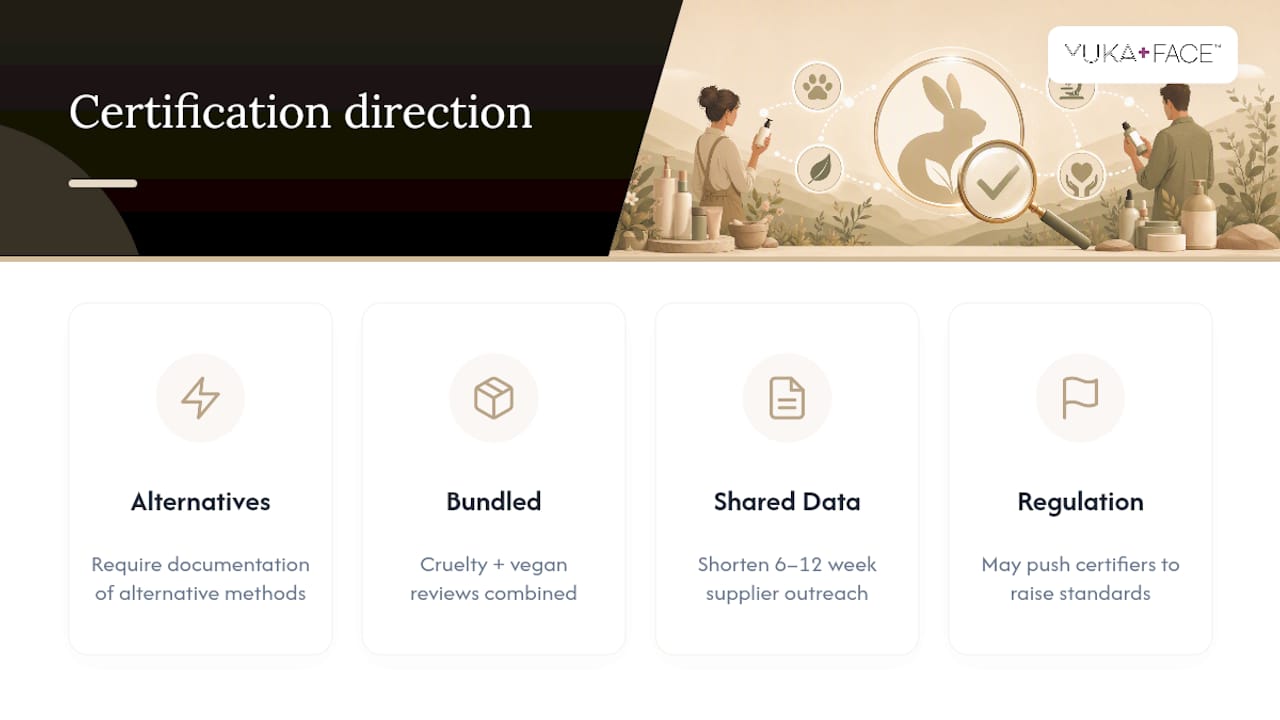
In vitro testing methods, computer modeling, and organ-on-a-chip technology are increasingly cited by certifiers as evidence a brand has genuinely moved away from animal testing rather than simply avoiding it on paper. As these alternatives become more scientifically accepted by regulators, certifiers are likely to require documentation of which specific alternative methods a brand's suppliers use, not just a statement that no animal testing occurred.
Combined certifications are also gaining ground. NSF's pairing of cruelty-free and vegan review under one process reflects growing shopper demand for a single, comprehensive check rather than two separate label searches. Expect more certifiers to offer bundled pathways rather than keeping vegan and cruelty-free strictly siloed.
Supply chain transparency technology, digital ledgers and centralized supplier databases shared across certifiers, could eventually reduce the six-to-twelve-week supplier outreach bottleneck that currently makes certification slow for brands. If certifiers start sharing verified supplier data instead of each running independent outreach, that timeline could compress meaningfully.
The pressure point to watch is regulatory harmonization. As more countries phase out cosmetic animal testing requirements, the gap between "legally required" and "certifier standard" should narrow, potentially pushing certifications to raise their bar even further to stay meaningfully ahead of the law.
Yuka+Face's View on What Certification Should Prove
Yuka+Face builds every product on a vegan, cruelty-free standard, and that commitment shapes how we read a certification, too. A logo means little without the audit trail behind it. We look for the same things this article outlines for shoppers: a fixed cut-off date, supplier declarations that reach the ingredient level, and a public listing we can point customers toward instead of asking them to take our word for it.
That's also why supplier transparency shapes our own sourcing decisions and communications, not just our marketing copy. If you're building a routine around ethical skincare choices, the fastest filter is the one in this guide: check the database, not the packaging.
— Kelly
Where to Verify Certification Claims Directly
Start with the primary sources. The Cruelty Free International Approval Programme outlines Leaping Bunny's full criteria, while PETA's searchable database covers its Ultimate Cruelty-Free List. The Vegan Society's criteria and NSF's protocol page round out the four programs to check before trusting any logo. For a broader consumer explainer, see The Cork Store's overview of what certification actually accomplishes. If you're ready to build a routine around verified, vegan-certified skincare, Yuka+Face's product lineup follows the same standards outlined here.
Sources
- The Leaping Bunny Difference | Leaping Bunny
- Cruelty Free International Approval Programme
- Search for Cruelty-Free Companies, Products, and More | PETA
- NSF Cruelty-Free Certification
FAQ
What Is the Best Cruelty-Free Certification?
No single program is universally "best," but Leaping Bunny (Cruelty Free International) is widely considered the most rigorous because it requires a fixed cut-off date, ingredient-level supplier monitoring, and independent audits rather than a self-declared statement.
What Is a Cruelty-Free Certificate?
It's formal recognition from an independent organization, such as Leaping Bunny, PETA, The Vegan Society, or NSF, confirming that a brand and typically its suppliers meet that program's specific standard for not testing on animals.
What Does PETA Certified Cruelty-Free Mean?
It means a company has submitted a statement to PETA confirming that neither it nor its suppliers test on animals, and the brand appears on PETA's Ultimate Cruelty-Free List, with an optional vegan designation available if the products also contain no animal-derived ingredients.
How Do You Get Certified by PETA?
Brands submit a statement of assurance confirming no animal testing by the company or its suppliers, and once accepted, they can appear on the Ultimate Cruelty-Free List and license PETA's logo, historically for a one-time fee near $350.
Is a Legal Ban on Animal Testing the Same as Cruelty-Free Certification?
No. A legal ban, like the one in the European Union, prohibits testing or sale of tested cosmetics in that market, but it doesn't verify supplier-level practices or apply outside that jurisdiction the way a certification like Leaping Bunny does.