
Microbiome-friendly skincare works when it delivers on one of three fronts: probiotics, prebiotics, or postbiotics that help balance the skin's bacterial ecosystem. Reviews show real gains in hydration and barrier strength, but results depend on your skin type, the formula, and consistent use. Results vary from person to person, so treat any new product as a four to eight week test, not an overnight fix.
TL;DR:
- Microbiome-friendly skincare mainly uses probiotics, prebiotics, or postbiotics to support skin's bacterial balance, but results vary based on skin type and consistency.
- Supporting ingredients include live beneficial bacteria, nutrients for existing microbes, and byproducts of microbial fermentation, all requiring careful formulation for stability and efficacy.
- Applying these products after cleansing and before moisturizer, along with gentle, pH-balanced formulas, maximizes their benefits and minimizes disruption.
- Common skin habits like hot showers, over-exfoliation, and harsh cleansers can damage the microbiome, while gentle routines and fewer disruptions help preserve it.
- Evidence of benefits includes improved hydration, barrier strength, and reduced inflammation, but long-term, personalized results depend on individual skin and microbiome conditions.
Table of Contents
- What "Microbiome-Friendly Skincare" Actually Means
- Probiotics, Prebiotics, and Postbiotics Explained
- Building a Routine Around Your Skin's Microbiome
- What Damages Your Skin Microbiome (and Easy Fixes)
- What the Research Actually Shows
- Why Results Vary and When to See a Dermatologist
- Kelly's Perspective: Where Botanical Formulation Meets Microbiome Science
- Where to Start With Yuka+Face
- Sources
- FAQ
What "Microbiome-Friendly Skincare" Actually Means
Your skin hosts trillions of bacteria, fungi, and other microbes that make up its microbiome. That layer of microscopic life acts like a shield, competing with harmful organisms for space and resources while helping regulate pH and inflammation. Microbiome-friendly skincare is any product formulated to protect or feed that community instead of stripping it away.
The term covers more ground than most shoppers realize. Some products aim to support existing microbes by avoiding harsh surfactants and keeping pH close to skin's natural range (around 4.5 to 5.5). Others go further and try to deliver live or fermented strains directly onto skin, hoping to boost microbial diversity or crowd out problem bacteria. These are different strategies with different levels of evidence behind them, and product labels rarely make the distinction clear.
A comprehensive review of microbiome-based skincare interventions found that probiotics, prebiotics, and postbiotics are the three main tools formulators use to regulate skin pH, calm inflammation, and reinforce the barrier. This is the science-backed core of the category. Everything else, from marketing copy to packaging claims, sits on top of that foundation.
Certification adds another layer to the picture. Organizations like MyMicrobiome test formulas for their effect on skin bacteria and award a certification mark to products that pass. A certification badge is a useful trust signal, but it doesn't guarantee a specific clinical outcome for your skin. Think of it as one data point among several, not a verdict.
Understanding your skin microbiome is really the starting point for evaluating any of these claims. Once you know what the microbiome does, you can judge whether a product's promises make biological sense or just sound good on a label.
Probiotics, Prebiotics, and Postbiotics Explained
Three ingredient categories drive most of the science behind probiotic skincare products, and they work through different mechanisms.
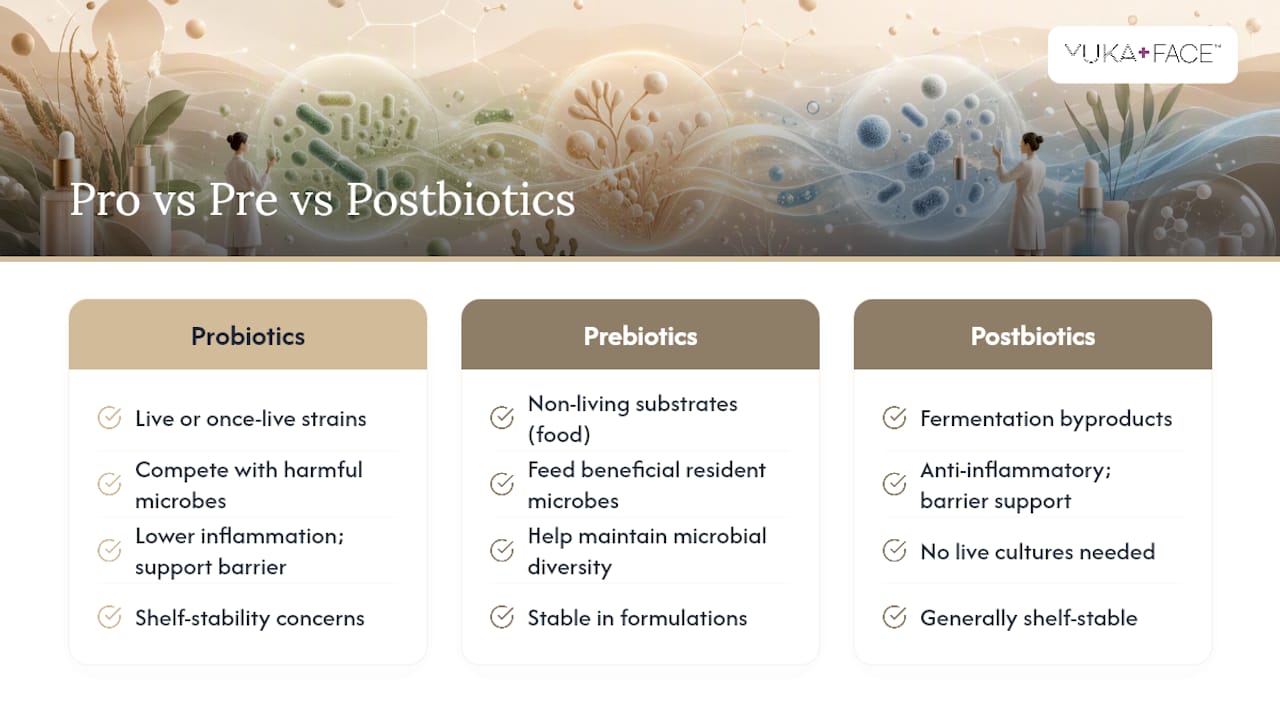
Probiotics are live or once-live beneficial bacteria strains, similar in concept to what you'd find in yogurt or a supplement, but formulated for topical use. On skin, they're thought to compete with harmful bacteria for space and nutrients, which can lower inflammation and support barrier repair. Oral probiotics work through a separate pathway: the gut-skin axis. A review on probiotics and the gut-skin axis found that intestinal microbiota balance directly influences skin inflammation, and conditions like acne and eczema often improve when gut health improves. That's why some skincare enthusiasts pair topical routines with gut-supporting habits.
Prebiotics don't contain live organisms at all. They're food for the beneficial microbes already living on your skin. Common examples include inulin and various oligosaccharides, which the same review on microbiome-based interventions identifies as ingredients that nourish beneficial microbes and may help maintain microbial diversity over time. If probiotics are like planting new seeds, prebiotics are the fertilizer that helps everything already growing thrive.
Postbiotics are the byproducts of microbial fermentation, things like lactic acid and short-chain fatty acids. These compounds don't need to be alive to work. The same research found that postbiotics can have direct anti-inflammatory and barrier-supporting effects when formulated correctly, which makes them appealing for sensitive or reactive skin since there's no concern about live cultures surviving the shelf life of a bottle.
Ferments, a related category, show up often in serums and essences. They're created when a specific ingredient (rice, green tea, soybean) is broken down by beneficial bacteria or yeast, producing smaller, more bioavailable compounds along with some of those same postbiotic benefits.
Formulation matters as much as the ingredient list. Gentle, low-foaming surfactants cause less disruption than sulfate-heavy cleansers. A pH-friendly formula, generally in that 4.5 to 5.5 range, keeps the skin's protective acid mantle intact. Stability is a real concern too: probiotic strains can lose potency if a formula sits on a warm shelf for months, which is part of why postbiotics and ferments are often considered more reliable from a shelf-stability standpoint.
Pro Tip: Apply probiotic or ferment-based products before heavier creams or oils, on slightly damp skin. Thinner, water-based formulas absorb better first, and damp skin helps active ingredients penetrate instead of sitting on the surface.
Building a Routine Around Your Skin's Microbiome
Order matters. Microbiome-friendly products generally work best applied right after cleansing, while skin is clean but not stripped, and before richer moisturizers or oils that create a barrier of their own.
A practical order looks like this:
- Rinse with lukewarm water and a gentle, low-foam cleanser.
- Apply a prebiotic or probiotic essence or toner while skin is still slightly damp.
- Layer on a postbiotic or ferment-based serum to target hydration or inflammation.
- Seal everything in with a barrier-supporting moisturizer.
- Finish with sunscreen in the morning, since UV damage is itself a microbiome disruptor.
Reading labels takes some skepticism. "Probiotic" on a front label doesn't always mean live cultures survived manufacturing. "Fermented" is often more reliable, since it usually points to postbiotic content that doesn't depend on live organisms. Look for pH-balanced or pH-friendly language, and check ingredient lists for prebiotics like inulin or beta-glucan rather than trusting the marketing claim alone.
Routines should flex with your skin type:
- Sensitive skin: favor postbiotic and ferment-based products over live probiotics, since fewer active variables means less chance of reaction. Skip fragrance and heavy essential oils.
- Oily or acne-prone skin: look for lightweight prebiotic serums and avoid stripping cleansers that trigger a rebound in oil production.
- Dry skin: pair a postbiotic serum with a richer, barrier-focused moisturizer, since dry skin often has a compromised barrier that needs both hydration and reinforcement.
A quick shopping checklist helps cut through the noise. Favor short ingredient lists, pH-balanced formulas, and fragrance-free options if your skin reacts easily. Avoid products high on the ingredient list with sulfates, denatured alcohol, or synthetic fragrance blends, since those tend to work against the same balance the rest of the formula is trying to build. For more on how pH factors into all of this, Yuka+Face's guide to skin pH breaks down why that range matters so much.
What Damages Your Skin Microbiome (and Easy Fixes)
Certain habits disrupt the skin's bacterial balance faster than any product can repair it. UCLA Health research on bathing habits found that frequent hot showers and over-cleansing strip natural oils and disturb the microbial layer, along with harsh surfactants and unnecessary antibiotic use.
The most common disruptors include:
- Over-exfoliating with acids or scrubs more than two to three times a week.
- Long, hot showers that strip natural oils and disrupt microbial balance.
- Harsh sulfate-based cleansers that foam heavily but strip the skin's protective layer.
- Unnecessary oral or topical antibiotics, which kill beneficial bacteria along with harmful ones.
- Frequent hand sanitizer use without a follow-up moisturizer to help rebuild the barrier.
Simple fixes go a long way. Switch to lukewarm water, cut exfoliation back to once or twice weekly, and choose cleansers labeled sulfate-free or pH-balanced. If you're on antibiotics for a medical reason, that's a decision for you and your doctor, but it's worth mentioning to a dermatologist if you're seeing skin changes afterward.
Telling the difference between microbiome damage and normal adjustment takes a little patience. A new product that causes mild tingling for a day or two, followed by calmer, more balanced-looking skin, is usually just an adjustment period. Redness, persistent breakouts, or a tight, flaky feeling that doesn't improve after a week or two is a sign the product or habit is actively working against your skin's balance, not with it.
What the Research Actually Shows
The clinical picture is encouraging but not settled. Reviews of microbiome-based interventions report improvements in barrier function, hydration, and inflammation reduction tied specifically to probiotic, prebiotic, and postbiotic formulations, more so than to generic moisturizers without those ingredients.
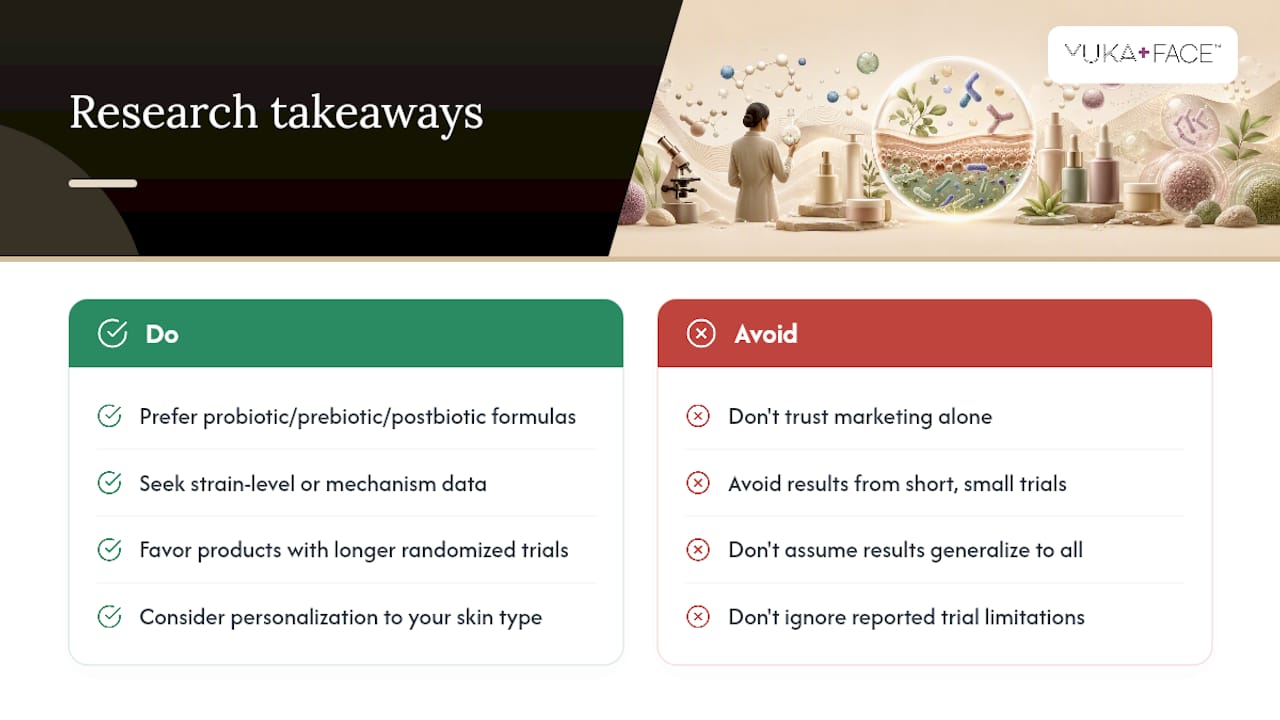
Some trial data gets specific. Selected clinical findings on topical probiotics and postbiotics report measurable drops in transepidermal water loss (TEWL) and improved hydration scores after use, along with reductions in inflammatory markers. That's a real, measurable signal, not just a marketing claim. The catch is that many of these trials run short, often weeks rather than months, and sample sizes are frequently small enough that results don't always generalize across skin types.
Formulation and personalization gaps remain the biggest open questions. A product that performs well for one person's skin microbiome may do very little for someone else's, since everyone's baseline bacterial makeup differs. Consumer coverage of the microbiome skincare trend tends to emphasize calming and barrier benefits without always flagging these trial limitations, which is worth keeping in mind when a product description sounds too confident.
Stronger evidence going forward would look like longer randomized controlled trials (three to six months rather than two to four weeks), standardized endpoints so studies can be compared directly, and strain-level data that identifies exactly which bacterial strains or postbiotic compounds drove the results. Until that exists, the honest read is: promising direction, real but modest effects, and results that depend heavily on the individual.
Why Results Vary and When to See a Dermatologist
No two skin microbiomes are identical, which is exactly why a product that transforms your friend's skin might do nothing for yours. Genetics, climate, diet, and even the products you've used for years all shape your particular bacterial mix, so a one-size-fits-all recommendation almost never fits everyone equally well.
A stepwise approach beats guessing. Introduce one new microbiome-friendly product at a time rather than overhauling your entire routine at once. Patch test on your inner arm for 48 hours before applying to your face. Then commit to four to eight weeks of consistent use before judging whether it's working, since microbial shifts take longer than a single week to show up on skin. Yuka+Face's guide to personalizing your routine walks through this process in more detail if you want a structured plan to follow.
Some signs call for a dermatologist instead of another product swap. Persistent redness, painful breakouts, cracking or bleeding skin, or a rash that spreads rather than resolves are all reasons to get a professional opinion. So is any reaction that includes swelling or breathing difficulty, which needs immediate medical attention, not a wait-and-see approach. A dermatologist can also test for specific bacterial or fungal imbalances that no amount of trial-and-error with retail products will diagnose on its own.
Kelly's Perspective: Where Botanical Formulation Meets Microbiome Science
Natural doesn't mean unscientific, and that's the balance worth getting right. At Yuka+Face, plant-based postbiotics and gentle, pH-aware formulas get the same scrutiny as any active ingredient, because a beautiful botanical blend that disrupts your skin's pH does more harm than good.
The honest caveat is this: topical care supports the surface, but it can't replace what's happening internally. A great serum won't outrun poor sleep, stress, or gut health working against you. Treat your skincare as one piece of a bigger picture, not the whole solution.
— Kelly
Where to Start With Yuka+Face
The approach to microbiome-friendly skincare comes down to formulation restraint, focusing on products that are built around gentle, pH-aware ingredients designed to work with your skin's bacterial balance instead of stripping it away for a temporary "clean" feeling.

If you're rebuilding a routine around barrier support and hydration, the hydration and restoration guide breaks down which ingredients matter most for a compromised barrier. For a full daily structure that puts these principles into practice from the moment you wake up, the morning skincare routine walks through order and product pairing step by step. Start there, apply one new product at a time as recommended above, and give your skin the four to eight weeks it actually needs to show you what's working.
Sources
- Microbiome-Based Interventions for Skin Aging and Barrier Function: A Comprehensive Review
- Selected clinical findings on topical probiotics/postbiotics and skin barrier outcomes
- What is microbiome skin care? Benefits of the trend explained | CNN Underscored
FAQ
How Do I Improve My Skin Microbiome?
Use gentle, pH-balanced cleansers, limit exfoliation to two or three times a week, and introduce prebiotic or postbiotic products gradually while giving each one four to eight weeks before judging results.
How Does Gut Health Affect Skin?
The gut-skin axis links intestinal microbial balance to skin inflammation, and research shows that improving gut microbiota can ease conditions like acne and eczema, so diet and topical care often work best together.
What Damages the Skin Microbiome?
Over-exfoliation, harsh sulfate-based cleansers, frequent hot showers, and unnecessary antibiotic use are the most common disruptors, each stripping away beneficial bacteria along with dirt and oil.
What Kills Skin Bacteria Naturally?
Long exposure to hot water, alcohol-heavy toners, and antibacterial hand sanitizers all reduce beneficial bacteria on skin; rebuilding that balance takes gentler cleansing habits and microbiome-friendly skincare products like postbiotic serums or prebiotic-rich moisturizers.
Is Microbiome-Friendly Skincare Worth the Investment?
For most people, yes, provided the formula favors gentle surfactants and pH-balanced ingredients, since reviews link those categories to measurable gains in hydration and barrier strength over generic alternatives.