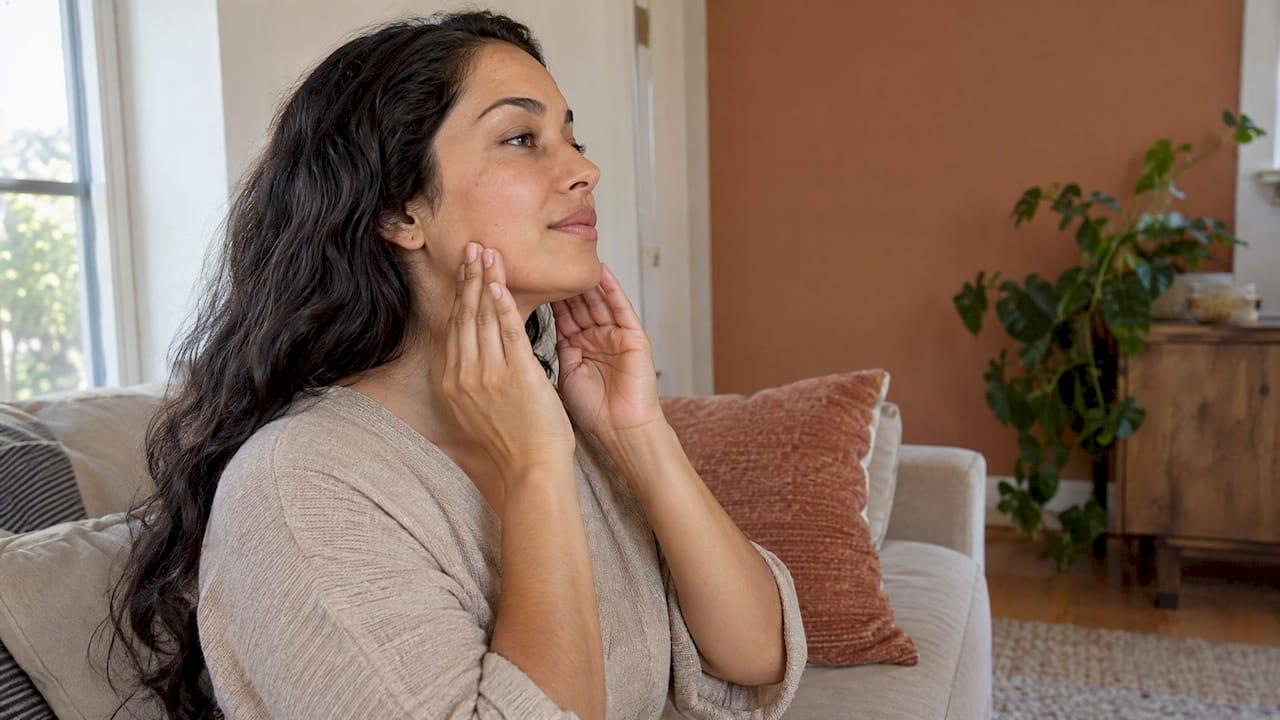
Facial lymphatic drainage is a very light massage that guides excess fluid from the face toward the lymph nodes in the neck and collarbone area. Done gently on clean skin with a slippery product, it can leave the face looking less puffy for a few hours. The result depends on light pressure, the right direction and a simple routine, and the skin underneath needs a barrier-friendly formula that lets your fingers glide. Our vegan, cruelty-free serums, oils and moisturizers are made for exactly that step.
TL;DR
- Facial lymphatic drainage is a light-pressure massage that moves fluid toward the lymph nodes. It works on the skin only, not the muscle.
- The visible effect is temporary de-puffing. UCLA Health says there is no evidence it causes weight loss.
- Start at the neck, then work from the center of the face outward and downward. Never press hard.
- Skip it, or ask a doctor first, with blood clots, heart or kidney disease, infection, cancer history or swelling with no known cause.
- Use a clean face and a glide product, such as a serum or facial oil, to keep friction low.
Table of Contents
- What facial lymphatic drainage actually is
- What it can and cannot do
- Before you start: who should skip it
- How to do a lymphatic drainage face massage at home
- Hands, gua sha or another tool
- How often to do it
- Puffy face: what else to look at
- For estheticians and spa retail
- Our perspective
- Build the routine with Yuka+Face
- FAQ
- Sources
What facial lymphatic drainage actually is
The lymphatic system is a network of vessels and nodes that carries excess fluid away from your tissue. Unlike blood, it has no pump of its own. It relies on muscle movement and breathing.
Facial lymphatic massage, often called manual lymphatic drainage or MLD, is a gentle self-massage. Cleveland Clinic describes it as moving excess fluid from tissue toward major lymph nodes. For the face, that means pulling fluid toward the nodes in the chest and armpit area.
The pressure is the part most people get wrong. Facial lymph vessels sit just under the skin, so the touch has to be far lighter than a regular facial massage. Dermatologist Kseniya Kobets, MD, explains in SELF that classic facial massage is deeper and targets muscle, while MLD uses a very light touch on superficial nodes.
What it can and cannot do
Realistic benefits
UCLA Health says MLD can reduce swelling and temporarily make skin look slimmer and tighter. It also says there is no evidence it causes weight loss, and many other claimed benefits lack strong evidence.
For a puffy face, the effect is a short-term fluid shift. Women's Health reports that the "snatched" look is mostly a temporary drop in fluid retention, not a change to fat, muscle or bone, and that it typically lasts hours to a day or two.
Skin glow after a session is more likely from circulation. Dr. Kobets attributes it to increased blood flow from handling the skin, not to toxin removal, according to SELF.
Where it is used professionally
In clinical settings, MLD is used around cosmetic procedures. A peer-reviewed review finds it is less well studied for the face, but may help with complications after injectables, fillers or botulinum toxin, and may help with swelling after facelifts or eyelid procedures. If you are recovering from a procedure, follow your provider's instructions first.
Before you start: who should skip it
For most healthy adults, gentle self-massage is low risk. Some conditions change that.
Cleveland Clinic lists these reasons not to do it: blood clots or DVT, cancerous tissue, cellulitis, heart disease, kidney disease, radiation-damaged skin and tuberculosis. Avoid it during an active illness. If you have lymphedema, ask your healthcare provider first.
Women's Health adds a physician conversation first for these situations:
- Active facial infections or open wounds
- Active severe acne or significant active rosacea
- Blood clotting disorders
- Congestive heart failure or kidney disease
- A history of cancer involving lymph nodes, or head and neck radiation
- Thyroid conditions affecting the neck
If your facial swelling has no known cause, see a healthcare provider rather than massaging it. Healthline gives the same advice for people with a lymphatic infection or a high risk of blood clots.
UCLA Health recommends consulting your primary care provider first, and learning the technique from a certified lymphedema therapist, physical therapist or massage therapist trained in MLD. For more on safety around professional treatments, see this guide to physician-led facial care.
How to do a lymphatic drainage face massage at home
The routine below follows Cleveland Clinic's directions and the sequence experts describe in Women's Health. Plan on 5 to 15 minutes.
1. Prepare the skin
Do it after a shower, when the body is warm. Cleveland Clinic recommends that timing. Wash your hands and face. If you wear makeup or sunscreen, a double cleanse first leaves a clean base. Our guide to double cleansing covers the steps, and the Vitamin C Cleansing Oil is the oil step.
Then apply a glide product. Dry fingers drag on skin, and dragging is the opposite of what you want. A serum or facial oil works. Our Bright Eyes Peptide Serum suits the eye area, where the skin is thinnest.
2. Open the pathway at the neck
Fluid needs somewhere to go. Experts quoted in Women's Health say to always start at the neck, then guide fluid down the neck, toward the collarbone and behind the ears.
Cleveland Clinic's version: press from the center of the chest toward each armpit, then move your fingers downward from below the ears toward the chest 5 to 10 times.

3. Work the face, center to outside
Use the pads of your fingers, flat and soft. Aim for the pressure of stroking a sleeping eyelid, not kneading dough. SELF quotes esthetician Joanna Vargas describing a "shockingly gentle touch".
- Cheeks: make gentle downward circles on the cheeks about 10 times, per Cleveland Clinic.
- Under the eyes: use your ring finger, the weakest finger, and sweep lightly outward toward the temples.
- Forehead: stroke from the center out toward the temples, then down in front of the ears.
- Jaw and chin: glide from the chin along the jawline toward the ears, then down the neck.
- Finish: repeat the neck strokes toward the collarbone.
The skin should move a little. The muscle should not. Stop if skin turns red or bruised. Experts in SELF say there is no harm in trying as long as you stay gentle and do not leave the skin red or bruised.
4. Wind down
Some people feel temporary tiredness, headache or nausea afterward. Cleveland Clinic suggests resting and drinking plenty of water through the day.
Hands, gua sha or another tool
Hands are enough. If you like a tool, a gua sha stone follows the same rules. Cleveland Clinic's gua sha guidance says to clean the tool, apply lotion or serum for glide, use a gentle touch, work outward from the center in one smooth direction, and avoid pressing into swollen areas to prevent burst capillaries and bruising. It also says to avoid scraping irritated or inflamed skin.
The same page lists circulation problems, diabetes, eczema or psoriasis, blood thinners, chemotherapy and pregnancy as reasons to avoid gua sha. For product order and technique, see our gua sha with skincare routine.
There is also a research caution: Cleveland Clinic notes research does not address the claimed de-puffing effect of gua sha, though the gentle downward motion may help fluid move.

How often to do it
There is no single rule. Healthline notes that some people do it daily and others once or twice a week. Vargas recommends weekly sessions of 5 to 15 minutes, on a bare, clean face.
A practical pattern: two or three short sessions a week, or the morning of a day you want less puffiness. Because the effect fades within hours to a day or two, consistency matters more than force. Licensed massage therapist Matthew Perry says in Women's Health that stronger pressure is a common misconception and that the best techniques are light, intentional and relaxing.
Puffy face: what else to look at
Massage treats fluid, not its cause. Certified lymphedema therapist Kelly Sturm says in PaperCity that MLD is helpful for puffiness and post-procedure recovery, and that for most people with a healthy lymphatic system, a healthy lifestyle is enough to support it. Hydration, sleep and a steady routine matter.
The skin you massage matters as well. Barrier-friendly products reduce irritation, which is helpful if you have sensitive skin. Our morning skincare checklist and evening ritual tips show where a massage fits.
For estheticians and spa retail
Facial drainage is a common request in spa and medspa settings, and clients often ask what to use at home between visits. A short, simple home routine keeps the message consistent: light pressure, clean skin, a glide product, and a gentle moisturizer to finish. After a treatment, our post-facial skincare guide covers the first 24 hours. Our Hydrating Power Moisturizer is the finishing step.
Our perspective
Massage works best on skin that is calm. That is why we keep routines short and formulas simple.
Our products are vegan, cruelty-free and made with botanical research and scientific expertise. They are created for all skin types and ages, with a focus on barrier repair and sensitive skin.
For a drainage massage, that means a cleanser, a glide product and a moisturizer. Each step should feel gentle, and none should leave the skin stripped. We call this the unbothered skin philosophy.
Kelly
Build the routine with Yuka+Face
A drainage massage needs three things from skincare: a clean base, a smooth glide and a moisturizer to seal it in. Yuka+Face offers cleansers, toners, serums and oils, plus moisturizers and masks. Gift cards start from $50.

The Lavender Essence Balancing Toner and B3 Gentle Cleanser are a good place to start for a simple routine.
FAQ
Does facial lymphatic drainage work?
It can reduce puffiness for a short time. Surgeon Jennifer Levine, MD, tells SELF the de-puffing is instant but temporary. Do not expect lasting changes to face shape.
Is there a downside to lymphatic drainage?
Pressing too hard can redden or bruise skin. Some people feel tired or get a headache afterward. People with blood clots, heart or kidney disease, infection or a cancer history should talk to a doctor first.
How do I start the massage?
Start at the neck, then move to the face. Use light pressure on clean skin with a serum or oil, and always stroke toward the collarbone, ears and neck.
Can I use a gua sha tool?
Yes, with the same gentle pressure and a glide product. Work outward in one direction and avoid swollen or irritated skin.
Sources
- How To Do Lymphatic Drainage Self-Massage, Cleveland Clinic
- Lymphatic Drainage Facials: Pros, Cons, How to Do It, Women's Health
- Does Facial Lymphatic Drainage Massage Actually Work? SELF
- Lymphatic drainage massage: separating fact from fiction, UCLA Health
- The Utility of Lymphatic Massage in Cosmetic Procedures, PMC
- Why gua sha might be good for you, Cleveland Clinic
- Lymphatic Drainage for Face, Healthline
- Diving Into the World of Lymphatic Drainage, PaperCity
- Physician-led facial balancing guide