
The best post-facial skincare is minimal, not more. Cleanse gently, moisturize, and apply broad-spectrum SPF 30+, while skipping heat, sweat, and strong actives for a short period, typically a few days. That short pause protects the results your esthetician just gave you and lets your skin's barrier settle. Yuka+Face's gentle, botanical formulas fit naturally into this window, but always follow your provider's specific aftercare notes first.
TL;DR:
- The skin's barrier is highly vulnerable immediately after a facial, requiring minimal cleansing with lukewarm water and avoiding scrubbing tools.
- Reintroduce active skincare ingredients gradually, typically after redness or flaking subsides, and only one active at a time to prevent irritation.
- Heavy makeup, heat, sweat, and picking should be avoided for several days, while daily sunscreen application is essential due to increased photosensitivity.
- Longer recovery times may be needed for deeper treatments like chemical peels or microneedling before reintroducing actives or wearing makeup.
- Yuka+Face's botanical, barrier-friendly formulations support recovery, emphasizing hydration, barrier repair, and sun protection during this sensitive period.
Table of Contents
- What to Do for Post-Facial Skincare in the First 24 Hours
- When Can You Reintroduce Actives After a Facial?
- Post-Facial Dos and Don'ts, and Why They Matter
- Simple AM and PM Routines After a Facial
- How Should Different Skin Types Adjust Their Aftercare?
- When Should You Contact Your Aesthetician or a Doctor?
- Why Restraint Is the Real Skill in Post-Facial Care
- Where to Find Gentle, Barrier-First Skincare for Recovery
- Sources
- FAQ
What to Do for Post-Facial Skincare in the First 24 Hours
Your skin is at its most reactive in the first day after treatment. Pores may still be open from extractions, circulation is elevated, and the surface barrier is temporarily thinner than usual. That combination makes this the window where small mistakes, like a hot shower or an unwashed pillowcase, cause the most irritation.
Keep the routine boring on purpose:
- Cleanse minimally. Use lukewarm water and a gentle, non-foaming cleanser, or skip cleansing entirely if your skin still feels clean. Skip washcloths, brushes, or any scrubbing tool.
- Moisturize right away. Choose a fragrance-free formula built on humectants and ceramides to support the barrier while it recovers, a strategy backed by clinical research on barrier-repairing ingredients.
- Apply sunscreen before any sun exposure. Broad-spectrum SPF 30 or higher is the baseline; a mineral formula is the gentler pick if skin feels tender.
- Avoid touching your face, heavy makeup, steam, saunas, and hard workouts. Sweat and heat raise inflammation risk and can push bacteria into freshly cleared pores, according to esthetician guidance on post-facial care.
- Handle the small stuff. Swap to a clean pillowcase, wash your hands before touching your face, and clean any makeup brushes before they touch treated skin again.
Pro Tip: Keep a travel-size mineral sunscreen in your bag the day of your facial. Reapplying every two hours matters more than the SPF number on the bottle.
When Can You Reintroduce Actives After a Facial?
Not every facial demands the same recovery timeline. A relaxation or hydrating facial with light massage lets you ease back into your normal routine within a day. Enzyme peels, acid treatments, and dermaplaning ask for more patience, usually a couple of days. Deeper corrective work, like chemical peels or microneedling, can require several days before any active ingredient touches your skin again.
A conservative, stepwise return works for nearly every treatment type:
- Wait for visible redness or flaking to subside before adding anything beyond moisturizer and sunscreen.
- Reintroduce one active ingredient at a time, at a reduced frequency, such as every third night instead of nightly.
- Watch for stinging, tightness, or new redness over the next one day before adding a second active.
- Follow your provider's specific timeline if you had a peel or microneedling. These treatments often call for a longer pause, sometimes a week or more, because the skin is still re-epithelializing, a process outlined in dermatology research on skin healing.
Introducing actives one at a time isn't just cautious. It also makes it obvious which product caused a reaction if one shows up, a principle supported by research on topical treatment tolerability.
Post-Facial Dos and Don'ts, and Why They Matter
Every rule on this list traces back to one fact: your skin's barrier is more permeable than usual right now, a vulnerability rooted in basic skin anatomy.
Don't:
- Use exfoliants, retinoids, or acids for at least a few days.
- Wear heavy or long-wear makeup that clogs still-open pores.
- Take hot showers, saunas, or steam rooms, since heat drives inflammation.
- Do intense exercise, since sweat can carry bacteria into extraction sites.
- Pick at scabs or redness, which raises the risk of hyperpigmentation, especially on deeper skin tones.
- Schedule facial waxing or laser treatments within the timeframe your provider recommends.
Do:
- Apply sunscreen daily, since exfoliation increases photosensitivity.
- Stick with a gentle, barrier-supporting moisturizer.
- Change your pillowcase the night of treatment.
- Ask your provider before trying any new sample product, even one they handed you.
Simple AM and PM Routines After a Facial
Once you have the don'ts down, the actual routine is short. The goal, as estheticians often frame it, is quiet support: hydration, barrier repair, and sun protection, not another round of active treatment.
Morning:
- Splash with lukewarm water, or use a gentle cleanser only if needed.
- Apply a hydrating serum built around hyaluronic acid.
- Layer a moisturizer with ceramides or squalane to lock in that hydration.
- Finish with broad-spectrum SPF 30 or higher, every single morning.
Evening:
- Cleanse gently, skipping anything foaming or textured.
- Add a soothing serum if your esthetician recommended one.
- Moisturize again, and consider an occlusive balm at night if you're peeling. Moist wound-healing techniques can speed recovery and reduce scarring risk compared to letting skin dry out.
Pro Tip: If a product stings on application, that's your skin telling you it's not ready. Rinse it off and go back to plain moisturizer for another day.
Favor humectants and barrier lipids over anything marketed as "active" right now. Lightweight serums and cream-based moisturizers tend to feel more comfortable than gels or foaming textures during this stretch. Yuka+Face's hydration-focused formulas are built around exactly these ingredient categories.
How Should Different Skin Types Adjust Their Aftercare?
The core rules stay the same across skin types. The adjustments are in emphasis.
Acne-prone skin: Calm, don't attack. Stick with a gentle cleanser and a light hydrator, and resist the urge to spot-treat blemishes across the whole face while it's still recovering.
Sensitive or rosacea-prone skin: Minimize handling as much as possible. Mineral sunscreen is the safer call here, paired with barrier-repairing ingredients rather than anything with fragrance or alcohol.
Dry or dehydrated skin: Layer a humectant serum under a richer moisturizer, and add an occlusive balm at night if flaking shows up.
Pigmentation concerns: Sun protection is non-negotiable, and patience matters more than usual. Exfoliating too early undoes the exact results you paid for.
When Should You Contact Your Aesthetician or a Doctor?
Mild redness, slight tightness, or a few small whiteheads in the days after extractions are normal, and often a sign the treatment did its job clearing debris from pores. Spreading redness, increasing pain, warmth, swelling, pus, or fever are not. Those point to a possible infection.
If you notice any of those signs, stop all actives immediately, take a photo to track changes, and contact your provider with details of the treatment you had. Severe swelling, blistering, or systemic symptoms warrant urgent medical care rather than a wait-and-see approach.
Why Restraint Is the Real Skill in Post-Facial Care
Most people assume more product equals faster results. After a facial, that assumption works against you. The instinct to layer on serums, exfoliants, or a new retinoid the same week defeats the purpose of the treatment itself, since the skin is busy repairing rather than absorbing anything new.
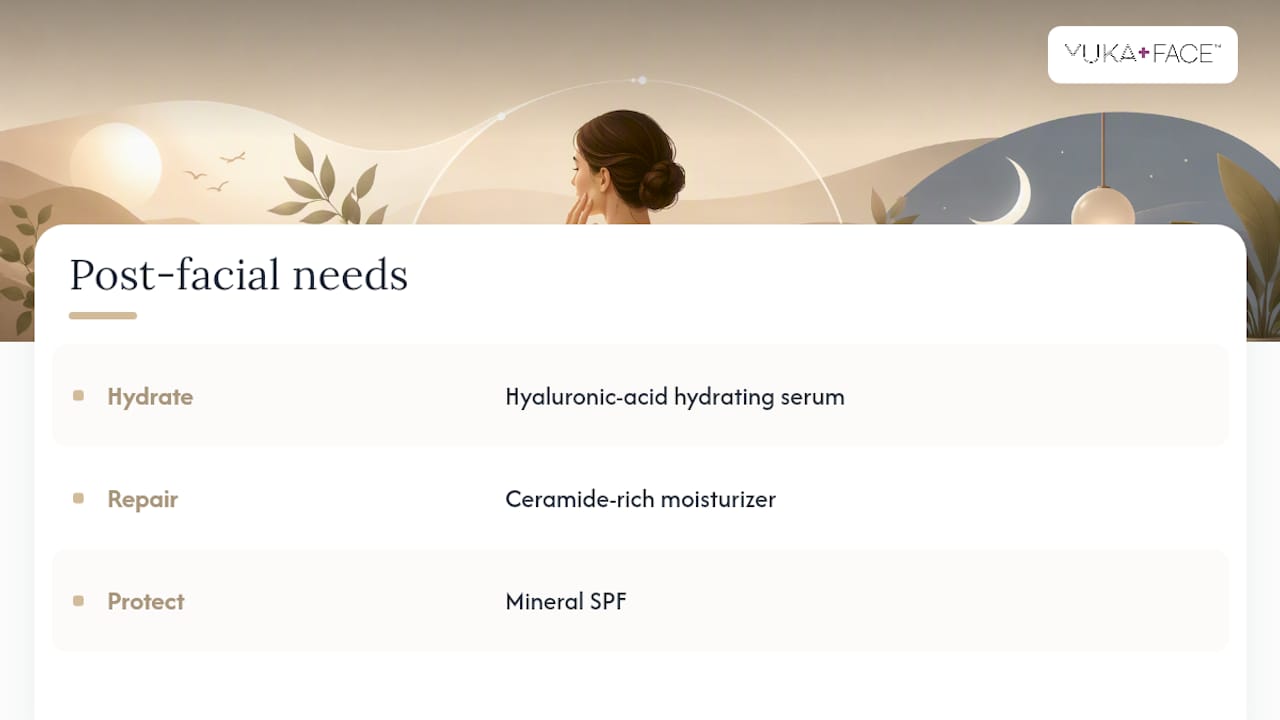
Yuka+Face's approach leans into that restraint. Its formulations skip synthetic fragrance and harsh surfactants in favor of botanical ingredients that support the barrier rather than challenge it, which is exactly what freshly treated skin needs. A hydrating serum built on hyaluronic acid, a ceramide-rich moisturizer, and a mineral SPF cover the three jobs your skin actually needs done in the days after a facial: hydrate, repair, protect.
None of this replaces your esthetician's specific instructions. But it does mean the products you reach for during recovery don't have to work against the treatment you just paid for. For more on which ingredients earn a place in that routine, Yuka+Face's guide to barrier-repairing ingredients breaks down what to look for and what to skip.
— Kelly
Where to Find Gentle, Barrier-First Skincare for Recovery
Yuka+Face is built for exactly this stretch of your skincare routine, when your skin needs support, not a challenge. Every formula is vegan, cruelty-free, and formulated around botanical ingredients rather than harsh actives, which makes it a natural fit for the few days after a facial when your barrier is still settling.

If you're putting together your post-facial routine, start with a hydrating serum and a ceramide-based moisturizer, then build outward once your skin is fully calm. Yuka+Face's morning skincare routine guide walks through exactly how to layer those products for daytime protection, including sunscreen pairing. For anyone recovering from a more intensive treatment, the hydration and barrier restoration guide goes deeper into which ingredients speed that process along. Shop the full lineup and build a routine that respects what your skin just went through.
Sources
- PMC article on skin barrier / moisturizing (example)
- Training
- Post Facial Skincare Routine That Protects Results | Mink Total
FAQ
What should I do for post-facial care?
Keep it simple: a gentle cleanse if needed, a fragrance-free moisturizer, and broad-spectrum SPF 30 or higher, while skipping heat, sweat, and strong actives for a short period, typically a few days depending on treatment intensity.
What is the 4 2 4 rule in skincare?
Definitions of this rule vary across sources and it isn't standard post-facial guidance. Stick with the well-established timeline instead: avoid actives and heat for a short period, typically a few days, and reintroduce products gradually from there.
What should I avoid doing after a facial?
Skip exfoliants, retinoids, heavy makeup, hot showers or saunas, intense workouts, and picking at your skin, since all of these increase irritation or infection risk while your barrier is still recovering.
Is it normal to get whiteheads after a facial?
Yes, a few small whiteheads or tiny scabs are common after extractions and usually resolve on their own within a few days. Spreading redness, pus, or increasing pain are not normal and warrant a call to your provider.
When can I wear makeup again after a facial?
Wait at least one day, longer if you had extractions or a peel, and choose a lightweight, non-comedogenic formula when you do return to makeup.