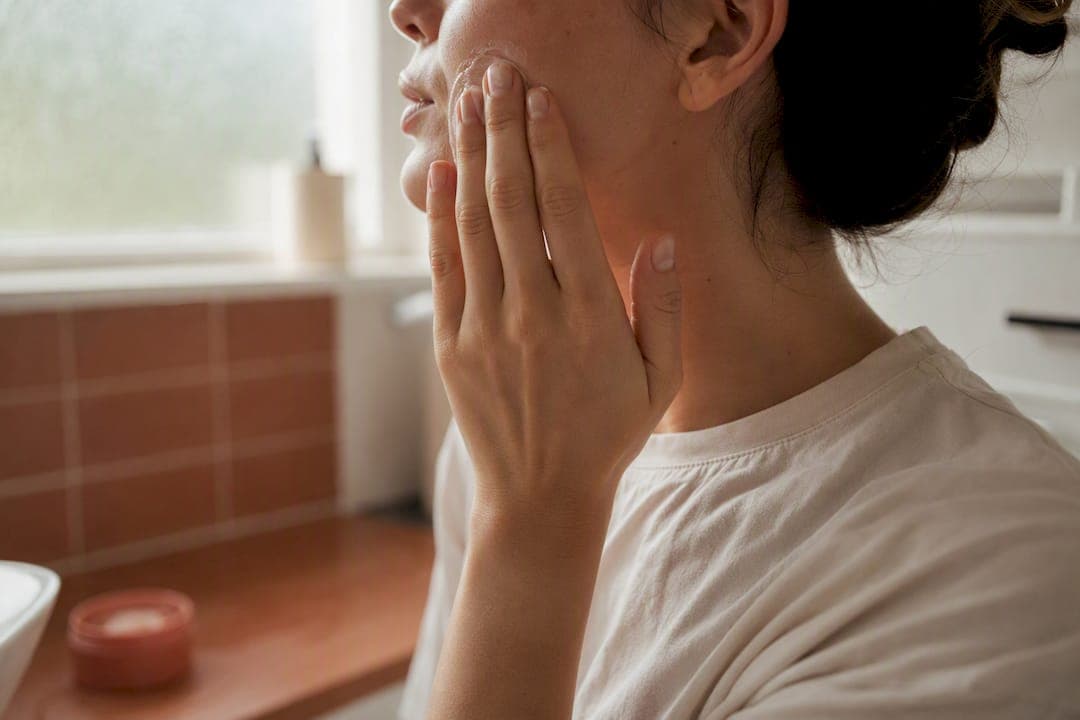
Fungal-acne-safe skincare means avoiding fatty acids and esters that Malassezia yeast can metabolize, generally those in the C11 to C24 carbon chain range. Favor water-based gels, squalane, glycerin, and niacinamide over rich oils and butters. Simplify your routine to a handful of clean products and give it two to four weeks before judging results. If bumps persist or spread, see a dermatologist for a proper diagnosis rather than guessing further.
TL;DR:
- Fatty acids with chain lengths between C11 and C24, especially in triglycerides, esters, and plant oils, are primary triggers for Malassezia overgrowth.
- Water-based gels, humectants like glycerin and hyaluronic acid, squalane, and niacinamide are safe options that do not feed Malassezia or cause flares.
- A routine should be kept simple with gentle cleansing, lightweight hydration, and mineral sunscreen, giving skin two to four weeks to respond before further intervention.
- Persistent or spreading bumps after routine adjustment signal the need for a dermatologist and potentially short-contact antifungal treatments like ketoconazole or selenium sulfide washes.
- Ingredients ending in "-ate," such as isopropyl myristate and palmitates, along with triglyceride oils like coconut, olive, and shea butter, should be avoided during active fungal acne.
Table of Contents
- What Is Fungal Acne and How Is It Different From Regular Acne?
- Why Does Malassezia Feed on Certain Skincare Ingredients?
- Which Ingredients Should You Avoid With Fungal Acne?
- What Ingredients Are Safe for Fungal-Acne-Prone Skin?
- How Do You Build a Fungal-Acne-Safe Routine?
- How Do You Choose Fungal-Acne-Safe Products by Category?
- When Should You Use Antifungal Treatments or See a Dermatologist?
- What Do People Get Wrong About Fungal Acne?
- Yuka+Face's Approach to Fungal-Acne-Aware Formulation
- Where to Find Fungal-Acne-Conscious Skincare
- Sources
- FAQ
What Is Fungal Acne and How Is It Different From Regular Acne?
Fungal acne isn't acne at all. The clinical name is Malassezia folliculitis, and it happens when yeast that normally lives on everyone's skin overgrows inside hair follicles and triggers inflammation. The result looks like a rash of small, uniform, often itchy bumps clustered across the forehead, chest, back, or shoulders, areas with more oil glands and hair follicles for the yeast to colonize.
That uniformity is the biggest tell. Bacterial acne shows a mix of blackheads, whiteheads, and inflamed cysts in different stages of healing. Fungal acne bumps tend to look nearly identical to each other, cluster tightly together, and itch in a way regular acne rarely does. Heat, sweat, occlusive clothing, humid climates, and recent antibiotic use are common triggers, since antibiotics wipe out the bacteria that normally keep Malassezia in check, letting the yeast take over the local skin environment.
Malassezia is a normal resident of human skin, and it only becomes a problem when conditions shift in its favor. That's a useful thing to know, because it means the goal isn't to eliminate the yeast entirely. It's to stop feeding it and let your skin's balance reset.
Here's the part most people skip: if you've tried benzoyl peroxide, salicylic acid, or standard acne treatments for weeks with zero improvement, or the bumps got worse, that non-response is itself a diagnostic clue. Bacterial acne usually responds, at least partially, to these treatments. Fungal acne often doesn't, because you're treating the wrong organism.
The only truly reliable way to confirm fungal acne is a KOH scrape, a quick, painless test where a dermatologist takes a skin sample and examines it under a microscope with potassium hydroxide solution to reveal yeast structures directly. If your bumps are widespread, painful, or not improving after a few weeks of ingredient-conscious skincare, that's the point to book a dermatology visit rather than keep experimenting on your own. For readers looking into professional treatment options for stubborn or inflamed skin, dermatologist-recommended picks can help clarify when a clinical visit makes sense.
Why Does Malassezia Feed on Certain Skincare Ingredients?
Malassezia can't make its own fatty acids the way most fungi and bacteria can. It's what scientists call lipid-dependent, meaning it needs to pull fatty acids directly from its environment to survive and multiply. On your skin, that environment includes sebum and, crucially, whatever oils, esters, and emulsifiers you put on top of it.
Malassezia species preferentially metabolize fatty acids with carbon chains roughly between C11 and C24 in length, according to research on Malassezia's lipid dependence. That range is the biochemical backbone of nearly every fungal-acne-safe ingredient list circulating online. It's not an arbitrary cutoff. Fatty acid chain length determines how easily an enzyme can bind and break down the molecule, and mid-length chains happen to sit in the sweet spot Malassezia's enzymes are built to process.
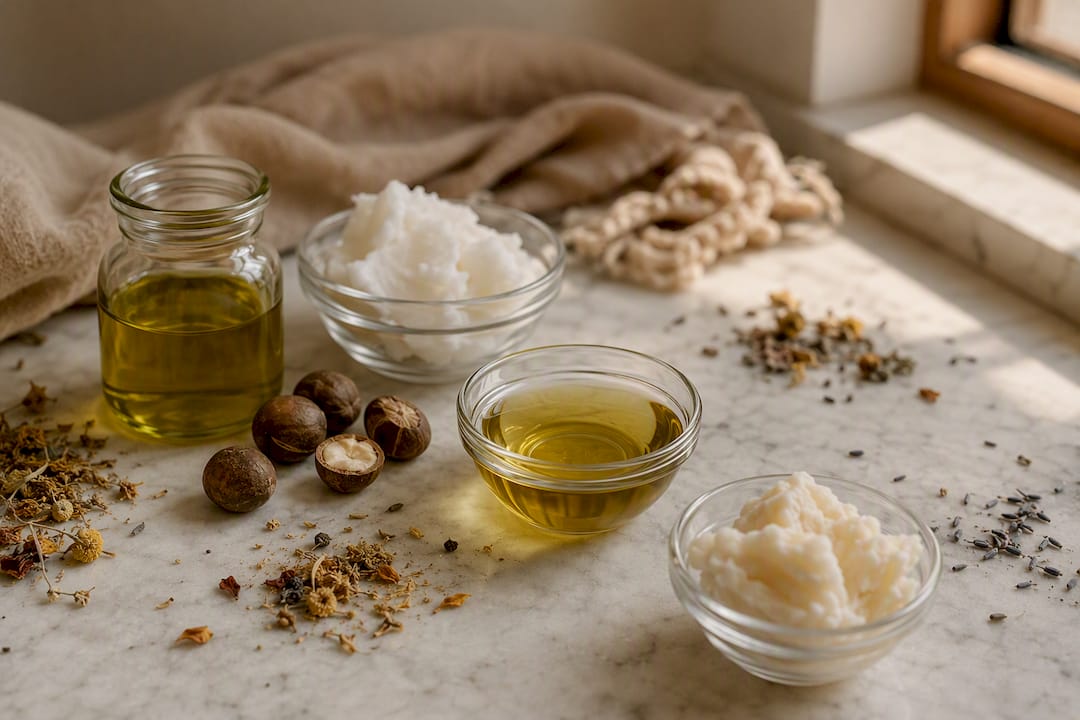
That single fact explains a lot of confusing ingredient behavior. Coconut oil, for instance, is mostly lauric acid, a C12 fatty acid sitting right in the danger zone. Olive oil leans heavily on oleic acid, C18. Shea butter is loaded with stearic and palmitic acids, C18 and C16. These are all considered excellent, nourishing ingredients in general skincare, and they are. They're just also, structurally speaking, exactly what Malassezia is built to eat.
Three ingredient categories show up again and again in flare triggers:
Triglyceride-based plant oils and butters. Most plant oils are triglycerides built from fatty acids that fall inside the C11 to C24 window. Coconut, olive, avocado, and many nut oils fit this pattern, along with butters like shea and cocoa.
Fatty acid esters. These are common emollients and texture enhancers built by attaching a fatty acid to an alcohol. Isopropyl myristate and isopropyl palmitate are the two most notorious names, and both sit squarely in the metabolizable range.
Polysorbates. Polysorbate 20, 60, and 80 are emulsifiers used to blend oil and water phases in lotions, serums, and sunscreens. They're derived from fatty acids and sorbitol, and they show up in far more "clean" formulas than most people expect.
It's worth being honest about the limits of this heuristic. The C11 to C24 rule comes from mechanistic and lab-based studies on how Malassezia processes fatty acids, not from large controlled trials proving that every listed ingredient triggers flares in every person. Community-built ingredient checkers apply this same chain-length logic, but they're heuristics, not medical certifications, and individual tolerance genuinely varies. Some people react to polysorbate 80 in one product and tolerate it fine in another, likely due to concentration, formulation order, or how much time it spends on skin. Treat the rule as a strong starting filter, not an absolute law.
Which Ingredients Should You Avoid With Fungal Acne?
Reading an ingredient label for fungal-acne triggers is a different skill than reading one for general sensitivity. You're not scanning for fragrance or alcohol. You're scanning for specific chemical patterns tied to that C11 to C24 range.
Start with the ingredients that show up most often in flare reports:
- Esters ending in "-ate": isopropyl myristate, isopropyl palmitate, cetyl palmitate, myristyl myristate
- Free fatty acids: lauric acid, myristic acid, palmitic acid, stearic acid, oleic acid, linoleic acid
- Emulsifiers: polysorbate 20, polysorbate 60, polysorbate 80, sorbitan oleate
- Plant oils and butters: coconut oil, olive oil, avocado oil, shea butter, cocoa butter, most nut oils
- Certain fermented or oil-derived extracts: some plant ferments carry lipid content that hasn't been well studied for Malassezia interaction
The naming pattern is your fastest shortcut. Anything ending in "-ate" that follows a word describing a fatty alcohol or acid (isopropyl, cetyl, myristyl, glyceryl) is worth pausing on. Plant oil names are usually literal: if you see "oil" preceded by a plant name, assume it's a triglyceride blend until you check otherwise.
Ingredient order on an INCI list matters more than people realize. Ingredients are listed by concentration from highest to lowest, so a trigger ingredient sitting in the first five or six spots is a bigger concern than the same ingredient appearing near the bottom of a 30-ingredient list, where it may be present at a fraction of a percent.
Pro Tip: Fermented ingredients are one of the trickiest gray zones on a label. Many ferments contain small amounts of lipids that haven't been individually studied for Malassezia interaction, so if a "fermented" or "ferment filtrate" ingredient sits high on the list and you're mid-flare, it's reasonable to skip it until your skin has settled.
Two label claims deserve real skepticism: "oil-free" and "non-comedogenic." Neither term is regulated, and neither one screens for the C11 to C24 range specifically. A product can be technically oil-free and still contain polysorbate 80 or isopropyl palmitate. Non-comedogenic ratings measure a different problem entirely, whether an ingredient clogs pores, not whether Malassezia can metabolize it. Treat both claims as marketing language, not a substitute for reading the actual ingredient list.
What Ingredients Are Safe for Fungal-Acne-Prone Skin?
The good news is the safe list is longer and more useful than most people assume, and it includes several genuinely excellent skincare ingredients, not just bland fillers.
For hydration and texture, these are the workhorses:
- Squalane: a lightweight, shelf-stable emollient with a molecular structure Malassezia doesn't process the way it does triglyceride oils
- Mineral oil and MCT (medium-chain triglyceride derivatives from coconut, refined to remove problematic fatty acids in some formulations): commonly tolerated occlusives
- Glycerin: a humectant that draws water into skin without offering any metabolizable fatty acid content
- Hyaluronic acid: hydrates through water-binding rather than lipid delivery
- Propanediol: a lightweight humectant and solvent increasingly used to replace heavier emollients
For active treatment, four ingredients do most of the heavy lifting. Niacinamide supports the skin barrier and helps regulate sebum production, which matters because excess sebum is part of what feeds Malassezia in the first place. Azelaic acid carries mild antifungal and anti-inflammatory properties, making it one of the few actives that addresses both the yeast and the resulting irritation. Urea in lower concentrations gently exfoliates and hydrates without oil-based emollients. Zinc PCA helps control oil and has mild antimicrobial properties, which is why it shows up in a lot of oil-control serums.
Ceramides deserve a specific mention, because they're often mistakenly avoided out of an overcorrection against anything lipid-related. Ceramides are barrier lipids, and clinical guidance on their role in skin health confirms they support barrier repair and hydration without supplying the kind of metabolizable fatty acids Malassezia depends on. Don't strip ceramides from your routine just because the word "lipid" appears nearby.
Texture matters almost as much as ingredient choice. Gel and water-based formulas tend to be safer defaults because their base doesn't rely on oil-phase emollients to deliver hydration. Silicones, ingredients like dimethicone, are another useful category precisely because they're not fatty acids at all. They're synthetic polymers that Malassezia has no enzymatic pathway to break down, which is why silicone-based primers and sunscreens are often well tolerated even during active flares.
How Do You Build a Fungal-Acne-Safe Routine?
A fungal-acne-safe routine works best when it's boring, and following a gentle skincare routine with anti-inflammatory botanical ingredients can help soothe sensitive skin during flare-ups. Fewer products, fewer variables, and enough consistency to actually see whether it's working.
Morning routine
- Cleanse with a gentle, water-based gel or foaming cleanser. Skip cleansing oils and balms during an active flare, since many rely on triglyceride oils as their base.
- Treat with a water-based niacinamide or azelaic acid serum while skin is still damp, which helps with absorption.
- Moisturize with a lightweight gel moisturizer built on squalane, glycerin, or hyaluronic acid rather than plant oils or butters.
- Protect with a mineral sunscreen in a water- or silicone-based vehicle. This is where a lot of routines quietly fail, since many chemical sunscreens rely on oil-soluble solvents that introduce esters into an otherwise clean routine.
Evening routine
- Cleanse the same way you did in the morning, removing sunscreen and sweat thoroughly since occlusion is one of Malassezia's favorite conditions.
- Treat with a rotating active. Azelaic acid most nights, with an occasional salicylic acid exfoliant to help clear follicle buildup, or a retinoid if your skin tolerates it and a dermatologist has recommended one.
- Moisturize with the same simple, gel-based option from your morning routine.
- Adjunct wash (as needed): if flares are persistent, a short-contact antifungal wash, left on for a few minutes before rinsing, can help under a dermatologist's guidance, covered in more detail below.
A few layering rules make a real difference. Apply thinner products like water-based serums before gel moisturizers. Don't combine multiple strong actives in the same session; azelaic acid and a retinoid on the same night can increase irritation without added benefit. And give any new routine two to four weeks before deciding it isn't working. Skin cycles take time, and Malassezia populations don't reset overnight just because you swapped a moisturizer.
Pro Tip: If you're not sure whether your current breakout is fungal or bacterial, resist the urge to throw every treatment at it at once. Simplify first. Piling on salicylic acid, benzoyl peroxide, and a new "FA-safe" serum simultaneously makes it impossible to tell what's actually helping, or what's making things worse.
For readers who want a deeper walkthrough of building routines around ingredient sensitivities rather than skin type alone, personalizing your skincare routine is worth a closer look before you start swapping products.
How Do You Choose Fungal-Acne-Safe Products by Category?
Ingredient rules only help if you can apply them while standing in a drugstore aisle or scrolling a product page. Each product category has its own common pitfalls.
Cleansers
Surfactant-based gel and foam cleansers are the safest default because they rinse clean and don't leave a lipid film behind. Oil cleansers aren't automatically off-limits, some are formulated with safer oils like squalane, but many rely on sunflower, olive, or other triglyceride oils as their base. During an active flare, skip prolonged-contact oil cleansing and save it for maintenance phases once your skin has calmed down.
Moisturizers
This is where most fungal-acne-safe shopping goes wrong, because "moisturizing" and "oily" get conflated. A water-gel formula anchored by squalane, glycerin, or hyaluronic acid delivers real hydration without the oil-phase ingredients that cause trouble. Heavy creams built around shea butter, cocoa butter, or a long list of plant oils belong in your rotation once your skin is stable, not during an active breakout. Barrier-focused formulas built around hydration and restoration principles tend to lean on humectants and ceramides rather than fatty emollients, which is generally the safer direction during a flare.
Sunscreens
Mineral sunscreens using zinc oxide or titanium dioxide in a water- or silicone-based vehicle are the most consistently well-tolerated option. Chemical sunscreens aren't inherently unsafe, but their formulas often rely on oil-soluble solvents and esters to dissolve UV filters, which is precisely the category most likely to sneak in a trigger ingredient. Read the full ingredient list on a sunscreen the same way you would a moisturizer, not just the active filters listed on the front of the bottle
Serums
Serums are usually the easiest category to get right, since most are water- or gel-based by design. Watch for oil-based delivery serums, particularly "glow" or "radiance" serums that use plant oils as a carrier for vitamins or antioxidants. A niacinamide or hyaluronic acid serum in a simple aqueous base is close to as safe as this category gets.
Makeup and leave-on cosmetics
Foundation, concealer, and primer formulas frequently contain esters and polysorbates for texture and blendability, and they stay on skin for hours, which gives Malassezia more contact time. Scan for isopropyl myristate, polysorbate 20, and similar names the same way you would on skincare, and favor simple, water-based formulas over long-wear or dewy finishes that typically rely on more oil-phase ingredients to achieve that look.
When Should You Use Antifungal Treatments or See a Dermatologist?
If a genuinely fungal-acne-safe routine hasn't improved your skin after two to four weeks, the next step isn't a different moisturizer. It's either a targeted antifungal or a clinical diagnosis.
Short-contact antifungal washes, most commonly containing ketoconazole or selenium sulfide, are frequently used as an adjunct to routine simplification. Clinical guidance on treating pityrosporum folliculitis describes leave-on-then-rinse regimens, typically applying the wash to affected areas, leaving it for a few minutes, then rinsing, used several times a week rather than daily.
That timeline matters because unsupervised long-term use carries real limits. Overusing antifungal washes can dry and irritate skin without necessarily improving yeast overgrowth, and it doesn't address the ingredient triggers that may be feeding the problem in the first place. Antifungal washes work best paired with a genuinely FA-safe routine, not as a substitute for one.
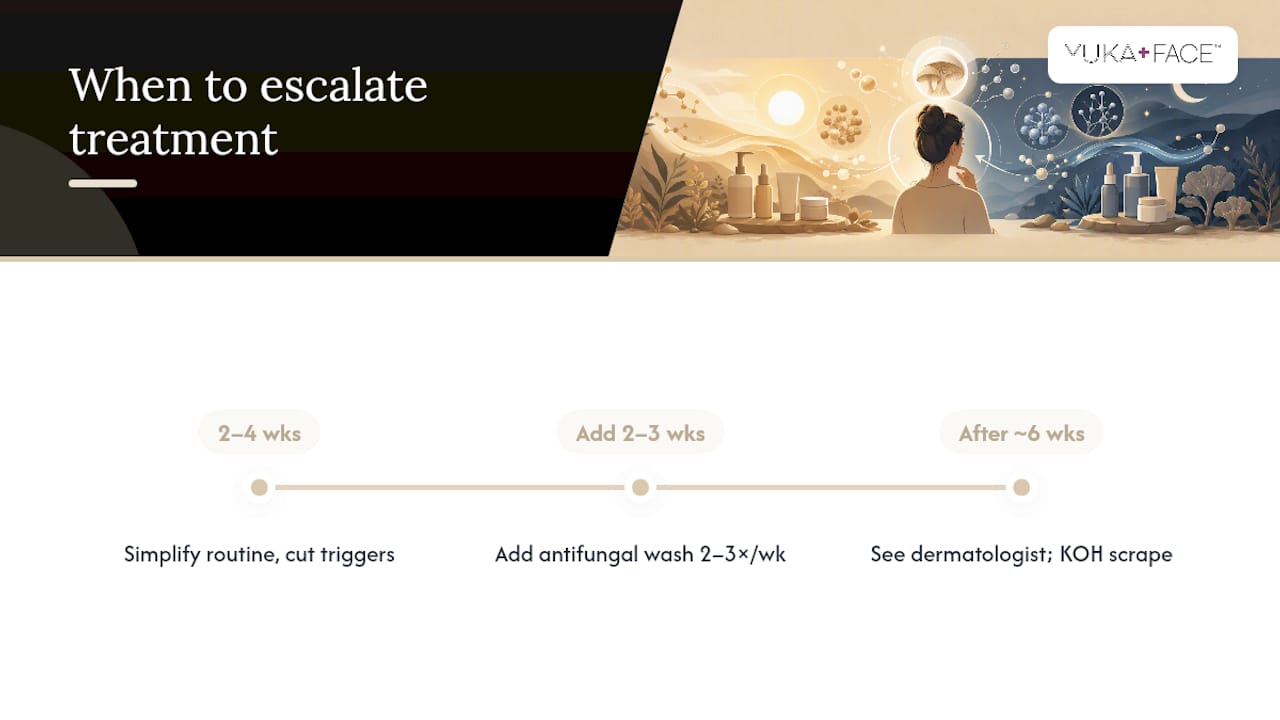
A practical timeline looks like this: simplify your routine and cut trigger ingredients for two to four weeks first. If bumps persist, add a short-contact antifungal wash two to three times a week for another two to three weeks. If you're still seeing no improvement after that, or the rash is spreading, painful, or you're simply unsure what you're treating, book a dermatologist visit. A KOH scrape takes minutes and removes the guesswork entirely.
What Do People Get Wrong About Fungal Acne?
A few myths keep fungal-acne sufferers stuck in unproductive loops. The biggest one: all oils are bad. That's an overcorrection. Squalane and MCT-derived oils are generally well tolerated because their structure doesn't fall into the metabolizable range the way coconut or olive oil does. The issue is specific fatty acid chains, not the word "oil" on a label.
Another common trap: assuming non-comedogenic means fungal-acne-safe. These are separate screening systems measuring separate problems, and a non-comedogenic product can still be loaded with polysorbates or fatty esters.
And no, diet changes alone won't resolve an active flare. Some in vitro research shows certain essential oils have antifungal properties against Malassezia in lab settings, but concentration, formulation, and skin irritation risk make them unreliable as a standalone treatment.
When reintroducing products after a flare clears, go slow: one new product every seven to ten days, patch-tested on a small area first. That pace lets you actually identify what triggers a reaction instead of guessing across five new products at once.
— Kelly
Yuka+Face's Approach to Fungal-Acne-Aware Formulation
Formulating naturally derived skincare while staying mindful of Malassezia triggers takes real deliberateness, since so many beloved plant oils and butters fall directly into the C11 to C24 range. Yuka+Face's vegan, cruelty-free philosophy leans on ingredients chosen for how they perform on skin, not just where they come from, which means favoring humectants like glycerin and hyaluronic acid, and lightweight, non-metabolizable emollients like squalane, over heavier botanical oils in formulas designed for reactive or breakout-prone skin.
A sensible starting regimen keeps things simple: a gentle, water-based cleanser, a hydrating gel-textured moisturizer, and a mineral sunscreen for daytime protection. That's the entire routine for the first few weeks, no extras, no experimentation.
None of this replaces a dermatologist's opinion during an active flare. If bumps are spreading, painful, or unresponsive to two to four weeks of ingredient-conscious care, a clinical diagnosis comes first. Product choices matter most once you actually know what you're treating.
Where to Find Fungal-Acne-Conscious Skincare
You've now got the ingredient logic. The next question is what to actually put on your shelf. Yuka+Face builds its formulas around humectant-forward hydration and lightweight emollients like squalane rather than the heavy plant oils and butters that tend to sit in Malassezia's feeding range, which makes several products in the lineup a natural fit for a fungal-acne-conscious routine.
A morning skincare routine built around gel textures and water-based hydration is the easiest place to start, since morning is when most people layer a moisturizer under sunscreen and unknowingly introduce a trigger ingredient. For a broader look at the formulation choices behind the brand, the guide to vegan skincare principles walks through how ingredient sourcing and skin performance intersect.
One honest note before you shop: no product line, ours included, is a substitute for a dermatologist's diagnosis during an active flare. If you're mid-breakout and unsure whether you're dealing with fungal or bacterial acne, get that answered first. Once your skin is stable, building a routine around clean, water-based formulas becomes a lot easier. Browse the Yuka+Face journal for the full routine breakdown and start with the morning routine guide today.
Sources
- Physiology and lipid dependence of Malassezia species (PMC5456241)
- Review of Malassezia in skin disease (PMC3749459)
- Clinical approaches to pityrosporum folliculitis (PubMed 26597143)
- Cleveland Clinic patient guidance on ceramides
FAQ
What Skincare Should I Use if I Have Fungal Acne?
Choose water-based cleansers, humectants like glycerin and hyaluronic acid, squalane-based moisturizers, and niacinamide or azelaic acid serums, then protect skin with a mineral sunscreen in a water- or silicone-based vehicle.
What Skincare Should I Avoid With Fungal Acne?
Avoid fatty acid esters like isopropyl myristate and isopropyl palmitate, polysorbates 20/60/80, and most triglyceride-based plant oils and butters such as coconut, olive, and shea, since these fall within Malassezia's C11–C24 feeding range.
What Kills Fungal Acne Naturally?
No natural remedy reliably clears fungal acne on its own; some essential oils show antifungal activity against Malassezia in lab studies, but formulation and safety concerns make them unreliable as a standalone treatment compared to clinician-guided antifungal washes.
What Kills Malassezia on the Face?
Topical antifungals like ketoconazole and selenium sulfide, typically used as short-contact washes a few times a week, are the treatments with the clearest clinical backing, ideally combined with a fungal-acne-safe routine and dermatologist guidance for persistent cases.
Is Niacinamide Safe for Fungal Acne?
Yes, niacinamide is one of the most widely recommended actives for fungal-acne-prone skin because it supports the skin barrier and helps regulate sebum without introducing metabolizable fatty acids.