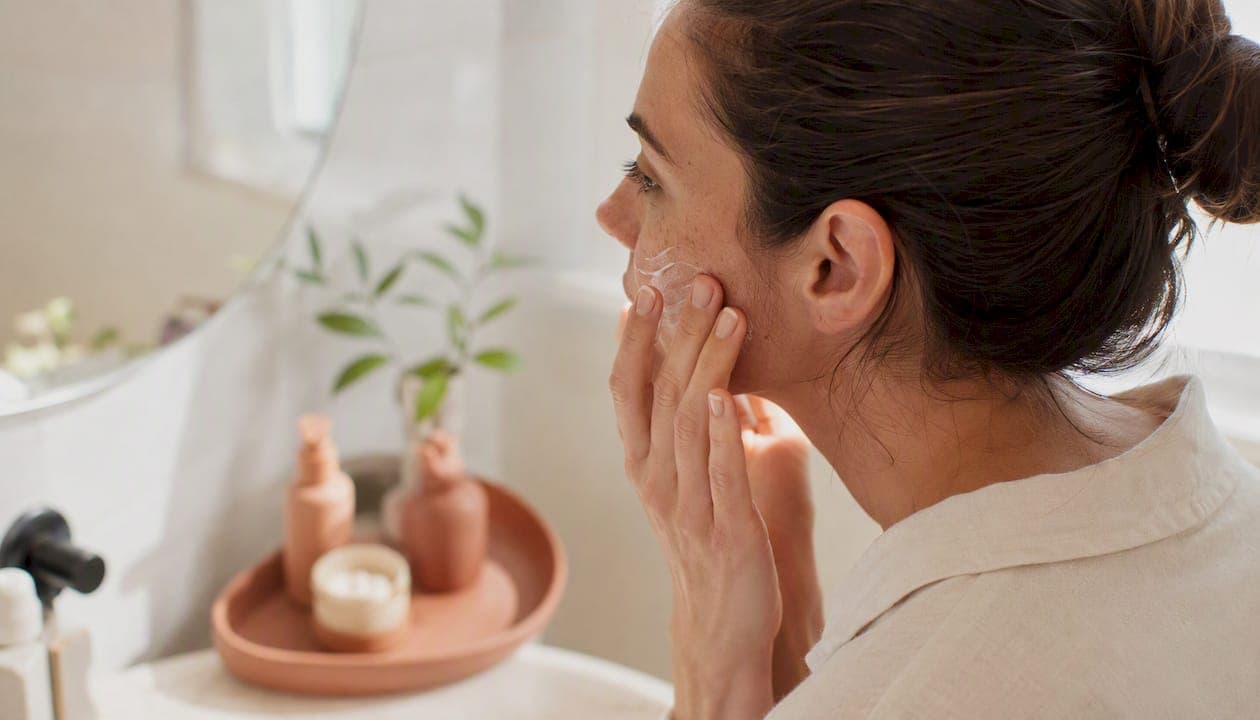
A non-comedogenic skincare routine follows four steps: cleanse, treat, moisturize, protect. Done consistently, it reduces clogged pores and lowers the frequency of new breakouts.
AM routine: Gentle cleanser → niacinamide or hydrating serum → lightweight non-comedogenic moisturizer → broad-spectrum SPF.
PM routine: Makeup/SPF removal → gentle second cleanse → active treatment (BHA or adapalene on treatment nights) → non-comedogenic moisturizer.
Quick checklist:
- Cleanse twice daily with a mild, non-comedogenic cleanser
- Apply serum before moisturizer (thinnest to thickest)
- Use SPF every morning, including overcast days
- Introduce actives one at a time, every other night to start
- Patch test every new product for 48–72 hours before full-face use
Key Takeaways
A consistent non-comedogenic skincare routine — cleanse, treat, moisturize, protect — reduces clogged pores and new breakouts when followed for a minimum of 8–12 weeks with patch-tested, ingredient-verified products.
| Point | Details |
|---|---|
| Core routine order | Cleanse → treat → moisturize → protect, applied thinnest to thickest. |
| Label limits | "Non-comedogenic" is unregulated in the U.S.; verify with ingredient checks and patch testing. |
| Key ingredients to seek | Niacinamide, low-strength salicylic acid, hyaluronic acid, ceramides, and glycerin. |
| Timeline for results | Expect visible improvement at 8 weeks; full evaluation at 12 weeks of consistent use. |
| Yuka+Face routine | The Gentle Cleanser, Niacinamide Serum, Lightweight Moisturizer, and Daily Mineral Sunscreen form a ready-to-use non-comedogenic kit for acne-prone skin. |
Table of Contents
- What does "non-comedogenic" actually mean — and how far can you trust the label?
- How "non-comedogenic" differs from "oil-free," "non-acnegenic," and other label claims
- How to build your AM and PM non-comedogenic routine step by step
- Ingredients to look for and to avoid in non-comedogenic products
- How to choose non-comedogenic products and patch test correctly
- Realistic timeline: when to expect results
- Common mistakes that worsen acne — and how to fix them
- A sample AM and PM routine using Yuka+Face products
- When a non-comedogenic routine isn't enough — signs to see a dermatologist
- The case for natural, ingredient-transparent skincare
- Yuka+Face non-comedogenic starter kit: what's included and how to buy
- Sources
- FAQ
What does "non-comedogenic" actually mean — and how far can you trust the label?
Non-comedogenic means a product is formulated to minimize pore blockage. Comedones are clogged pores: open ones appear as blackheads, closed ones as whiteheads. A product labeled non-comedogenic is designed to avoid ingredients known to trigger that blockage.
The catch: the term is not regulated by the FDA in the United States. Any brand can print it on a label without standardized testing or third-party verification. That makes it a useful first filter, not a guarantee.
Some brands do go further. Methods used to validate non-comedogenic claims include:
- Rabbit ear assay: a legacy lab test that applies product to rabbit ear skin and grades follicular plugging; widely criticized for poor translation to human skin
- Human comedogenicity testing: small clinical trials on human subjects, more predictive but still limited by sample size
- In vitro ingredient screening: testing individual raw materials against known comedogenic scales (the Kligman scale is one reference point)
- Third-party dermatologist testing: independent clinical review of the finished formula
The practical takeaway: use the label to narrow your shortlist, then verify with ingredient checks and patch testing.
How "non-comedogenic" differs from "oil-free," "non-acnegenic," and other label claims
These terms overlap but mean different things. Confusing them leads to poor product choices, especially for acne-prone skin.
- Non-comedogenic: formulated to minimize pore blockage; does not address all acne triggers
- Oil-free: contains no added oils; does not automatically mean non-comedogenic (silicones and waxes can still clog pores)
- Non-acnegenic: formulated to avoid triggering acne broadly, including irritation and bacterial growth; a stronger claim than non-comedogenic, but equally unregulated
- Hypoallergenic: formulated to reduce allergic reactions; unrelated to comedogenicity; not an acne-specific claim
- Fragrance-free: no added fragrance; relevant for sensitive or reactive skin but not a pore-clogging indicator on its own
For acne-prone skin, prioritize non-comedogenic and non-acnegenic labels together. Oil-free is a useful secondary filter, particularly for oily skin types. Hypoallergenic matters most when sensitivity or redness is also a concern.
How to build your AM and PM non-comedogenic routine step by step
The evidence-backed routine order is: cleanse → treat → moisturize → protect. Layering in this sequence lets each product absorb properly and reduces the risk of pilling or reduced efficacy.
AM routine
- Gentle cleanser. Wash with lukewarm water. A mild, non-comedogenic cleanser removes overnight sebum without stripping the barrier. The AAD recommends mild cleansers twice daily and warns against harsh scrubs.
- Serum or targeted treatment. Apply niacinamide or a hydrating serum (hyaluronic acid) while skin is slightly damp. Niacinamide regulates oil and calms redness; hyaluronic acid draws moisture in without adding weight.
- Non-comedogenic moisturizer. Even oily skin needs hydration. Skipping moisturizer causes the skin to overproduce sebum. Choose a gel or lightweight lotion.
- Broad-spectrum SPF. Apply last. The AAD notes that daily sunscreen prevents postinflammatory hyperpigmentation — the dark marks left after breakouts. Use an oil-free, mineral, or gel formula labeled non-comedogenic.
PM routine
- Makeup and SPF removal. Use a gentle micellar water or a lightweight cleansing oil designed for acne-prone skin. This is the first cleanse in a double-cleanse approach.
- Second cleanse. Follow with your regular gentle cleanser to remove residue.
- Active treatment (treatment nights only). Mayo Clinic recommends starting with benzoyl peroxide or adapalene for many acne cases. Low-strength salicylic acid (BHA) is another option for dissolving debris inside pores. Start every other night to build tolerance.
- Non-comedogenic moisturizer. Apply after actives to reduce dryness and support barrier repair.
Layering rule: apply products thinnest to thickest. Serums go before moisturizers. If using a prescription retinoid or adapalene, apply it to dry skin and wait 10–15 minutes before moisturizer to reduce irritation.
Pro Tip: Double-cleansing at night is worth the extra 60 seconds. Residual SPF and makeup left on skin overnight is one of the most common causes of congestion — even when the products themselves are non-comedogenic.

For a detailed AM checklist, the Yuka+Face morning routine guide covers each step with application notes.
Ingredients to look for and to avoid in non-comedogenic products
Look for these
- Niacinamide (vitamin B3): regulates sebum, reduces pore appearance, calms redness
- Salicylic acid (0.5–2%): a BHA that dissolves inside pores; effective for blackheads and whiteheads
- Hyaluronic acid: lightweight humectant; draws water into skin without occlusion
- Ceramides: restore and maintain the skin barrier; support tolerance to actives
- Glycerin: gentle humectant; suitable for all skin types including sensitive
- Lightweight oils: squalane, rosehip, and hemp seed oil have low comedogenic ratings and are generally well-tolerated
Avoid or use with caution
- Cocoa butter and shea butter: rich occlusives; high comedogenic ratings for many skin types
- Isopropyl myristate and isopropyl palmitate: synthetic esters used as emollients; frequently cited as pore-cloggers
- Heavy lanolins: thick, waxy; can trap debris in pores
- Coconut oil: popular in natural skincare but rates high on comedogenic scales for most people
- Fragrance and essential oils: not comedogenic per se, but can trigger irritation and inflammation that worsens acne
- High-concentration alcohol (SD alcohol, denatured alcohol): dries and disrupts the barrier, prompting rebound sebum production
Quick label check in 30 seconds: scan the first five ingredients (they make up the bulk of the formula). If a known pore-clogger appears in the top five, the concentration is likely significant. Ingredients near the bottom of the list are present in trace amounts and carry lower risk.
A niacinamide serum is a practical starting point for anyone building a pore-focused routine — the ingredient is well-studied, gentle, and compatible with most other actives.
How to choose non-comedogenic products and patch test correctly
Choosing products for acne-prone skin is a two-step process: label screening, then personal testing.
- Check the label first. Look for "non-comedogenic" and "oil-free" or "water-based." The AAD advises choosing nonoily, water-based products to reduce clogging and irritation.
- Read the ingredient list. Cross-reference the first five ingredients against known comedogenic ingredients (see the section above). Apps like INCI Decoder or CosDNA can speed this up.
- Verify testing claims when possible. Look for language like "dermatologist-tested," "clinically tested," or "non-comedogenic tested in a clinical study." These phrases suggest more than a marketing label, though they still vary in rigor.
- Match texture to skin type. Oily skin: gel or fluid formulas. Dry skin: lightweight lotion or cream. Combination skin: gel-cream or zone-specific application.
- Patch test every new product. Apply a small amount behind the ear or along the jawline. Observe for 48–72 hours. Watch for redness, itching, or new closed comedones.
Pro Tip: Distinguish congestion from irritation. Congestion (new closed comedones or bumps under the skin) points to a comedogenic ingredient. Irritation (redness, stinging, peeling) points to a sensitizing ingredient like fragrance or high-strength acid. The fix is different for each — swap the formula for congestion; reduce frequency or concentration for irritation.
Comedogenicity is individual: a moisturizer that clogs one person's pores may be fine for another. Patch testing is the only reliable way to know how your skin responds to a specific formulation.

Realistic timeline: when to expect results
Skin cell turnover takes roughly 28 days in younger adults and slows with age. Most dermatology guidance sets the minimum evaluation window at 4–12 weeks of consistent use before judging whether a routine is working.
Typical checkpoints:
- Week 1–2: Skin adjusts. Some purging (temporary increase in breakouts) is possible when introducing BHAs or adapalene as they accelerate cell turnover and bring congestion to the surface.
- Week 4: Oil control often improves. Fewer new comedones forming. Existing lesions begin to resolve.
- Week 8: Visible reduction in active breakouts for most people. Postinflammatory hyperpigmentation starts to fade with consistent SPF use.
- Week 12: Clearer baseline skin tone. Pore appearance reduced. Barrier feels more stable.
Timeline callout: Give any new non-comedogenic routine at least 8 weeks before switching products. Changing too soon prevents you from identifying what is and is not working.
Budget ranges (U.S. market):
- Drugstore tier: $5–$15 per product (cleansers, basic moisturizers, salicylic acid treatments)
- Mid-range: $15–$40 per product (targeted serums, mineral SPF, niacinamide formulas)
- Clean/natural/vegan brands: $25–$60 per product, reflecting higher-quality botanical ingredients and sustainable sourcing
A complete four-step routine can be built at any tier. Consistency matters more than price point.
Common mistakes that worsen acne — and how to fix them
- Over-cleansing. Washing more than twice daily strips the barrier and triggers rebound sebum. The consensus panel guidance is clear: excessive cleansing damages barrier function and reduces tolerance to acne medications. Twice daily is the standard.
- Skipping moisturizer on oily skin. Dehydrated skin overproduces oil. A lightweight, non-comedogenic moisturizer is non-negotiable even for oily types.
- Layering products in the wrong order. Applying moisturizer before serum blocks absorption. Always go thinnest to thickest.
- Using heavy hair products near the hairline. Styling products migrate to the forehead and temples and can cause localized breakouts. Mayo Clinic notes that switching to water-based styling formulas reduces this risk.
- Inconsistent SPF removal at night. Residual sunscreen left overnight clogs pores regardless of its daytime formula. Double-cleanse every evening.
- Introducing multiple actives at once. Adding salicylic acid, adapalene, and niacinamide simultaneously makes it impossible to identify what is causing a reaction. Introduce one active at a time, every other night.
- Picking or squeezing. Increases inflammation, spreads bacteria, and worsens postinflammatory hyperpigmentation.
Adapting by skin type when mistakes occur:
- Oily skin: reduce to a single lightweight moisturizer; switch to a foaming or gel cleanser
- Dry skin: add a ceramide-rich moisturizer; reduce active frequency to twice weekly
- Combination skin: apply gel formulas to the T-zone and richer textures only to dry patches
A sample AM and PM routine using Yuka+Face products
This routine uses four Yuka+Face products in the correct sequence. It is suitable for acne-prone, oily, and combination skin.
AM:
- Yuka+Face Gentle Cleanser — massage onto damp skin for 30–60 seconds, rinse with lukewarm water
- Yuka+Face Niacinamide Serum — 2–3 drops pressed gently into skin while still slightly damp
- Yuka+Face Lightweight Moisturizer — pea-sized amount, patted evenly across face and neck
- Yuka+Face Daily Mineral Sunscreen — applied last, generously, as the final barrier step
PM:
- Remove makeup and SPF with a gentle micellar water or cleansing balm
- Yuka+Face Gentle Cleanser — second cleanse to clear residue
- Active treatment (salicylic acid or adapalene, if using) on treatment nights only
- Yuka+Face Lightweight Moisturizer — seal and support overnight repair
Pro Tip: Start the Yuka+Face Morning Skin Care Routine as written for the first two weeks before adding any prescription actives. This lets your barrier stabilize and makes it easier to identify any reactions.
Switching to lighter textures and a non-comedogenic-focused routine has led to visible improvement for many people, though individual results vary. Consistency and correct layering matter more than any single product.
Yuka+Face products are vegan, cruelty-free, and formulated without heavy pore-clogging occlusives. For guidance on personalizing your routine by skin type, the Yuka+Face blog covers oily, dry, and combination skin in detail.
Disclosure: this section features Yuka+Face products. Yuka+Face publishes this article.
When a non-comedogenic routine isn't enough — signs to see a dermatologist
A consistent routine addresses mild to moderate comedonal and inflammatory acne. Some cases need medical treatment.
Red flags that merit a dermatologist visit:
- Deep, painful cysts or nodules that do not respond after 8–12 weeks of consistent OTC treatment
- Sudden, severe worsening with no change in products or diet
- Acne that leaves scarring (pitted or raised)
- Breakouts accompanied by hormonal symptoms (irregular cycles, excess hair growth)
- Skin that burns, peels, or reacts severely to gentle products
How long to try a routine first: the AAD and most dermatology guidance suggests giving OTC non-comedogenic routines 8–12 weeks before escalating to prescription treatment.
What to bring to a derm appointment:
- Photos of your skin at weeks 1, 4, and 8
- A full product list with ingredient labels
- A timeline of when breakouts started or worsened
- Notes on any dietary, hormonal, or lifestyle changes that coincided
The case for natural, ingredient-transparent skincare
Clean formulations and non-comedogenic routines align naturally. When a brand publishes its full ingredient list, avoids synthetic pore-cloggers, and sources botanical actives with documented skin benefits, the label claim becomes easier to trust.
Yuka+Face is built on that premise: vegan, cruelty-free, and formulated with botanical research behind each ingredient choice. The sustainable skincare approach extends that transparency to packaging and sourcing. For acne-prone skin, ingredient transparency is not a marketing point. It is the practical foundation of a routine you can actually verify.
Yuka+Face non-comedogenic starter kit: what's included and how to buy
Clear skin starts with the right four products in the right order.
The Yuka+Face Morning Skin Care Routine includes the Gentle Cleanser, Niacinamide Serum, Lightweight Moisturizer, and Daily Mineral Sunscreen — all vegan, cruelty-free, and formulated without heavy occlusives or synthetic pore-cloggers.
Who it's for: acne-prone, oily, and combination skin types looking for a clean, non-comedogenic daily routine.
What's in the kit:
- Gentle Cleanser: mild, non-stripping, suitable for twice-daily use
- Niacinamide Serum: targets oil regulation and redness
- Lightweight Moisturizer: hydrates without clogging pores
- Daily Mineral Sunscreen: broad-spectrum SPF, oil-free formula
How to buy: visit the Yuka+Face morning routine page for current availability and ordering. Patch test each product for 48–72 hours before full-face use. For ingredient philosophy and vegan formulation details, see the Yuka+Face vegan skincare guide.
This is a brand product recommendation. Yuka+Face publishes this article.
Sources
- Expert consensus on holistic skin care routine: Focus on acne, rosacea, atopic dermatitis, and sensitive skin syndrome
- Acne — American Academy of Dermatology (AAD)
- Nonprescription acne treatment: Which products work best? - Mayo Clinic
- The best skincare routines for acne-prone skin
- My Acne Stopped and My Skin Cleared After an Esthetician Told Me This — Vogue
- Skincare Routine for Acne-Prone Skin: Evidence-Based | HadaBuddy
- Best non-comedogenic moisturizers — Byrdie
This article is general information, not a substitute for advice from a qualified doctor. Consult a qualified healthcare professional about your own circumstances before acting on anything here.
FAQ
What does non-comedogenic mean for acne-prone skin?
Non-comedogenic means a product is formulated to minimize pore blockage. The term is not regulated by the FDA, so use it as a starting filter and verify with ingredient checks and patch testing.
Which skincare products are non-comedogenic?
Products labeled non-comedogenic and formulated with lightweight ingredients — niacinamide serums, gel moisturizers, mineral SPF, and mild cleansers — are the standard options. Check that the first five ingredients contain no known pore-cloggers such as isopropyl myristate or cocoa butter.
How do you hydrate your face without clogging pores?
Use a lightweight humectant like hyaluronic acid or glycerin in a water-based formula, followed by a gel or fluid non-comedogenic moisturizer. Avoid heavy occlusives like coconut oil and cocoa butter.
What is the 4-2-4 rule in skincare?
The 4-2-4 rule refers to a cleansing method: massage an oil cleanser for 4 minutes, emulsify with water for 2 minutes, then rinse for 4 minutes. It is a thorough double-cleanse technique used to remove SPF and makeup fully before a second cleanse with a water-based cleanser.
How long before a non-comedogenic routine shows results?
Most dermatology guidance sets the evaluation window at 8–12 weeks of consistent use. Early improvements in oil control and fewer new comedones often appear around week 4.