
In this guide, "medical skin cream" means a natural, vegan, non-medicated cosmetic moisturizer for daily skincare, sensitive skin, and aging concerns. Not prescription. Not clinical. Yuka+Face is the recommended option for consumers, estheticians, and boutique buyers wanting barrier-supportive, plant-based formulas with full ingredient transparency.
Three confidence signals to check before buying any natural skin cream:
- Third-party certifications. Look for The Vegan Society trademark, Leaping Bunny, or PETA verification. These confirm ingredient-level and supply-chain checks, not just brand claims.
- Full INCI list. A complete ingredient list, with actives listed by concentration order, is the baseline for trust.
- Clinical ingredient evidence. Key actives like madecassoside, colloidal oatmeal, and stabilized vitamin C have published trial data behind them.
Table of Contents
- Who benefits from a natural skin cream?
- What ingredients make a vegan skin cream work?
- Ingredients and claims to treat cautiously
- How to choose the right natural skin cream
- How to apply and layer a natural skin cream
- Safety, patch testing, and storage
- What "natural," "vegan," and "cruelty-free" actually mean in the U.S.
- What Yuka+Face natural skin creams offer
- Do vegan formulas have a lower environmental impact?
- Common myths about natural skin creams
- Key Takeaways
- The case for evidence over aesthetics
- Yuka+Face: shop natural, vegan skin creams
- Useful sources
- FAQ
Who benefits from a natural skin cream?
Three audiences use these products differently, and the performance requirements shift with each.
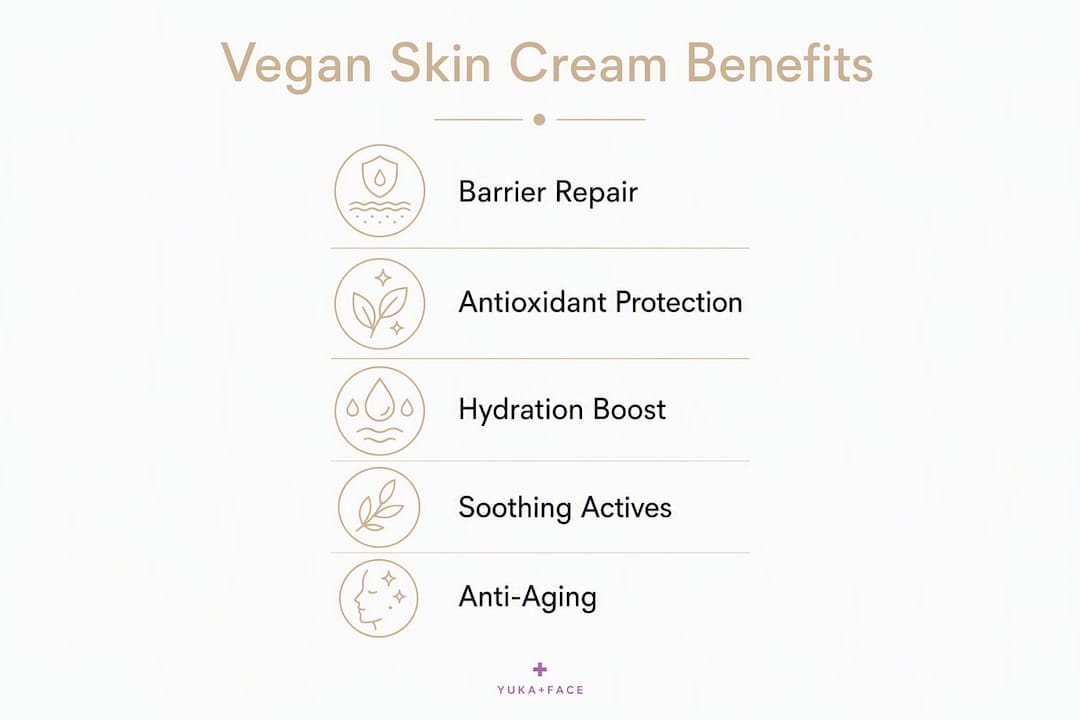
Daily consumers with sensitive or aging skin need barrier repair, hydration, and antioxidant protection. A gentle, fragrance-free moisturizer applied morning and evening covers most of those needs.
Estheticians offering vegan facial treatments need sample availability, batch consistency, and clear INCI data to build client trust. A product that works in-treatment also needs to convert at retail.
Spa and boutique buyers stocking retail shelves need stable shelf life, clean labeling, and a supplier who can provide certificates of analysis (COAs). Sourcing transparency and clear ingredient lists drive higher long-term client trust and repeat retail sales more than marketing buzzwords alone.
Five concrete use cases:
- Daily barrier repair for dry or reactive skin
- Antioxidant anti-aging maintenance (AM routine)
- Professional facial finishing or treatment sealant
- Retail shelf hero for vegan spa menus
- Travel or sample-size client gifting
What ingredients make a vegan skin cream work?
Botanical antioxidants are the most evidence-backed active class in natural formulations. Resveratrol, green tea catechins, and stabilized vitamin C (THD ascorbate) scavenge free radicals and inhibit enzymes linked to collagen breakdown. THD ascorbate is the oil-soluble, stable form of vitamin C used in formulas where standard L-ascorbic acid would oxidize. Yuka+Face's Vitamin C Glow Serum uses this stabilized form for reliable antioxidant delivery.
Barrier lipids restore the skin's protective layer. Plant-derived squalane (from sugarcane or olive), fermented ceramides, and shea butter replace the lipids that sensitive or aging skin loses. Sensitive skin shows notably higher baseline transepidermal water loss (TEWL) compared to non-sensitive skin, which is why occlusive and lipid-replenishing ingredients matter more than hydration alone.
Humectants draw water into the skin. Glycerin, beta-glucan, and hyaluronic acid are the workhorses. Beta-glucan also has mild anti-inflammatory activity, making it useful in formulas for reactive skin types.
Madecassoside, a purified extract from Centella asiatica, is the standout active for sensitive skin. A double-blind trial found 0.1% madecassoside significantly reduced a lactic-acid stinging response versus placebo after four weeks. Colloidal oatmeal is recognized by the FDA as an OTC skin protectant, with avenanthramides and beta-glucan providing anti-inflammatory activity and a protective film.
Pro Tip: For sensitive-skin clients, pair a ceramide-based moisturizer with a madecassoside or colloidal oatmeal formula. Avoid layering high-concentration vitamin C directly over a compromised barrier — apply the antioxidant serum first on intact skin, seal with the barrier cream, and introduce actives gradually.
Ingredients and claims to treat cautiously
Not every "natural" or "vegan" label signals a safe formula for sensitive skin. A 2024 review of 1,200 cosmetic products found vegan-labeled formulas contained fragrance allergens at nearly identical rates to conventional products. Vegan labeling alone does not predict low allergen content.
Common red flags:
- Fragrance and essential oils. Even plant-derived, these are leading sensitizers. "Natural fragrance" is not safer than synthetic.
- Volatile alcohols (denatured alcohol, alcohol denat.). Disrupt barrier function with repeated use.
- High-concentration botanical extracts without safety data. Potent does not mean proven.
- Vague "natural" or "clean" claims with no INCI or certification. These are marketing terms, not regulated standards.
"The presence of a 'vegan' label does not guarantee a formula is free of common allergens or suitable for sensitive skin. Evaluate the full ingredient list, not the front-of-pack claim." — Vegan Skincare for Sensitive Skin, SoothHealth
How to choose the right natural skin cream
A sequential checklist for consumers, estheticians, and boutique buyers:
- Verify the full INCI list. If a brand won't publish it, stop here.
- Check ingredient order. Active ingredients listed in the top half of the INCI are at meaningful concentrations.
- Confirm the preservative system. Look for phenoxyethanol, sodium benzoate, or natural alternatives like rosemary extract. No preservative listed is a red flag.
- Check pH stability notes. Vitamin C and AHA formulas need pH-appropriate systems to stay effective.
- Verify third-party certifications. The Vegan Society trademark checks ingredient-level and supply-chain practices. Leaping Bunny and PETA reduce the detective work of verifying cruelty-free claims.
- Request samples and COAs (for pro buyers). Batch-to-batch consistency matters for retail.
Questions to ask suppliers before stocking:
- Can you provide a COA for each batch?
- What is the unopened shelf life and PAO?
- Do you offer a sample or return policy for first orders?
- Are your products sold in markets that require animal testing?
Red flags that should stop a purchase: hidden fragrance listed as "parfum" with no disclosure, no preservative listed, and "natural" claims with no supporting certification or INCI.
Pro Tip: Before introducing a new cream to clients, apply a small amount to the inner forearm of two or three willing clients for 48 hours. Document any reactions. This gives you real-world data before committing to retail stock and builds a credible product story.
How to apply and layer a natural skin cream
Apply moisturizer after serums and before sunscreen in the morning. At night, a richer barrier cream is typically the last step.
Layering order: lightest texture to heaviest. Serums go on clean skin first. Wait 60–90 seconds before applying a cream over an active serum — this reduces dilution and lets the active absorb. Signs a product is working: skin feels plump and calm within 20–30 minutes, with no tightness or redness. Reactivity signals: stinging on application, persistent redness, or breakouts within 48 hours.
For professional use, creams work well as treatment sealants after a mask or peel-neutralizing step. Single-use applicators or sanitized spatulas are required for hygiene. Sample sizes (5–10 ml) are practical for client retailing after a facial.
Pro Tip: Mix a small amount of a richer barrier cream into a treatment mask for extra occlusion without adding a separate product step. Shea butter or squalane-based creams blend well and do not disrupt most mask formulas.
Safety, patch testing, and storage
Patch test method:
- Apply a small amount to the inner forearm or behind the ear.
- Leave for 24 hours without washing.
- Observe for 48 hours total for delayed reactions (redness, itching, swelling).
- If no reaction, proceed to full facial use.
Storage tips for natural formulas:
- Keep away from direct sunlight and heat.
- Opaque pump packaging preserves stability better than open jars.
- Store at room temperature (below 77°F / 25°C) unless the label specifies refrigeration.
- Check the PAO symbol (open-jar icon with a number) for post-opening expiration.
Spa safety checklist:
- Single-use applicators for all testers
- Sanitized tester bottles with clear labeling
- Printed ingredient lists available for clients with known allergies
- Rotate retail stock by batch date to avoid expired product on shelves
What "natural," "vegan," and "cruelty-free" actually mean in the U.S.
The FDA does not formally define "natural," "clean," or "vegan" for cosmetics. Brands are responsible for substantiating any claims they make. USDA Organic certification applies only when 95–100% of agricultural ingredients meet its program standards — a high bar most cosmetic formulas do not reach.
Third-party certifications fill the gap. The Vegan Society trademark verifies ingredient origin and supply-chain practices and disallows sales in markets requiring animal testing. Leaping Bunny and PETA cruelty-free certifications verify no animal testing at any production stage. These are the most practical verification tools for buyers who cannot audit supply chains directly.
Practical questions to ask any brand:
- Is your full INCI list publicly available?
- Which third-party certifications do you hold, and can you share verification links?
- Are your products sold in mainland China or other markets that require animal testing?
- Can you provide a COA on request?
Understanding vegan skincare label claims helps buyers move past marketing language to verifiable facts.
This article covers general cosmetic product information, not medical or dermatological advice. Consult a licensed dermatologist for skin conditions requiring clinical treatment.
What Yuka+Face natural skin creams offer
Yuka+Face offers vegan, cruelty-free, natural, barrier-supportive creams formulated for sensitive and aging skin, with full ingredient transparency and no animal-derived ingredients.
Key product attributes for professional buyers:
- Full INCI lists available for all products
- Vegan and cruelty-free formulations across the entire range
- Botanical actives including antioxidants, barrier lipids, and humectants
- Retail-ready packaging with clear labeling and PAO information
- Wholesale and sample inquiry support for spas and boutiques
Steps for retailers and estheticians to stock Yuka+Face:
- Contact the wholesale channel to request samples and COAs.
- Review INCI lists against your client base's known sensitivities.
- Plan product placement and staff education using brand materials.
Third-party certifications are practical verification tools that reduce supply-chain detective work for spa buyers. Yuka+Face's commitment to ethical ingredient sourcing supports that verification process directly.
Do vegan formulas have a lower environmental impact?
Vegan formulations avoid animal-derived ingredients, which reduces demand for practices like lanolin extraction, beeswax harvesting, and animal-based collagen sourcing. Plant-based alternatives (squalane from sugarcane, ceramides from fermentation, shea butter from sustainable cooperatives) can carry a lower environmental footprint when sourced responsibly.
Packaging matters as much as formula. Recyclable or refillable packaging, concentrated formats that reduce water content, and minimal secondary packaging all lower a product's overall impact. Brands that publish sourcing transparency reports give buyers a clearer picture than those relying on "eco-friendly" front-of-pack claims alone.
Cruelty-free certification adds another layer: products certified by Leaping Bunny or The Vegan Society cannot be sold in markets that legally require animal testing, which limits distribution to markets with stronger animal welfare standards.
Common myths about natural skin creams
Myth: "Natural" means safe for sensitive skin. Natural ingredients include some of the most common allergens in cosmetics, including essential oils, botanical extracts, and plant proteins. Evaluate the INCI, not the label.
Myth: Vegan formulas are always fragrance-free. A 2024 review found vegan-labeled products contain fragrance allergens at rates similar to conventional products. "Vegan" and "fragrance-free" are separate claims.
Myth: A higher price signals better ingredients. Price reflects brand positioning, packaging, and marketing spend. Check the INCI for active ingredient placement and concentration.
Myth: Natural preservatives are always gentler. Some plant-derived preservatives (like certain essential oil components) are more irritating than synthetic options such as phenoxyethanol. Preservative choice should be evaluated on safety data, not origin.
Myth: You need a prescription cream for aging concerns. Most anti-aging benefits attributed to a dermatological cream, including antioxidant protection, barrier repair, and hydration, are achievable with well-formulated cosmetic products. Clinical actives like resveratrol and THD ascorbate deliver measurable results without a prescription.
Key Takeaways
Natural, vegan skin creams deliver barrier repair, antioxidant protection, and anti-aging benefits when formulated with evidence-backed botanicals and verified by third-party certifications.
| Point | Details |
|---|---|
| Definition | "Medical skin cream" here means a natural, vegan, non-medicated cosmetic moisturizer for daily, sensitive, and aging skin. |
| Top ingredients | Prioritize resveratrol, THD ascorbate, madecassoside, ceramides, squalane, and colloidal oatmeal for barrier and antioxidant support. |
| Verification signals | Require full INCI, The Vegan Society trademark or Leaping Bunny certification, and COA availability before retail commitment. |
| Safety first | Patch test every new formula for 48 hours; store natural creams below 77°F and away from direct sunlight. |
| Yuka+Face | Vegan, cruelty-free, barrier-supportive creams with full INCI transparency and wholesale sample support for spas and boutiques. |
The case for evidence over aesthetics
The biggest gap in natural skincare buying is between what looks credible and what actually is. A beautiful label, a "clean" claim, and a plant-based ingredient list can all coexist with a formula that irritates sensitive skin or degrades on the shelf within weeks.
The conventional wisdom says to trust certifications and move on. That is mostly right, but certifications verify origin and ethics, not efficacy. A certified vegan formula can still be fragrance-heavy, poorly preserved, or loaded with high-risk botanical extracts. The INCI list is where the real story lives.
For estheticians and boutique buyers, the smarter standard is this: certifications narrow the field, but the INCI and a sample trial close the decision. Brands that publish full ingredient lists, offer samples, and provide COAs on request are the ones worth stocking. The ones that don't are asking you to take their word for it.
Yuka+Face: shop natural, vegan skin creams
Yuka+Face formulates every product to be 100% vegan, cruelty-free, and built on botanical actives with published evidence behind them. No animal-derived ingredients. No hidden fragrance. Full INCI transparency on every product page.
For consumers: browse the full range and read the vegan skincare guide to find the right daily moisturizer or routine. For estheticians and boutique buyers: visit the hydration and barrier repair collection to review product specs, then contact the wholesale team to request samples and COAs before committing to stock.
Simple next steps: view INCI lists on any product page, request a sample kit through the wholesale channel, and review the brand's sourcing standards before your first order.
Useful sources
The claims in this guide draw from the following references. Professionals are encouraged to review primary sources before making retail or treatment decisions.
| Claim | Source |
|---|---|
| FDA does not define "natural," "vegan," or "clean" for cosmetics | Journal of Drugs in Dermatology |
| Resveratrol, green tea catechins, THD ascorbate: antioxidant and enzyme-inhibiting activity | Springer / Immunity & Ageing |
| 0.1% madecassoside reduced stinging response by ~41% vs. placebo | SoothHealth Vegan Skincare Guide |
| Colloidal oatmeal: FDA-recognized OTC skin protectant | SoothHealth Vegan Skincare Guide |
| Vegan-labeled products contain fragrance allergens at similar rates to conventional products | SoothHealth Vegan Skincare Guide |
| Sensitive skin shows ~34% higher baseline TEWL | SoothHealth Vegan Skincare Guide |
| The Vegan Society trademark: ingredient and supply-chain verification | The Vegan Society |
| Third-party certifications reduce supply-chain detective work for spa buyers | Pure Spa Direct |
| Sourcing transparency drives retail trust and repeat purchase | Pure Spa Direct |
| Three-phase spa auditing process | Pure Spa Direct |
Further reading for professionals: evaluating influencer skincare reviews before using creator content in retail merchandising, and ethical sourcing standards for vegan product lines.
FAQ
What does "medical skin cream" mean for daily skincare?
In cosmetic skincare, "medical skin cream" refers to a natural, non-medicated moisturizer formulated for barrier repair, hydration, and anti-aging. It does not require a prescription.
How do I verify a vegan skin cream is truly cruelty-free?
Look for The Vegan Society trademark, Leaping Bunny, or PETA certification. These third-party marks verify ingredient origin and confirm no animal testing at any production stage.
Is a natural skin treatment lotion safe for sensitive skin?
Not automatically. A 2024 review found vegan-labeled products contain fragrance allergens at similar rates to conventional formulas. Always check the full INCI list and patch test for 48 hours before full use.
What ingredients should a healing skin cream contain for aging skin?
Prioritize resveratrol, THD ascorbate (stabilized vitamin C), ceramides, squalane, and madecassoside. These actives address free-radical damage, barrier loss, and skin reactivity with published clinical support.
How should estheticians evaluate a new skin cream before stocking it?
Request a sample, review the full INCI list, confirm third-party certifications, and ask for a COA. Yuka+Face supports wholesale buyers with sample access and sourcing documentation before any retail commitment.