Not all alcohol in toner is a problem, but the kind matters more than the label suggests. Short-chain alcohols like Alcohol Denat., ethanol, and SD Alcohol can strip the skin's barrier and are a poor match for dry or sensitive skin, while fatty alcohols like cetyl or stearyl alcohol are gentle emollients with the opposite effect. Oily skin can sometimes tolerate a low-to-moderate dose of drying alcohol, but rebound oiliness is a real trade-off. When in doubt, check the ingredient list and lean alcohol-free.
TL;DR:
- High concentrations of short-chain alcohols like Alcohol Denat. and ethanol in the first five ingredients increase the risk of barrier damage and moisture loss, especially for sensitive or dry skin.
- Fatty alcohols such as cetyl and stearyl alcohol are gentle emollients that improve skin softness and are not harmful, unlike volatile alcohols.
- Formulations with humectants like glycerin or hyaluronic acid can cushion the drying effects of alcohol and reduce irritation, making mid-range alcohol formulas more tolerable.
- Dry, sensitive, eczema-prone, or rosacea skin should avoid alcohol-based toners altogether to prevent worsening barrier compromise.
- Oily or acne-prone skin may tolerate low-alcohol toners, but formulas with niacinamide or gentle BHA are preferable for oil control without rebound oiliness.
Table of Contents
- Types of Alcohol You'll Find on a Toner Label
- What Alcohol Actually Does to Skin: Benefits and Harms
- Which Skin Types Should Avoid Alcohol Toners (and Which Can Use Them)
- How to Choose a Toner: A Label-Reading Checklist
- Our Take on Alcohol-Free Formulation
- Meet a Toner Built Around What Skin Actually Needs
- Sources
- FAQ
Types of Alcohol You'll Find on a Toner Label
The word "alcohol" covers two very different ingredient families, and mixing them up is the single biggest reason shoppers avoid toners that would actually help them.
Short-chain, volatile alcohols are the drying kind. They show up under a handful of names, and once you know them, spotting a high-alcohol toner takes seconds:
- Alcohol Denat. (denatured alcohol, added to discourage drinking it)
- Ethanol and SD Alcohol (SD stands for "specially denatured")
- Isopropyl alcohol, more common in older astringents than modern toners
These evaporate fast, which is exactly why formulators use them: they help a toner feel weightless, dry down quickly, and act as a solvent that carries other actives into the skin.
Fatty alcohols are the opposite story. Cetyl alcohol, stearyl alcohol, and cetearyl alcohol are derived from fatty acids, and they behave like emollients rather than solvents, smoothing and softening rather than stripping. Seeing one of these on a label is not a red flag.
Witch hazel deserves a special mention. Most commercial witch hazel extracts contain ethanol at roughly 14 to 15 percent unless the bottle explicitly says "alcohol-free," which makes a lot of "natural" toners more of an astringent than shoppers expect.
Ingredient lists are ranked by concentration, so position tells you almost everything. If Alcohol Denat. or Alcohol shows up in the first five ingredients, treat the formula as high-alcohol and proceed with some caution.
What Alcohol Actually Does to Skin: Benefits and Harms
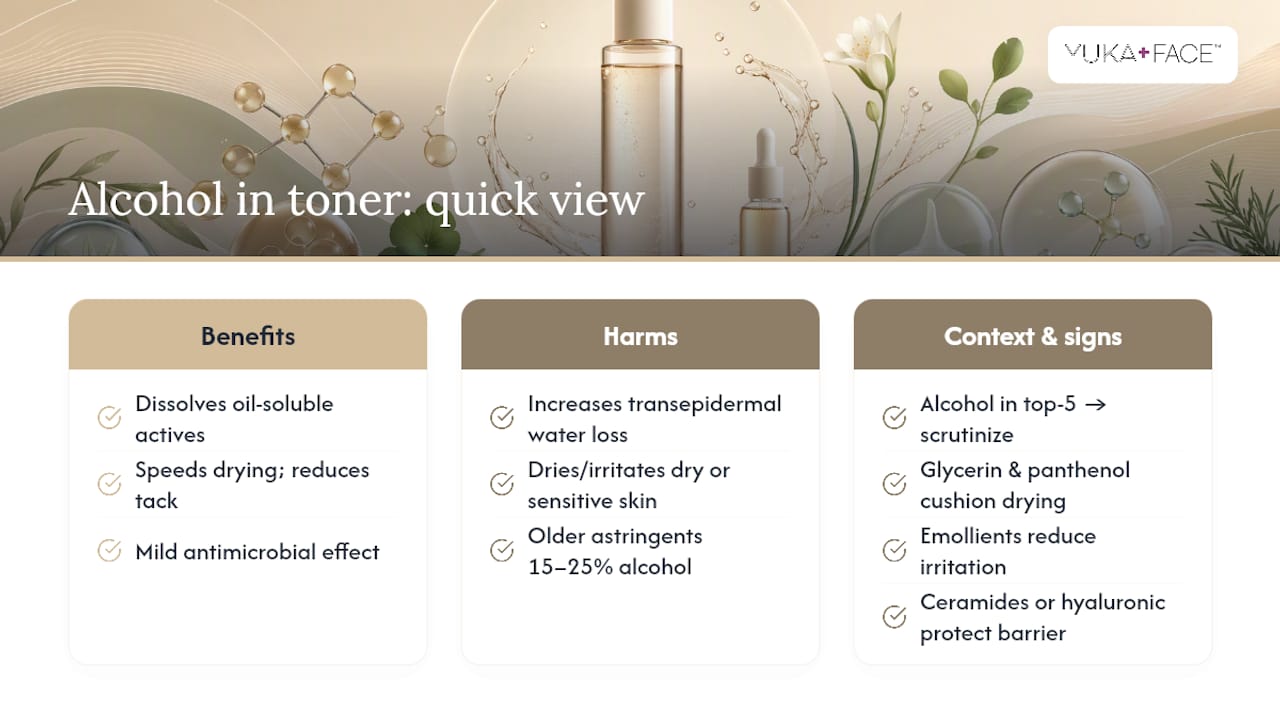
Alcohol earns its place in a formula for practical reasons. It dissolves oil-soluble ingredients that water alone can't carry, it helps a toner sink in and dry within seconds instead of leaving a tacky film, and in some formulas it contributes a mild antimicrobial effect that supports the product's preservation system.
The harm side of the ledger is where things get more serious. Research reviewed by the Cosmetic Ingredient Review indexed on PubMed links short-chain alcohols at high concentrations to measurable increases in transepidermal water loss, the technical term for how fast moisture escapes through a compromised barrier. Dermatologists interviewed by Byrdie describe Alcohol Denat. as offering little intrinsic skin benefit on its own, and they generally advise against it for dry or sensitive skin because of that drying, sometimes irritating effect.
Concentration signal: Older-style astringent toners often ran 15 to 25 percent alcohol, a range where barrier stress becomes far more likely. Anything with alcohol among the top five ingredients on a leave-on toner deserves the same scrutiny, even without a printed percentage.
Formulation context changes the math, though. A toner with a modest dose of ethanol plus glycerin and panthenol behaves very differently on skin than a stripped-down astringent with no humectants at all, because those supporting ingredients cushion the drying effect. Small trials on alcohol-containing formulas back this up: adding emollients measurably reduces irritation compared to alcohol used alone. The presence of ceramides, hyaluronic acid, or panthenol further down the list is a good sign the brand built-in some protection rather than relying on alcohol to do all the work.
Which Skin Types Should Avoid Alcohol Toners (and Which Can Use Them)
Your skin type decides more here than any other factor, so start there before you shop.
- Dry, sensitive, eczema-prone, or rosacea-prone skin: avoid alcohol-forward toners entirely. The barrier is already compromised, and short-chain alcohols make transepidermal water loss worse, not better.
- Oily or acne-prone skin: a low-alcohol formula may be tolerable in small doses, but watch for the rebound effect, where stripped skin overproduces oil to compensate.
- Combination skin: spot-apply a light alcohol toner only to the T-zone, and use an alcohol-free, hydrating toner everywhere else.
- Normal skin with no history of sensitivity: the most flexible group, but still worth watching for early warning signs.
Pro Tip: Patch-test any new toner on a one-inch patch of your inner forearm, watch for immediate stinging over 48 hours and delayed irritation up to 72 hours, and stop at the first sign of persistent redness or flaking.
Stinging that fades in seconds is normal for some actives. Tightness that lingers for hours, new flaking, or redness that shows up a day later means the barrier is under stress. If that persists for more than a week, or if you already have a diagnosed condition like dermatitis, it's worth a conversation with a dermatologist rather than pushing through.
How to Choose a Toner: A Label-Reading Checklist
Reading a toner label takes less time than reading a nutrition label, once you know what you're scanning for.
Watch for Alcohol Denat., SD Alcohol, Ethanol, or Isopropyl Alcohol anywhere in the first five ingredients. That position is your clearest concentration clue, no percentage required. Favor formulas where humectants and skin-identical ingredients rank higher instead, since that ordering tells you what the product is actually built around.
- For dryness: look for glycerin or hyaluronic acid near the top of the list.
- For oil control without stripping: niacinamide, azelaic acid, or a gentle BHA do the job that alcohol used to.
- For redness or reactivity: centella asiatica or green tea extract calm rather than dry.
- For routine timing: apply toner to slightly damp skin right after cleansing, and skip pairing a high-alcohol toner with retinoids or strong exfoliants on the same night, since that combination compounds barrier stress.
| Watch out for | Prefer instead |
|---|---|
| Alcohol Denat., SD Alcohol, or Ethanol in the top five ingredients | Glycerin, hyaluronic acid, or panthenol near the top |
| Fragrance-heavy astringents with no humectants | Ceramide or niacinamide-forward formulas |
| Isopropyl alcohol for "quick dry" | Lightweight essences that absorb without solvents |
Clinical consumer guidance from the Cleveland Clinic echoes this same pattern: water-based, alcohol-free toners with humectants for dry skin, and BHAs or niacinamide for oil control, instead of a high-alcohol astringent doing double duty.
Our Take on Alcohol-Free Formulation
Some brands build toners around humectants, not solvents, because a barrier that's intact does more for oil balance and hydration than a quick-dry finish ever will. That preference shows up consistently across our formulas, guided by a philosophy that skin doesn't need to be stripped to be balanced. The guidance above isn't separate from how we formulate. It's the reasoning behind it.
— Kelly
Meet a Toner Built Around What Skin Actually Needs
The Lavender Essence Balancing Toner skips short-chain alcohol entirely and leans on humectants and soothing botanicals instead, the same combination this article points to for protecting the barrier while still balancing oil and texture.
That makes it a fit for sensitive, dry, and combination skin alike: hydrating enough for a compromised barrier, calm enough for reactive skin, and light enough that combination skin won't feel weighed down in the T-zone. Pat it onto damp skin right after cleansing, before serum, and let it absorb for a few seconds. If you're rebuilding a routine around barrier support rather than stripping, browse the full Yuka+Face shop for the rest of the lineup, or start with the toner itself and see how your skin responds over the next two weeks.
Sources
- Safety assessment of denatured alcohols and SD alcohols in cosmetics (CIR / PubMed indexed review)
- Byrdie — Is alcohol denat harmful for skin? Expert perspectives
- Cleveland Clinic — What does toner do?
FAQ
Is alcohol in toner bad for your skin?
It depends on the type. Short-chain alcohols like Alcohol Denat. or ethanol can increase water loss and disrupt the barrier at high concentrations, while fatty alcohols like cetyl or stearyl alcohol are gentle emollients that pose no such risk.
Is it safe to use alcohol as a toner?
Straight rubbing alcohol or high-percentage isopropyl alcohol is too harsh for regular skincare use. A toner with a small amount of drying alcohol balanced by humectants is a different, generally milder situation.
What ingredients should not be in toner?
For dry or sensitive skin, avoid toners listing Alcohol Denat., SD Alcohol, or Ethanol among the first five ingredients, along with high fragrance loads and harsh astringent extracts with no supporting humectants.
Which alcohol to avoid in skincare?
Avoid short-chain, volatile alcohols, Alcohol Denat., SD Alcohol, ethanol, and isopropyl alcohol, especially if your skin is dry, sensitive, or prone to eczema or rosacea. Fatty alcohols like cetyl and stearyl are not the same category and don't need the same caution.
Are alcohol-free toners better for oily skin?
Not automatically. Oily skin can sometimes tolerate a low-alcohol formula, but alcohol-free options built with niacinamide or a gentle BHA often control oil without the rebound oiliness that comes from stripping the barrier.