
A toner preps skin, resets pH after cleansing, and clears leftover residue. An essence delivers concentrated hydration and active ingredients that target dullness or rough texture. Dermatologists and cosmetic chemists draw that line consistently, and it's the one worth remembering when you're standing in front of a shelf full of near-identical bottles.
If you run a minimalist routine, one well-chosen hydrating product usually covers you. If you're layering for dry skin, sun damage, or textural repair, both earn a spot.
- Toner = prep, pH balance, light exfoliation
- Essence = concentrated hydration, active delivery, K-beauty roots
- Bottom line: pick one for simplicity, use both for targeted repair
Key Takeaways
Toner preps and balances skin while essence delivers concentrated hydration and active ingredients, and most routines don't require both to work well.
| Point | Details |
|---|---|
| Core distinction | Toner preps, cleanses, and balances pH; essence hydrates deeply and delivers actives. |
| Routine order | Apply toner first, essence second, then serum and moisturizer, thinnest to thickest. |
| Skip stacking acids | Avoid layering multiple exfoliating acids across toner, essence, and serum at once. |
| Both aren't mandatory | One hydrating step suffices for minimalist routines; layer both for dry or textured skin. |
| Yuka+Face fit | The Lavender Essence Balancing Toner combines both roles; the Simple Radiance Trio builds a full routine around it. |
Table of Contents
- Toner vs Essence: What a Toner Actually Does
- What Is an Essence in a Skincare Routine?
- Toner vs Essence: Key Differences at a Glance
- How to Use Toner and Essence Together
- Should You Use Toner, Essence, or Both?
- Ingredients to Look for in Toner vs Essence
- How Yuka+Face Approaches Toner vs Essence
- What Skincare Enthusiasts Get Wrong About This Debate
- Try the Yuka+Face Approach to Toner and Essence
- Sources
- FAQ
Toner vs Essence: What a Toner Actually Does
A toner is a lightweight liquid applied right after cleansing to rebalance skin's pH and sweep away anything your cleanser missed. That's its job now. Decades ago, toners existed mainly to strip residual soap and correct alkalinity; today's versions do far more, and three functional types dominate the category.
- Hydrating toners — lightweight humectants for daily moisture top-off
- Exfoliating (acid) toners — glycolic, lactic, or salicylic acid for texture and clarity
- Cleansing/clarifying toners — witch hazel or mild astringents for oil control
Look for glycerin and hyaluronic acid in hydrating versions, AHAs or BHA in exfoliating ones. Skip formulas heavy on alcohol denat, which tends to strip rather than balance. Texture ranges from watery liquid to fine mist, and application runs from a soaked cotton pad to a few pats straight from your palms.
What Is an Essence in a Skincare Routine?
An essence is a lightweight but concentrated liquid built to hydrate deeply and carry active ingredients deeper into skin than a typical toner reaches. It's the step most Western routines lacked until Korean beauty brought it into the mainstream, and the K-beauty tradition still shapes how essences are formulated, often centered on fermented extracts meant to support the skin barrier.
- Texture: watery to slightly viscous, dispensed by pump, dropper, or mist
- Application: poured into palms and pressed in, or patted directly onto damp skin
- Best for: dryness, early aging, dullness, rough texture
- Common actives: fermented ingredients, niacinamide, hyaluronic acid, peptides
Essences generally feel richer than toners on the skin, even when both look equally watery in the bottle, because of higher humectant concentration.
Toner vs Essence: Key Differences at a Glance
The functional split comes down to this: toners prep and balance, essences hydrate and deliver treatment. But the line blurs constantly, since many brands use the labels inconsistently, and a product's ingredient list tells you more than its name ever will.
- Primary purpose: toner preps and balances; essence hydrates and treats
- Texture: toner is typically thinner and more watery; essence often feels slightly thicker
- Routine placement: toner comes right after cleansing (step 2); essence follows (step 3), before serum
- Common actives: toner leans on acids or astringents; essence leans on ferments, peptides, niacinamide
- Best for: toner suits oily or acne-prone skin needing pH reset; essence suits dry or aging skin needing deep hydration
- Frequency: both typically apply twice daily, morning and night
Some newer formulas blend both functions into a single product, so don't assume a "toner" can't hydrate deeply or that an "essence" can't gently exfoliate. Read the ingredient panel before you decide what a bottle is actually for.
How to Use Toner and Essence Together
The rule that governs layering order is usually to apply from thinnest to thickest, so toner goes first, essence second, then serum and moisturizer last. Getting the sequence wrong may risk trapping a heavier product under a thinner one, which can block absorption.
- Cleanse skin and pat mostly dry.
- Apply toner: soak a cotton pad and sweep gently, or pour a coin-size amount into your palms and press onto your face.
- Wait 30 to 60 seconds for the toner to absorb.
- Apply essence: pour a few drops into your hands and press into skin in gentle layers rather than rubbing.
- Follow with serum, then moisturizer, sealing in both hydrating steps.
This layering approach, sometimes called "moisture sandwiching," works well for dry or dehydrated skin that needs multiple thin hydration layers rather than one heavy cream. It's not mandatory for everyone.
Pro Tip: Pat products in with warm fingertips instead of rubbing with cotton. The warmth and pressure improve absorption and cause less friction, which matters if your skin barrier is already compromised.
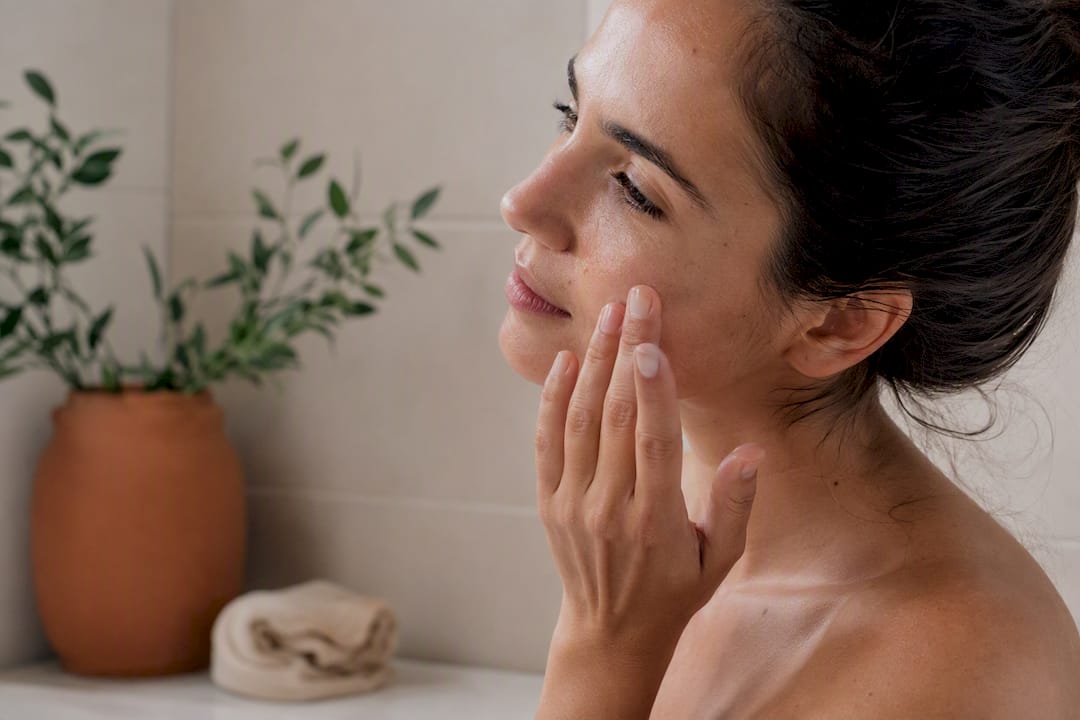
One safety note worth repeating: don't stack multiple exfoliating acids across your toner, essence, and serum in the same routine. That combination raises irritation risk fast. If you're introducing a new acid toner or active-heavy essence, patch test on your inner arm for a few days first, and give actives about 60 seconds between layers to actually absorb.
Should You Use Toner, Essence, or Both?
You don't necessarily need both. What matters most is your skin type, how many other hydrating products already sit in your routine, your budget, and how many layers your skin can comfortably tolerate.
- Oily or acne-prone skin: a lightweight exfoliating or clarifying toner is often enough on its own
- Dry or dehydrated skin: an essence delivers more sustained hydration; add a hydrating toner if you want extra prep
- Sensitive skin: choose one gentle, fragrance-free hydrating product rather than layering two
- Mature or aging skin: an essence with peptides or ferments plus a hydrating toner supports both barrier and texture
- Textured or rough skin: a mild exfoliating toner a few times a week, paired with a soothing essence daily
Run through this quick checklist before buying either product:
- How many minutes can you realistically spend on your routine each day?
- Does your current serum or moisturizer already deliver strong hydration?
- Are you already using an exfoliating acid elsewhere in your routine?
- Is your main goal prep and balance, or deep treatment and hydration?
Can an essence replace a toner? Often, yes, if your toner's only job was hydration. If your toner exfoliates or clarifies, an essence won't do that work. And a single well-formulated hydrating step can be plenty for a minimalist routine. Layering both makes more sense for very dry skin or specific treatment goals like fading texture or dullness.
Ingredients to Look for in Toner vs Essence
Match the ingredient class to the job you need done: humectants hydrate, acids exfoliate, ferments and peptides support barrier repair and texture.
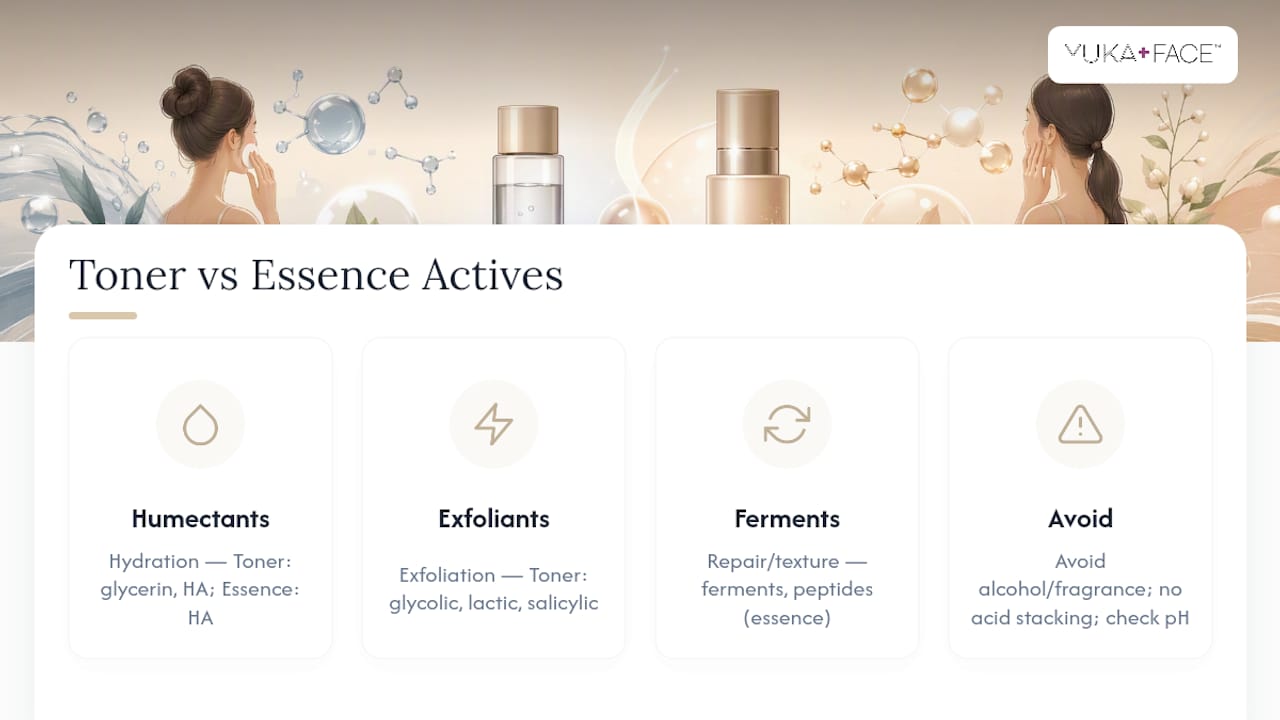
In toners, look for glycerin and hyaluronic acid for hydration, glycolic, lactic, or salicylic acid for exfoliation, and panthenol or centella asiatica for soothing. In essences, look for fermented extracts, niacinamide, peptides, hyaluronic acid, and botanical filtrates.
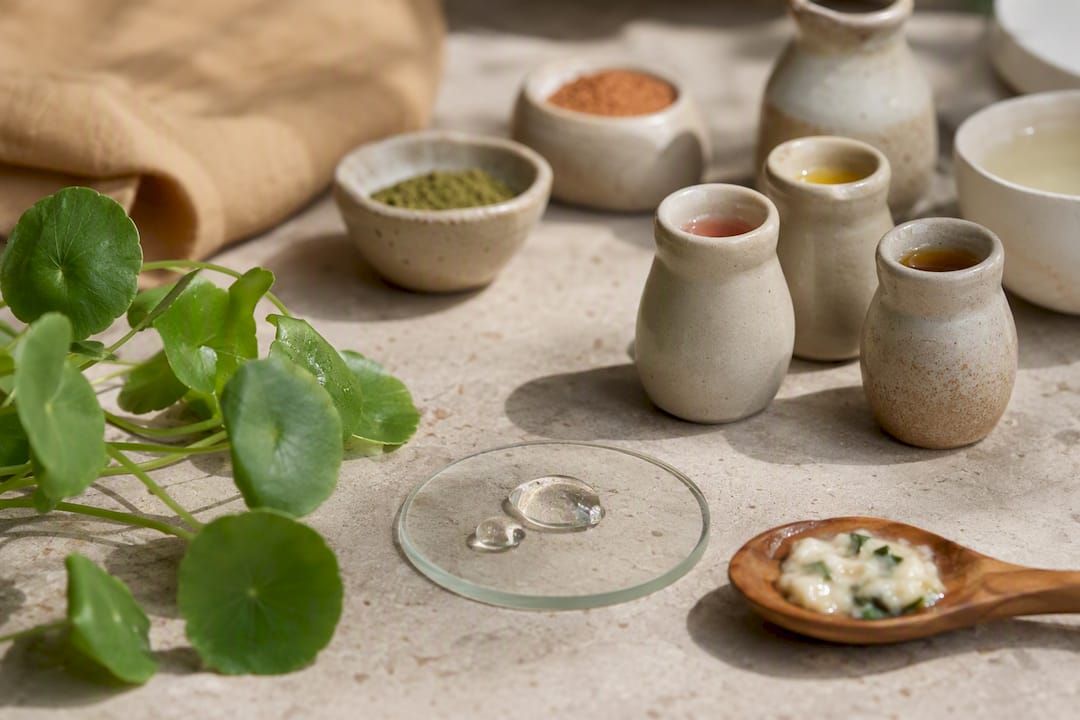
Avoid high concentrations of alcohol, added fragrance if your skin reacts easily, and stacking two or more exfoliating acids across different products in the same routine, since that overlap is a common cause of unexpected irritation. Understanding pH's role in skincare also helps explain why a pH-balanced exfoliating toner performs more predictably than one with no pH indication at all.
Pro Tip: Scan the ingredient list top to bottom before checking the product name. Ingredients are listed by concentration, so what's near the top tells you more about what the product actually does than the word "toner" or "essence" on the label.
How Yuka+Face Approaches Toner vs Essence
Yuka+Face builds every formula around natural, vegan, cruelty-free ingredients, so whichever step you add to your routine, hydration and barrier support come without synthetic filler.
The Lavender Essence Balancing Toner covers both roles at once: it balances pH like a toner while delivering the calming hydration you'd expect from an essence, making it a practical starting point if you want simplicity over a multi-step lineup. For a fuller routine, the Simple Radiance Trio pairs that balancing step with complementary products to cover cleansing and hydration in one curated set.
Quick buyer checklist:
- Want one product that handles prep and hydration? Start with the Lavender Essence Balancing Toner.
- Want a complete routine without guessing what pairs well? The Simple Radiance Trio bundles the essentials.
- Building a full morning routine? Layer the toner before serum and moisturizer, per the steps above.
What Skincare Enthusiasts Get Wrong About This Debate
Most people treat toner and essence like a hierarchy, assuming essence is the "upgraded" version of toner. That's not accurate. They solve different problems, and the confusion mostly traces back to brands slapping either label on formulas that don't fit the traditional definition of either one.
The bigger miss is skipping the ingredient list entirely and buying based on marketing language. A product called "essence" with mostly water and fragrance isn't doing more for your skin than a well-formulated toner with glycerin and centella. Conventional advice tends to push a rigid seven-step routine as the goal, but that pressure leads people to buy products they don't need instead of solving the actual skin concern in front of them.
What should you prioritize? Start with what your skin is missing, hydration, exfoliation, or barrier support, and pick the product whose ingredients actually address it. A single well-chosen multi-function product, like a balancing toner that also hydrates, often beats two mediocre separate steps. Simplicity backed by the right ingredients outperforms a longer routine assembled out of habit.
Try the Yuka+Face Approach to Toner and Essence
Instead of guessing which of a dozen serums and treatments belongs in your routine, Yuka+Face builds that decision into the product itself. The Lavender Essence Balancing Toner covers pH balance and hydration in one step, so you're not buying two bottles to solve one problem.
If you want a complete routine without piecing it together yourself, the Simple Radiance Trio bundles cleansing and hydration steps that are formulated to work together, all vegan and cruelty-free. It's a straightforward way to skip the trial-and-error most people go through when building a skincare routine from scratch.
Ready to simplify your routine? Visit the Lavender Essence Balancing Toner product page to see how it fits into your current lineup, or explore the full morning skin care routine guide for layering guidance built around Yuka+Face products.
Sources
- Stop Confusing Toners and Essences—Here’s the Difference | NewBeauty
- What’s the Difference Between Toners and Essences? | The Strategist
- Toner vs Essence - Byrdie
- Demystifying K-Beauty: Essence vs. Toner vs. Ampoules
FAQ
Which Is Better, Toner or Essence?
Neither is universally better. Toner suits pH balance and light exfoliation, while essence suits deep hydration and active delivery, so the right choice depends on your skin's specific needs.
Do I Need Both Essence and Toner?
Not always. A single hydrating product can work for minimalist routines, while both together benefit dry, aging, or textured skin that needs extra layered hydration.
Can You Replace Toner With Essence?
Yes, if your toner's only function was hydration. If your toner also exfoliates or clarifies, an essence won't replicate that specific job.
Do I Need Toner if I Have Essence?
Not necessarily. If your essence already balances and hydrates, like the Lavender Essence Balancing Toner from Yuka+Face, you can skip a separate toner step entirely.