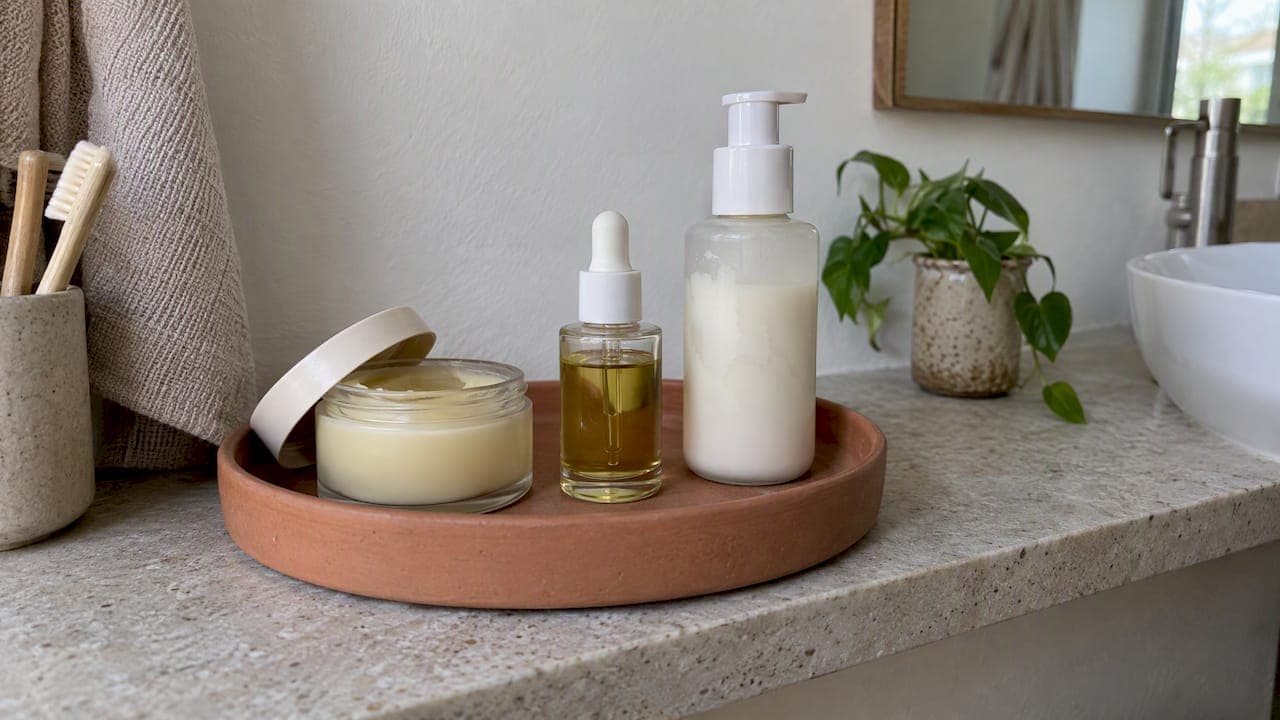
Waterless skincare can deliver real advantages: higher concentrations of oil-soluble actives, stronger barrier support for dry or reactive skin, and a lighter environmental footprint in shipping and packaging. The trade-offs matter too. Many well-studied actives, including niacinamide and standard hyaluronic acid, need water to work, and removing water from a formula does not erase the water used to grow and process raw ingredients.
TL;DR:
- Waterless skincare concentrates on oil-soluble actives, offering higher potency and better barrier support, especially for dry, sensitive, or aging skin.
- Removing water limits the inclusion of water-soluble actives like niacinamide and hyaluronic acid unless reformulated into oil-soluble or powdered formats.
- Anhydrous products naturally resist microbial growth due to low water activity but still require careful packaging to prevent oxidation and contamination.
- These formulas are typically heavier, less precise to apply, and often cost more upfront, but smaller amounts can last longer, influencing actual cost over time.
- Their environmental advantage mainly lies in lighter shipping and packaging, but upstream ingredient production and sourcing impact sustainability more significantly.
Table of Contents
- What waterless skincare is and why water is used in conventional formulas
- Core skin benefits: potency, barrier support, and suitability for sensitive or aging skin
- Formulation science: water activity, preservatives, and stability
- Common waterless formats and key ingredients, and how to read labels
- Sustainability benefits and the lifecycle caveats worth knowing
- Who benefits most and how to add waterless products to your routine
- Common misconceptions and safety caveats worth knowing
- Why we formulate with this science in mind
- Comparing efficacy: waterless versus water-based, by the evidence
- Potential drawbacks and limitations to weigh before switching
- Cost comparison: waterless versus conventional products
- An honest take on the waterless skincare trend
- Where Yuka+Face fits into a waterless-friendly routine
- FAQ
- Sources
What waterless skincare is and why water is used in conventional formulas
Waterless or anhydrous skincare means a product formulated with little to no water, relying instead on oils, butters, waxes, and powders as the base. Low-water formulas sit somewhere between: they include a small amount of water or none at all, concentrated into balms, bars, or pressed serums.
Conventional skincare is built around water for practical reasons. Water dissolves water-soluble actives, creates the light, spreadable textures people expect from lotions and gels, and helps certain humectants pull moisture into the skin. Traditional cosmetic formulas typically consist largely of water, often making up most of the formulation, acting mainly as a filler and solvent rather than an active ingredient itself.
Common waterless and low-water formats include:
- Cleansing balms and solid bars that melt on contact with skin.
- Oil serums that deliver concentrated lipids and oil-soluble vitamins.
- Powdered cleansers or masks activated with a small amount of water at the point of use.
- Pressed or stick formats for moisturizer, sunscreen, or spot treatment.
Once that 70 to 80% water baseline is gone, whatever remains in the formula (oils, actives, emollients) takes up a much larger share of the total product.
Core skin benefits: potency, barrier support, and suitability for sensitive or aging skin
Removing water concentrates everything else in a formula, which is the main reason waterless products feel different on the skin. A vitamin C oil serum with no water carries a higher proportion of active oil-soluble vitamin C per drop than a vitamin C lotion diluted with water, fillers, and emulsifiers.
That concentration has two practical effects:
- Oil-soluble actives perform at higher strength per application, which matters for ingredients like retinol derivatives, ceramides, and plant oils rich in fatty acids.
- Lipid-rich textures support barrier repair by replenishing the skin's natural oils directly, rather than relying on water-based humectants to temporarily plump the surface.
- Fewer fillers often means fewer potential irritants, a detail dermatologists point to when recommending waterless options for reactive skin.
Dermatologist commentary and reporting on waterless beauty note that lipid-rich, concentrated formats can support skin barrier recovery and tend to be gentler for sensitive or mature skin, since they often skip some of the preservatives and stabilizers water-based emulsions require.
That advantage has limits. Many of the most clinically validated actives, including standard niacinamide, hyaluronic acid in its common form, and certain peptides, are water-soluble and need an aqueous carrier to dissolve and penetrate effectively. A waterless-only routine can leave those actives out entirely unless a brand reformulates them into oil-dispersible or powdered versions. For dry, eczema-prone, or aging skin focused on barrier repair, waterless formats often shine. For routines built around brightening or deep hydration with humectant-driven actives, water-based products still carry weight.
Formulation science: water activity, preservatives, and stability
The reason waterless products get attention from formulators goes beyond texture. It comes down to a measurable property called water activity, or aw, which describes how much free, usable water is available in a product for microorganisms to grow in.
Water activity is the critical variable for microbial growth, and anhydrous products have low aw, which can restrict microbial growth and reduce the need for traditional antimicrobial preservatives in many cases. Bacteria and mold need accessible water to multiply, so a balm or oil with almost none of it is naturally more resistant to contamination than a lotion packed with water.
That does not mean waterless products are automatically preservative-free or risk-free. Technical guidance on water activity in cosmetics emphasizes that low aw should be treated as one preservation factor among several, since in-use contact with water, such as wet fingers dipping into a jar, can raise contamination risk even in an otherwise dry formula. Oils also face a different threat: oxidation and rancidity. Brands typically manage that with antioxidants like tocopherols or rosemary extract and with opaque, airless packaging that limits light and air exposure.
Pro Tip: Choose waterless products in pump or airless dispensers rather than open jars whenever possible, since less air and finger contact means slower oxidation and lower contamination risk.
Common waterless formats and key ingredients, and how to read labels
Matching a format to your goal starts with recognizing what each one actually does.
- Solid cleansing bars work like a bar soap but are formulated with plant oils and butters for gentler cleansing.
- Cleansing balms melt into oil on contact, dissolving makeup and sunscreen before a second cleanse.
- Oil serums deliver concentrated fatty acids, plant extracts, and oil-soluble vitamins like vitamin E.
- Powder-to-serum or powder-to-cleanser products stay dry until mixed with water right before use, extending shelf stability.
- Pressed or stick serums compact actives into a solid format for travel and precise application.
Ingredient lists on these products lean heavily on plant oils, butters, waxes, fatty esters, and powdered actives, with humectants like glycerin appearing only in small, bound amounts rather than as a primary base. Worth knowing before you shop: many water-soluble actives, including several common vitamin C derivatives, standard hyaluronic acid, and niacinamide, are not usable in a purely anhydrous base and require a water-based or hybrid formula to function as studied. Checking what active ingredients in skincare actually do helps clarify which actives you might be missing in an all-waterless routine.
Sustainability benefits and the lifecycle caveats worth knowing
The clearest environmental win from waterless skincare happens in shipping and packaging. A concentrated balm or oil serum weighs less than its water-diluted equivalent, which lowers fuel use and emissions per unit shipped, and often allows for smaller, simpler packaging.
- Lighter products mean lower transportation emissions per unit, since brands are not shipping water weight across supply chains.
- Compact solid and powder formats reduce packaging material compared to pump bottles and jars sized for diluted liquids.
- Travel convenience is a practical side benefit: no spill risk, no liquid restrictions at airport security.
Academic review of waterless cosmetic formulations finds that reducing a product's water content lowers its shipping weight and packaging needs, contributing to a smaller carbon footprint. That is a real, measurable gain, but it is not the whole environmental picture. Life-cycle analyses of cosmetics show that a large share of a product's total water and carbon footprint sits upstream, in farming and processing raw materials, not in the final formula's water content. Removing water from the finished product reduces certain use-phase impacts without automatically eliminating the indirect water footprint behind the oils, butters, and extracts inside it.
Before trusting a sustainability claim, look for a published life-cycle assessment, refillable packaging options, and transparent sourcing information rather than relying on "waterless" alone as proof of lower impact. For more on packaging choices that actually reduce shipping weight, see this guide to eco-friendly skincare packaging.
Who benefits most and how to add waterless products to your routine
Dry, sensitive, eczema-prone, and mature skin tend to respond best to waterless formats, since lipid-rich textures replenish the skin barrier directly. Frequent travelers and minimalists who want fewer, more concentrated products also gain the most practical value. If your routine depends on water-soluble actives like niacinamide or standard hyaluronic acid for brightening or hydration, keep at least one water-based product in rotation.
- Swap your night cream for a nourishing balm if your skin feels tight or flaky by morning.
- Try a powder or balm cleanser in place of a foaming gel if you have oily or acne-prone skin and want to control stripping.
- Introduce one waterless product at a time for two weeks before adding another, so you can track how skin responds.
Our guide to skin barrier health covers which ingredients matter most during that transition.
Pro Tip: Store waterless balms and oils away from bathroom humidity and heat, and use a clean spatula instead of fingers to pull product from a jar.
Common misconceptions and safety caveats worth knowing
"Preservative-free" on a waterless label does not guarantee a product is risk-free. Formulators caution that anhydrous systems still require stabilization against oxidation and careful packaging, and some waterless products still need preservation against in-use contamination once fingers or water enter the jar.
Waterless is not a universal upgrade over water-based formulas. It is a different formulation approach suited to specific actives and skin needs, not a replacement for every product type. And a waterless label alone says nothing about the water used to grow and process the ingredients inside it, so transparent sourcing still matters more than the marketing term itself. Our guide to clean beauty covers how to spot greenwashing in claims like these.
Why we formulate with this science in mind
We build every Yuka+Face formula around the same principle this research supports: concentrated, nature-based ingredients do more with less. Our product range is 100% natural, cruelty-free, and environmentally conscious, vegan, and created for all skin types and ages, blending botanical research with scientific expertise rather than chasing trends.
We rely on rich antioxidants, vitamins, and essential oils to support holistic beauty, nurturing skin and soul rather than treating aging as something to fight. That philosophy shapes how we select every ingredient, whether a formula is water-based, waterless, or somewhere in between.
Comparing efficacy: waterless versus water-based, by the evidence
Neither format wins universally. The honest comparison depends on which active ingredient is doing the work and how it is delivered.
For oil-soluble actives like vitamin E, ceramides, ferulic acid, and many plant-derived fatty acids, waterless and low-water formats deliver them at higher concentration, since there is no water diluting the base. Dermatologist commentary on waterless beauty points to lipid-rich, concentrated formats as supportive of skin barrier recovery, particularly for dry or compromised skin where barrier lipids are already depleted.
For water-soluble actives, the comparison flips. Niacinamide, standard hyaluronic acid, and many peptides were studied and validated in aqueous formulations, and their performance data comes from products built on that water-based delivery system. Claiming equivalent results from a reformulated oil-dispersible or powdered version of the same active is not something current evidence supports broadly; the delivery matters as much as the ingredient itself.
Solid and powder formats have their own efficacy angle: research into solid, biodegradable cosmetic formulations found comparable performance with lower water use and positive user acceptance when sensory properties were carefully optimized, suggesting format change does not have to mean compromised results, provided the formulation work is done well. The practical takeaway is to match format to active, not to assume one approach is categorically stronger than the other.

Potential drawbacks and limitations to weigh before switching
Waterless products come with real constraints beyond the water-soluble active issue already covered. Texture is the first one most people notice: balms and oils feel heavier and take longer to absorb than lotions, which can feel wrong for oily or acne-prone skin, or in hot, humid climates where a rich texture feels uncomfortable.
Application can also be less precise. Pressed serums and solid sticks are harder to dose consistently than a pump or dropper, which matters for actives with a recommended usage amount. Powder formats require an extra mixing step that adds friction to a routine, and once mixed with water, that portion behaves like a standard water-based product in terms of shelf life.

Price is another limitation worth factoring in, since concentrated formulas often cost more per unit than their diluted counterparts, even though a small amount goes further. And despite lower microbial risk from low water activity, waterless products are not immune to spoilage: oils oxidize, butters can turn rancid, and jar formats introduce contamination risk every time a finger touches the product. None of this makes waterless a poor choice. It means the format trades one set of considerations (water dilution, preservative load) for another (texture, dosing, oxidation management).
Cost comparison: waterless versus conventional products
Comparing price per product is misleading without factoring in concentration and how long a product actually lasts. A waterless oil serum or balm often costs more upfront than a water-based lotion of similar size, but because the active ingredients are not diluted with water, a smaller amount typically does the same job.
That changes the real cost equation to price per use rather than price per bottle. A diluted water-based moisturizer may need a generous scoop each application, while a concentrated balm or oil needs only a few drops. Packaging also plays into the comparison: solid bars and powders tend to have simpler, less expensive packaging than airless pumps or glass droppers, which can offset some of the higher ingredient cost.
The honest comparison depends on your skin's needs and how a product fits your routine, not on sticker price alone. A $50 balm that lasts six months because a small amount goes a long way is not necessarily more expensive than a $25 lotion used up in six weeks. Buyers should weigh concentration, usage amount, and how a product's claims hold up against the lifecycle and sourcing considerations covered earlier, rather than comparing shelf prices in isolation.
An honest take on the waterless skincare trend
Waterless skincare deserves its momentum, but not as a blanket upgrade. The real opportunity is matching format to need: a lipid-rich balm for a damaged barrier, an oil serum for concentrated antioxidants, and a water-based formula when the active you want only works dissolved in water.
What I'd ask readers to resist is treating "waterless" as shorthand for "better" or "more sustainable" without checking the sourcing and lifecycle claims behind it. The formulation science is genuinely interesting. The marketing around it is not always as careful.
— Kelly
Where Yuka+Face fits into a waterless-friendly routine
We offer concentrated, nature-based formulas designed to address skin needs such as barrier repair and sensitive skin calm, emphasizing ingredient transparency over dilution.
If you are exploring lipid-rich, low-water options, a few categories to start with:
- Oils and concentrated serums for oil-soluble actives at meaningful strength, browsable in our shop.
- Moisturizers and masks formulated for dry or barrier-compromised skin on our dry skin landing page.
- Vegan, cruelty-free formulas across every category, detailed in our guide to vegan skincare.
Check each product page for specific storage and use instructions before adding it to your routine, and start browsing organic skincare at Yuka+Face to find the format that matches your skin.
FAQ
Is waterless skincare actually better than water-based skincare?
Neither format is universally better. Waterless products can concentrate oil-soluble actives and support barrier repair, while water-based formulas remain necessary for actives like niacinamide and standard hyaluronic acid that need an aqueous carrier to work as studied.
What do people apply on their face at night in a minimalist routine?
A common minimalist approach layers a gentle cleanser with a nourishing oil, balm, or richer moisturizer at night, since skin repairs itself during sleep and benefits from lipid replenishment. Many waterless balms and oil serums suit this step well, particularly for dry or barrier-stressed skin.
Can drinking more water improve crepey or dehydrated-looking skin?
Overall hydration supports general health, but skin texture issues like crepiness are driven mainly by collagen loss, sun damage, and barrier function rather than how much water someone drinks. Topical barrier-support ingredients and sun protection have a more direct, researched effect on skin texture than water intake alone.
Does waterless skincare need fewer preservatives?
Low water activity in anhydrous products can restrict microbial growth and reduce the need for traditional antimicrobial preservatives in many cases, but it does not eliminate the need for protection against oxidation or in-use contamination from fingers and water exposure.
Is waterless skincare automatically more sustainable?
Waterless products typically weigh less and need less packaging, which lowers shipping-related emissions per unit, but a large share of a product's total environmental footprint comes from raw-material farming and processing upstream, so sourcing and lifecycle transparency matter as much as the water content of the final formula.
Sources
- Water in cosmetics: a dive into water-free beauty
- Waterless (anhydrous) beauty: solving the microbiological stability puzzle — Eurofins
- Water activity in cosmetic products (DGK-FG technical guidance)
- The benefits of waterless beauty for sensitive & aging skin — Los Angeles Times