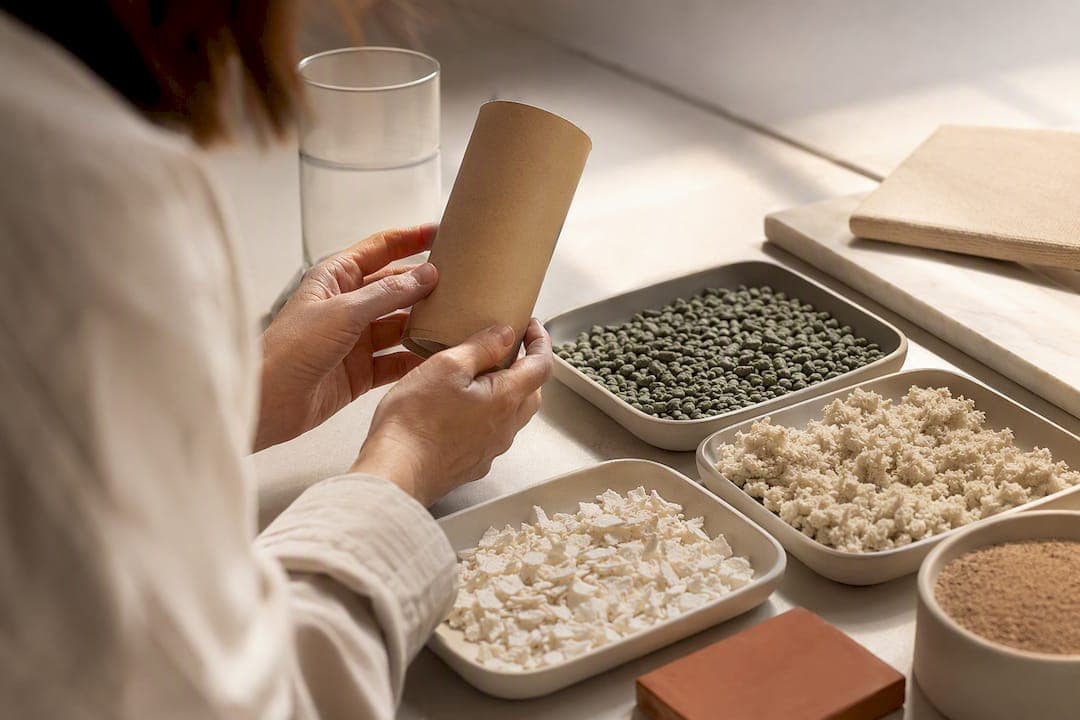
The strongest starting point for eco friendly skincare packaging is a short list of three approaches: refillable systems, bio-based rigid components from suppliers like Sulapac and Agropak, and verified post-consumer recycled (PCR) plastics. Refill systems cut material use per lifecycle. Bio-based rigids offer a premium feel with a lower microplastic footprint. Verified PCR gives brands cost and scale without waiting on newer materials to mature. The right pick depends on formulation, budget, and whether your customers will actually reuse what you send them.
TL;DR:
- Refillable systems and verified post-consumer recycled plastics are most effective for reducing overall material impact, especially when consumer reuse or recycling infrastructure exists.
- Material choice must match formulation type, with water-based products needing validated barriers and oil-based formulas offering more flexibility in container options.
- Suppliers' claims about biobased or recyclable content require third-party verification and detailed documentation, not just marketing percentages or vague labels.
- Full transition to eco-friendly packaging often takes four to nine months, depending on customization requirements, lab testing, and tooling lead times.
- Prioritize testing samples from multiple suppliers within the same material category to ensure barrier performance and finish quality meet formulation and brand standards.
Table of Contents
- What Counts as Eco-Friendly Skincare Packaging?
- How Do Sustainable Skincare Packaging Suppliers Compare?
- How Should You Choose an Eco-Friendly Packaging Supplier?
- Which Sustainable Materials Actually Work for Skincare Formulas?
- What Should You Budget for Price, MOQ, and Lead Time?
- How Do You Vet and Test a New Packaging Supplier?
- How Does Yuka+Face Approach Sustainable Packaging Decisions?
- How Were These Eco-Friendly Packaging Options Evaluated?
- Which Certifications Actually Mean Something for Packaging?
- Where Do You Actually Find These Suppliers?
- What Happens to This Packaging After the Customer Is Done?
- What Are the Buying Criteria That Actually Predict Supplier Quality?
- How Do You Actually Switch to Eco-Friendly Packaging?
- How Long Does a Packaging Transition Typically Take?
- A Packaging Buyer's Honest Take on "Green" Claims
- See How Yuka+Face Pairs Sustainable Values With Real Products
- Sources
- FAQ
What Counts as Eco-Friendly Skincare Packaging?
"Eco-friendly" gets stretched to cover almost anything with a green label, so it helps to separate marketing language from the actual industry terms buyers should use: recyclable, biodegradable, compostable, bio-based, and PCR (post-consumer recycled). Sustainable skincare packaging usually means some combination of these, chosen to match a specific product's formulation and a brand's actual disposal infrastructure.
None of these terms are interchangeable, and mixing them up is the single most common sourcing mistake. A bio-based plastic isn't automatically biodegradable. A recyclable jar isn't useful if your customer's curbside program won't take it. Refillable skincare packaging solves a different problem entirely: it doesn't ask a material to disappear, it asks the customer to keep using the same shell.
The comparison below breaks down where actual suppliers land on these distinctions, with the material facts a packaging buyer needs before requesting a sample.
How Do Sustainable Skincare Packaging Suppliers Compare?
Here's how five suppliers stack up on the dimensions that matter most: material type, formulation compatibility, and how fast you can realistically get product on shelf.
| Supplier | Material Type | Best For | Biobased/PCR Credentials | Barrier for Water-Based Formulas | MOQ/Lead Time | Price Tier |
|---|---|---|---|---|---|---|
| Sulapac | Bio-based composite | Premium jars, closures | Up to 100% biobased content | Patented barrier built for water-based bulks | Mid to high, varies by mold | High |
| Albéa (Metamorphosis) | FSC paper tube with laminate | Creams, balms | FSC-certified fiber paper | Laminate liner, best for semi-solid formats | Moderate MOQ, standard lead times | Mid |
| Stocksmetic | Recyclable/reusable stock containers | Fast-turn launches, smaller brands | Recyclable and reusable design lines | Depends on container, generally suited to varied viscosities | Low MOQ, ready-to-ship stock | Low to mid |
| HCPackaging | PCR and bio-based lines | Brands scaling volume | PCR content across multiple lines | Practical barrier performance for common formulas | Scales with order size | Mid |
| Agropak | Natural-fiber composite (coconut shell/bamboo) | Solid and semi-solid skincare | 93% bio-based carbon content, verified by TÜV SÜD | Better suited to lower-water formulas without added liners | Custom mold lead times | Mid to high |
Sulapac built its pitch around a barrier solution that lets brands use bio-based materials with water-based bulks, something petroleum-free materials have historically struggled with. The company claims no persistent microplastics from its composite, which matters if your brand markets itself on ocean or landfill impact.
Albéa's Metamorphosis tube swaps most of the plastic tube body for FSC-certified paper, wrapped around a laminate structure that handles the barrier job. It works well for creams and balms; it's not the pick for a thin, high-water essence unless the laminate has been validated for that specific viscosity.
Stocksmetic operates differently: it's a stock supplier, meaning you're choosing from existing molds rather than commissioning new ones. That trades some brand differentiation for speed and a lower minimum order quantity, which matters if you're testing a new SKU before committing to custom tooling.
HCPackaging and Agropak sit at opposite ends of the "how new is this material" spectrum. HCPackaging leans on established PCR and bio-based lines built for brands that need volume now. Agropak's coconut shell and bamboo fiber composite is newer territory, and it comes with independent compression and drop testing, exactly the kind of documentation you should demand from any supplier making a durability claim.
A few red flags to watch for when a supplier's pitch sounds greener than its paperwork:
- No certificate for biobased carbon content (ask for the actual ASTM D6866 test result, not a marketing percentage).
- A "recyclable" claim with no note on which recycling streams actually accept the material locally.
- Barrier claims for water-based formulas with no third-party validation attached.
- Vague or shifting MOQ numbers between the sales call and the written quote.
How Should You Choose an Eco-Friendly Packaging Supplier?
Start with the formulation, not the material. A water-based serum behaves completely differently inside packaging than an oil-based balm, and that single fact eliminates half the options on any supplier's catalog before you even look at price.
Match material to formulation first. Water-based products need a validated barrier, whether that's Sulapac's patented composite barrier or a laminate liner inside a paper tube. Oil-based and anhydrous formulas have far more flexibility, since they're less prone to degrading packaging from the inside.
Think in lifecycle terms your customer will actually follow. A compostable jar is only meaningful if your customer has access to industrial composting, which most municipal programs still don't offer. Refillable systems avoid that problem by keeping the same outer shell in rotation, which is why refill programs pair well with subscription and repeat-purchase models.
Build a request list before you call a single supplier:
- Material data sheets and biobased/PCR percentage documentation
- Third-party barrier or migration test results
- Sample policy, including cost and turnaround
- Certifications (FSC, compostability standard, biobased carbon verification)
Check the commercial fine print. MOQ, decoration compatibility (can it be printed, embossed, or labeled the way your brand needs?), and whether your existing fill line can handle the new format without new tooling.
Pro Tip: Order samples from at least two suppliers in the same material category before you commit. Barrier performance and finish quality vary more between suppliers using "the same" bio-based resin than most buyers expect.
Which Sustainable Materials Actually Work for Skincare Formulas?
Glass remains the gold standard for barrier performance and recyclability, and it's infinitely recyclable without quality loss. Its downside is weight: heavier shipping costs and a higher breakage risk, which matters more for e-commerce brands shipping direct than for retail-only lines.
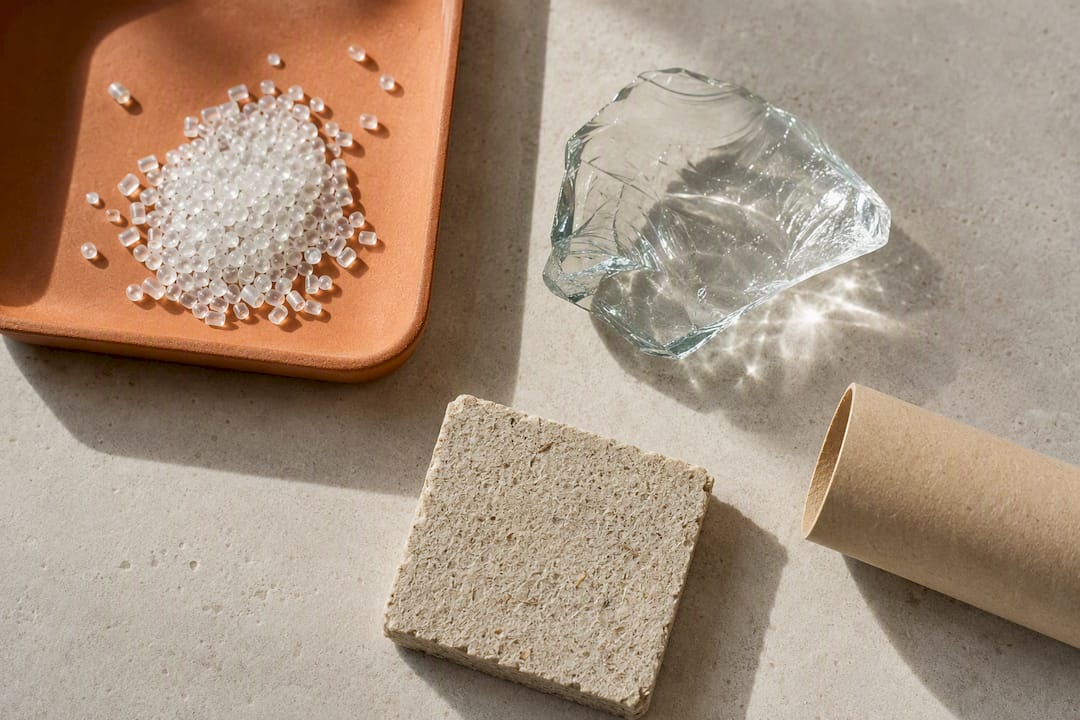
PCR plastics are the practical workhorse. Recycled content genuinely cuts virgin plastic use, but the real-world benefit depends on two things buyers often skip: the actual PCR percentage (30% and 80% PCR are very different products) and whether your customers' local infrastructure can recycle the finished piece again.
Bio-based plastics are advancing fast. Recent research on bio-based composites shows materials closing the performance gap with polypropylene and polyethylene while adding biodegradability, though matching plastic-level durability at scale is still a work in progress for the industry. Treat "biobased" claims skeptically until a supplier shows independent barrier validation, not just a percentage on a spec sheet.
Paper-based tubes and natural-fiber composites solve different problems. Albéa's paper tube works well for creams and balms once paired with a laminate barrier; it's not built for thin, high-water formulas without that liner. Agropak's fiber composite jars behave similarly: strong for solids and semi-solids, but they need an inner cup or liner before they're ready for anything with meaningful water content.
What Should You Budget for Price, MOQ, and Lead Time?
Minimum order quantities follow a fairly predictable pattern. Custom bio-based and paper-based tooling tends to carry higher MOQs because the molds themselves are expensive to produce. Stock glass containers and some PCR lines scale down further, since you're buying into an existing mold rather than commissioning one.
Customization is what actually drives cost up, more than the base material choice. Special coatings, embossing, custom color matching, and new tooling each add both dollars and weeks to a timeline that would otherwise move quickly.
A realistic sequence looks like this:
- Sample request and review: 2 to 4 weeks
- Formulation compatibility and barrier testing: 2 to 6 weeks, longer if third-party lab testing is involved
- Pilot production run: 4 to 8 weeks depending on tooling needs
- Certification and testing costs should be budgeted separately. TÜV SÜD or ASTM D6866 verification isn't free, and skipping it to save money is exactly how "biobased" claims end up unsupported later.
How Do You Vet and Test a New Packaging Supplier?
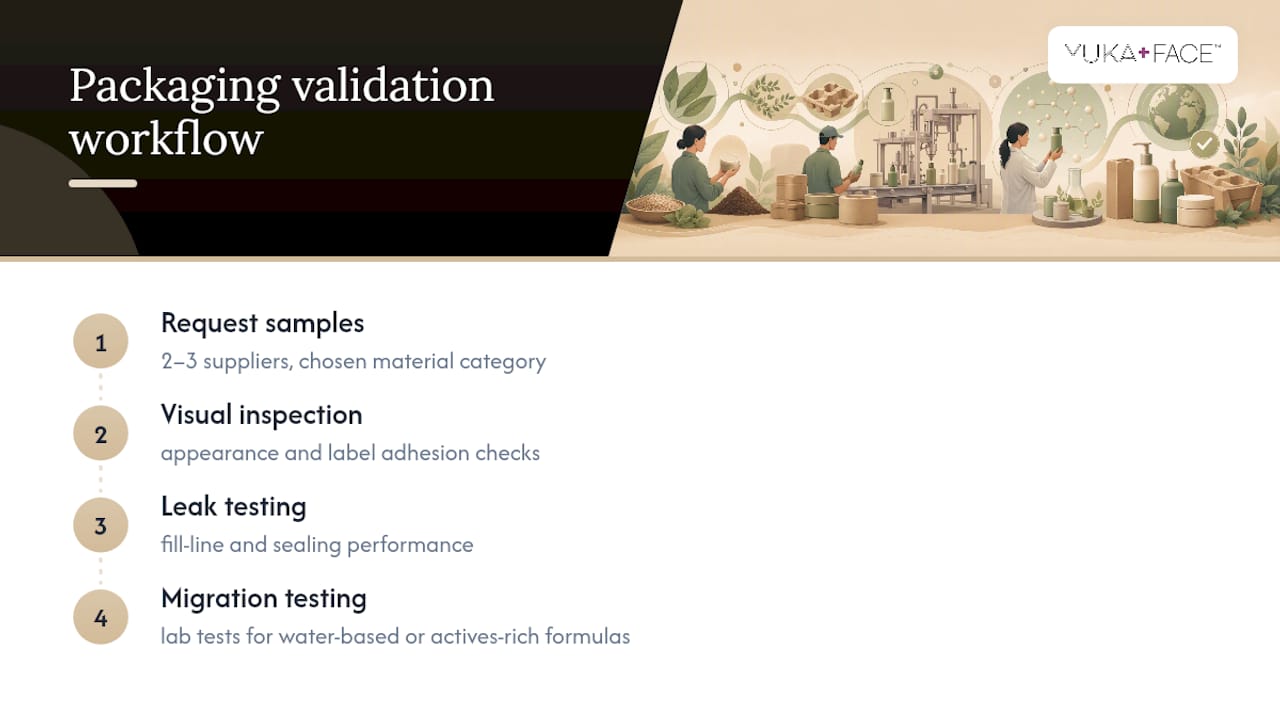
Running a structured vetting process protects you from committing production budget to a material that fails in your own formula. Implementation guides for eco-friendly cosmetic packaging consistently point to the same four-step sequence:
- Request documentation first. Material data sheets, certification records, and a written sample policy, before any commercial conversation goes further.
- Run in-house checks, then lab tests where needed. Visual inspection, leak tests, and basic storage stability catch obvious problems fast; migration and barrier testing belong in a lab for water-based or actives-heavy formulas.
- Pilot before you scale. A fill-line trial on real equipment reveals problems no spec sheet will show you.
- Set quality gates in writing. Batch traceability, third-party certificates on file, and an agreed remediation process if a batch fails spec.
How Does Yuka+Face Approach Sustainable Packaging Decisions?
Yuka+Face builds its product range around a 100% natural, cruelty-free, and environmentally conscious standard, which means packaging decisions get weighed the same way formulation decisions do. For a water-based toner versus an oil-rich serum, that can mean prioritizing a verified bio-based rigid format for one and a refillable system for the other, depending on how the audience actually uses and replaces the product.
How Were These Eco-Friendly Packaging Options Evaluated?
The suppliers and materials above were assessed against a consistent set of criteria rather than marketing language alone: documented biobased or PCR content (backed by a named standard like ASTM D6866, not a bare percentage claim), independent barrier or durability testing where a supplier offered it, formulation compatibility for water-based versus oil-based products, and transparency around MOQ and lead times.
Suppliers that published third-party verification, such as Agropak's TÜV SÜD-verified biobased carbon content and independent compression and drop testing, were weighted more heavily than suppliers making unverified claims. Sulapac's barrier solution for water-based bulks was evaluated on the specific technical claim the company makes, not a general "sustainable" label. Albéa's paper tube was assessed for the format it's actually built for (creams and balms) rather than treated as a universal replacement for plastic tubes.
This approach mirrors what any packaging buyer should do before signing a purchase order: separate what a supplier claims from what a supplier can document. A biobased percentage without an ASTM D6866 certificate is a marketing number. A barrier claim without migration test data is a hope, not a spec.
Which Certifications Actually Mean Something for Packaging?
FSC certification applies to paper and fiber-based packaging, confirming the wood pulp came from responsibly managed forests. It's the certification behind Albéa's Metamorphosis tube, and it's worth checking for on any paper-based component, since uncertified "paper-look" packaging is common and doesn't carry the same sourcing accountability.
USDA Organic certification applies to the product formulation, not the packaging material itself, but brands often confuse the two. A jar can't be "USDA Organic certified"; the cream inside it can be. Don't accept a supplier's packaging pitch that leans on this certification as if it applies to the container.
Cradle to Cradle certification evaluates a product across five categories, including material health and circularity, and it's a heavier lift for a supplier to earn than FSC. Few skincare packaging suppliers carry it yet, so treat its presence as a genuine differentiator rather than an expected baseline.
Biobased content verification, typically through ASTM D6866 testing (as Agropak provides) or third-party labs like TÜV SÜD, confirms what percentage of a material's carbon actually comes from renewable biological sources rather than petroleum. This is the certification most often skipped or fudged, and it's the one worth asking for by name rather than accepting a supplier's own percentage claim at face value.
Where Do You Actually Find These Suppliers?
Beyond the suppliers already compared, skincare brands frequently work through wholesale platforms and direct manufacturer outreach. Stocksmetic operates as a stock supplier with decoration services layered on, which suits brands that want a sustainable option without commissioning custom tooling. Sulapac and Agropak both work on a more custom basis, better suited to brands with the volume and timeline to commission molds.
Established beauty brands offer a useful reference point for how packaging choices show up at retail. The Body Shop and Lush have both built long-standing reputations around refill stations and reduced-plastic packaging in physical retail formats. Dr. Hauschka and Kiehl's have leaned into recyclable glass and metal for years, reflecting the premium-market preference for materials with strong recyclability track records. Newer clean-beauty brands like Youth to the People (YTTP), Biossance, Herbivore, Tata Harper, Farmacy, OSEA, and Marie Veronique have each made different bets: some on PCR plastic, some on glass, some on refill pouches paired with a reusable outer jar.
Product types available across these supplier relationships span the full skincare category: jars for creams and masks, tubes for cleansers and treatments, droppers and pumps for serums and oils, and refill pouches or cartridges designed to pair with a permanent outer shell.
What Happens to This Packaging After the Customer Is Done?
End-of-life outcomes vary more than most packaging marketing admits, and that gap between claim and reality is where a lot of consumer trust gets lost. A compostable jar does nothing for a customer without access to industrial composting, and most municipal composting programs still don't accept packaging waste.
Recyclable materials only deliver their benefit if the local recycling stream actually accepts them. PCR plastics and glass generally have the broadest curbside acceptance in the United States, while some bio-based composites require specific facilities that aren't widely available yet.
Refillable systems sidestep the disposal question almost entirely, since the outer shell stays in use across multiple refill cycles instead of entering a waste stream at all. That's part of why refill models pair particularly well with subscription and repeat-purchase skincare brands, where the customer relationship already assumes repeated contact.
The practical guidance for consumers is simple even when the packaging isn't: check the material against local recycling rules rather than trusting a logo on the box, rinse containers before recycling, and treat refill programs as the lowest-effort sustainable choice available, since they require no sorting decision at all.
What Are the Buying Criteria That Actually Predict Supplier Quality?
Quality consistency matters more than any single certification. Ask a supplier for batch-to-batch variation data, not just a one-time test result, since a barrier that performs well on a sample batch can drift once production scales.
Certifications should be checked for currency and scope, not just existence. An FSC certificate that's expired, or a biobased claim that only covers one component of a multi-part closure, tells a different story than the marketing page suggests.
Ethical sourcing practices are harder to verify from a spec sheet, but a supplier's willingness to share factory audits, labor certifications, or supply chain transparency documentation is a reasonable proxy. Suppliers that resist these requests, or treat them as unusual, are worth a second look before a large order commitment.
Financial and operational stability round out the list: a supplier's capacity to actually fulfill a scaling order matters as much as the sustainability story, since a beautiful bio-based jar is worthless if the supplier can't deliver it on schedule for a product launch.
How Do You Actually Switch to Eco-Friendly Packaging?
Start by defining what "sustainable" means for your specific brand before contacting a single supplier, using insights from industry-level marketing guidance that help brands align sustainable packaging choices with consumer messaging and retail requirements. Implementation frameworks for eco-friendly cosmetic packaging consistently recommend setting concrete goals first: reduced virgin plastic, verified biobased content, or a refill program, rather than chasing a vague "green" positioning.
Audit your current SKU lineup by formulation type. Water-based serums, oil-based balms, and powder products each have different packaging requirements, so a single new material rarely replaces everything at once. Most brands transition in phases, starting with the SKU that has the most straightforward formulation compatibility.
Request samples from two or three suppliers in the material category you've selected, and test them against your actual formula rather than a generic base. Run the compatibility checks outlined earlier: visual inspection, leak testing, and lab-based migration testing for anything water-based or actives-heavy.
Pilot with a limited production run before committing full inventory. This catches fill-line issues, labeling adhesion problems, and any barrier failures that a small sample batch wouldn't reveal. Only after a successful pilot should a brand move to full-scale reorder quantities with the new supplier locked in.
How Long Does a Packaging Transition Typically Take?
A realistic full transition, from initial supplier outreach to a shelf-ready product in new eco-friendly packaging, generally spans four to nine months depending on how much customization the new packaging requires.
Sample review and initial compatibility testing typically take four to six weeks. Formulation-specific lab testing, particularly for water-based products needing barrier validation, can extend that by several more weeks depending on lab availability. Tooling for custom molds, if required, is usually the longest single phase, often stretching eight to twelve weeks before a pilot batch is even possible.
Brands switching to stock or semi-custom options, like Stocksmetic's ready-to-ship lines, can move considerably faster since there's no new mold to commission. Brands committing to fully custom bio-based tooling from suppliers like Sulapac or Agropak should plan for the longer end of that window, and build in a buffer for a second pilot round if the first one surfaces a barrier or fill-line issue.
A Packaging Buyer's Honest Take on "Green" Claims
There's no single perfect material, and any supplier promising one is skipping a step. The better path weighs how your customers actually behave, what your formulation genuinely needs, and what a supplier can prove rather than promise. Prototype early, demand third-party test data, and favor refill wherever your audience will realistically reuse what you send them.
— Kelly
See How Yuka+Face Pairs Sustainable Values With Real Products
There are other routes to sourcing sustainable packaging: custom bio-based tooling, stock containers, refill systems, each with its own tradeoffs in cost and timeline. If you want to see how a natural, cruelty-free skincare brand actually applies these principles to finished products rather than just spec sheets, Yuka+Face's own product and editorial pages are a useful reference point.
Yuka+Face's guide to vegan skincare walks through how ingredient sourcing and packaging philosophy connect in practice, and the morning skincare routine page shows how that philosophy shows up across a full product lineup rather than a single SKU. If you're a boutique retailer, spa owner, or estheticians looking to stock a line built around these values, browse the Yuka+Face product shop to see the finished formulations, or reach out through the brand's journal for partnership inquiries.
Sources
For readers who want to go straight to the primary sources:
- Nature article on bio-based composites matching PP/PE performance
- Sustainable and luxurious materials for cosmetic packaging | Sulapac
- Skincare packaging from natural fiber materials | Agropak
FAQ
What Is the Most Sustainable Skincare Packaging Material?
There's no single winner; glass offers the best recyclability and barrier performance but adds shipping weight, while bio-based composites from suppliers like Sulapac reduce microplastic risk at a higher price point. Refillable systems reduce lifecycle waste regardless of which base material you choose.
How Do I Know if a "Biobased" Claim Is Real?
Ask for the supplier's ASTM D6866 or TÜV SÜD verification documents showing the exact percentage of biobased carbon content, not just a marketing percentage on a spec sheet.
What's a Realistic MOQ for Eco-Friendly Skincare Packaging?
It varies widely by material and customization level; stock containers from suppliers like Stocksmetic can have lower minimums, while custom bio-based or paper tooling from suppliers like Sulapac or Albéa typically requires higher order volumes to offset mold costs.
Is Refillable Packaging Better Than Recyclable Packaging?
For repeat-purchase and subscription skincare brands, refillable systems generally reduce more material waste over time than single-use recyclable packaging, since the outer shell stays in circulation across multiple product cycles.
Does Yuka+Face Use Sustainable Packaging?
Yuka+Face builds its product range around a natural, cruelty-free, and environmentally conscious standard, and applies that same lens to packaging decisions across its skincare lineup.