
TL;DR:
- Active ingredients are substances in skincare that produce direct, measurable effects on the skin, such as brightening or exfoliating. Their effectiveness depends on proper concentration, pH, and formulation, with inactive ingredients supporting delivery and stability. Using one new active at a time and monitoring skin response minimizes irritation and improves results.
Active ingredients are defined as the substances in a product that produce a direct, measurable biological effect on the skin or body. The FDA and Health Canada both use this definition to separate the working compounds in a formula from everything else in the bottle. Understanding what active ingredients are gives you a real advantage when choosing skincare products, because it shifts your focus from marketing claims to the science behind them.
What is active ingredients: the core definition
An active ingredient provides a medicinal or biological effect intended to treat, mitigate, or affect body structure and function. In skincare, that means the compound that actually changes your skin. Vitamin C brightens. Salicylic acid clears pores. Retinol signals cells to produce more collagen. Every other component in the formula exists to support those actions, not to perform them.
The term "active ingredient" is the recognized regulatory and industry standard. You will also see it written as "active substance" in pharmaceutical contexts, but the meaning is identical. Regulatory bodies like the FDA require manufacturers to list active ingredients separately on product labels, which is why you can scan a label and immediately identify what a product is designed to do.
Skincare products and medicinal products both use this framework. A sunscreen lists its UV filters as actives. A prescription acne cream lists benzoyl peroxide or tretinoin. A serum from a natural brand like Yuka+Face lists its botanical actives, such as plant-derived vitamin C or niacinamide, in the same way. The category applies regardless of whether the source is synthetic or natural.
How do active ingredients work in skincare products?
Active ingredients in skincare are scientifically proven compounds that target specific concerns by acting directly on skin cells, enzymes, and structural proteins. The mechanism varies by ingredient, but the principle is consistent: the active must reach the right layer of skin at the right concentration to do its job.
Three factors govern whether an active ingredient actually works:
- Concentration. Each active has a functional range. Niacinamide shows visible results at concentrations between 2% and 5%. Below that threshold, the effect is minimal. Above it, irritation risk rises without proportional benefit.
- pH level. Vitamin C (L-ascorbic acid) requires a pH below 3.5 to remain stable and penetrate the skin barrier. A formula with the right ingredient but the wrong pH delivers little to no result.
- Formulation quality. The surrounding ingredients determine how well an active absorbs. Penetration enhancers, emulsifiers, and the base itself all affect delivery speed and depth.
Common mechanisms include chemical exfoliation (AHAs like glycolic acid dissolve the bonds between dead skin cells), hydration (hyaluronic acid draws water into the skin from the environment), and cell signaling (retinol binds to receptors in skin cells and triggers collagen production). Each of these processes requires the active to reach a specific target, which is why formulation factors like concentration and pH are not secondary details. They are the difference between a product that works and one that does not.
Pro Tip: Check the ingredient list position. Active ingredients appear near the top of the INCI list when present at effective concentrations. If a celebrated active appears near the bottom, the concentration is likely too low to produce results.
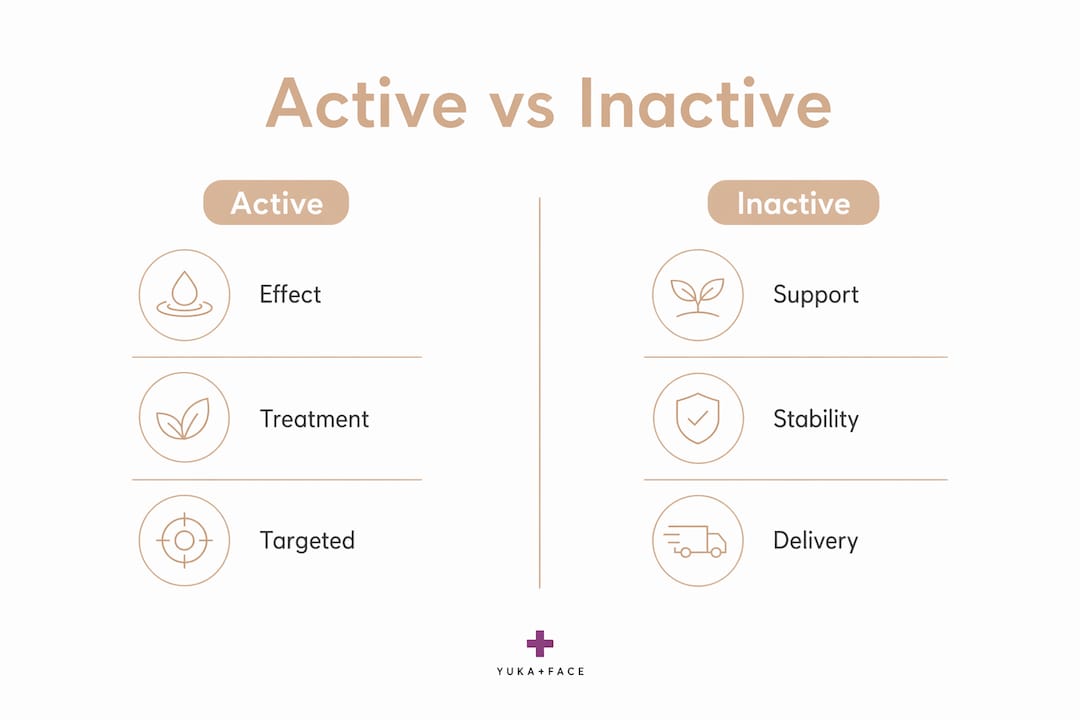
What is the difference between active and inactive ingredients?
Inactive ingredients, known as excipients, are essential for drug delivery, preservation, and ensuring active ingredients reach their targets, even though they have no direct biological effect themselves. The word "inactive" is misleading. These ingredients are not passive fillers. They are the delivery system.
| Feature | Active ingredients | Inactive ingredients (excipients) |
|---|---|---|
| Primary role | Produce a direct biological effect on skin | Support delivery, stability, and texture |
| Examples | Retinol, vitamin C, salicylic acid | Glycerin, cetyl alcohol, preservatives |
| Listed on label | Yes, often separately required by regulators | Yes, in the full INCI ingredient list |
| Effect on skin | Targeted: brightening, exfoliating, hydrating | Indirect: moisturizing base, pH buffering |
| Can cause reactions | Yes, especially at high concentrations | Yes, some people react to preservatives or fragrances |
Excipients aid absorption, stability, shelf life, and enhance active ingredient delivery in skincare formulations. Without them, actives degrade quickly or fail to penetrate the skin at all. A vitamin C serum without the right stabilizing agents oxidizes within weeks and turns orange, losing its potency entirely.
The synergy between active and inactive ingredients is what separates a well-formulated product from a poorly made one. A high-quality hyaluronic acid serum works not just because of the hyaluronic acid, but because the surrounding humectants, pH adjusters, and preservatives keep it stable and help it bind to skin effectively. Understanding organic ingredients in skincare formulations helps clarify how both categories contribute to a product's overall performance.
Pro Tip: If your skin reacts to a product but the active ingredient is one you have used before, look at the excipients. Fragrances, certain preservatives like methylisothiazolinone, and alcohol-based solvents are common irritants that hide in the inactive list.
Examples of key active ingredients and their benefits
Common skincare actives include retinol, niacinamide, vitamin C, hyaluronic acid, and salicylic acid, each targeting distinct skin concerns. Here is what each one does and who it suits best.
- Retinol (vitamin A derivative). Retinol stimulates collagen production and accelerates cell turnover. It addresses fine lines, uneven texture, and hyperpigmentation. Start at 0.025% to 0.1% if you are new to retinoids. Use it at night only, as it degrades in sunlight. Pair with a gentle moisturizer to reduce dryness.
- Vitamin C (L-ascorbic acid). Vitamin C neutralizes free radicals and inhibits melanin production, which brightens skin tone and fades dark spots. It works best in the morning under SPF. Stable derivatives like ascorbyl glucoside suit sensitive skin better than pure L-ascorbic acid.
- Hyaluronic acid. Hyaluronic acid is a humectant that pulls water into the skin from the environment. It suits all skin types, including oily and acne-prone. Apply it to damp skin and seal with a moisturizer to prevent it from drawing moisture out of the skin in dry climates.
- Salicylic acid (BHA). Salicylic acid is oil-soluble, which means it penetrates into pores and dissolves the sebum and dead cells that cause breakouts. It is the primary active for acne and blackheads. Concentrations of 0.5% to 2% are effective for most people.
- Niacinamide (vitamin B3). Niacinamide reduces redness, minimizes the appearance of pores, and regulates sebum production. It is one of the most well-tolerated actives available and works across skin types. It pairs well with most other actives without causing reactions.
- AHAs (glycolic acid, lactic acid). Alpha hydroxy acids dissolve the bonds between dead skin cells on the surface, improving texture, tone, and radiance. Lactic acid is gentler and better for dry or sensitive skin. Glycolic acid penetrates deeper and suits oily or thicker skin types.
Understanding how these actives function in face serums helps you match the right product format to your skin concern. Serums deliver high concentrations of actives in a lightweight base, making them the most efficient delivery format for most of these ingredients.
How to safely incorporate active ingredients into your skincare routine
Mixing multiple active ingredients without care causes inflammation and skin barrier damage. The safest approach is to introduce one new active at a time and observe your skin's response before adding another.
Follow this sequence when building a routine with actives:
- Start with one active. Choose the ingredient that addresses your primary concern. If acne is the issue, start with salicylic acid. If dullness is the concern, start with vitamin C. Do not layer multiple new actives in the first month.
- Patch test first. Apply a small amount of the product to your inner forearm or behind your ear for 24 hours. If no reaction occurs, apply it to a small area of your face for three days before full use.
- Introduce gradually. Use the new active two to three times per week for the first two to four weeks. This gives your skin time to build tolerance without triggering a reaction.
- Wait before adding another active. After two to four weeks with no irritation, you can consider adding a second active. Avoid combining strong acids with retinoids in the same application. Use one in the morning and the other at night.
- Monitor your skin barrier. Signs of barrier damage include tightness, stinging, flaking, and increased sensitivity. If these appear, reduce frequency and add a plain moisturizer until the skin recovers.
Higher concentrations of actives do not always mean better results. Excessive concentrations increase irritation risk without delivering proportional benefit. A 10% niacinamide product is not twice as effective as a 5% one. It is simply more likely to cause redness. Reading clean ingredient labels helps you evaluate concentration and formulation quality before you buy.
Pro Tip: Combining strong acids and retinoids in the same step leads to redness and barrier damage. If you use both, apply your acid in the morning and your retinoid at night. This timing approach gets you the benefits of both without the conflict.
The role of dermatological research in beauty continues to refine guidance on concentration thresholds and safe combinations. Consulting a dermatologist before adding prescription-strength actives like tretinoin or high-percentage AHAs is always the right call.
Key Takeaways
Active ingredients are the compounds in skincare that produce real, measurable results, and their effectiveness depends on concentration, pH, and the quality of the full formulation around them.
| Point | Details |
|---|---|
| Definition of active ingredients | Active ingredients are substances that produce a direct biological effect on the skin or body. |
| Role of inactive ingredients | Excipients stabilize, preserve, and deliver actives. They are not optional fillers. |
| Concentration is not everything | Higher concentrations increase irritation risk without always improving results. |
| Introduce actives one at a time | Add one new active every two to four weeks to identify reactions and build tolerance. |
| Match actives to skin concerns | Retinol targets aging, salicylic acid targets acne, and hyaluronic acid targets hydration. |
Why potency alone does not tell the whole story
People often assume that a stronger active ingredient means a better product. That assumption gets a lot of skin into trouble. After years of paying close attention to how formulations actually perform, the pattern is clear: the products that deliver the most consistent results are rarely the ones with the highest concentrations. They are the ones where the entire formula is built around making the active work.
I have seen people cycle through high-percentage retinol products, dealing with constant peeling and redness, when a lower concentration in a well-buffered, nourishing base would have given them better long-term results with none of the damage. Skilled formulators balance ingredient potency with skin barrier tolerance. That balance is the real skill in skincare formulation, and it is what separates a product that transforms your skin over months from one that irritates it in weeks.
The other misconception worth addressing: natural actives are not automatically gentler than synthetic ones. Botanical vitamin C derivatives, plant-sourced retinol alternatives, and fermented actives can be just as potent as their lab-made counterparts. What matters is the concentration, the delivery system, and your skin's individual response. Monitoring how your skin reacts over time, rather than chasing the highest percentage on the label, is the most reliable path to results. Understanding skin rejuvenation science gives you the framework to evaluate any active ingredient claim with confidence.
— Kelly
Yuka+Face and ingredient transparency
Yuka+Face builds every product around ingredient clarity. The brand's commitment to 100% natural, vegan formulations means every active is plant-derived and every excipient is chosen for function, not filler. For consumers who want to understand what they are putting on their skin, the Yuka+Face vegan skincare guide breaks down ingredient sourcing and what to look for on a label.

The Yuka+Face blog covers active ingredient education, routine building, and formulation insights across skin types and concerns. If you are building a routine around specific actives, the morning skincare routine guide shows how to layer them safely and effectively for daily use.
FAQ
What is the definition of active ingredients in skincare?
An active ingredient is any substance in a skincare product that produces a direct, measurable biological effect on the skin. Regulatory bodies including the FDA and Health Canada use this definition to distinguish actives from excipients and stabilizers.
What are examples of active ingredients in cosmetics?
Common examples include retinol, vitamin C, hyaluronic acid, salicylic acid, and niacinamide. Each targets a specific concern: retinol for aging, salicylic acid for acne, and hyaluronic acid for hydration.
What is the difference between active and inactive ingredients?
Active ingredients produce the intended effect on skin. Inactive ingredients, called excipients, support delivery, stability, and texture without directly changing the skin themselves.
How do active ingredients work on the skin?
Active ingredients work by interacting with skin cells, enzymes, or structural proteins at a specific concentration and pH. The surrounding formulation determines how effectively the active penetrates and performs.
Can you use multiple active ingredients at the same time?
Combining actives without care causes irritation and barrier damage. Introduce one active at a time, wait two to four weeks, and avoid applying strong acids and retinoids in the same step.