
Vegan peptides can be a genuinely useful supportive ingredient for firmer, smoother-looking skin, but they are not a wrinkle cure and no study claims otherwise. The single move that matters most before you buy: scan the ingredient list for a named peptide, not a vague "peptide blend," confirm the brand's vegan and cruelty-free sourcing, and keep sunscreen in the routine every single day. Treat any peptide serum as one supportive layer in a bigger skincare picture, not a replacement for it.
TL;DR:
- Choose products with a clearly named peptide in the ingredient list rather than vague blends or complexes for better transparency.
- Verify that the brand’s sourcing claims are separate from vegan or cruelty-free certifications, ideally with third-party proof.
- Look for formulations with protective packaging, such as airless pumps or opaque bottles, to ensure peptide stability and potency.
- Expect gradual improvements over 6 to 12 weeks with consistent daily use, especially when combined with sunscreen and proper layering.
- Be cautious of formulas with added fragrances or multiple active ingredients, which can increase the risk of skin irritation.
Table of Contents
- What Are Vegan Peptides in Skincare?
- How Strong Is the Evidence Behind Peptide Skincare?
- Common Vegan Peptide Ingredients and How to Spot Them
- How to Choose a Vegan Peptide Skincare Product
- How to Use Peptide Skincare in Your Daily Routine
- Is Peptide Skincare Safe? Sensitization and Realistic Expectations
- The Yuka+Face Perspective on Vegan Peptide Formulation
- Where Yuka+Face Fits Your Vegan Peptide Checklist
- Sources
- FAQ
What Are Vegan Peptides in Skincare?
Peptides are short chains of amino acids, the same building blocks that make up the collagen and elastin in your skin. What makes a peptide "vegan" is simple: it is derived from plants, algae, or fermentation processes rather than animal tissue, which is where many older-generation peptides originated. The peptide itself does the same basic job either way. What changes is the source, and for shoppers who care about cruelty-free formulation, that distinction is the whole point.
Molecular size and formulation determine whether a peptide can actually do anything once it's on your skin. Peptides are relatively large molecules, so how a brand delivers them (the vehicle, the pH, the packaging) affects whether they reach living skin cells or just sit on the surface, according to a 2025 review on peptides and skin senescence. That's why two products with the "same" peptide can perform very differently.
Vegan peptides typically come from one of three sources:
- Plant hydrolysates from rice, soy, or wheat proteins, broken down into smaller peptide fragments
- Microalgae, especially Chlorella and Spirulina, prized for antioxidant and hydration signals
- Fermentation-derived peptides, produced by fermenting plant substrates with specific fungi or bacteria strains
Cosmetic chemists also classify peptides by what they're formulated to do. Signal peptides are designed to encourage skin cells to behave as if they're producing more collagen. Carrier peptides, like copper-binding peptides, are built to shuttle trace minerals into skin. Neurotransmitter-affecting peptides target the muscle contractions behind expression lines, working more like a topical relaxant than a moisturizing agent. Reviews of plant and microalgae-derived peptides document all three categories showing up across skincare formulations sourced from soy, rice, wheat, Spirulina, and Chlorella.
How Strong Is the Evidence Behind Peptide Skincare?
The honest answer: promising but incomplete. A systematic review of topical peptide and exosome therapies found that several clinical studies reported improvements in fine lines, elasticity, texture, and skin thickness, with no adverse effects noted among participants. But the review's authors were candid about a real limitation: the overall clinical evidence base for topical peptides remains limited, with fewer large, long-duration human trials than the marketing claims around peptides would suggest.
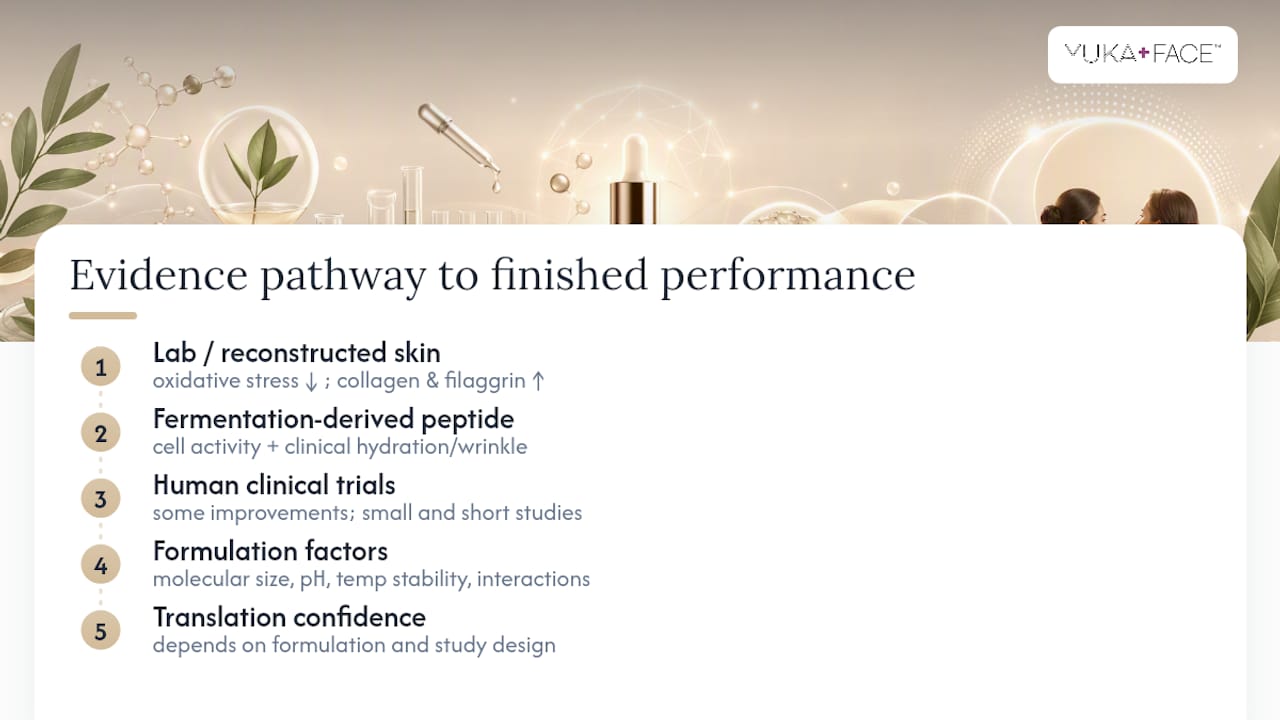
Lab and reconstructed-skin studies fill in some of the mechanistic story. One notable example: a reconstructed-skin study on Citrus junos seed peptides, an upcycled plant-derived ingredient, found the peptides reduced oxidative stress markers and increased type-I collagen and filaggrin signals after simulated UV exposure. That's a meaningful mechanistic result, but a reconstructed-skin model is not a living human face, and the study doesn't prove identical results in a finished consumer product.
Fermentation-derived peptides have some of the more compelling data. An AAQPR peptide derived from Aspergillus oryzae-fermented wheat peptone showed collagen-related and UVA-protective activity in cell studies, and researchers also tested it clinically, reporting improved hydration and fine-wrinkle appearance when used in a finished formulation. That combination, cell data plus a human clinical read, is closer to the gold standard than most peptide claims you'll see on a label.
The gap between "works in a dish" and "works on your face" comes down to formulation, peptide identity, and study design. A 2025 review on peptides points to molecular size, pH, temperature stability, and ingredient interactions as the variables that decide whether a peptide actually penetrates skin or breaks down before it gets the chance. Two products using an identical peptide name can behave completely differently depending on how they're built. Study duration matters too. A 4 week trial and a 12 week trial can tell very different stories about the same ingredient.
Common Vegan Peptide Ingredients and How to Spot Them
Reading an ingredient list for peptides takes a bit of pattern recognition, since brands don't always spell out "vegan" next to the peptide name. Look for terms like rice peptides, soy peptide lysate, wheat peptide, Spirulina hydrolysate, or Chlorella extract. Fermentation-derived peptides sometimes appear under descriptive names tied to the fermentation substrate or organism, rather than a simple INCI peptide term, so a bit of research on unfamiliar names pays off.
A few practical guidelines for reading labels:
- Prefer a named peptide (a specific INCI term) over a generic "peptide complex" or "peptide blend" with no further detail.
- Be skeptical of "hydrolyzed protein" alone. Without a source named, you can't confirm it's plant-derived at all.
- Remember that ingredient position on the list isn't a reliable stand-in for potency. Ingredients under 1% concentration can appear anywhere after the main formula base, so a peptide listed near the bottom isn't necessarily a token amount.
- Check whether the brand publishes sourcing details for its plant, algae, or fermentation-derived actives, not just a marketing claim.
Packaging matters more than most shoppers realize. Peptides are sensitive to light, air, and heat, and can degrade before you've even opened the bottle. Airless pumps and opaque or dark glass containers protect active ingredients far better than clear jars, especially once a product is opened and exposed to daily air contact. If a serum promises peptide benefits but ships in a clear jar you dip your fingers into, that's a formulation red flag worth noticing. Yuka+Face covers this kind of ingredient sourcing in more detail in its peptide-focused organic skincare article.
How to Choose a Vegan Peptide Skincare Product
Finding a genuinely well-made vegan peptide serum is less about brand reputation and more about a short, repeatable checklist. Here's what actually separates a transparent formula from a marketing shell:
- Find a named peptide on the ingredient list. If you can't identify what peptide is doing the work, you can't evaluate the product.
- Verify the vegan and cruelty-free claims separately. These are two different promises. Vegan speaks to animal-derived ingredients; cruelty-free speaks to animal testing. Check for supplier transparency or a recognized third-party certification if that verification matters to you.
- Look for human data, not just "clinically tested." A trustworthy brand will describe the study's endpoints, duration, and subject count rather than hiding behind a vague badge.
- Assess the full formula for irritants. A peptide surrounded by heavy fragrance, essential oils, or several strong actives raises your irritation risk more than the peptide itself does.
- Prefer protective packaging with clear storage guidance. Airless pumps, opaque bottles, and a "store away from direct sunlight" note are all good signs the brand understands active-ingredient stability.
One labeling caveat worth knowing: the FDA does not legally define "vegan," and its cruelty-free guidance notes the term isn't fully standardized either. Brands can use both terms fairly loosely unless they've pursued third-party certification, so supplier-level transparency is worth more than the word on the front label. The FDA's cosmetics labeling regulations also require ingredients to be listed in descending order of predominance, which is useful context when you're comparing two similar products.
Watch for a few red flags: language that edges into drug or treatment claims ("eliminates wrinkles," "rebuilds collagen structure"), proprietary blends with no ingredient disclosure at all, and formulas stacking heavy fragrance with multiple strong actives.
Pro Tip: Snap a photo of the ingredient list before you buy. Search the named peptide later at home. A five-minute check can save you from a $60 bottle of vague "collagen-boosting complex."

How to Use Peptide Skincare in Your Daily Routine
Peptides work best as one deliberate step in a routine, not as a stand-alone miracle product. Here's the order that gets the most out of them:
- Morning: cleanse, apply your peptide serum to slightly damp or dry skin per the product's directions, follow with moisturizer, then finish with broad-spectrum sunscreen. Skipping sunscreen undoes a meaningful share of what a peptide serum is trying to accomplish, since UV damage works against the same collagen and texture goals peptides support.
- Evening: cleanse, apply your peptide or other active serum, then moisturize to lock in hydration overnight.
- Introduce one active at a time. Adding a new peptide serum alongside a new retinol or acid in the same week makes it hard to know what's actually helping or irritating your skin.
- Patch-test on your inner forearm for a few days before applying a new product to your face, especially if you have sensitive skin.
- Give it 6 to 12 weeks before judging results. Skin cell turnover and visible collagen changes take time, and most of the meaningful clinical studies run on that kind of timeline.
Waiting roughly 30 to 60 seconds between serum and moisturizer gives a peptide formula time to settle before you seal it in, according to Yuka+Face's layering guidance. Peptides support your skin's existing processes. They don't replace what daily SPF protection is doing for you.
Is Peptide Skincare Safe? Sensitization and Realistic Expectations
Most peptide studies report few adverse effects, which is reassuring, but it's rarely the peptide itself causing a reaction when something does go wrong. Fragrance, certain preservatives, and exfoliating acids formulated alongside a peptide are the more common culprits behind redness or breakouts. A 2025 review notes that formulas pairing peptides with heavy fragrance or multiple strong actives carry a higher irritation risk than the peptide contributes on its own.
A few specific points worth flagging:
- If you have a soy or wheat allergy, check labels carefully before using plant-derived peptides sourced from those proteins, and look for allergen disclosure or formulation purity notes.
- "Supports collagen" and "rebuilds collagen" are not the same claim. The first is a defensible, evidence-aligned statement. The second implies a drug-level effect that most cosmetic peptides can't substantiate.
- A brand that shares actual study details, like sample size or test duration, is telling you more than one that just says "clinically proven."
Realistic expectations matter here. Peptides are a supportive ingredient category, and the research so far points to gradual improvements in texture and firmness rather than dramatic transformation.
The Yuka+Face Perspective on Vegan Peptide Formulation
Formulating with vegan peptides means making trade-offs in public, not just on a lab bench. Yuka+Face builds its peptide formulas around botanical research paired with short, transparent ingredient lists, because a shopper shouldn't need a chemistry degree to know what's in their serum. That philosophy runs through the brand's educational content, including a detailed look at peptides in organic skincare, written to help readers apply the same checklist covered above.
Every formulation choice gets measured against the same standard: named peptides instead of vague blends, cruelty-free sourcing, and packaging that actually protects the actives inside. That's not a marketing flourish. It's the same list a careful shopper would use anyway.
— Kelly
Where Yuka+Face Fits Your Vegan Peptide Checklist
Some serum and moisturizer lines are built around the same checklist this article just walked through: named peptides, disclosed sourcing, and protective packaging instead of vague "peptide complex" labeling.

If you're shopping for a peptide product that discloses what's actually in the bottle, Yuka+Face's shop carries serums and moisturizers formulated around transparent, plant and fermentation-derived actives rather than proprietary blends. Some formulas are built vegan and cruelty-free from the ground up, not adapted from an animal-derived original. For a deeper dive into how peptides fit into a full routine, the morning skin care routine guide walks through layering order step by step. Ready to see what a peptide serum built on this checklist actually looks like? Browse the current lineup and check the ingredient list for yourself before you buy.
Sources
- Peptides: Emerging Candidates for the Prevention and Treatment of Skin Senescence: A Review
- Anti-photoaging effects of upcycled Citrus junos seed anionic peptides on ultraviolet-radiation-induced skin aging in a reconstructed skin model
- An AAQPR peptide from Aspergillus oryzae-fermented wheat peptone promotes regenerative potential of dermal and epidermal layers
- FDA — Cruelty-free / Not tested on animals (cosmetics labeling claims)
FAQ
Are there any vegan peptides?
Yes. Vegan peptides are derived from plant hydrolysates (rice, soy, wheat), microalgae like Spirulina and Chlorella, or fermentation processes, rather than animal tissue. They're increasingly common in serums and moisturizers, including Yuka+Face's peptide formulas.
Do peptides in skincare actually work?
Several clinical studies included in a systematic review reported improvements in fine lines, elasticity, texture, and skin thickness with topical peptides, and no adverse effects were noted. The evidence base is still considered limited, so results vary by formulation and peptide identity.
Do plant peptides really work?
Plant-derived peptides show real mechanistic signals in lab and reconstructed-skin studies, including reduced oxidative stress and increased collagen markers in a Citrus junos seed peptide study. Those results are promising but don't guarantee identical outcomes once the peptide is in a finished consumer product on your face.
What is the best vegan anti-aging skin care?
The strongest vegan anti-aging approach combines a named, transparently sourced peptide with daily sunscreen and consistent use over 6 to 12 weeks. Some brands formulate serums and moisturizers around exactly this checklist, using short ingredient lists and protective packaging to keep plant-derived actives stable.
Can vegan peptides cause skin irritation?
Peptides themselves rarely cause reactions in studies, but formulas that pair peptides with heavy fragrance, essential oils, or multiple strong actives raise irritation risk. Patch-test any new product on your inner forearm first, and check for soy or wheat allergen disclosure if you have a relevant sensitivity.