
Yes, you can use vitamin C and niacinamide together. Dermatologist consensus and modern formulation science both confirm they are compatible in everyday skincare routines.
- The Cleveland Clinic and AAD both support combining antioxidant actives in layered routines.
- Yuka+Face formulates with stable vitamin C derivatives and niacinamide-containing serums designed to work together without irritation.
- One caveat: check which vitamin C form your product uses (L-ascorbic acid vs. a gentler derivative) and patch-test if your skin is sensitive.
Key Takeaways
Vitamin C and niacinamide are compatible, complementary ingredients that work best when layered in the correct order or split across AM and PM routines.
| Point | Details |
|---|---|
| Compatibility confirmed | Modern dermatologist consensus confirms vitamin C and niacinamide are safe to use together in normal skincare routines. |
| Layer thinnest to thickest | Apply L-ascorbic acid first, wait 30–60 seconds, then apply niacinamide per AAD layering guidance. |
| Choose your vitamin C form | L-ascorbic acid (10–15%) is most potent; stable derivatives suit sensitive skin and pair more easily with niacinamide. |
| Patch-test before combining | Test each product separately on the inner forearm for 24–48 hours before introducing both to your face. |
| Yuka+Face for the routine | The Yuka+Face Vitamin C Glow Serum uses a stable derivative that layers cleanly with niacinamide products for all skin types. |
Table of Contents
- What does each ingredient do, and why pair them?
- Why the "they cancel each other out" myth is outdated
- How to layer vitamin C and niacinamide in your routine
- Which forms and concentrations work best?
- How to introduce the duo safely
- What the clinical evidence says
- Ready-to-use AM and PM routine examples
- An editorial perspective on the duo
- Yuka+Face products for your vitamin C + niacinamide routine
- Sources
- FAQ
What does each ingredient do, and why pair them?
Niacinamide is vitamin B3. Applied topically, it supports the skin barrier, regulates sebum, reduces inflammation, and slows the transfer of melanosomes to surface skin cells, which is the mechanism behind its fading effect on dark spots. Vitamin C (most potently as L-ascorbic acid) works differently: it neutralizes free radicals, inhibits tyrosinase to reduce pigment production, and acts as a cofactor in collagen synthesis.
The pairing makes practical sense because the two ingredients address overlapping but distinct concerns. Vitamin C delivers faster brightening and antioxidant protection; niacinamide adds tolerability, reduces redness, and strengthens the barrier that vitamin C can sometimes stress at high concentrations.
- Oily or acne-prone skin: niacinamide alone handles sebum and inflammation well; adding vitamin C targets post-acne marks.
- Sun damage or anti-aging focus: vitamin C is the priority for photodamage reversal; niacinamide supports the barrier and reduces residual discoloration.
- Both concerns together: the combination covers brightening, barrier repair, and antioxidant defense in one routine.
Why the "they cancel each other out" myth is outdated
The concern originated from a laboratory finding: when niacinamide and L-ascorbic acid were combined under high heat, they converted into nicotinic acid, a compound that can cause flushing. That sounds alarming until you look at the conditions. The reaction required sustained elevated temperatures far above anything a serum sits at on your bathroom shelf or your skin.
Healthline's review of the chemistry confirms that at normal room temperature and typical skin-surface pH, this conversion does not occur at meaningful levels. The old lab result simply does not translate to real-world product use.
A few formulation points worth knowing:
- pH matters for L-ascorbic acid. It requires a low pH (roughly below 3.5) to remain stable and penetrate effectively. Niacinamide is stable across a much wider pH range, so it does not destabilize when layered over or under an ascorbic acid product.
- The concern is formulation-level, not ingredient-level. Combining a very low-pH vitamin C serum with a niacinamide product in the same formula could theoretically cause minor conversion. Layering two separate products on skin does not create those conditions.
- Modern derivatives sidestep the issue entirely. Sodium ascorbyl phosphate, ascorbyl glucoside, and 3-O-ethyl ascorbic acid are all pH-neutral and fully compatible with niacinamide in the same formula.
How to layer vitamin C and niacinamide in your routine
The AAD recommends applying products from thinnest to thickest texture. That single rule covers most layering decisions for this pair.
- Cleanse. Start with a clean, dry face.
- Apply vitamin C first. If you are using an L-ascorbic acid serum, it goes on before niacinamide. Its low pH needs direct contact with skin to absorb properly.
- Wait briefly. Thirty to sixty seconds is enough for most people. Sensitive skin types can wait two to three minutes. Neither window is strictly required for safety; the pause simply lets the first product settle before you layer.
- Apply niacinamide. Serum or moisturizer, depending on your product format.
- Finish with SPF in the morning. Vitamin C boosts photoprotection, but it does not replace sunscreen.
Pro Tip: If you find the layering step adds too much friction to your morning routine, a single combined serum containing both a stable vitamin C derivative and niacinamide is a practical alternative. Cosmopolitan's dermatologist guidance notes that combined formulas work well for most skin types and remove the guesswork entirely.
For sensitive skin, splitting the two ingredients across AM and PM is equally valid: vitamin C in the morning for antioxidant protection, niacinamide in the evening for barrier repair. You get the full benefit of both without any layering at all.
Which forms and concentrations work best?
Choosing the right vitamin C form and niacinamide concentration is where most people either get excellent results or unnecessary irritation.
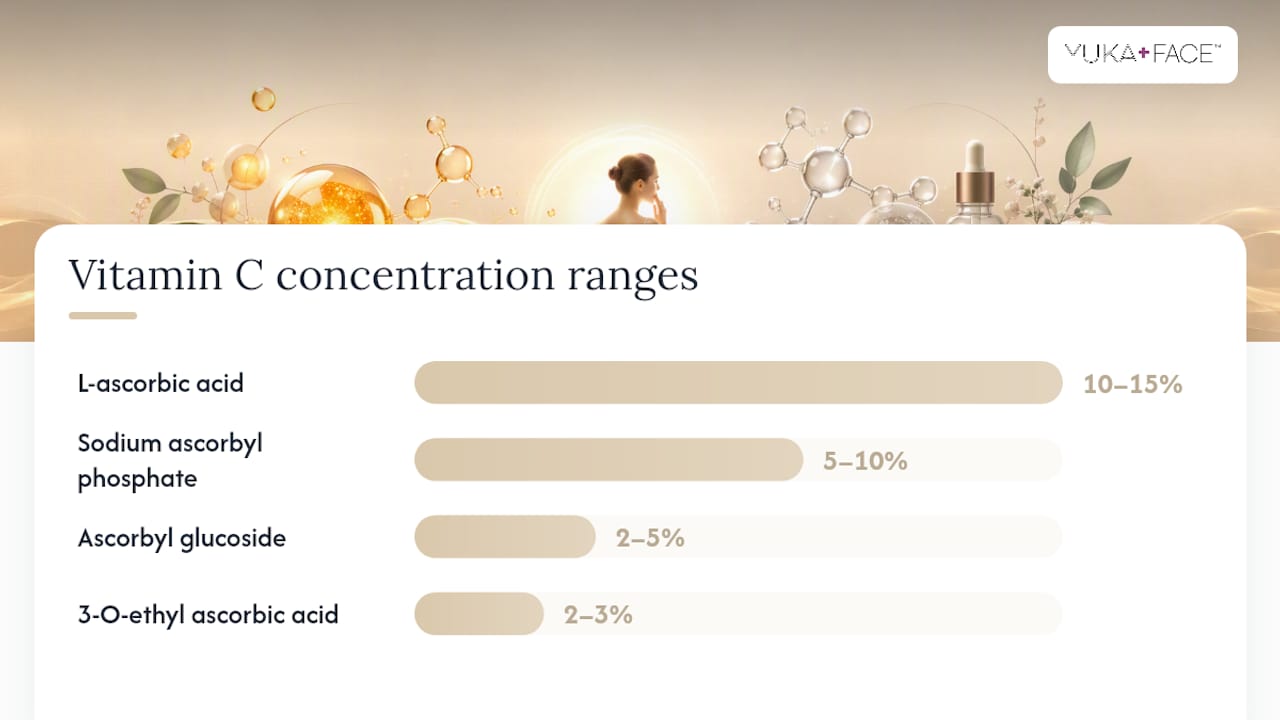
| Vitamin C Form | Typical Concentration | Stability | Best Use |
|---|---|---|---|
| L-ascorbic acid | 10–15% | Low (oxidizes quickly) | AM, experienced users, brightening focus |
| Sodium ascorbyl phosphate | 5–10% | High | AM or PM, sensitive skin |
| Ascorbyl glucoside | 2–5% | High | AM or PM, beginners |
| 3-O-ethyl ascorbic acid | 2–3% | High | AM or PM, all skin types |
Cleveland Clinic guidance recommends storing L-ascorbic acid serums away from light and heat to slow oxidation, and choosing formulas that include stabilizers such as vitamin E and ferulic acid. Research on stabilized L-ascorbic acid formulations shows that pairing ascorbic acid with vitamin E and ferulic acid significantly improves potency and shelf stability.
For niacinamide:
- 2–5% covers most benefits: barrier support, sebum regulation, and pigmentation reduction.
- Up to 10% is used in some products but can cause flushing or irritation in sensitive skin, particularly when layered with acidic actives.
- Beginners should start at the lower end and increase only if well tolerated after four to six weeks.
How to introduce the duo safely
Patch testing before adding any new active to your routine takes two minutes and prevents days of irritation.
- Choose a test site. The inner forearm or behind the ear are both reliable. Avoid the face for initial testing.
- Apply a small amount of each product separately to the test site.
- Wait 24–48 hours. Check for redness, swelling, stinging, or itching.
- If clear, introduce one product at a time into your face routine. Start with niacinamide for one week, then add vitamin C. This makes it easy to identify which product caused any reaction.
- Watch for irritation signs during the first two to four weeks: persistent stinging after application, visible redness that does not fade within 30 minutes, flaking, or a tight, compromised-feeling barrier.
If irritation appears, stop both products, simplify your routine to a gentle cleanser and plain moisturizer, and let the barrier recover for several days. Reintroduce one product at a time at a lower frequency (every other day) before building back to daily use.
See a board-certified dermatologist if you experience a widespread reaction, hives, or swelling, if redness persists beyond 48 hours after stopping use, or if you suspect allergic contact dermatitis rather than simple irritation.
What the clinical evidence says
The evidence base for using vitamin C and niacinamide together is solid, though most studies examine each ingredient separately rather than in direct combination.
Vitamin C's role in photodamage reversal and collagen synthesis is well documented in peer-reviewed literature. A PMC review of topical agents covers the antioxidant, anti-inflammatory, and barrier-supporting mechanisms of both ingredients, providing mechanistic support for their complementary use. On compatibility specifically, Healthline's chemistry review summarizes the dermatologist consensus: the nicotinic acid conversion concern does not apply to normal product use.
Clinical reporting on combination approaches shows complementary effects on pigmentation and barrier function. The evidence for each ingredient individually is strong; the evidence for the specific combination is coherent but still growing. What is clear: no credible clinical data supports avoiding this pairing in normal skincare use.
Ready-to-use AM and PM routine examples
AM routines
- Gentle (derivative-based): Cleanser → sodium ascorbyl phosphate or ascorbyl glucoside serum → niacinamide moisturizer → SPF 30+. Best for sensitive or reactive skin.
- Standard (L-ascorbic acid): Cleanser → L-ascorbic acid serum (10–15%) → wait 60 seconds → lightweight moisturizer → SPF 30+. Add niacinamide in the moisturizer layer or as a separate serum.
- Acne-prone adaptation: Cleanser → niacinamide serum → lightweight, oil-free moisturizer with vitamin C derivative → SPF 30+. Keeps textures minimal and avoids heavy layering.
PM routines
- Niacinamide-centered: Cleanser → niacinamide serum → barrier-repair moisturizer. Simple, effective for barrier recovery nights.
- Split routine (AM/PM): Vitamin C in the morning as above; niacinamide serum or moisturizer at night. No layering required, full benefit of both.
- Combined layering (tolerant skin): Cleanser → L-ascorbic acid serum → 60-second wait → niacinamide serum → moisturizer. Use two to three nights per week initially before going daily.
For layering ease, serums sit under moisturizers. If both products are serums, apply the thinner one first. A step-by-step routine guide can help you map these steps to your existing products.
An editorial perspective on the duo
The vitamin C and niacinamide conversation gets overcomplicated. The old myth about cancellation persists in comment sections and ingredient-checker apps long after the chemistry was settled. What actually matters is simpler: pick stable forms, layer in the right order, and give your skin time to adjust.
A stable derivative at a lower concentration often delivers comparable brightening with far less friction, especially for anyone new to actives or managing a compromised barrier.
Niacinamide's role in this pairing is underrated. It does not just tolerate vitamin C; it actively compensates for vitamin C's weaknesses, calming the inflammation that high-concentration ascorbic acid can trigger and reinforcing the barrier that acidic formulas can temporarily disrupt. That is a genuinely complementary relationship, not just co-existence.
Yuka+Face's approach, choosing natural, vegan formulations with stable vitamin C derivatives and gentle niacinamide concentrations, reflects exactly this logic. Start with a stable form, support the barrier, and let the skin respond before increasing potency. For complex skin conditions, a board-certified dermatologist remains the right resource for personalized guidance.
Yuka+Face products for your vitamin C + niacinamide routine
Yuka+Face offers vegan, cruelty-free formulations built for exactly the routines described above. The Vitamin C Glow Serum uses a stable vitamin C derivative, making it compatible with niacinamide-containing moisturizers and serums without the pH management that L-ascorbic acid requires. Gentle textures mean it layers cleanly under SPF in the morning.

For barrier support in the evening, Yuka+Face moisturizers containing niacinamide pair naturally with the serum or stand alone as the PM step in a split routine. All products are formulated for all skin types, including sensitive skin, and align with the patch-test-first approach outlined in this article.
Build your morning skin care routine with Yuka+Face products designed to work together. Visit the store to find the right combination for your skin goals.
Sources
- Niacinamide and Vitamin C: Can You Combine Them? — Healthline
- How to use niacinamide and vitamin C in your skincare routine — Cosmopolitan
- Pubmed
- Ncbi
- Health
- Aad
Consult a board-certified dermatologist for personalized advice, especially if you have a compromised barrier, active acne, or a history of contact dermatitis.
This article is general information, not a substitute for advice from a qualified doctor. Consult a qualified healthcare professional about your own circumstances before acting on anything here.
FAQ
Can you use vitamin C and niacinamide together?
Yes. Dermatologist consensus and modern formulation science confirm they are compatible in everyday skincare routines. The old concern about nicotinic acid conversion applies only to extreme lab conditions, not normal product use.
What should you not mix with niacinamide?
Niacinamide is generally well tolerated alongside most actives. Use caution when combining it with very high-concentration acids (AHAs, BHAs) at the same time, as stacking multiple low-pH products can stress the barrier. For guidance on pairing niacinamide with other actives, see niacinamide and retinol.
How long should you wait between applying vitamin C and niacinamide?
Thirty to sixty seconds is sufficient for most people. Sensitive skin types can wait two to three minutes. The pause allows the first product to absorb before layering, but it is not required for safety.
What should you not mix vitamin C with?
Avoid combining L-ascorbic acid with benzoyl peroxide, which can oxidize vitamin C and reduce its effectiveness. Using multiple low-pH exfoliating acids at the same time as a high-concentration ascorbic acid serum can also increase irritation risk. Niacinamide itself is not on this list.