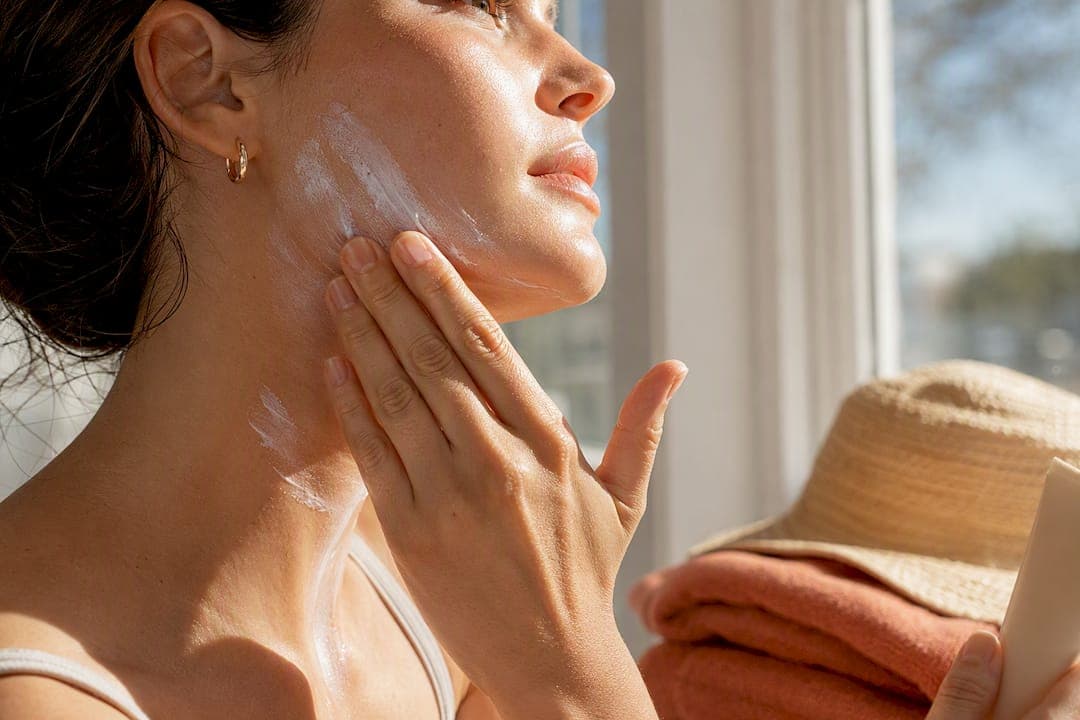
The essential summer skincare routine involves daily use of broad-spectrum sunscreen with SPF 30 or higher, a lightweight moisturizer, and an antioxidant layer underneath. Experts recommend reapplying sunscreen every couple of hours when outdoors. Mornings focus on protection; nights focus on repair. Board-certified dermatologists and the American Academy of Dermatology back this exact framework, and Yuka+Face builds its warm-weather lineup around it.
TL;DR:
- Reapply sunscreen every two hours outdoors, regardless of SPF, and use sufficient amounts to cover all exposed skin thoroughly.
- Switch to gel or lightweight moisturizers for oily or combination skin types to prevent pore clogging in high humidity.
- Incorporate antioxidant serums with vitamin C in the morning and heavier repair moisturizers at night for optimal protection and recovery.
- Protect areas often missed with sticks or zinc-based lip balms, such as ears, scalp, and lips, especially during prolonged sun exposure.
- Avoid heavy oils, photosensitizing botanicals, and aggressive acids during peak sun months to reduce risks of breakouts, burns, and discoloration.
Table of Contents
- Daily Summer Skincare Routine: The AM and PM Sequence
- How Do You Pick the Right Sunscreen for Summer?
- Adjusting Your Summer Skincare Routine by Skin Type
- Which Active Ingredients Are Safe to Use in Summer?
- Managing Sweat, Rashes, and the Spots You Keep Missing
- Yuka+Face and a Simpler Summer Routine
- Why Drinking Water Matters for Summer Skin
- Protecting Skin Beyond What You Apply
- How Humidity and Pollution Change Your Summer Skin
- Ingredients to Avoid or Limit in Summer
- Handling Sunburn, Heat Rash, and Extra Oil
- Should Your Nighttime Routine Change in Summer?
- An Editor's Take on the Summer Skincare Reset
- Where to Start With Yuka+Face This Summer
- Sources
- FAQ
Daily Summer Skincare Routine: The AM and PM Sequence
Order matters more than product count. A serum applied over sunscreen does nothing for either product; apply it backward, and you have wasted both.
Morning steps:
- Cleanse with a gentle, non-stripping formula. Skip anything foaming and harsh. Overnight oil buildup in summer heat needs a rinse, not a scrub.
- Apply an antioxidant serum, ideally one with vitamin C, while skin is still slightly damp.
- Layer a lightweight moisturizer if your skin needs it. Oily skin in humid climates can often skip this step entirely.
- Finish with broad-spectrum SPF 30 or higher, always last. Sunscreen is a barrier, not a base layer.
Evening steps:
- Remove sunscreen and sweat with a proper cleanse. Double cleansing (an oil or balm first, then a water-based cleanser) clears mineral sunscreen residue that a single wash leaves behind.
- Apply your treatment, whether that is a retinoid or another night treatment, on the nights your rotation calls for it.
- Seal with a repair moisturizer slightly richer than your daytime one, since skin does most of its recovery work overnight.
For sunscreen, use a sufficient amount to cover the face and body thoroughly, approximately the size of a nickel for the face and enough to cover the body evenly. If you sweat heavily during the day, a quick rinse before reapplying keeps salt and residue from clogging pores. For a full-length walk-through of the morning half of this sequence, Yuka+Face's morning skin care routine guide breaks it down step by step.
How Do You Pick the Right Sunscreen for Summer?
Broad-spectrum SPF 30 or higher is the baseline the AAD recommends for daily use, and it is non-negotiable in summer. Broad-spectrum matters because UVB rays burn skin while UVA rays age it and both contribute to skin cancer risk, so a sunscreen that only blocks one leaves you exposed to the other.
Format changes how well you actually use it:
- Lotions are easiest to measure accurately, which is why Consumer Reports testing favors them for reliable coverage.
- Sprays are convenient for bodies and scalps but harder to measure, and Consumer Reports notes they should be sprayed into your hands first, then rubbed on, rather than applied directly to the face.
- Sticks work well for reapplying over makeup and for precise spots like ears and hairlines.
- Gels absorb fast and suit oily or acne-prone skin that resists heavier lotions.
Reapply every 2 hours outdoors, or immediately after swimming or heavy sweating. That guidance comes straight from Consumer Reports' testing protocol, and it holds regardless of the SPF number on the bottle. A higher SPF does not buy you more time between applications.
Tinted sunscreens deserve a specific mention. Iron oxides in tinted formulas block visible light, which matters if you deal with melasma or post-inflammatory hyperpigmentation, since visible light can worsen those conditions even when UV rays are blocked. Don't forget lip protection either; a zinc-based lip sunscreen covers a spot most routines miss entirely.
Adjusting Your Summer Skincare Routine by Skin Type
A single routine rarely fits every skin type once temperatures climb. Small swaps keep the framework intact while solving your specific problem.
- Oily and acne-prone skin: Swap heavy creams for a gel moisturizer, and if breakouts flare, use a salicylic acid cleanser one to three nights a week rather than daily.
- Dry skin: Keep humectants like hyaluronic acid and barrier-supporting ceramides in your routine. Avoid stripping, sulfate-heavy cleansers that leave skin tighter after washing than before.
- Sensitive or pigmentation-prone skin: Stick with minimally irritating, fragrance-light formulas and lean on tinted SPF for the visible-light protection mentioned above.
- Combination skin: Treat the T-zone with a gel formula and the cheeks with a slightly richer one, or use a single lightweight lotion everywhere and adjust cleanser frequency by zone.
If summer brings a persistent rash, unexplained discoloration, or a breakout pattern that does not respond to over-the-counter changes, see a board-certified dermatologist. Conditions like tinea versicolor and severe hyperpigmentation often need a prescription-strength approach that a routine swap cannot fix on its own.
Which Active Ingredients Are Safe to Use in Summer?
Vitamin C is one active worth keeping year-round, not scaling back. It works as an antioxidant that neutralizes the free radicals UV exposure generates, and Harvard Health notes it complements sunscreen rather than duplicating its job. A broader review of photoprotection research backs the same point: antioxidants address oxidative stress that sunscreen alone does not fully block. Fat-soluble vitamin C derivatives, like THD ascorbate, absorb well into skin's lipid layers, which makes them a solid pick for a morning antioxidant layer under SPF.
Retinoids don't need to be paused for summer, but they do need backup. Continue your usual retinoid at night as long as daytime SPF stays strict; if reapplying sunscreen every two hours is not realistic for you, bakuchiol offers a gentler alternative with less sun-sensitivity risk.
- Reduce exfoliation frequency and skip aggressive in-office resurfacing during peak sun months. Both leave skin more reactive to UV exposure exactly when exposure is highest.
- Layer actives with intention: mornings go antioxidant, then SPF; nights go retinoid or exfoliant, alternated rather than stacked.
Pro Tip: If irritation creeps in, don't drop your retinoid entirely. Buffer it with a moisturizer applied first and cut back to two nights a week. That keeps the benefit without triggering a flare-up cycle.
Managing Sweat, Rashes, and the Spots You Keep Missing
Heavy sweating traps salt and oil against skin, and that combination is a common trigger for folliculitis. A quick rinse after a workout, even without a full shower, cuts that risk substantially.
- Treat fungal rashes early. Tinea versicolor flares in heat and humidity, and dermatologists often reach for an antifungal dandruff shampoo used as a body wash to manage it.
- Cover the spots you always skip: ears, the part in your scalp, the tops of your feet, and your lips. A sunscreen stick handles the first three; a zinc lip balm handles the last.
- Choose breathable fabrics. Tight, sweat-trapping clothing worsens chafing and heat rash, so loose, moisture-wicking materials help more than any product applied afterward. UPF-rated fabric, including UPF swimwear, adds a layer of physical protection sunscreen alone can't match at the beach or pool.
- Push pigmentation lasers to fall. Dermatologists generally recommend holding off on resurfacing treatments until sun exposure drops, since summer sun raises the risk of rebound discoloration after a laser session.
Yuka+Face and a Simpler Summer Routine
Many vegan, cruelty-free skincare formulas built from plant-based ingredients fit a season where lighter is better and fewer synthetic fillers means less risk of clogged pores. A gel moisturizer replaces a heavier cream for the humid months, an antioxidant serum slots into the morning layer under SPF, and a sunscreen-compatible moisturizer keeps the barrier intact without weighing skin down. None of these swaps require abandoning the AM/PM sequence outlined above. They just replace ingredients with natural, vegan formulations built for the same steps. Yuka+Face's dedicated summer skincare guide walks through specific product pairings for warm-weather skin.
Why Drinking Water Matters for Summer Skin
Sunscreen and serums work on skin from the outside. Hydration works on it from the inside, and summer heat pulls more water out of your body through sweat than any other season. Skin that runs low on internal hydration loses elasticity and looks duller, no matter how good your topical routine is.
Dehydration also makes skin more reactive. Barrier function weakens when your body is running a water deficit, and a weaker barrier means product irritation, increased sensitivity to sun exposure, and slower recovery from minor sunburn. Drinking water consistently throughout the day, rather than a large amount at once, keeps that barrier steadier.
There is no single magic number that applies to everyone, since fluid needs shift with body size, activity level, and climate. The practical guidance is simpler: increase water intake on hot days, especially if you are sweating from exercise or spending hours outdoors, and pay attention to thirst rather than ignoring it. Foods with high water content, like cucumber and watermelon, add to your intake without requiring you to track every glass.

Topical hydrators like hyaluronic acid draw moisture into skin's surface layers, but they cannot compensate for a body that is chronically under hydrated. The two work together, not as substitutes for each other.
Protecting Skin Beyond What You Apply
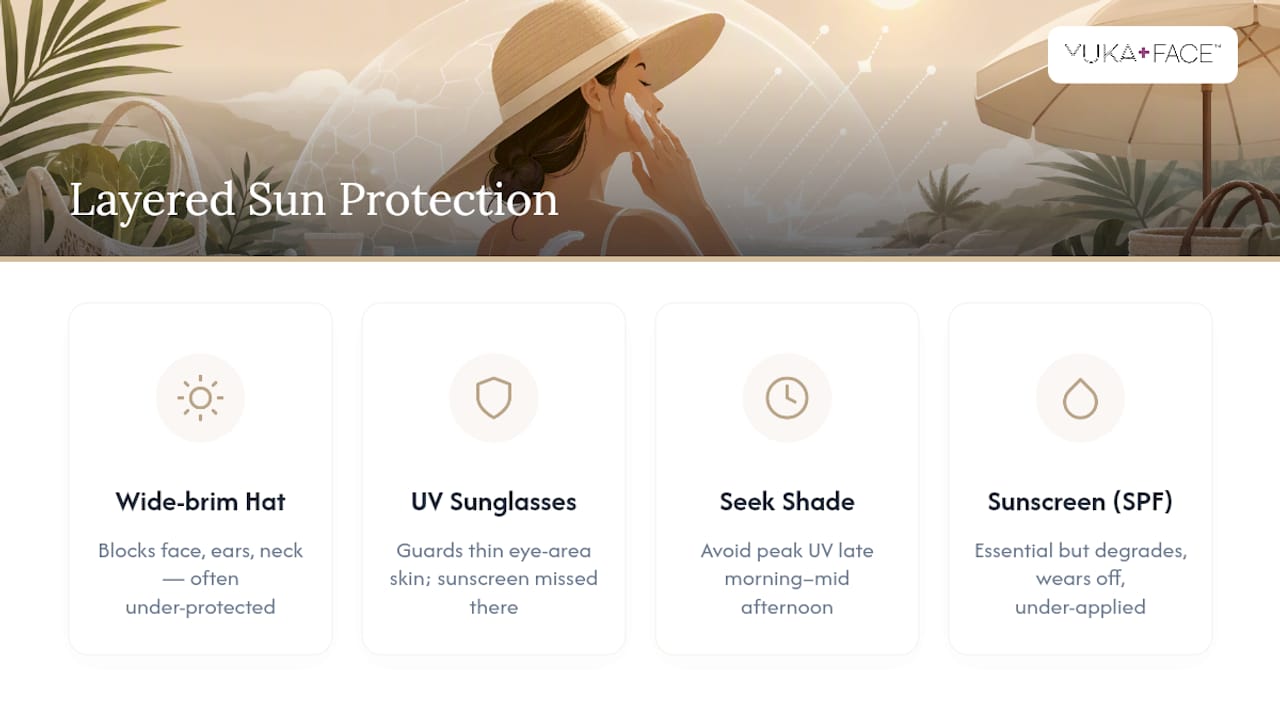
Sunscreen has limits. It degrades in sunlight, wears off with sweat, and rarely gets applied thick enough to hit its labeled SPF in real-world use. Physical barriers pick up the slack sunscreen leaves behind.
A wide-brimmed hat blocks direct sun from your face, ears, and neck, three areas that account for a disproportionate share of skin cancer diagnoses because they are so often under-protected. Sunglasses with UV protection guard the thin, delicate skin around your eyes, an area where fine lines show up early and sunscreen application tends to be inconsistent at best.
Seeking shade during peak UV hours, generally late morning through mid afternoon, cuts your cumulative exposure without requiring any extra product at all. Combining shade timing with a hat and sunglasses reduces the burden on sunscreen alone, which matters given how often reapplication schedules slip during a full day outdoors. None of these measures replace SPF. They reduce how hard your sunscreen has to work, which matters given how easy it is to under-apply or forget a reapplication window.
How Humidity and Pollution Change Your Summer Skin
Humidity thickens the air with moisture, and skin responds by producing more oil to compensate for what it reads as an already-saturated environment. That extra oil is why summer breakouts spike even in people who rarely deal with them in cooler months.
Pollution adds a separate problem. Airborne particulates settle on skin throughout the day and, combined with UV exposure, contribute to the oxidative stress that ages skin and dulls its appearance. Cities with higher smog levels see this effect more acutely, but pollution exposure is not limited to urban environments alone.
The fix for both overlaps with the core summer routine. A gentle, thorough cleanse removes the day's buildup of oil, sweat, and airborne residue before it has a chance to sit in pores overnight. An antioxidant serum, the same vitamin C layer already recommended for UV protection, also helps counter the oxidative load pollution adds. Lightweight, non-comedogenic moisturizers keep skin hydrated without adding to the oil humidity already produces. None of this requires a separate pollution-specific product line. It just means taking the cleanse and antioxidant steps seriously rather than treating them as optional.
Ingredients to Avoid or Limit in Summer
Some ingredients that work fine in winter cause real problems once temperatures and sun exposure climb.
- Heavy oils and thick occlusives (think dense, wax-based balms) can trap sweat and oil against skin, contributing to clogged pores and breakouts in humid conditions.
- Certain essential oils and citrus extracts, particularly bergamot and other photosensitizing botanicals, can trigger a reaction called phytophotodermatitis when skin is exposed to sun after application.
- High-strength alpha and beta hydroxy acids used daily increase sun sensitivity and raise burn risk if sunscreen application slips even slightly.
- Alcohol-heavy toners that strip the skin barrier leave it more vulnerable to both sun damage and moisture loss during hot, drying weather.
None of these ingredients are permanently off-limits. The issue is frequency and pairing: an exfoliating acid used nightly with inconsistent SPF is a different risk profile than the same acid used twice a week with diligent sunscreen habits.
Handling Sunburn, Heat Rash, and Extra Oil
Sunburn calls for cool compresses, a fragrance-free moisturizer, and hydration, both topical and internal, while skin recovers. Skip harsh actives like retinoids or acids on burned skin until it has fully healed, since both will worsen the irritation.
Heat rash shows up as small, itchy bumps in areas where sweat gets trapped, commonly the chest, back, and skin folds. Loose clothing and a prompt rinse after sweating prevent most cases; a cool shower and a light, non-comedogenic lotion calm existing flare-ups.
Increased oiliness is simply biology responding to heat and humidity, not a sign your routine has failed. Switching to a gel moisturizer, using a gentle salicylic acid cleanser a few nights a week, and resisting the urge to over-cleanse (which triggers even more oil production) usually brings it back under control within a week or two.
Should Your Nighttime Routine Change in Summer?
Nighttime skincare needs a few summer-specific tweaks beyond the standard PM sequence. Double cleansing becomes more important, since sunscreen and sweat both leave residue that a single wash often does not fully clear.
Repair moisturizers can go slightly lighter than their winter counterparts. Skin in summer already retains more moisture from ambient humidity, so a heavy night cream can feel greasy and may contribute to clogged pores rather than solving dryness. If your nights include a retinoid or exfoliating acid, this is also the moment to check that your daytime SPF habit is solid. Nighttime actives that increase sun sensitivity only cause problems if the next day's protection is inconsistent.
An Editor's Take on the Summer Skincare Reset
The instinct to overhaul your routine every summer is largely wasted effort. What actually needs to change is smaller than most advice suggests: lighter textures, stricter reapplication, and a little less exfoliation. Everything else, the antioxidant serum, the retinoid, the core cleanse, can usually stay exactly where it was in January. A pared-back approach works because consistency beats complexity, especially in a season when heat and sweat make people abandon routines they find too fussy to maintain. If you want a longer-form version of the morning half of this sequence, Yuka+Face's checklist lays out nine steps worth skimming.
— Kelly
Where to Start With Yuka+Face This Summer
A lineup that maps directly onto the routine above includes a lightweight, antioxidant-rich serum for the morning step between cleansing and moisturizer; a gel-based hydrator to replace heavier creams for oilier skin in humidity; and a sunscreen-compatible moisturizer that completes the AM sequence without pilling or feeling greasy under SPF.

If you're ready to see how the full lineup fits together, the summer skincare guide walks through specific pairings by skin type, and it's the fastest way to figure out exactly where to start.
This article is general information, not a substitute for advice from a qualified doctor. Consult a qualified healthcare professional about your own circumstances before acting on anything here.
Sources
- American Academy of Dermatology — sunscreen FAQs and guidance
- Consumer Reports — Best sunscreens of the year
- Harvard Health — Why topical vitamin C is important
- Time — 13 summer skin-care tips dermatologists swear by
FAQ
What Is the Best Skincare Routine for Summer?
The most effective summer routine pairs a broad-spectrum SPF 30 or higher, applied last every morning, with a lightweight moisturizer and an antioxidant serum like vitamin C underneath. Reapply sunscreen every two hours outdoors, and switch to gel textures if your skin runs oilier in humidity.
What Are the 5 Basic Skin Care Steps?
A simple five-step framework covers cleanse, treat (an antioxidant serum or targeted treatment), moisturize, protect (sunscreen in the morning), and repair (a richer product or retinoid at night). Summer keeps all five steps but lightens the textures and tightens the SPF reapplication habit.
How Do You Layer Skincare Products in Summer?
Layer thinnest to thickest: cleanser first, then an antioxidant serum, then a lightweight moisturizer if needed, and sunscreen always last in the morning. At night, cleanse (double cleanse if you wore sunscreen all day), apply treatment actives like a retinoid, then seal with a repair moisturizer.
Do I Need a Different Moisturizer in Summer?
Most people benefit from switching to a gel or lightweight lotion in summer, since heavier creams can trap sweat and oil and contribute to clogged pores in humid weather. Dry skin types can often keep a slightly richer formula as long as it isn't heavy or occlusive.
How Often Should I Reapply Sunscreen in Summer?
Reapply broad-spectrum sunscreen every two hours when you're outdoors, and immediately after swimming or heavy sweating, according to Consumer Reports testing guidance. A sunscreen stick or powder SPF makes reapplying over makeup far easier than a lotion mid-day.