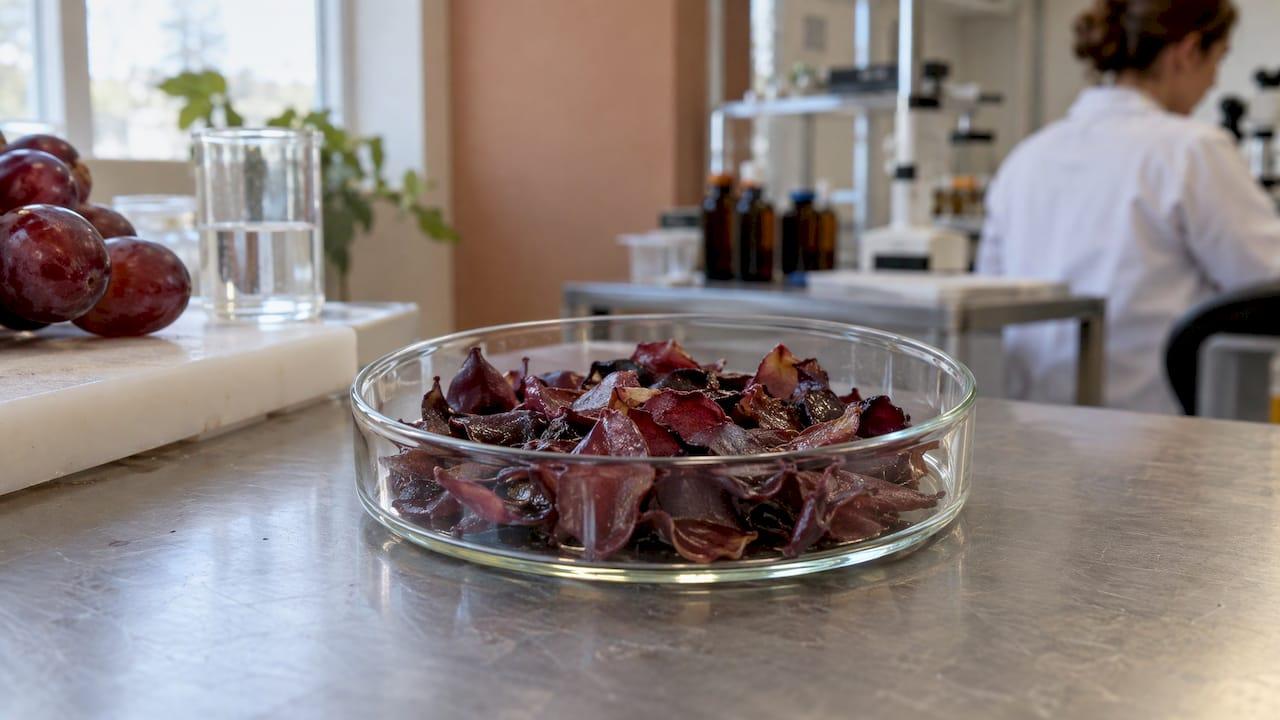
Resveratrol is a plant antioxidant that shows real promise for fine lines, uneven tone and redness, but most of the strongest data comes from lab work and small trials. Human studies of topical products are encouraging and still limited. For sensitive and barrier-compromised skin, the practical answer is a gentle antioxidant routine built on short, stable ingredient lists, with resveratrol as one option among several. This guide is written for estheticians, spa and retail buyers, and skincare-minded readers who need to explain the ingredient clearly and use it well.
TL;DR
- Resveratrol is a stilbenoid, a plant compound found most abundantly in red grape skin, studied for antioxidant and anti-inflammatory effects on skin.
- Small human studies of topical use report better elasticity, hydration, wrinkles and pigmentation, but reviewers say more well-designed trials are needed.
- Topical resveratrol was generally not irritating in most studies, though one case of contact dermatitis has been reported.
- Grape seed extract is a different ingredient with its own chemistry, and its skin evidence is mostly preclinical.
- Stability matters: resveratrol breaks down under UV light, so formulation and packaging decide how much a product delivers.
Table of Contents
- What resveratrol is
- What the research says
- Resveratrol serum benefits by concern
- Why stability decides whether a product delivers
- How to use resveratrol in a routine
- Safety and tolerability
- Resveratrol vs retinol
- Grape seed extract is not resveratrol
- How to choose a product
- Build the routine with Yuka+Face
- FAQ
- Sources
What resveratrol is
Resveratrol is a stilbenoid found most abundantly in red grape skin. Plants make it in response to stress. In skincare it is used as an antioxidant: a molecule that neutralizes free radicals, the unstable particles produced by UV light, pollution and normal metabolism that damage skin cells and collagen over time.
You will see it on labels as resveratrol, trans-resveratrol (the more studied form) or as part of grape, peanut or Japanese knotweed extracts. Ingredient lists rarely state a percentage, so the form and the formula matter more than the name.
What the research says
The honest summary is a gap between mechanism and proof. A 2020 review of resveratrol and the skin describes laboratory and animal work pointing to UV protection, anti-inflammatory action, antioxidant defense, antimicrobial activity and reduced pigment production. The same review concludes that clinical evidence is not yet enough to establish skin benefits in practice.
That is the frame to carry into any client conversation. Resveratrol is a reasonable, well-studied antioxidant. It is not a proven replacement for sunscreen or for treatments with a long clinical record.
Human studies on topical use
A few trials give a sense of what to expect:
- Aging skin, topical products. The 2020 review reports that resveratrol-containing topical products improved wrinkles, hydration and pigmentation in older adults, and calls for more well-designed trials.
- A 2% trans-resveratrol emulsion. In a 2021 study of 20 women aged 30 to 35 who applied it twice daily for eight weeks, elasticity, barrier function, smoothness, thickness and density improved, with no adverse events reported in that study.
- A combination formula. A 2014 study of 55 women aged 40 to 60 used 1% resveratrol, 0.5% baicalin and 1% vitamin E for 12 weeks. Lines, wrinkles, firmness and pigmentation improved, but because the formula had three actives, the result cannot be credited to resveratrol alone.
These are small groups, short timelines and often a single formula. They support the idea that topical resveratrol can contribute to visible smoothness and tone. They do not establish how large the effect is.
Oral resveratrol is a separate question
Supplement results are mixed. In the 2020 review, one trial of 50 people reported better hydration, elasticity, roughness and wrinkle depth after oral fruit extracts containing resveratrol, while a 30-person oral supplement trial did not appreciably improve skin aging. The 2021 skin-bioactivities review adds that poor solubility, low oral bioavailability and rapid metabolism limit how much reaches the skin when swallowed.
That is one reason topical use gets the attention. A 2011 review notes that topical delivery may place resveratrol directly at the skin site and avoid systemic metabolism. For clients asking about resveratrol-rich foods, the research on whole grapes and skin is thin, and one example is a mouse study pairing grape powder with topical resveratrol, which is not a basis for diet advice.

Resveratrol serum benefits by concern
Here is what can reasonably be said for each concern, and how firmly.
| Concern | What the evidence shows | How firmly |
|---|---|---|
| Fine lines and elasticity | Improvements reported in small topical trials | Encouraging, small samples |
| Hydration and barrier | Barrier function improved with a 2% emulsion in 20 women | Early |
| Dark spots | Abundant lab data, scarce human data | Preliminary |
| Redness | A 16-person, six-week study of a blend with green tea polyphenols and caffeine improved facial redness | Very limited, no control group |
| Acne | One split-face study of 20 patients | Early |
Dark spots and uneven tone
A 2019 review of resveratrol as a topical hypopigmenting agent found plenty of laboratory evidence and little human data. It calls for clinical trials to confirm efficacy and safety for pigment disorders. Position resveratrol as one supportive step for tone alongside daily sunscreen, not as a fix for melasma or post-inflammatory marks.
Redness and sensitivity
A 2024 review in the Journal of Integrative Dermatology says evidence for grape-derived ingredients in rosacea is sparse. It cites a 16-person, six-week study of a blend of resveratrol, green tea polyphenols and caffeine that improved facial redness, while noting the small sample and missing control group limit conclusions. For a client with persistent redness, the right next step is a dermatologist, and the routine is a supportive layer.
Acne
A 2023 review describes a study in which a resveratrol hydrogel was applied daily to one side of the face in 20 patients for 60 days. The treated side showed a 53.75% drop in Global Acne Grading System score versus 6.10% on the vehicle side. The authors treat it as an early result needing further research. It is interesting, not a protocol.

Why stability decides whether a product delivers
This is the point most consumer articles skip. The same 2023 review says resveratrol has promise for anti-aging and photoprotection but is unstable under ultraviolet exposure and needs formulation strategies to protect it. Poor solubility is another known limit, according to the 2021 bioactivities review.
In practice that means:
- Opaque or airtight packaging matters more than a pretty jar.
- Store the product away from sunlight and heat, in a cabinet rather than on a window ledge or a retail shelf under spotlights.
- Use it in the evening if the product is not packaged for light protection, and wear sunscreen in the morning.
Light is a double-edged factor for skin. It degrades some actives, and it is also used on purpose in wellness treatments, as in this overview of photobiomodulation benefits and dosage.
How to use resveratrol in a routine
A simple order works for most clients and for treatment-room retail recommendations:
- Cleanse. Remove oil, sunscreen and makeup. A double cleanse suits evening wear.
- Tone. Use a gentle, alcohol-free toner to prep the skin.
- Apply the antioxidant serum. A few drops on clean skin, once daily to start. Move to twice daily if the skin stays calm.
- Moisturize. A cream seals in the serum and supports the barrier. See the difference between moisturizing and hydrating.
- Protect. Broad-spectrum SPF every morning. Antioxidants add to sunscreen, never replace it.
Results in the studies above ran from eight to twelve weeks, so set that expectation with clients. Introduce one new active at a time and patch test on the inner forearm or behind the ear first.
What to pair it with
Resveratrol sits well with other antioxidants such as vitamin E, which appeared in the 2014 combination trial, and with humectants and barrier lipids. For a wider view of the category, see our guides to antioxidants for skin health and natural anti-aging ingredients. The research here does not identify a specific ingredient to avoid, so the rule is the usual one: add one active at a time and watch the skin for a week or two.
Safety and tolerability
The 2019 review reports topical resveratrol was generally not irritating in most studies, with one reported case of contact dermatitis. It also notes that theoretical pigment-loss risks need further investigation. The 2021 review lists headache, drowsiness, electrolyte changes and rash after high-dose systemic resveratrol and stresses that topical clinical safety data are limited.
What this means for use:
- Patch test before first use, especially with sensitive skin or known plant allergies.
- Stop if redness, itching or swelling develops, and see a dermatologist for a reaction that persists.
- Clients who are pregnant, nursing or on medication should check any oral resveratrol supplement with their doctor. The studies above concern topical use.
Resveratrol vs retinol
They do different jobs. Retinol is a vitamin A derivative used to speed cell turnover and smooth texture, and it has a long clinical record. It also asks for a slow introduction because of dryness and irritation. Resveratrol is an antioxidant that works defensively against oxidative stress, and it is usually described as the gentler of the two. The evidence for resveratrol is smaller.
For clients with reactive skin who want a retinol-style routine without the adjustment period, a plant-based option is bakuchiol. Our guides compare retinol and bakuchiol and explain bakuchiol benefits as a natural retinol alternative. Many routines pair an antioxidant in the morning with a retinol alternative in the evening.
Grape seed extract is not resveratrol
Grape seed extract comes up in the same searches, but it is a different material. Grape seed contains many flavonoids and polyphenols, and a 2021 study of an activated grape seed extract found that resveratrol did not act through the mechanism tested in that paper. That study found antioxidant and anti-inflammatory activity in cell assays and a 3D human skin model. That is preclinical work, so it cannot be read as proof that standard grape seed skincare changes skin in people.
In a label review, treat the two names separately: grape seed extract and resveratrol are not interchangeable, and a product listing one does not necessarily contain the other.
How to choose a product
Whether you are stocking a spa shelf or choosing for yourself, check these points:
- Short, readable ingredient list. Fewer ingredients make reactions easier to trace.
- Light-protective packaging. Dark glass, airless pumps or tubes.
- The antioxidant system as a whole. Vitamin E, botanical oils and other polyphenols support each other, as the combination trial suggests.
- Barrier support. Ceramide-friendly oils and humectants help sensitive skin tolerate actives.
- Cruelty-free and vegan claims you can verify. Leaping Bunny certification is the standard marker for cruelty-free.
For professionals, a related point: clients rarely need five antioxidants. One well-formulated serum, a moisturizer and daily SPF outperform a crowded shelf.
Our view on antioxidants
We build Yuka+Face around the idea that skin does best with simple routines and short, transparent ingredient lists. Our formulas are vegan, cruelty-free and designed for all skin types and ages, with a focus on barrier repair and sensitive skin.
Resveratrol is a good example of why we favor that approach. The research is promising, the human data is still small, and stability depends on formulation. A routine of gentle cleansing, a toner, a serum and a moisturizer gives skin the antioxidants, vitamins and essential oils it can use, without asking it to carry a long list of actives.
We would rather help you build a routine that your skin tolerates every day than chase a single ingredient. That is the philosophy behind our range.
Kelly
Build the routine with Yuka+Face
Our cleansers, toners, serums and oils are vegan, cruelty-free and made for sensitive and barrier-stressed skin. For dry or dehydrated skin, start with the moisturizers and masks. A gift card is available from $50 for anyone who prefers to choose their own products.
Estheticians, spa owners and boutique or hotel retailers can use the same range for treatment rooms and shelves.
FAQ
Is resveratrol good for skin?
It is a well-studied antioxidant with encouraging results in small topical trials for wrinkles, hydration and pigmentation. Reviewers say larger, better-designed human trials are still needed. It works best as one part of a routine that includes sunscreen.
Is resveratrol better than retinol?
They serve different purposes. Retinol has the longer clinical record for texture and fine lines but needs a gradual start. Resveratrol is a gentler antioxidant with less clinical evidence. Some routines use both at different times of day.
Can resveratrol cause side effects?
Topical resveratrol was generally not irritating in most studies, with one reported case of contact dermatitis. Patch test first and stop use if irritation appears. High-dose oral resveratrol has been linked to headache, drowsiness and rash, so talk to a doctor before taking supplements.
Is grape seed extract the same as resveratrol?
No. Grape seed extract contains many flavonoids and polyphenols, and resveratrol is a separate compound found mostly in grape skin. The skin research on grape seed extract is mostly in cells and lab models.
How long until I see results?
The trials above ran eight to twelve weeks, so plan on that window with daily use and sunscreen. Skin that is dry or reactive may need a calming, barrier-focused routine first.
Sources
- Role of Resveratrol in Regulating Cutaneous Functions (2020)
- The bioactivities of resveratrol and its naturally occurring derivatives on skin (2021)
- The Grape Antioxidant Resveratrol for Skin Disorders (2011)
- Phytoestrogens (Resveratrol and Equol) for Estrogen-Deficient Skin (2021)
- Dermatological Bioactivities of Resveratrol (2023)
- Resveratrol as a Multifunctional Topical Hypopigmenting Agent (2019)
- Naturally occurring antioxidants for treating rosacea (2024)
- AGSE: A Novel Grape Seed Extract Enriched for PP2A (2021)
- Resveratrol in its natural combination in whole grape (2015)
- Photobiomodulation benefits and dosage