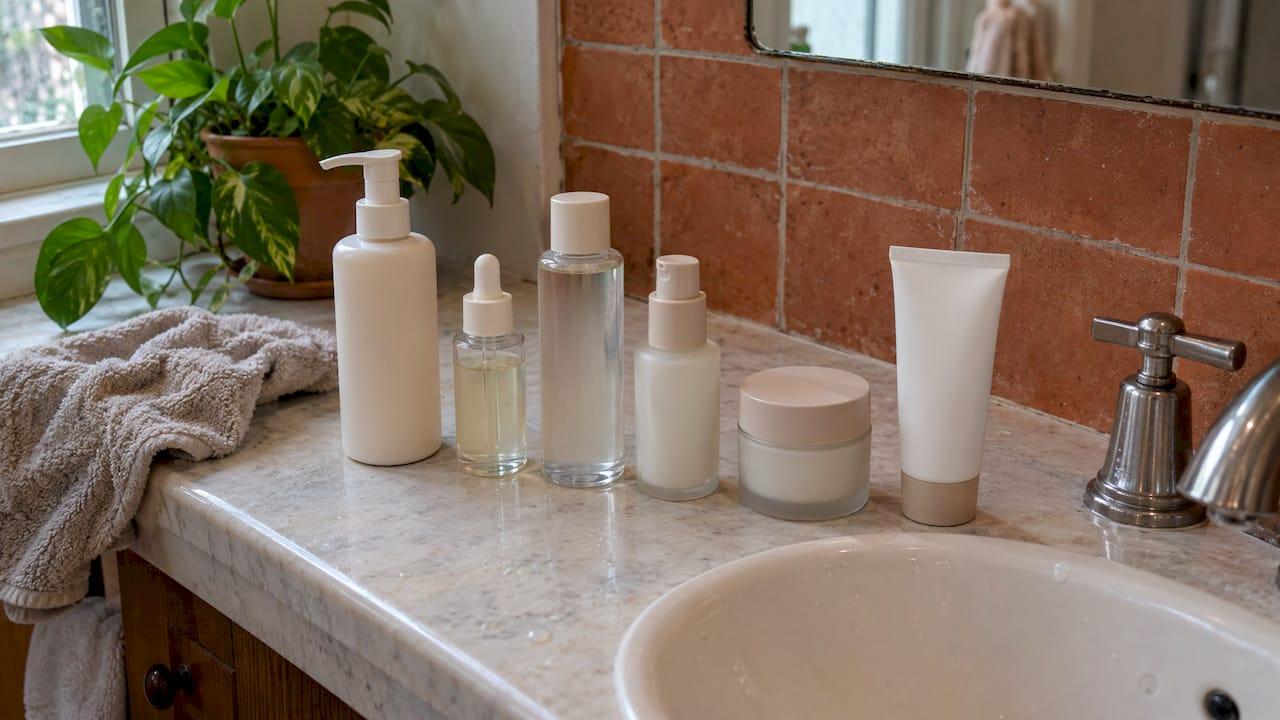
A pore minimizing routine does not shrink pores. It keeps them clear and the skin around them firm, so they look smaller. Genetics sets pore size, according to Cleveland Clinic. What you control is oil, debris, irritation and sun damage. A routine that handles those four things is gentle cleansing twice a day, a pore-clearing step used at the right frequency, a balancing toner, an oil-free moisturizer and daily sunscreen.
This guide gives the full routine, the order, the frequency and the mistakes that make pores look bigger. It is written for people with sensitive skin, and for estheticians and spa and retail teams who explain pore care to guests.
TL;DR
- Pores cannot be permanently shrunk. Clear, calm, protected skin makes them look smaller.
- Cleanse twice a day with warm (not hot) water and a gentle cleanser. Do not scrub.
- Add one pore-clearing step, such as salicylic acid or a weekly mask, and watch for dryness.
- Moisturize every day and wear broad-spectrum SPF 30 or higher.
- Skip squeezing, extractor tools, baking-soda scrubs and DIY glue masks.
Table of Contents
- Why pores look large, and what a routine can change
- The pore minimizing routine at a glance
- Step 1: Cleanse twice a day, gently
- Step 2: Add one pore-clearing step
- Step 3: Tone to balance the skin
- Step 4: Treat texture and firmness in the evening
- Step 5: Moisturize, even if skin is oily
- Step 6: Protect with sunscreen every morning
- Quick fixes: what ice and steam really do
- What to avoid
- A sample routine you can follow
- For estheticians and spa and boutique retail
- Build your routine with Yuka+Face
- FAQ
- Sources
Why pores look large, and what a routine can change
A pore is the opening of a hair follicle. It releases oil (sebum) onto the skin. You cannot close it or open it, because pores have no muscles. Pore size is mostly inherited.
Several things make pores more visible:
- Oil production. Oilier skin tends to show larger pores. Men tend to have more oil glands, and hormonal changes also play a role, per Cleveland Clinic.
- Clogging. The American Academy of Dermatology (AAD) explains that pores can look larger when they clog, because a clogged pore stretches.
- Aging. Collagen and elastin loss leaves less support around the opening.
- Sun damage. Sun breaks down collagen and elastin in the same way.
Clogged pores and enlarged pores are related but not the same thing. Cleveland Clinic notes that excess oil can clog a pore, while enlargement can also come from age, skin products, hair follicles and sun damage. That is why one routine needs to cover oil control, clearing and protection together.
The realistic goal is a smoother surface and less visible openings. Most people can reach it with consistent basics.
The pore minimizing routine at a glance
| Step | When | What it does | Frequency |
|---|---|---|---|
| 1. Cleanse | Morning and evening | Removes oil, debris and makeup | Twice daily |
| 2. Clear | Evening | Helps unclog pores | Daily to weekly, by tolerance |
| 3. Tone | After cleansing | Balances the skin before moisture | Once or twice daily |
| 4. Treat | Evening | Targets texture and firmness | Per product directions |
| 5. Moisturize | Morning and evening | Keeps skin hydrated and comfortable | Twice daily |
| 6. Protect | Morning | Prevents collagen and elastin loss | Daily |
Step 1: Cleanse twice a day, gently
Cleansing is the base of the routine. The AAD recommends washing twice a day with warm water and a gentle, non-comedogenic cleanser. Non-comedogenic means a product is made not to clog pores. The AAD also says to avoid scrubbing. Wash again after heavy sweating.
Where it goes wrong:
- Hot water. It strips and irritates. Use warm.
- Harsh or alcohol-based cleansers. The AAD advises avoiding oil-based or alcohol-based cleansers for oily skin because they can irritate.
- Washing too often. MedlinePlus advises washing once or twice a day, not repeatedly. Irritated skin makes pores more noticeable.
- Sleeping in makeup. MedlinePlus lists this as something to avoid.
Where we come in. Our B3 Gentle Cleanser is a daily cleanser. For evenings with makeup or sunscreen, the Cleansing Duo and the Vitamin C Cleansing Oil support a two-step approach. Our guide to double cleansing explains the order. Every Yuka+Face formula is vegan, cruelty-free and built on a short ingredient list.
If you want a professional opinion on your skin, in-office facial treatments for skin rejuvenation are another way to keep skin clean and calm alongside a home routine.
Step 2: Add one pore-clearing step
Cleansing removes surface oil. A clearing step works on what sits inside the pore. Pick one and introduce it slowly.
Salicylic acid (BHA)
The AAD says salicylic-acid cleansers may help unclog pores, and some are gentle enough for daily use. If it dries or irritates your skin, alternate it with a mild, non-comedogenic cleanser. MedlinePlus also says a salicylic acid wash may help when skin is oily and acne-prone.
Chemical exfoliants in general
AHAs, BHAs, retinols and enzymes can all help clear pores. Healthline notes they may be harsh or drying, and recommends working with a dermatologist to set how often to use them. The AAD adds that glycolic, lactic and salicylic acids can reduce oiliness but may be too harsh, so stop or use them less often if skin is irritated.
A weekly mask
A clay-type mask is a lower-frequency option. Once or twice a week is a common starting point. Our Masks sit alongside our moisturizers. For a natural approach built around bakuchiol and kaolin, read our guide on how to minimize pores naturally.
A simple start for sensitive skin:
- Choose one clearing product only.
- Use it two evenings a week for two weeks.
- Move to every other evening only if skin stays comfortable.
- Keep every other step in the routine gentle.
The AAD's guidance on over-the-counter acne products says to keep the rest of the routine gentle when adding them, and to pair them with gentle cleansers and moisturizers to support the skin barrier.
Step 3: Tone to balance the skin
A toner goes on after cleansing, before treatments and moisture. Choose one that does not dry the skin out. MedlinePlus advises avoiding rubbing alcohol and very drying toners. Our Lavender Essence Balancing Toner is made for this step.
Apply it with clean hands or a cotton pad. Press it in, and do not rub. Rubbing adds friction, and friction adds irritation.
Step 4: Treat texture and firmness in the evening
As skin ages, collagen and elastin decline, and pores can look more open. Retinol is the most studied ingredient for this concern. The AAD says retinol or retinyl palmitate may help when skin is oily, mildly acne-prone or less firm. It should be applied before bed. Some people get irritated, and anyone who is pregnant or breastfeeding should avoid it. Cleveland Clinic suggests talking to a healthcare provider if retinol or salicylic acid irritates you.
If you prefer a plant-based route, our comparison of retinol and bakuchiol explains how the two ingredients differ. Our Bright Eyes Peptide Serum is another serum in the range, and our piece on peptides in organic skincare covers the ingredient.
Introduce one treatment at a time. If you start two new actives in the same week, you cannot tell which one irritates.

Step 5: Moisturize, even if skin is oily
Skipping moisturizer is a common mistake with oily skin. The AAD advises applying moisturizer after cleansing to keep skin hydrated. Cleveland Clinic recommends an oil-free moisturizer after cleansing to avoid dry skin. Dry, irritated skin can look rougher, and pores stand out more on rough skin.
Our Hydrating Power Moisturizer is the daily moisturizer in the range. If you are unsure about the difference between the two ideas, our note on moisturizing vs. hydrating explains it. If you use facial oils, read which ones are non-comedogenic before adding one at night.
MedlinePlus also advises avoiding oil-based cosmetics and using water-based or noncomedogenic moisturizers when acne medicines cause drying or peeling.

Step 6: Protect with sunscreen every morning
Sun damage breaks down collagen and elastin, and that makes pores more visible. Cleveland Clinic recommends broad-spectrum sunscreen in the daytime routine for this reason. The AAD recommends SPF 30 or higher, water-resistant and broad-spectrum, every day.
For skin that breaks out, the AAD notes that sunscreens with zinc oxide and titanium dioxide may be preferable, and it advises avoiding sunscreens with fragrance or oils. Read the label before you buy.
For the rest of the morning sequence, see our morning skin care routine and the 9-step morning checklist. The evening side is covered in our evening skincare ritual.
Quick fixes: what ice and steam really do
Ice cubes and chilled rollers can make pores look smaller for a short time. Cleveland Clinic says the tightening lasts only a few minutes and fades as skin warms. It is a cosmetic effect and not a change in pore size.
Sensitive skin needs care here. Westlake Dermatology warns that repeated or intense cold can cause redness, broken capillaries, rosacea flares and cold burns, and that the risk is higher for sensitive skin. If you try it, wrap the ice in a soft cloth, keep it moving and keep it brief.
Pores do not open and close with temperature. Steam and cold water do not change their size.
What to avoid
These habits make pores look worse or damage skin:
- Squeezing and extractor tools. Cleveland Clinic says they can cause scarring and harm the skin. MedlinePlus also says not to squeeze, pick or rub pimples.
- Pore strips. Healthline reports that research is limited and strips can irritate and remove natural oils. Avoid them with sensitive skin or allergies. If you use them, wet the skin first and use them no more than once a week.
- DIY charcoal-and-glue masks. Healthline warns they can dry or damage skin and clog pores.
- Baking-soda scrubs. They can dry and irritate.
- Scrubbing with grit. The AAD says to avoid scrubbing.
- Layering many actives at once. More steps do not mean faster results.
If a product stings, turn red or peels, stop it. Return to cleanser, moisturizer and sunscreen until skin settles. Persistent breakouts, pain or scarring call for a dermatologist.
A sample routine you can follow
Morning
- Rinse or cleanse with a gentle cleanser and warm water.
- Apply toner.
- Apply serum if you use one.
- Moisturize.
- Apply broad-spectrum SPF 30 or higher.
Evening
- Remove makeup and sunscreen with a cleansing oil, then cleanse with a gentle cleanser.
- Apply toner.
- Use your one pore-clearing or retinoid-type step on its scheduled nights only.
- Moisturize.
Weekly
- One mask session, once or twice a week.
Give the routine at least several weeks before judging it. Results build as pores stay clear and skin stays protected.
For estheticians and spa and boutique retail
Guests ask about pores more than almost any other concern, and they often expect a permanent fix. A clear, honest frame helps: pore size is inherited, and the routine changes how visible pores are. That message sets the right expectation and builds trust.
A simple way to present it at the counter or in the treatment room:
- Start with the cleanse. It is the step every guest can do right away.
- Limit the plan to one new active. Sensitive guests do best when the rest of the routine stays gentle.
- Name the daily SPF. It is part of the pore routine, not an add-on.
- Warn off squeezing and DIY masks. Guests often arrive having tried them.
Our range of cleansers, toners, serums and oils is sold online and through boutique retail and spas. Our guide to in-spa treatments for large pores covers the treatment side.
Our view
We do not promise smaller pores. We promise a routine that is simple and that the skin can tolerate. Most pore advice fails because it asks skin to do too much: strong acids, scrubs, masks, all in one week. Irritated skin looks rougher, and pores show more on rough skin.
Our approach is to keep the formulas short and plant-based, and to keep the routine short too. Cleanse, tone, treat, moisturize, protect. Everything we make is vegan and cruelty-free, and we hold Leaping Bunny certification. Our formulas are designed for sensitive skin and for the barrier, because a calm barrier is where visible pore care starts.
We also think the routine should fit the person. Skin at 25 and skin at 55 have different needs, and both can look clear and well cared for. Start with the basics and add one thing at a time.
Kelly
Build your routine with Yuka+Face
A full pore minimizing routine needs a cleanser, a toner, a moisturizer and one treatment or mask. Our Cleansers, Toners, Serums and more are all vegan and cruelty-free. Our Moisturizers and Masks complete the set. A gift card is available from $50 if you are buying for someone else.

New to the range? Begin with the cleanser and moisturizer, then add one more product after two weeks.
FAQ
Can you permanently shrink pores?
No. Genetics largely determines pore size, so pores cannot be permanently shrunk, according to Cleveland Clinic. Acne Action says the same. Twice-daily cleansing, sun protection and clearing clogged pores can make them look smaller.
How do you unclog pores naturally?
Start with gentle, twice-daily cleansing with warm water and a non-comedogenic cleanser. Add a plant-based mask once or twice a week, and moisturize daily. Avoid squeezing, pore strips and baking-soda scrubs, which can irritate skin.
Can ice close pores?
Ice can make pores look smaller for a few minutes. It does not close them, and pores have no muscles to open or shut. Sensitive skin can react to repeated cold, so keep it brief and wrap the ice in cloth.
What is the best ingredient for pore minimizing?
The AAD points to salicylic acid for unclogging pores and retinol for oily or less firm skin. Both can irritate, and retinol should be avoided during pregnancy or breastfeeding. Use one at a time and keep the rest of the routine gentle.
How long does a pore minimizing routine take to work?
Allow several weeks of consistent use. Pores stay clearer as oil and debris are removed regularly, and skin looks smoother as irritation falls. If you see no change, or breakouts continue, see a dermatologist.
Sources
- 7 Dermatologist Approved Tips to Shrink Your Pores, Cleveland Clinic
- Clogged Pores: What They Are, Causes, Treatment & Prevention, Cleveland Clinic
- What can treat large facial pores? American Academy of Dermatology
- How to control oily skin, American Academy of Dermatology
- Acne - self-care, MedlinePlus
- How to Unclog Pores: Safe Methods, What to Avoid, and More, Healthline
- Ice Water Facials on TikTok: Do They Really Work? Westlake Dermatology
- Think That DIY Acne Trick Is Helping? AAD release
- How to Minimize Facial Pores, Acne Action