For dark circles and puffiness, an eye serum wins because its lightweight, concentrated formula with ingredients like hyaluronic acid and peptides penetrates faster. For dryness and crepey skin, an eye cream wins because it seals in moisture. Yuka+Face and most dermatologists agree the two aren't competitors; consistency over 8 to 12 weeks matters more than which one you pick first.
TL;DR:
- Eye serums are ideal for quick absorption and targeting concerns like puffiness, dark circles, and fine lines through smaller molecules with active ingredients.
- Eye creams excel at sealing in moisture and rebuilding barrier function using emollients and lipids, especially for dryness and mature skin.
- Layering serum first, followed by cream, maximizes ingredient penetration and effectiveness, with application timing and technique being crucial.
- Results from eye products typically become noticeable after 28 to 56 days of consistent use, with significant improvements in hydration and elasticity.
- Choosing products based on skin type and concern, rather than trends, ensures better compatibility and long-term benefits.
Table of Contents
- Eye Serum vs Eye Cream at a Glance
- What an Eye Serum Is and How It Works
- What an Eye Cream Is and How It Works
- Key Ingredients to Look For (Mapped to Concerns)
- Serum, Cream, or Both: A Decision Guide by Skin Type
- How to Layer Eye Serum and Eye Cream, Step by Step
- How Long Results Actually Take
- Why I Recommend Matching the Product to the Skin, Not the Trend
- Where Yuka+Face Fits Into Your Eye Routine
- Sources
- FAQ
Eye Serum vs Eye Cream at a Glance
The texture tells you most of what you need to know before you even read the ingredient list. Serums run water or gel based, so they absorb fast and carry smaller molecules deeper into skin. Creams lean on oils and emollients, sitting on the surface longer to lock moisture in place. Dermatologists describe serums as lighter, concentrated treatments for targeted concerns and creams as richer products built for hydration and barrier support.
Here's how the two typically break down by function:
- Serum: thin texture, fast absorption, built to deliver active ingredients for specific concerns like puffiness or dark circles.
- Cream: thicker texture, slower absorption, built to hydrate and reinforce the skin barrier.
- Best for serum: puffiness, dark circles, early fine lines, dullness.
- Best for cream: dryness, flaking, mature or crepey skin, cold weather.
Neither format is objectively better. They're built for different jobs.
What an Eye Serum Is and How It Works
An eye serum is a water or gel based formula loaded with a high concentration of active ingredients in smaller molecules, which is why it tends to reach deeper skin layers faster than a heavier product. That thinner base is also why serums layer so easily under makeup without leaving residue or pilling.
The actives inside a serum are chosen for speed and specificity. Hyaluronic acid pulls moisture into the surface layers for a plumping effect. Caffeine constricts blood vessels temporarily, which is why it shows up in nearly every de-puffing formula. Peptides signal skin to support its own collagen. Vitamin C brightens and helps fade the look of dullness around the orbital bone.
Morning use tends to favor serums for a practical reason: serums often layer better under makeup because they're less occlusive than heavier creams. Apply it, let it absorb for a few seconds, then move on to moisturizer or concealer without the greasy slip a rich cream can leave behind. If you're building out a full serum routine beyond the eye area, this skin-matched serum guide breaks down formulations by concern.
What an Eye Cream Is and How It Works
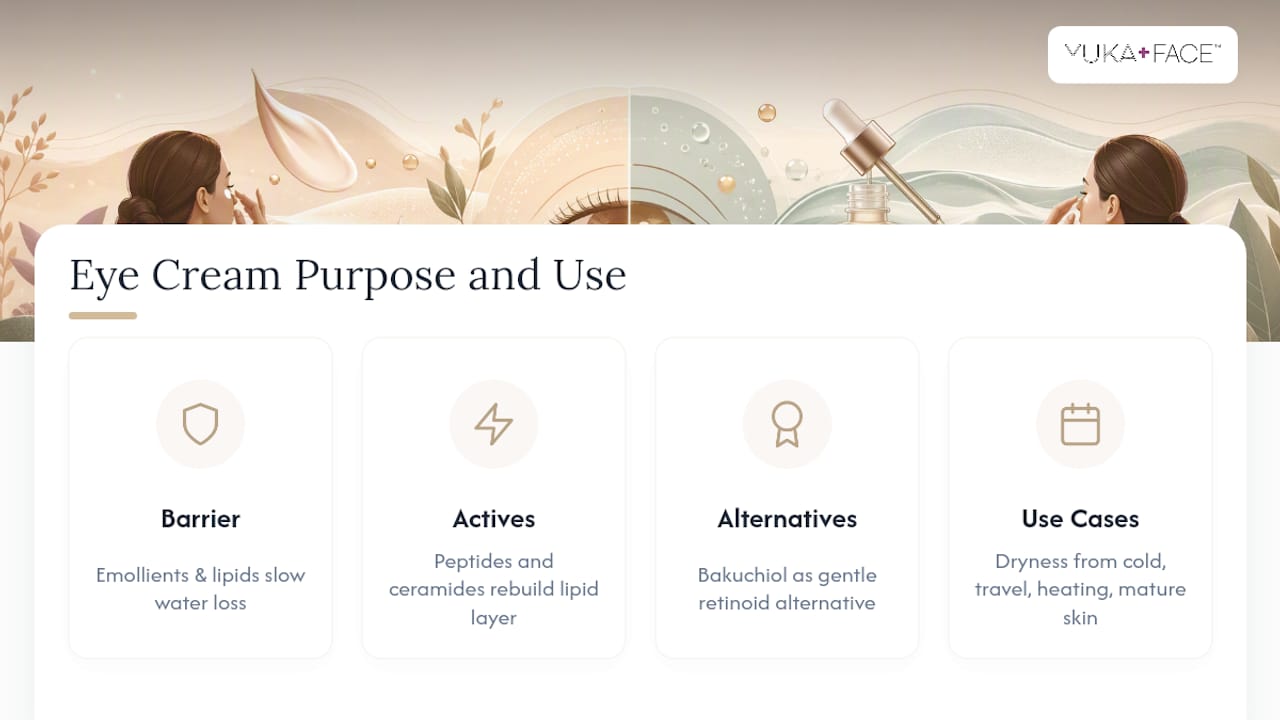
An eye cream leans on emollients and lipids to form a protective layer that slows water loss and reinforces the skin barrier. That's a different job than a serum's, and it's why the two aren't really rivals.
Common cream actives take a slower, steadier approach than serum actives. Peptides still show up here, but they're joined by ceramides, which rebuild the lipid layer that keeps moisture from escaping in the first place. Some creams include gentle retinoid alternatives like bakuchiol, chosen specifically because the eye area can't tolerate the same retinoid strength the rest of the face handles.
Creams become the primary tool when dryness is the main complaint rather than puffiness or discoloration. Colder months, air travel, indoor heating, and mature skin all pull moisture out faster than a serum alone can replace it. That's when a richer, occlusive layer earns its place in the routine.
Key Ingredients to Look For (Mapped to Concerns)
Reading a label gets a lot easier once you know which ingredient is meant to solve which problem. Here's a practical map:
- Dark circles: vitamin C, niacinamide, caffeine.
- Puffiness: caffeine, peptides.
- Fine lines: peptides, gentle retinoid alternatives like bakuchiol.
- Dehydration: hyaluronic acid.
- Barrier weakness: ceramides.
The delivery vehicle matters as much as the ingredient itself. A high concentration of vitamin C in a heavy cream base won't penetrate the same way it does in a thin serum, which is part of why formulation, not just the ingredient list, drives results.
The eye area is thinner and more reactive than the rest of the face, so a few ingredients deserve extra caution. Skip added fragrance, which is one of the most common triggers for irritation this close to the lash line. Go easy on high-percentage acids and strong retinoids unless a formula is specifically built for the eye contour, since both can cause stinging, flaking, or tiny bumps known as milia.
Pro Tip: If a new product causes small white bumps under your eyes within a few weeks, that's often milia from a formula too rich or too active for that skin. Switch to a lighter serum and give your skin a break before reintroducing anything heavier.
Serum, Cream, or Both: A Decision Guide by Skin Type
Matching product type to skin type removes most of the guesswork. Run through this before you buy:
- Oily or combination skin: start with a serum. A heavy cream can feel greasy and may contribute to congestion around the eye.
- Dry or mature skin: a cream should anchor the routine. Look for ceramides and peptides to rebuild barrier function over time.
- Sensitive eyes: choose fragrance-free formulas in either category, and patch test on the inner wrist before applying near the lash line.
- Acne-prone or breakout-prone skin: favor lighter serums over rich creams, since heavier occlusive layers are more likely to trigger milia in that thin skin.
Layering both is ideal when you're dealing with more than one concern at once, like puffiness in the morning and dryness by evening. Experts commonly recommend applying serum first, then sealing with a cream so the active ingredients penetrate before the heavier layer locks them in. One product is usually enough if your only complaint is mild dryness or occasional puffiness, not both.
If you notice makeup sliding off within an hour of application, you're likely using too much cream. Cut back to a pea-sized amount and let it fully absorb before applying concealer.
How to Layer Eye Serum and Eye Cream, Step by Step
Application order and technique matter almost as much as the products themselves. Follow this sequence:
- Cleanse and pat the area dry.
- Apply a small dot of serum per eye, pressing gently with your ring finger around the orbital bone.
- Wait a few seconds for it to absorb before moving on.
- Follow with a pea-sized amount of cream, patting rather than rubbing.
- In the morning, finish with sunscreen; at night, this is where a retinoid alternative can go if your cream doesn't already include one.
Use your ring finger specifically. It applies the lightest pressure of any finger, which matters on skin this thin. Pat rather than drag, and stay just above the bone rather than directly on the lash line where product is more likely to migrate into eyes.
Pro Tip: Save vitamin C serums for the morning, paired with SPF, since vitamin C works partly by neutralizing free radical damage from daytime sun exposure. Save retinoid alternatives for nighttime, when skin does most of its repair work. For a full walk-through of order and timing beyond the eye area, this evening skincare routine guide covers the same layering logic.
How Long Results Actually Take
Patience isn't optional here, and the clinical data backs that up. A 12-week trial on a multi-component anti-aging eye cream recorded a 28.12% increase in hydration, an 18.81% gain in elasticity, and a 54.99% jump in collagen production. Those are formulation-specific results, not a blanket promise every cream on a shelf will deliver.
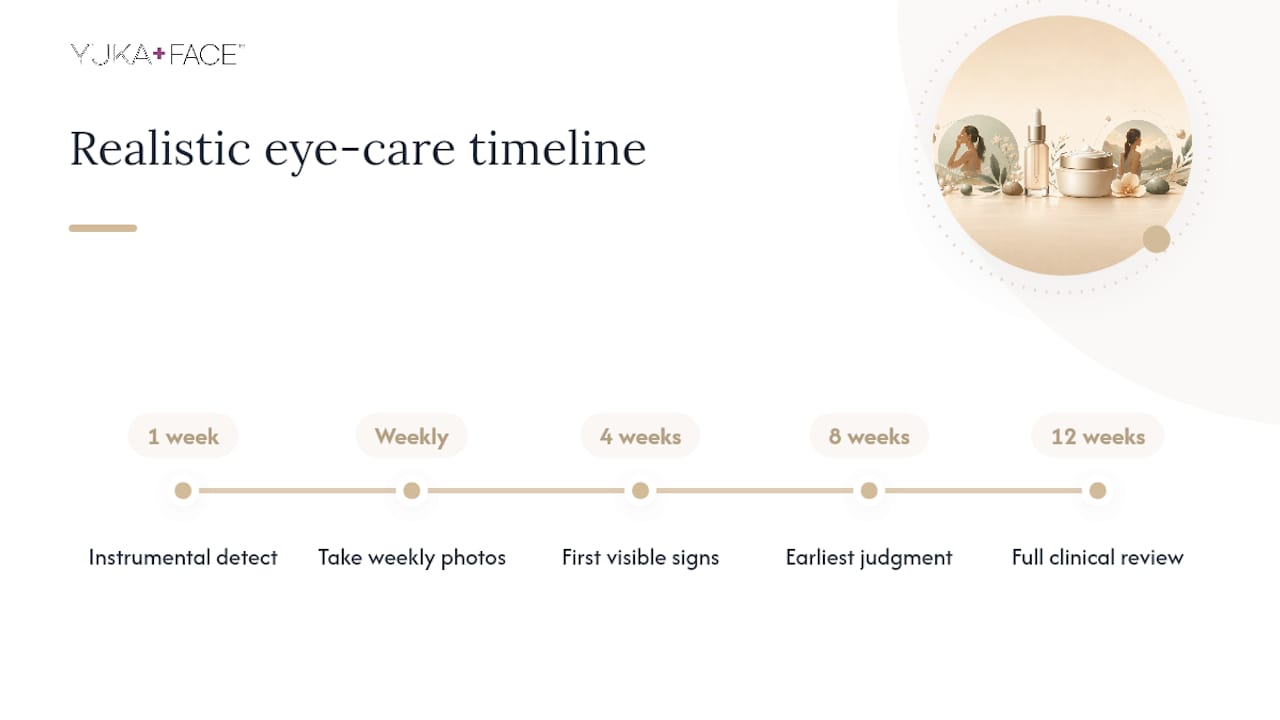
Instrumental measurements can pick up wrinkle reduction within 7 days of consistent use, but the changes you can actually see in the mirror, like less eyelid sagging or lighter dark circles, tend to show up between 28 and 56 days, based on a controlled clinical evaluation of a periorbital cream.
That gap between what a machine detects and what you notice is the most misunderstood part of eye care. Machines catch subtle shifts almost immediately; your eyes need weeks of accumulated change before the difference reads as obvious. Consistency, more than any single ingredient, is what clinical and expert sources point to as the deciding factor in whether a product works.
The practical takeaway: pick one serum and one cream, use them daily, and hold off judgment until week 8 at the earliest. Snapping progress photos in the same light each week beats relying on memory, since gradual change is easy to miss day to day. For more on realistic timelines across active ingredients, see what actually works in skin rejuvenation products.
Why I Recommend Matching the Product to the Skin, Not the Trend
Skin-matched layering beats chasing whatever ingredient is trending that month, and Yuka+Face's vegan, botanical-plus-scientific formulations reflect that approach well: pick actives for the concern in front of you, not the one in a headline. If you're building a full routine around this logic, our guide to face serum types and morning-and-evening routine breakdown are worth reading next. A silk pillowcase, like the ones from Bella Lu, also helps by reducing the overnight friction that worsens creasing around the eyes.
— Kelly
Where Yuka+Face Fits Into Your Eye Routine
Some brands offer matched serum and cream pairs to simplify layering without guessing compatibility. The Bright Eyes Peptide Serum handles the serum role: a lightweight, peptide-driven formula for puffiness and early fine lines, applied as a small dot per eye in the morning before makeup. The Bakuchiol Ageless Eyes functions as the cream step, a richer, occlusive layer built around a gentle retinoid alternative that's suited to nighttime repair without the irritation a stronger retinoid can cause this close to the lash line.

Use the peptide serum first, pat it in with your ring finger, wait a few seconds, then follow with the bakuchiol cream at night or a lighter layer of it in the morning if your skin runs dry. These products are vegan and cruelty-free, formulated around a botanical-plus-scientific philosophy. Start with the Bright Eyes Peptide Serum and pair it with a morning skin care routine built for consistency, since that's what the 8 to 12 week timeline actually rewards.
Sources
- Comprehensive evaluation of the efficacy and safety of a new multi‐component anti‐aging topical eye cream
- In vitro, ex vivo, instrumental and clinical evaluation of a topical cream on the signs of periorbital ageing
- Eye Serum Vs. Eye Cream, Explained by Dermatologists
FAQ
Do you need both eye serum and eye cream?
Not always. Combine them if you're dealing with multiple concerns like puffiness and dryness together; one product is often enough if you have a single, mild concern.
What is the best under eye product, cream or serum?
It depends on the concern: serums work best for dark circles and puffiness, while creams work best for dryness and barrier support, according to dermatologist guidance.
Which should go first, eye cream or serum?
Serum goes first because its smaller molecules need direct skin contact to absorb, followed by cream to seal in the treatment and add hydration.
Do I really need an eye serum?
If your main concerns are dark circles, puffiness, or early fine lines, a serum's concentrated actives address those faster than a cream alone, though a cream still matters for daily barrier support.