
TL;DR:
- Essential fatty acids cannot be produced by the human body and must be obtained from food or topical sources. Maintaining a balanced intake of omega-3 and omega-6 fatty acids supports skin health, reduces inflammation, and improves cellular function; the typical Western diet often exceeds recommended omega-6 levels, creating imbalance. Combining dietary sources with topical oils enhances skin barrier integrity and overall health, while focusing on proper ratios prevents chronic inflammation and related conditions.
Essential fatty acids are fats the human body cannot synthesize and must obtain from food or topical sources. The two strictly essential fatty acids are alpha-linolenic acid (ALA, omega-3) and linoleic acid (LA, omega-6). Both integrate into cell membranes, regulate inflammation, and support skin barrier function. Nutrition authorities set Adequate Intake levels at 1.6 g/day of ALA for men and 1.1 g/day for women, and 17 g/day of LA for men and 12 g/day for women. Getting these amounts consistently from diet is the foundation of long-term health and skin vitality.
What are essential fatty acids and how do they differ?
The omega-3 and omega-6 families each contain multiple fatty acids with distinct roles. Understanding the types of fatty acids within each family clarifies why food variety matters.
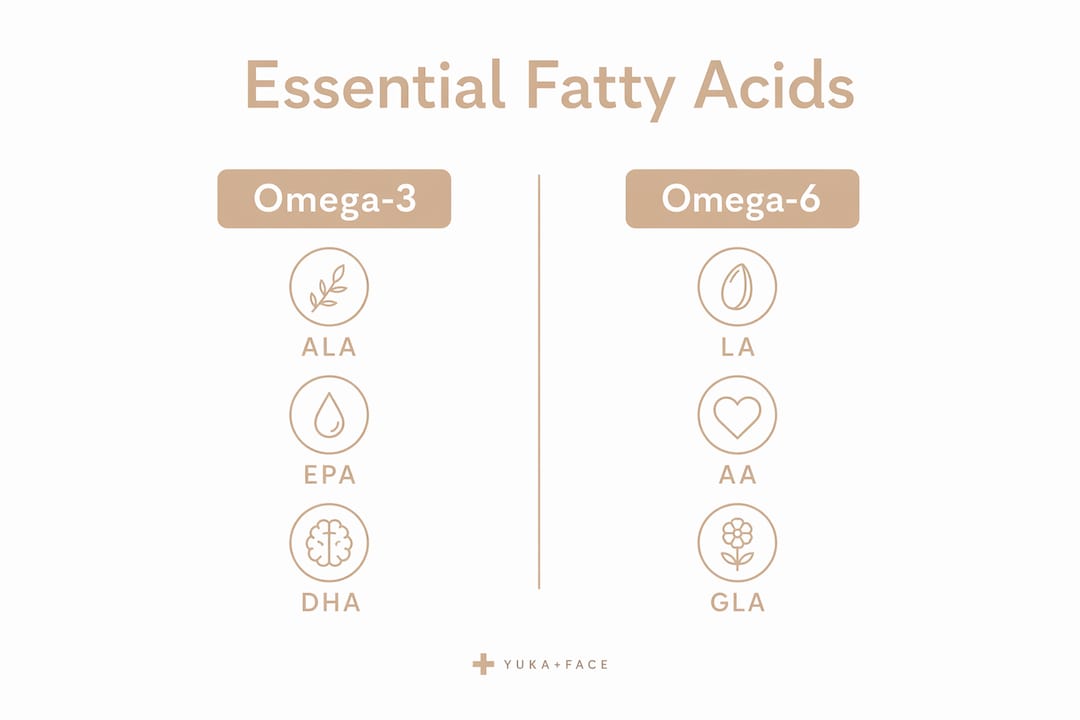
Omega-3 fatty acids:
- ALA (alpha-linolenic acid): The parent omega-3, found in flaxseed, chia seeds, and walnuts. Strictly essential.
- EPA (eicosapentaenoic acid): Derived from ALA or consumed directly from fatty fish. Supports anti-inflammatory signaling.
- DHA (docosahexaenoic acid): Critical for brain and eye tissue. Found in salmon, sardines, and algae-based supplements.
Omega-6 fatty acids:
- LA (linoleic acid): The parent omega-6, found in sunflower oil, corn oil, and most nuts. Strictly essential.
- GLA (gamma-linolenic acid): Found in evening primrose oil and borage oil. Supports skin hydration and reduces inflammation.
- AA (arachidonic acid): Derived from LA, found in meat and eggs. Serves as a precursor to pro-inflammatory eicosanoids needed for healing.
The biochemical difference between these families lies in where their double bonds sit along the carbon chain. That structural difference determines which eicosanoids the body produces. Eicosanoids from omega-6 promote inflammatory responses needed for tissue repair, while omega-3 derivatives help resolve inflammation after healing is complete. Both signals are necessary. Neither family is the "bad" one.
One critical detail most people miss: the body converts only 8–20% of ALA into EPA and less than 1% into DHA. That conversion rate is low enough that relying on plant-based ALA alone rarely meets the brain and cardiovascular system's demand for DHA. Women convert ALA slightly more efficiently than men, but the gap is not large enough to eliminate the need for direct EPA and DHA sources.
Pro Tip: If you follow a plant-based diet, algae-based DHA supplements are the most direct way to bypass the ALA conversion bottleneck. Algae is where fish get their DHA in the first place.
What are the health benefits of essential fatty acids?
Adequate EFA intake produces measurable benefits across multiple body systems. The role of fatty acids in diet extends well beyond basic energy supply.

Brain and eye function. DHA makes up a large portion of the brain's gray matter and the retina's photoreceptor cells. EFAs contribute to cellular phospholipid synthesis, which means every neuron depends on a steady supply of these fats to maintain membrane integrity and signal transmission.
Cardiovascular health. Eating fish twice a week correlates with better heart health outcomes. Fish oil supplements specifically reduce high triglycerides, though their benefit for preventing cardiovascular events in people without existing disease is mixed. Fish oil also reduces joint pain and stiffness in rheumatoid arthritis, making it useful beyond heart health alone.
Immune and inflammatory balance. EFAs regulate the immune system by controlling which eicosanoids the body produces. When omega-3 and omega-6 intake is balanced, the body can mount an inflammatory response when needed and resolve it efficiently. Chronic imbalance tips the system toward persistent low-grade inflammation, which underlies many modern health conditions.
Skin health. This is where EFAs have a direct, visible impact. EFAs maintain skin barrier integrity by supporting ceramide synthesis. Ceramides are the lipids that hold skin cells together and prevent water loss. A deficiency in EFAs shows up as dry, flaky, or reactive skin. Topical application of EFA-rich oils can reinforce the barrier from the outside while dietary intake supports it from within.
- Improved skin hydration and reduced transepidermal water loss
- Stronger barrier against environmental irritants and pollutants
- Reduced redness and sensitivity linked to inflammatory skin conditions
- Support for skin cell turnover and a more even complexion
Inadequate EFA intake alters cell membrane rigidity and impairs metabolic signaling. That impairment affects not just skin but every organ that relies on fluid, responsive cell membranes to function properly.
What are the best dietary and topical sources of essential fatty acids?
Getting EFAs from food is the most reliable strategy. Topical application adds a second layer of support specifically for skin health.
Top dietary sources
| Fatty acid | Food sources | Notes |
|---|---|---|
| ALA (omega-3) | Flaxseed, chia seeds, hemp seeds, walnuts | Conversion to EPA/DHA is limited |
| EPA and DHA (omega-3) | Salmon, sardines, mackerel, algae supplements | Most direct source for brain and heart |
| LA (omega-6) | Sunflower oil, corn oil, almonds, pumpkin seeds | Abundant in Western diets |
| GLA (omega-6) | Evening primrose oil, borage oil, hemp seed oil | Useful for skin hydration |
The challenge is not getting enough omega-6. Western diets show an omega-6 to omega-3 ratio as high as 15–20:1, compared to an evolutionary ratio closer to 4:1. That imbalance is driven by processed vegetable oils in packaged foods. Excess LA competes with ALA for the same enzymes, which reduces the body's ability to produce anti-inflammatory omega-3 derivatives.
Topical sources for skin
Applying EFA-rich oils directly to skin delivers fatty acids to the barrier without relying on digestion or conversion. The most effective topical sources include:
- Rosehip oil: High in LA and ALA, supports skin regeneration and hydration.
- Hemp seed oil: Balanced omega-6 to omega-3 ratio, calming for reactive skin.
- Sea buckthorn oil: Contains rare omega-7 alongside omega-3 and omega-6, supports barrier repair.
- Evening primrose oil: Rich in GLA, used for dry and sensitive skin conditions.
Yuka+Face formulates with plant-based oils selected for their fatty acid profiles. The types of essential oils for skin matter as much as the concentration. A well-chosen oil delivers EFAs directly to the stratum corneum, where they reinforce ceramide production and reduce water loss.
Pro Tip: Look for cold-pressed, unrefined oils on ingredient labels. Heat processing degrades polyunsaturated fatty acids, reducing their skin benefit before the product even reaches you.
Consuming versus applying EFAs is not an either/or decision. Research on skin and hair care consistently shows that dietary and topical approaches work best together. Diet builds the foundation; topical oils address the barrier directly and quickly.
How to balance essential fatty acid intake for optimal health
Balancing omega-6 and omega-3 is the most practical step most people can take to improve both systemic health and skin condition.
- Reduce processed oil consumption. Corn oil, soybean oil, and sunflower oil dominate packaged foods and restaurant cooking. Cutting back on these lowers omega-6 intake without eliminating it entirely.
- Add direct EPA and DHA sources. Eat fatty fish two to three times per week, or take an algae-based DHA supplement daily. This raises omega-3 levels without depending on ALA conversion.
- Choose whole-food omega-6 sources. Nuts, seeds, and avocado provide LA alongside fiber, minerals, and other nutrients. These whole foods behave differently in the body than refined oils.
- Read skincare labels for fatty acid-rich oils. Products containing hemp seed oil, rosehip oil, or evening primrose oil deliver topical EFAs. Check that these oils appear near the top of the ingredient list, not at the bottom where concentrations are minimal.
- Avoid over-supplementing. High-dose omega-3 supplements do not automatically improve health outcomes. Whole-food sources provide EFAs alongside co-nutrients that support absorption and metabolism.
One persistent misconception deserves direct correction. The term "nonessential" applied to fatty acids like AA or oleic acid does not mean they are unimportant. The classification is metabolic/02%3A_Module_Energy_and_Macronutrients/2.03%3A_Lipids/2.3.05%3A_Nonessential_and_Essential_Fatty_Acids), not a value judgment. Nonessential fatty acids are synthesized by the body, but they still perform critical functions in cell membranes, hormone production, and energy metabolism. Many common beauty myths about fats and skin stem from this misunderstanding.
Key Takeaways
Essential fatty acids, specifically ALA and LA, must come from diet or topical sources because the human body cannot produce them, and their balance directly determines skin health, inflammation control, and cellular function.
| Point | Details |
|---|---|
| Two strictly essential fatty acids | ALA (omega-3) and LA (omega-6) must come from food; the body cannot make them. |
| Low ALA conversion rate | Only 8–20% of ALA converts to EPA; direct fish or algae sources are more reliable for DHA. |
| Western diet imbalance | Omega-6 to omega-3 ratios of 15–20:1 promote inflammation; target closer to 4:1. |
| Topical and dietary EFAs work together | Dietary intake builds systemic health; topical oils reinforce the skin barrier directly. |
| "Nonessential" does not mean unimportant | Nonessential fatty acids are synthesized by the body but remain vital for health and function. |
What I've learned about EFAs that most articles get wrong
The conversation around essential fatty acids tends to collapse into two camps: "eat more fish oil" or "avoid all fat." Neither is useful. What the research actually shows is that the ratio between omega-6 and omega-3 matters more than the absolute amount of either.
I've seen people add high-dose fish oil supplements while continuing to eat a diet dominated by processed vegetable oils. The supplement barely moves the needle because excess LA is still competing for the same metabolic enzymes. The more effective move is reducing processed oil intake first, then adding direct EPA and DHA sources.
For skin specifically, the topical route is underused. Most people think of fatty acids as a dietary concern and overlook what a well-formulated oil can do applied directly to the skin. EFA-rich oils reinforce the barrier, reduce sensitivity, and improve hydration faster than dietary changes alone. The skin health and long-term vitality connection is real, and it runs through fatty acid status more than most people realize.
My practical advice: read ingredient labels on both food products and skincare. If a cooking oil lists "partially hydrogenated" anything, it has no place in a diet focused on EFA balance. If a skincare oil appears at the bottom of a long ingredient list, its concentration is too low to matter. Specificity and sourcing quality determine outcomes.
— Kelly
Yuka+Face and fatty acid-rich skincare
Yuka+Face builds its formulations around plant-based oils selected for their fatty acid content and skin compatibility. Every product is vegan, cruelty-free, and designed to support the skin barrier with nutrients the skin actually uses.

The vegan skincare guide covers how plant-derived EFA sources compare to animal-based alternatives and which oils deliver the most benefit for different skin types. For readers building a daily routine, the morning skincare routine guide shows how to layer EFA-rich products for maximum barrier support. Yuka+Face products are formulated to work with the skin's natural biology, not against it.
FAQ
What are essential fatty acids in simple terms?
Essential fatty acids are fats the body cannot make on its own and must get from food or supplements. The two main ones are ALA (omega-3) and LA (omega-6).
What foods are highest in essential fatty acids?
Fatty fish like salmon and sardines provide EPA and DHA directly. Flaxseed, chia seeds, and walnuts supply ALA, while sunflower oil and nuts provide LA.
Can you apply essential fatty acids to skin?
Yes. Oils like rosehip, hemp seed, and evening primrose deliver EFAs directly to the skin barrier, supporting ceramide production and reducing water loss without relying on digestion.
What happens if you don't get enough essential fatty acids?
Deficiency alters cell membrane rigidity and impairs metabolic signaling. Skin symptoms include dryness, flakiness, and increased sensitivity, while systemic effects include impaired immune and neurological function.
What is the best omega-6 to omega-3 ratio?
An evolutionary ratio of approximately 4:1 is considered optimal. Western diets often reach 15–20:1, which promotes chronic inflammation and impairs the body's ability to resolve it.