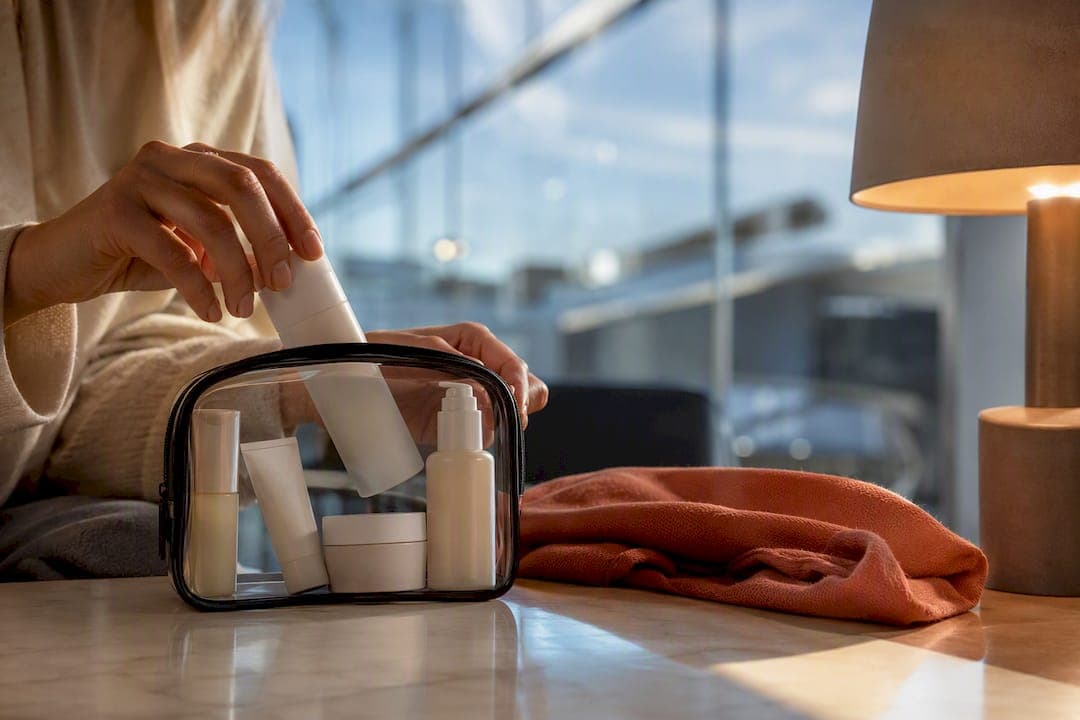
The easiest travel skincare routine is a minimalist, barrier-first kit: a gentle cleanser option, a hydrating serum or mist, a barrier moisturizer, broad-spectrum SPF, and a lip or spot rescue—five categories, nothing more. Every product needs to fit inside a container sized to meet the TSA 3-1-1 liquids rule to clear airport security, and that limit is exactly why fewer, better products beat a nine-step routine crammed into a quart bag.
TL;DR:
- Using airless pump bottles and pre-packaged travel sizes can help maintain ingredient stability and prevent leaks during travel.
- For trips longer than a weekend, consider refillable bottles and organize toiletries with vacuum storage to stay within TSA limits and stay efficient.
- During flights, a simple routine of mist, moisturizer, and lip balm keeps skin hydrated without risking irritation from exfoliants or multi-ingredient layering.
- Adjust moisturizer textures based on climate: richer in cold or dry environments, lighter gels in humid or hot ones, and reapply SPF frequently in high-UV conditions.
- Dedicate five days post-trip to gentle cleansing and barrier repair, then reintroduce actives gradually to support recovery and prevent skin issues.
Table of Contents
- How to Prep Your Skin Before You Travel
- Packing Your Kit Within the TSA 3-1-1 Rule
- What Skincare Should You Do During the Flight?
- Adjusting Your Skincare for Different Climates
- The Five-Day Recovery Routine After a Trip
- Sample Routines and a Printable Packing Checklist
- What I Never Leave Home Without
- Travel-friendly product lineups are available that remove the step of checking every label for ingredients, sizes, and whether a formula is actually vegan or just marketed that way: cleansing, hydrating, and sealing products built to match the barrier-first approach this guide walks through, with SPF, lip, and spot options available to round out the kit.
- Sources
- FAQ
How to Prep Your Skin Before You Travel
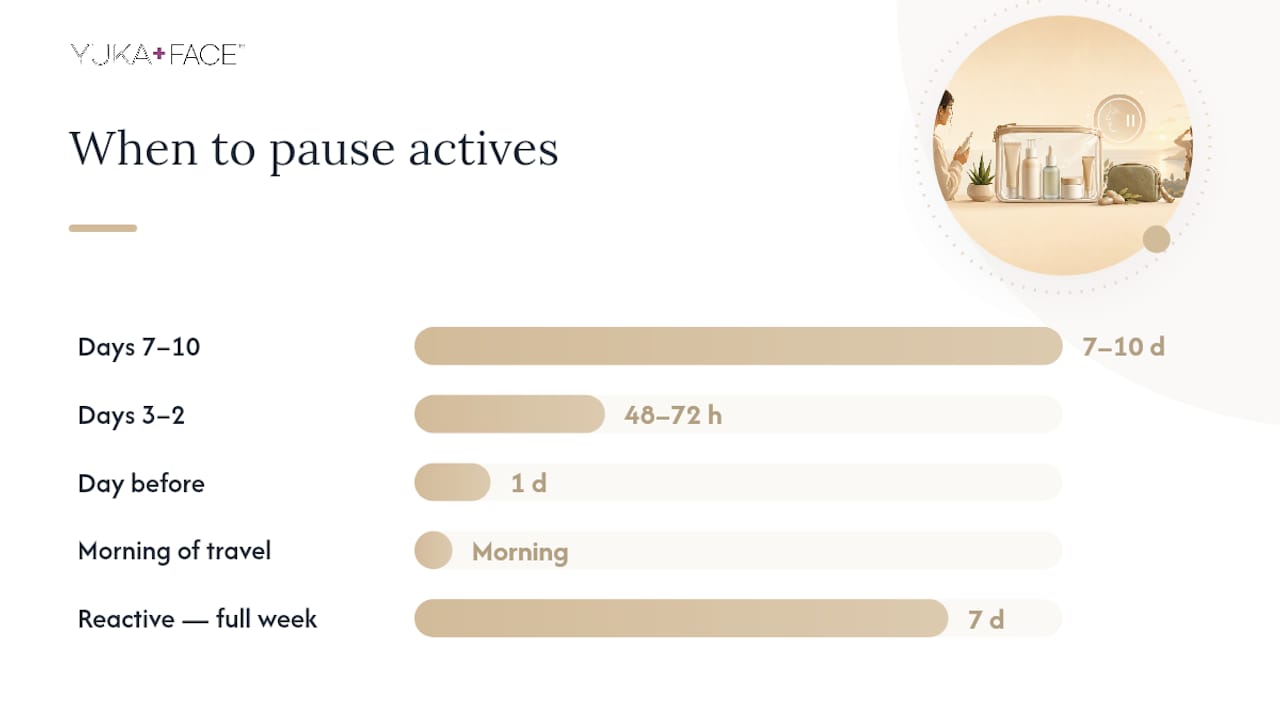
Skin doesn't fail mid-trip out of nowhere. It fails because it was already compromised before takeoff, and travel just finishes the job. The fix starts 48 to 72 hours before departure, longer if your skin reacts easily: pause retinoids, high-percentage acids, and any harsh exfoliant. Dermatology guidance is consistent on this point because these actives thin the outer barrier right when you need it strongest, and a weakened barrier combined with cabin air is how breakouts and flaking start on day two of a trip.
While you pull back on actives, layer in barrier support. Ceramides, glycerin, and niacinamide all reinforce the skin's outer layer rather than exfoliating it, which is the opposite job.
A workable pre-travel sequence looks like this:
- Days 7 to 10 out: keep your normal routine, but note any irritation so you know your baseline.
- Days 3 to 2 out: drop retinoids, vitamin C at high strength, and physical scrubs.
- Day before: one calm, hydrating routine, nothing new, nothing aggressive.
- Morning of travel: cleanse, hydrate, moisturize, SPF. That's it.
If your skin is reactive or eczema-prone, extend the pause to a full week and swap your cleanser for a fragrance-free option a few days early to rule out a late reaction before you're stuck with it on a plane.
Pro Tip: Test any new travel-size product on your inner arm three days before you leave. A reaction at 30,000 feet with no backup moisturizer is a bad place to discover a sensitivity.
Packing Your Kit Within the TSA 3-1-1 Rule
Airport security is not the enemy here. It's actually a decent forcing function for a smarter kit. The TSA's 3-1-1 rule caps carry-on liquids, gels, and aerosols at 3.4 ounces (100 milliliters) per container, and all of them need to fit in one quart-size clear bag. That's the whole rule, and it applies to every cream, serum, and sunscreen you're bringing.
A few packing choices make this painless:
- Choose airless pump bottles over jars. Pumps limit air exposure, which keeps active ingredients stable and stops leaks when cabin pressure shifts.
- Buy pre-packaged travel sizes when your brand offers them, rather than decanting a full-size product into a random container. Decanting unstable formulas like vitamin C serums can degrade the ingredient or introduce contamination.
- Use single-use pods or sachets for anything you'll only need once or twice on the trip.
- Wrap caps in a strip of tape or plastic film before you pack them. Pressure changes loosen lids more than you'd expect.
Trip length should decide how much you pack, not habit:
- Overnight: five products, travel size, one bag.
- Weekend (2 to 4 nights): same five products, slightly larger sizes if you're checking a bag, plus a backup SPF stick.
- Week or longer: the same five categories, but consider a refillable travel bottle for your moisturizer and serum instead of buying new minis each trip. A vacuum-style storage bag can also help you keep toiletries organized separately from clothes.
What Skincare Should You Do During the Flight?
Cabin air runs drier than almost any climate you'd visit on purpose. Low relative humidity at altitude pulls water out of skin fast, and hotel air conditioning does something similar on the ground. That's the entire reason an in-flight routine exists: not to treat your skin, just to stop it from losing moisture it can't easily replace.
Dermatologists and beauty editors who fly constantly keep it down to almost nothing. The consensus is a hydrating mist, a sealing moisturizer, and lip balm, applied in that order. Misting bare skin and walking away does very little, since water evaporates just as fast as you spray it on. Sealing the mist with a moisturizer traps that moisture against skin instead of letting cabin air pull it right back out.
Skip mid-flight:
- Exfoliating wipes or acids. Cabin pressure and dry air already stress the barrier; exfoliating adds insult to injury.
- Layered serums. Three products stacked on a plane tray table is a spill waiting to happen, and your skin doesn't need six steps at 35,000 feet.
- A full cleanse. Washing your face mid-flight with airplane bathroom water and paper towels usually irritates more than it helps.
Pro Tip: Keep hand cream in your seat pocket, not your bag. You'll touch your face less if your hands aren't dry and prone to picking or rubbing.
Adjusting Your Skincare for Different Climates
The same five products travel with you everywhere, but how you use them should shift with the destination. A moisturizer that feels perfect in a Colorado ski town will suffocate your skin in Bangkok in August.
Dry or cold climates call for richer textures and more frequent layering. Reapply your barrier moisturizer midday if skin feels tight, and consider a thicker night layer since indoor heating strips moisture just as efficiently as outdoor cold. Lip balm becomes a several-times-a-day habit, not an afterthought.
Hot, humid climates need the opposite adjustment. Swap a heavy cream for a lighter gel moisturizer so you're not fighting your own sweat, and lean harder on the hydrating serum underneath since humidity actually helps humectants like glycerin do their job. Cleanse more often if you're sweating through activity, but stick to a gentle formula rather than reaching for something stripping.
High-UV destinations, beach or mountain alike, are the one place where corners genuinely can't be cut. Reapply broad-spectrum SPF every two hours outdoors, and more often after swimming or heavy sweating. A few practical habits help this stick:
- Keep a stick or spray SPF in your bag, not just your room, so reapplication doesn't require a trip back to the hotel.
- Rinse salt or sand off skin as soon as possible; both can hold heat and moisture against skin in ways that trigger irritation.
- After a sweaty hike or beach day, hydrate before you moisturize. A dehydrated barrier can't hold a heavy cream properly.
The Five-Day Recovery Routine After a Trip
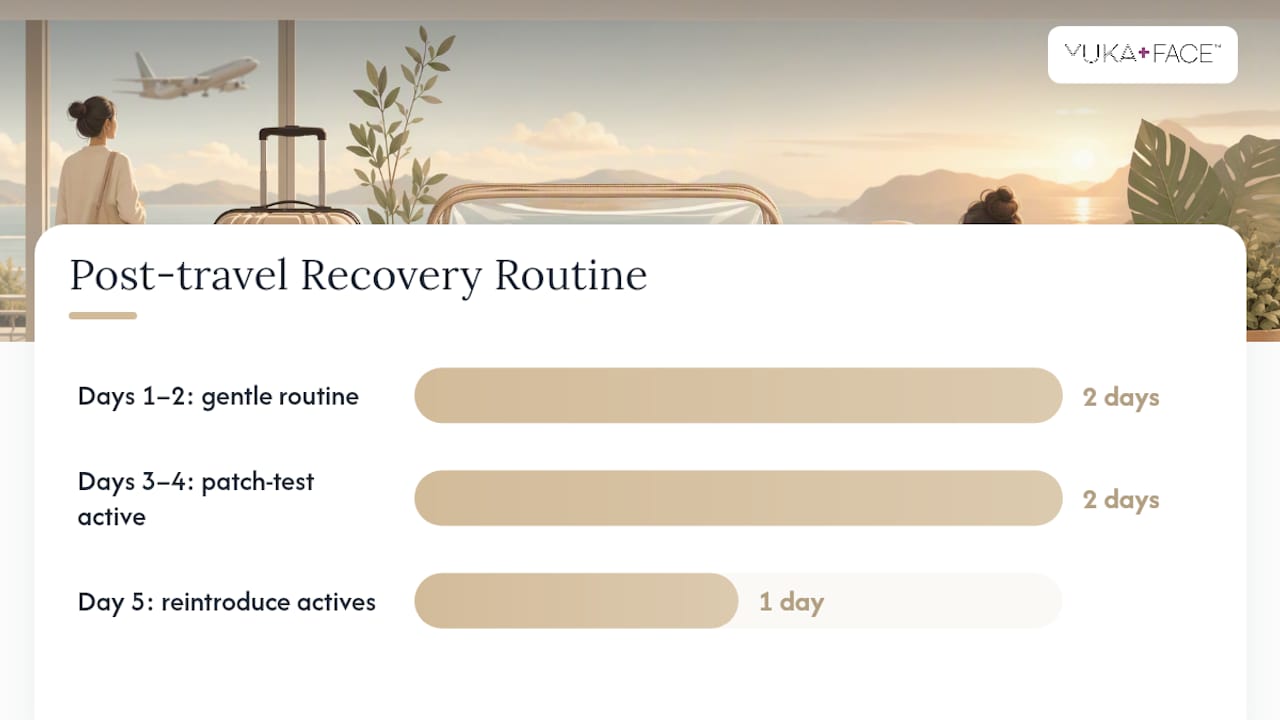
Travel skin doesn't need a punishment routine when you get home. It needs a reset. The 48 to 72 hour barrier recovery window, stretched to five days for anyone who traveled hard, gives the skin time to rebuild before you throw actives back at it.
- Days 1 to 2: gentle cleanse only, no acids or retinoids. Follow with a hydrating serum and a rich barrier moisturizer, both morning and night.
- Days 3 to 4: keep the same routine, but patch-test one active on a small area, like the side of your jaw, before applying it to your whole face.
- Day 5: reintroduce your normal actives at half strength or every other day if skin looks calm.
Persistent redness, painful bumps, or anything that looks infected after five days is a sign to stop self-treating and see a dermatologist. Reviewing how to maintain a healthy skin barrier between trips also makes the next recovery period shorter.
Pro Tip: Treat the five-day reset like a rule, not a suggestion, even if your skin looks fine on day two. Reactive breakouts often show up three or four days after the trigger, not immediately.
Sample Routines and a Printable Packing Checklist
Consistency, not variety, is what keeps travel skin calm. Here's how the five categories scale by trip length.
Every item above should fit the quart-bag rule, no exceptions. Travel-friendly, vegan formulations are available across these same categories, which makes substituting one product for another straightforward if you're building your own kit rather than following a strict brand list.
Quick packing checklist, mapped to the 3-1-1 rule:
- Cleanser (gel or micellar, 3.4 oz max)
- Hydrating serum or facial mist (3.4 oz max)
- Barrier moisturizer (3.4 oz max)
- Broad-spectrum SPF (stick formats skip the liquid limit entirely)
- Lip or spot rescue balm (typically under 3.4 oz by default)
- One quart-size clear bag to hold all of the above
What I Never Leave Home Without
I never travel without a barrier moisturizer in my carry-on, full stop. Everything else is negotiable, but skin that's already lost its water content on a six-hour flight doesn't recover on vacation, it recovers a week later at home. That's the whole logic behind a barrier-first approach: protect what you have instead of trying to fix what you've lost. It's a smaller kit, and it works better than the nine-step version most people pack and never open.
— Kelly
Travel-friendly product lineups are available that remove the step of checking every label for ingredients, sizes, and whether a formula is actually vegan or just marketed that way: cleansing, hydrating, and sealing products built to match the barrier-first approach this guide walks through, with SPF, lip, and spot options available to round out the kit.
These formulas are built around barrier-supporting ingredients like ceramides and glycerin, the same actives dermatology guidance points to for travel resilience. That means you're not choosing between a clean formula and a travel-practical one. For a closer look at how hydration and restoration work together in a barrier-first ritual, the foundation of a beauty routine built on hydration breaks down which ingredients matter most and why. If you're ready to build your own travel kit around these five categories, the Yuka+Face journal is a good next stop for picking sizes and pairings before your next trip.
Sources
- TSA — Liquids, aerosols and gels rule (3-1-1)
- Vacation Skincare 2026: A Skin Biology Travel Guide — SoothHealth
- What dermatologists always pack in their carry-on — Vogue Arabia
- Travel Skincare Kit: What to Pack + TSA Liquids — Luna London
FAQ
What Is the Simplest Travel Skincare Routine?
A minimalist, barrier-first kit covering five categories: cleanser, hydrating serum or mist, barrier moisturizer, broad-spectrum SPF, and a lip or spot rescue, each sized to fit the TSA 3-1-1 rule.
How Do I Pack Skincare for a Flight Under TSA Rules?
Every liquid, gel, or cream must be 3.4 ounces (100 milliliters) or less per container, with all containers fitting inside one quart-size clear bag; SPF sticks and balms in solid form skip this limit entirely.
Should I Change My Skincare Routine on the Plane?
Yes. Keep it to a hydrating mist sealed with a moisturizer plus lip balm, and skip exfoliation or layered serums, since cabin air is already drying and extra steps raise irritation risk.
How Long Should Skin Recovery Take After a Trip?
Plan on 48 to 72 hours at minimum, or a full five days if the trip was rough on your skin, focusing on gentle cleansing and barrier moisturizers before reintroducing any actives.