
Yes, you can use niacinamide with AHAs and BHAs. Layered correctly or timed correctly, the combination is not just safe for most skin types, it's often more effective than using either category alone. Three approaches work: apply your acid first, wait, then follow with niacinamide; split the two across AM and PM; or reach for a single formula that already buffers both actives together.
A few numbers to keep in mind before you start:
- Wait a short period between applying an acid and a niacinamide layer.
- Start niacinamide at 2% to 5%; go higher only once your skin tolerates it.
- Keep leave-on salicylic acid (BHA) at concentrations commonly used in cosmetic products, typically low percentages.
- Introduce one active at a time, allowing sufficient time between additions to monitor skin response.
Key Takeaways
Niacinamide and acids work well together when timing, concentration, and product order are managed deliberately rather than left to guesswork.
| Point | Details |
|---|---|
| Direct compatibility | Niacinamide can be layered with AHAs and BHAs when you wait 10 to 30 minutes between them. |
| Skin pH stays stable | Skin buffers back to its normal 4.5 to 5.5 pH range quickly, making conversion myths unlikely in real-world use. |
| Best acid for oily skin | Salicylic acid paired with niacinamide targets pores while calming inflammation. |
| Introduce actives slowly | Add niacinamide first for one to two weeks, then bring in your acid, and patch test each new product. |
| Yuka+Face fits the routine | Yuka+Face's plant-forward cleansers and barrier-focused moisturizers support the skin while acids do the exfoliating work. |
Table of Contents
- Why People Worry About Niacinamide and Acid pH
- What AHAs and BHAs Actually Do
- What Niacinamide Brings to the Table
- Can You Really Combine Niacinamide With AHAs and BHAs?
- How to Build a Routine That Actually Works
- Common Mistakes and Warning Signs to Stop
- What the Research Actually Shows
- What I've Learned About Long-Term Tolerance
- Pairing Yuka+Face Formulas With Your Acid Routine
- Sources
- FAQ
Why People Worry About Niacinamide and Acid pH
Skin sits at a naturally acidic surface pH, typically between 4.5 and 5.5. AHAs and BHAs need that acidic environment to work. Glycolic acid and salicylic acid perform best at a low pH because that's the condition under which they exist in their active, unionized form and can penetrate skin.
Niacinamide behaves differently. It stays effective across a wider, closer-to-neutral pH range, which is one reason it pairs so easily with other actives without needing special buffering.
Layering products briefly shifts the pH at the skin's surface. That shift is real but small, and skin buffers it back toward baseline fairly quickly, which is why a short wait between layers is usually enough rather than a strict hours-long separation.
The old worry that niacinamide converts into niacin (nicotinic acid) and causes flushing when mixed with acids comes from lab conditions involving extreme heat and very low pH, not anything that happens on your bathroom counter. Formulation research confirms niacinamide stays stable at typical cosmetic pH levels, roughly pH 5 to 7.
What AHAs and BHAs Actually Do
AHAs are water-soluble acids that dissolve the bonds holding dead skin cells together on the surface. That's why they're the go-to choice for texture, dullness, and uneven tone.
- Glycolic acid: smallest molecule, deepest penetration, typically 5% to 10% in leave-on products.
- Lactic acid: gentler and more hydrating, common in the 5% to 12% range.
- Mandelic acid: larger molecule, slower penetration, a good starting point for sensitive skin.
BHAs work differently. Salicylic acid is oil-soluble, which lets it travel through sebum and into clogged pores rather than just sitting on the surface. Leave-on formulas contain salicylic acid at concentrations effective and safe for their intended use, while rinse-off cleansers may use higher concentrations due to shorter contact time. If you're dealing with blackheads, congestion, or oily skin, BHA is the more targeted tool. For flat texture or pigmentation, reach for an AHA.
What Niacinamide Brings to the Table
Niacinamide, also known as vitamin B3, supports the skin barrier, calms inflammation, and helps regulate excess oil production. It also has a track record for softening the look of pores and evening out tone over time.
The conversion-to-niacin concern only shows up under extreme heat and pH conditions no skincare routine comes close to. In practice, niacinamide is one of the more forgiving actives to formulate around, which is exactly why so many exfoliating products now include it.
Can You Really Combine Niacinamide With AHAs and BHAs?
The practical consensus among dermatologists and formulators is straightforward: niacinamide and acids are generally compatible and frequently complementary. Acids exfoliate. Niacinamide calms and rebuilds. Put together, the acid does its job while niacinamide offsets some of the irritation that exfoliation can cause.
- Oily or acne-prone skin often does especially well pairing salicylic acid with niacinamide, since one clears pores while the other manages inflammation and oil.
- Dry or reactive skin usually tolerates lactic or mandelic acid alongside niacinamide better than glycolic.
- Retinoids and multiple acids in the same routine raise irritation risk regardless of niacinamide.
Niacinamide isn't a rescue ingredient that cancels out overuse of acids. It softens the edges of a well-dosed routine. It won't undo the damage from a 15% glycolic peel used nightly.
How to Build a Routine That Actually Works
Three structures cover almost every skin type and tolerance level.
- Layer in one routine. Cleanse, apply your acid, wait 10 to 30 minutes, then apply niacinamide followed by moisturizer. The wait matters because it lets the acid function at its intended pH before a later product shifts the surface chemistry. Shorter waits (closer to 10 minutes) are fine for lower-strength acids or once your skin is used to the combination.
- Split AM and PM. Use niacinamide in the morning under sunscreen, save your acid for nighttime. This removes the timing question entirely and is the easiest option for beginners.
- Use a combined formula. Many brands now buffer niacinamide and an acid into a single product, engineered so the pH works for both actives without you doing any math.
Whichever structure you pick, introduce actives one at a time. Start with niacinamide alone for one to two weeks, then add your acid. Patch test any new product on your inner arm for 24 to 48 hours before applying it to your face, since gradual introduction is what actually catches sensitivities before they become full-face problems.
Pro Tip: If your skin runs sensitive, put the acid into your cleanser instead of a leave-on serum, or use it every other night. That single change cuts irritation risk dramatically while still giving you the exfoliation benefit.
Common Mistakes and Warning Signs to Stop
The most common error is order confusion, applying niacinamide first and then layering acid directly on top, which can dilute the acid's effectiveness before it has a chance to work.
- Mixing acid and niacinamide together in your palm instead of layering them.
- Stacking multiple exfoliating acids, or an acid plus a retinoid, in the same session.
- Ignoring early irritation because "it'll calm down."
Watch for red flags: persistent stinging beyond the first minute, redness that lingers for hours, flaking that doesn't resolve within a few days, or a sudden wave of new breakouts. Any of these means pause your acid, simplify to a bare-bones routine of cleanser, niacinamide, moisturizer, and sunscreen, and consult a dermatologist if symptoms don't settle within a week.
What the Research Actually Shows
The science lines up cleanly with practical use. BHAs require an acidic environment to function as leave-on exfoliants, while niacinamide holds its effectiveness across a broader, more neutral pH range without needing that same acidity.
Skin's natural buffering capacity, sitting around pH 4.5 to 5.5, means normal layering during a skincare routine doesn't create the extreme conditions that would cause any harmful chemical conversion.
Clinical literature backs niacinamide's role in barrier repair and sebum regulation, and daytime AHA users need sunscreen since acids increase photosensitivity.
What I've Learned About Long-Term Tolerance
Most irritation complaints trace back to speed, not the ingredients themselves. Introduce one active at a time, start low on concentration, and lean harder on moisturizer and sunscreen than you think you need to. Scale up frequency only after two calm weeks; if redness or flaking shows up, drop back to your last tolerated step rather than pushing through it.
Pairing Yuka+Face Formulas With Your Acid Routine
Yuka+Face builds its formulas around vegan, plant-forward ingredients designed to support the skin barrier rather than fight against it, which matters when you're already asking your skin to tolerate an exfoliating acid.

For the layering routine above, a gentle BHA cleanser followed by a calming, barrier-focused moisturizer like the Korean Collagen PDRN Capsule Cream gives your skin the exfoliation benefit without stripping it in the process. If you're building an AM/PM split, our morning skin care routine walks through exactly how to sequence niacinamide and sunscreen so acid use at night doesn't leave you exposed during the day. Browse the morning routine guide and start adjusting your own routine this week.
Sources
- Beta hydroxy acids | FDA
- Salicylic acid - PubChem
- Niacinamide topical effects (review) - NCBI PMC6017965
- What is skin pH? - Cleveland Clinic
FAQ
Can I use niacinamide with acids?
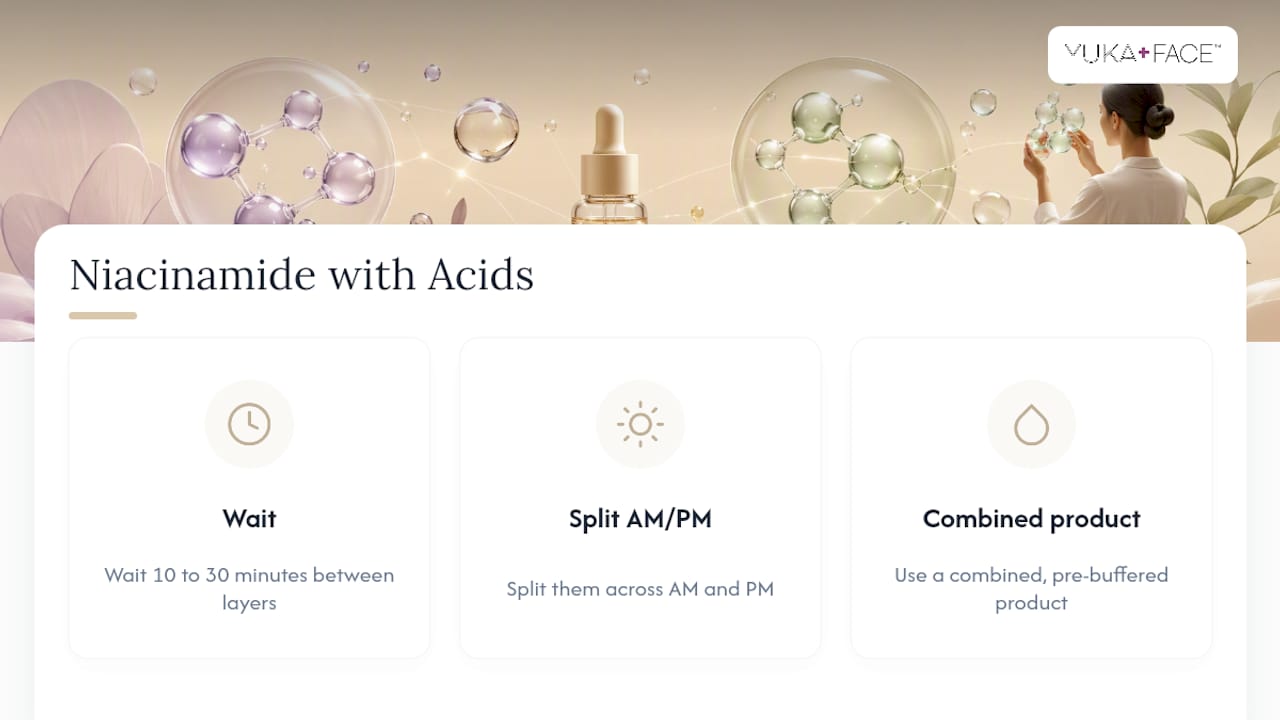
Yes. Niacinamide works well with both AHAs and BHAs when you either wait 10 to 30 minutes between layers, split them across AM and PM, or use a combined, pre-buffered product.
What should you never mix niacinamide with?
Niacinamide has very few true conflicts, but stacking it with multiple strong exfoliants or a retinoid in the same session raises irritation risk regardless of the niacinamide itself.
Will niacinamide remove blackheads?
Niacinamide alone doesn't dissolve the debris inside pores the way salicylic acid does; it works best alongside a BHA, calming inflammation while the acid clears the pore.
Is niacinamide acid good for skin?
Niacinamide isn't technically an acid, it's a form of vitamin B3, and it supports the skin barrier, reduces inflammation, and helps regulate oil production for most skin types.