
TL;DR:
- A natural cream for dry skin should combine humectants, emollients, and occlusives to effectively hydrate and seal moisture. The Yuka+Face Detox Night Cream adheres to this model, using botanicals, vegan ingredients, and soothes skin overnight. Applying it on damp skin with proper layering and avoiding irritants enhances its effectiveness.
The best natural cream for dry skin combines a humectant, an emollient, and an occlusive in one formula — drawing water in, smoothing the surface, and sealing moisture so it cannot escape through transepidermal water loss (TEWL). The Yuka+Face Detox Night Cream fits that model: vegan, cruelty-free, and formulated with botanicals that address all three functions while you sleep. Practitioners at the Cleveland Clinic consistently point to this three-layer approach as the standard for effective dry-skin care, and it holds whether you are shopping for a ready-made product or building a routine from scratch.
Table of Contents
- What does a natural cream for dry skin actually need to do?
- Which ingredients in a natural cream actually help dry skin?
- How do you choose the right natural cream for your skin?
- How should you apply a natural cream for the best results?
- Can you make a safe homemade cream for dry skin?
- What mistakes make dry skin worse in "natural" skincare?
- Why does the Yuka+Face Detox Night Cream work for dry skin?
- Key Takeaways
- The case for formulating with purpose, not just "natural" claims
- Yuka+Face Detox Night Cream: where to buy
- Useful sources
- FAQ
What does a natural cream for dry skin actually need to do?
Dry skin loses water faster than it can retain it. A cream that only adds oil addresses the surface but leaves underlying dehydration untouched. A cream that only adds water evaporates quickly without a sealing layer. The humectant + emollient + occlusive model solves all three gaps at once, which is why practitioners consistently recommend it over single-ingredient solutions.
Three functional roles every effective cream must fill:
- Humectant: Draws water from the environment or deeper skin layers into the upper dermis. Glycerin and hyaluronic acid are the most studied examples.
- Emollient: Fills gaps between skin cells, smoothing texture and improving flexibility. Plant oils like jojoba and sweet almond oil are classic emollients.
- Occlusive: Forms a physical barrier on the skin's surface to slow TEWL. Shea butter, plant waxes, and cocoa butter are common natural occlusives.
Texture maps to severity. Very dry or flaky skin benefits from a rich cream or balm with a higher occlusive load. Mildly dry skin responds well to a standard cream. Dehydrated skin (tight but not flaky) often needs a humectant-forward formula more than a heavy butter.
Certifications worth checking: Vegan and cruelty-free seals from recognized bodies (Leaping Bunny, PETA) carry weight. USDA Organic certification on specific ingredients is meaningful. The word "clean" on its own is a marketing term with no regulatory definition in the United States — it tells you nothing about irritation risk or ingredient quality.
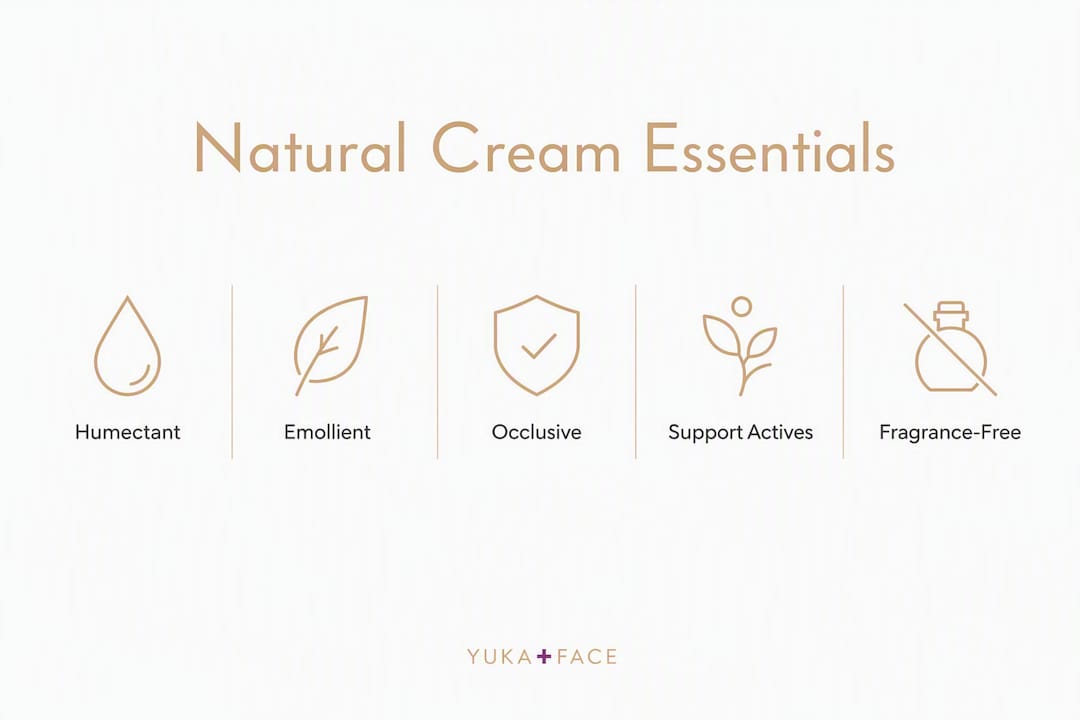
Pro Tip: Choose fragrance-free formulas if your skin is reactive, sensitive, or eczema-prone. "Unscented" is not the same as fragrance-free — some unscented products contain masking fragrances. Check the INCI list for "parfum" or "fragrance" before buying.
Which ingredients in a natural cream actually help dry skin?
Reading an INCI list is the fastest way to tell whether a product will work. The ingredients below are the ones with real functional roles — not just marketing appeal.
Humectants
Glycerin is the most reliable humectant in natural formulas. Plant-derived glycerin is vegan and widely available. Sodium hyaluronate (the salt form of hyaluronic acid) penetrates more readily than the full molecule and is found in both conventional and natural lines. Aloe vera gel adds mild humectant action alongside soothing compounds, making it useful for reactive or sun-stressed skin.
Practitioners recommend a balanced formulation strategy: use humectants to pull water into skin, emollients to smooth, and occlusives to lock moisture in — rather than relying on oils alone. A product that only seals without restoring water content can leave underlying dehydration unaddressed.
Emollients and plant oils
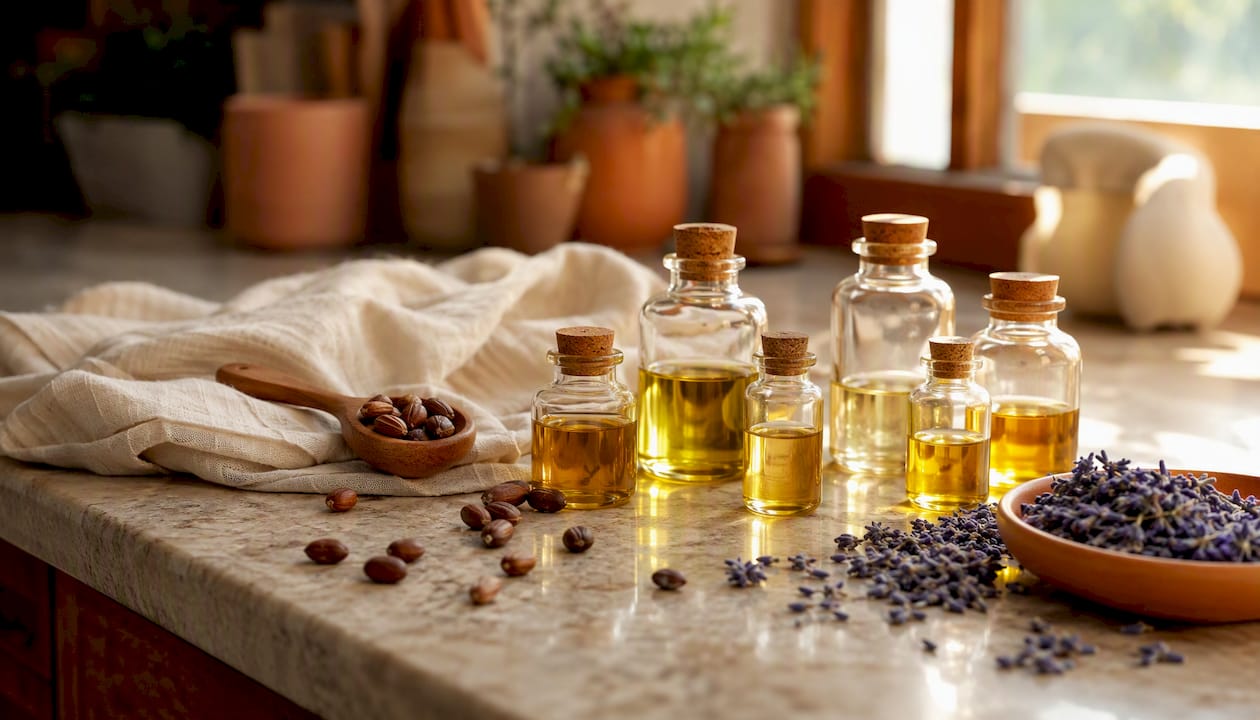
Jojoba oil is technically a liquid wax, which makes it one of the most stable carrier oils and a close structural match to the skin's own sebum. Sweet almond oil is lightweight and absorbs quickly — a good choice for the face. Apricot kernel oil is similarly light and suits sensitive skin. Rosehip oil adds antioxidant support from naturally occurring vitamin A precursors, making it popular for mature or sun-damaged dry skin.
Occlusives and richer butters
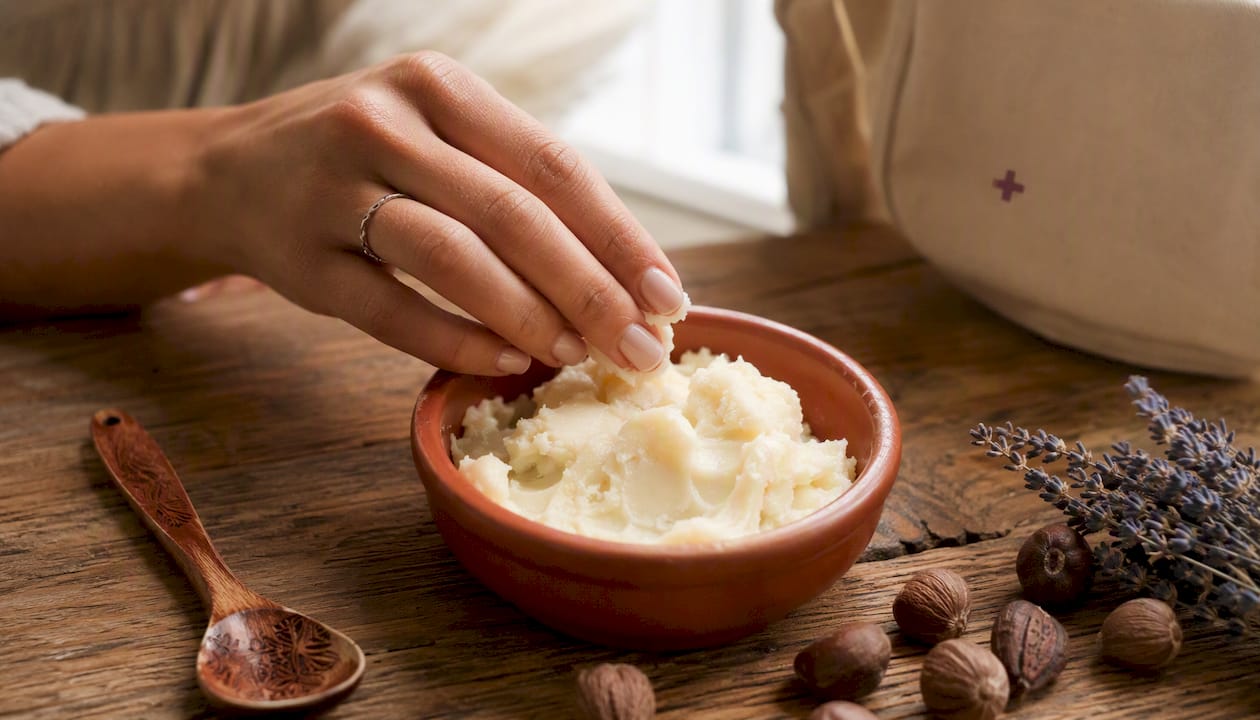
Shea butter is the workhorse occlusive in natural skincare. It seals effectively without being comedogenic at typical use levels. Cocoa butter is denser and works well on the body, elbows, and feet. Plant waxes (candelilla, carnauba) are vegan alternatives to beeswax and provide a lighter seal. Note: lanolin is a highly effective occlusive but is derived from sheep wool, so it is not vegan.
Support actives
Ceramide-mimicking botanicals (oat-derived lipids, for example) help reinforce the skin barrier at a structural level. Antioxidant-rich extracts — green tea, vitamin E (tocopherol), sea buckthorn — protect against oxidative stress that worsens barrier damage. These are not replacements for the core three-function model, but they add measurable value in a well-formulated cream.
Safety note: Essential oils and citrus botanicals (bergamot, lemon peel, lime) are among the most common contact dermatitis triggers in natural skincare. Lavender, tea tree, and peppermint also appear frequently in reaction reports. For reactive or eczema-prone skin, fragrance-free is the safer default.
How do you choose the right natural cream for your skin?
Not every dry skin profile needs the same formula. Matching the product to your specific situation saves time and money.
- Assess severity first. Tight, rough skin that flakes needs a richer cream with a strong occlusive. Skin that feels dry only after cleansing or in winter may do fine with a lighter lotion.
- Decide on fragrance. Fragrance-free is the lower-risk choice for sensitive, reactive, or eczema-prone skin. Lightly scented formulas are generally fine for non-reactive skin.
- Check the ingredient balance. A good formula lists a humectant (glycerin, sodium hyaluronate) in the first half of the INCI list, an emollient oil in the middle, and a butter or wax near the top or mid-list.
- Look at the preservative system. Any cream containing water needs a preservative. Phenoxyethanol, sodium benzoate, and potassium sorbate are common in natural lines. No preservative in a water-based cream is a red flag, not a selling point.
- Consider packaging. Airless pumps protect water-containing formulas better than open jars, which introduce bacteria every time you dip a finger in.
Red flags on labels:
- "Fragrance" or "parfum" listed without disclosure of what it contains
- Proprietary blends listed as a single entry with no INCI breakdown
- Essential oils listed high (top third) in the INCI, especially citrus or spice oils
- No preservative in an emulsified (water + oil) formula
For soothing reactive or eczema-prone dry skin, fragrance-free and minimal-ingredient formulas are the starting point. Patch-test any new product on the inner forearm for 24–48 hours before applying to the face.
How should you apply a natural cream for the best results?
Application technique affects how well even a good cream performs. These steps apply to both AM and PM routines.
- Cleanse gently. Use a sulfate-free or cream cleanser that does not strip the skin's natural oils.
- Apply to damp skin. Pat dry but leave the skin slightly damp. Humectants work better when there is surface moisture to bind to.
- Layer a serum first if needed. For very dry or dehydrated skin, apply a glycerin or hyaluronic acid serum before the cream. Thin, water-based layers go on before richer ones.
- Apply the cream. Press it gently into the skin rather than rubbing. This reduces friction on already-compromised skin.
- Add an oil or occlusive last (optional). For very dry patches — hands, elbows, heels — a drop of jojoba or a thin layer of shea butter over the cream adds extra sealing.
Frequency: twice daily (AM and PM) for dry skin. In winter or low-humidity environments, a midday reapplication on hands and any exposed areas helps. In summer, a lighter formula in the morning and the richer cream at night is a practical adjustment. For a full morning skin care routine that pairs well with a natural moisturizer, sequencing matters as much as product choice.
Pro Tip: Use a richer, occlusive-heavy cream as an overnight mask on very dry or flaky patches. Apply a thicker layer to clean, damp skin, leave it overnight, and rinse lightly in the morning. This technique, sometimes called "slugging" with a natural formula, works well for hands, elbows, and dry facial patches.
Quick troubleshooting:
- Pilling: Apply less product, or wait longer between serum and cream layers.
- Greasiness: Switch to a lighter emollient oil (apricot kernel instead of coconut) or reduce the amount used.
- Breakouts: Coconut oil is comedogenic for some skin types — swap it for jojoba or sweet almond.
Can you make a safe homemade cream for dry skin?
Yes, with one important constraint: if the recipe contains water, it needs a preservative or refrigeration.
Anhydrous (water-free) whipped balm — the safer DIY option
This small-batch recipe from naturallynourishedfamily.com is shelf-stable and straightforward.
- Melt 2 tablespoons shea butter and 1 tablespoon cocoa butter together gently.
- Add 1 tablespoon jojoba oil and 1 tablespoon sweet almond oil.
- Stir in a few drops of vitamin E oil (tocopherol) as an antioxidant.
- Cool the mixture until it reaches an opaque, soft consistency — similar to soft peanut butter. Do not whip while still liquid.
- Whip with a hand mixer until light and fluffy. Store in a clean glass jar.
Shelf life: 3–6 months at room temperature, away from direct sunlight. Use a spatula, not fingers, to avoid contamination.
For a vegan, nut-free version, replace sweet almond oil with sunflower or hemp seed oil and use candelilla wax instead of cocoa butter.
Emulsified (water-containing) creams
Homemade emulsified creams without a broad-spectrum preservative can develop mold or bacteria within days. If you add water, hydrosols, or aloe vera gel to a recipe, use a recognized broad-spectrum preservative (such as Leucidal Liquid or Optiphen) at the manufacturer's recommended rate, or refrigerate the batch and use it within 1–2 weeks. This is not optional — contaminated DIY creams cause skin infections.
What mistakes make dry skin worse in "natural" skincare?
The "natural" label does not guarantee gentleness. Several common practices and ingredients actively worsen dry skin.
- Over-exfoliating. Scrubbing or using AHAs too frequently removes the lipid layer that holds moisture in. Once or twice a week is the upper limit for dry skin.
- Alcohol-based toners. Denatured alcohol (listed as "alcohol denat." on INCI) strips the barrier. Avoid it entirely on dry skin.
- Oil-only solutions for dehydrated skin. Oils seal but do not hydrate. Applying a face oil to dehydrated skin without a humectant underneath can make tightness worse.
- High essential-oil concentrations. Formulators for sensitive-skin lines advise avoiding essential-oil-heavy formulas to reduce the risk of contact dermatitis — even when those oils are "natural."
- Skipping patch tests. Test new products on the inner forearm for 24–48 hours before full-face use, especially with botanical-heavy formulas.
"Clean" or "natural" labels do not guarantee low irritation. Essential oils and botanical extracts commonly used in natural skincare lines can cause contact dermatitis in sensitive people — the ingredient source does not determine its safety profile for your skin.
For eczema-prone skin: Stick to fragrance-free, minimal-ingredient formulas with ceramide-supporting botanicals. Avoid anything with citrus, spice, or high essential-oil loads. If dry patches are cracked, bleeding, or infected, see a dermatologist before applying any new product.
This article provides general skincare information, not medical advice. Confirm treatment options for eczema or chronic skin conditions with a qualified dermatologist.
Why does the Yuka+Face Detox Night Cream work for dry skin?
The Yuka+Face Detox Night Cream is formulated to the humectant + emollient + occlusive standard that practitioners recommend for dry skin. It is vegan and cruelty-free, with no animal-derived ingredients, and the formula is designed to work overnight when the skin's natural repair cycle is most active.
Why it fits the dry-skin model:
- Humectant layer: Plant-derived ingredients that draw and bind moisture to the skin surface.
- Emollient layer: Botanical oils that smooth texture and support barrier flexibility.
- Occlusive layer: Richer butters and plant-based ingredients that seal hydration and reduce TEWL through the night.
- Fragrance status: Check the product page for the current fragrance profile; for reactive skin, confirm fragrance-free status before purchase.
- Certifications: Vegan and cruelty-free, aligned with Leaping Bunny and PETA standards as stated by Yuka+Face.
Natural ingredients like plant-derived glycerin, hyaluronic acid, and butters can offer comparable hydration to conventional formulas when formulated correctly — the difference is in ingredient sourcing and formulation stability, not efficacy.
Usage tip: Apply the Detox Night Cream as the final step in your PM routine, on clean, slightly damp skin. For very dry skin, layer a glycerin or sodium hyaluronate serum underneath first. Use nightly for best results; adjust to every other night if the skin feels congested.
Pro Tip: Pair the Detox Night Cream with a hyaluronic acid or glycerin serum applied to damp skin first. The serum loads the skin with water; the cream seals it in. This two-step approach addresses both dehydration and dryness in one routine.
| Feature | Details |
|---|---|
| Best for | Very dry, dehydrated, and mature skin |
| Key benefits | Humectant + emollient + occlusive balance; overnight barrier repair |
| Texture/feel | Rich cream; absorbs without heavy residue |
| Fragrance status | Check product page for current formulation |
| Certifications | Vegan, cruelty-free |
Key Takeaways
An effective natural cream for dry skin must combine a humectant, an emollient, and an occlusive — no single-ingredient formula reliably addresses all three functions that dry skin needs.
| Point | Details |
|---|---|
| Use the three-function model | Choose a cream with humectant + emollient + occlusive for complete dry-skin coverage. |
| Go fragrance-free for reactive skin | Avoid "parfum" and high essential-oil loads; patch-test any new botanical formula for 24–48 hours. |
| Apply to damp skin | Humectants bind surface moisture — apply cream while skin is still slightly damp after cleansing. |
| Store DIY creams safely | Water-containing homemade creams need a preservative or refrigeration; use within 1–2 weeks without one. |
| Yuka+Face Detox Night Cream | Vegan, cruelty-free formula built on the humectant + emollient + occlusive model for overnight dry-skin repair. |
The case for formulating with purpose, not just "natural" claims
The most common mistake in natural skincare is treating "natural" as a synonym for "safe" or "effective." It is neither, automatically. Lavender oil is natural. So is poison oak extract. The question is always: what does this ingredient do, at what concentration, and for which skin type?
What actually separates a well-made natural cream from a poorly made one is formulation discipline — the decision to include a humectant that genuinely draws water, an emollient that actually repairs barrier lipids, and an occlusive that seals without clogging. Most natural products on the market fail on at least one of those three counts. They lean on a single hero ingredient (usually a butter or an oil), add a fragrant botanical for appeal, and call it done.
Yuka+Face takes a different approach: botanical research paired with formulation science, not one or the other. That combination is what makes the Detox Night Cream a functional product rather than a feel-good one. For readers who want to go deeper on sustainable skincare routines built around this philosophy, the brand's journal covers the full picture.
Yuka+Face Detox Night Cream: where to buy
Dry skin needs a cream that works overnight, not just one that smells good. The Yuka+Face Detox Night Cream is available directly through the Yuka+Face online store, with U.S. shipping and a straightforward returns process.

For readers building a full routine, the hydration and restoration guide on the Yuka+Face site pairs the Detox Night Cream with complementary products for a complete dry-skin protocol. New customers can explore the full vegan skincare range at yukaface.com. Visit the product page, review the current ingredient list, and add to cart directly.
Useful sources
- Moisturizers and Emollients — PMC (NIH)
- Skin barrier function and moisturizers — PubMed
- Plant-based ingredients in dermatology — PMC
- Ceramides and skin barrier repair — PMC
- Emollient therapy in atopic dermatitis — PMC
- Botanical extracts in skincare — PMC
- Dry skin: StatPearls — NCBI Bookshelf
- How to choose the best moisturizer for dry skin — Cleveland Clinic
- Natural skin care — Cleveland Clinic
- EWG Skin Deep Database
FAQ
What is the best natural thing to put on dry skin?
A cream that combines glycerin (humectant), a plant oil like jojoba (emollient), and shea butter (occlusive) addresses all three causes of dryness at once. Apply it to slightly damp skin for best absorption.
How do you make a homemade cream for dry skin?
The safest DIY option is an anhydrous balm: melt shea butter and cocoa butter, add jojoba or sweet almond oil and a few drops of vitamin E, cool to a soft consistency, then whip until fluffy. Any recipe that includes water requires a broad-spectrum preservative or refrigeration and should be used within 1–2 weeks.
What is the best natural moisturizer for dry skin?
The best natural moisturizer for dry skin is one formulated with all three functional layers: a humectant, an emollient, and an occlusive. The Yuka+Face Detox Night Cream is built on this model and is vegan and cruelty-free.
What should you avoid in a natural cream for dry skin?
Avoid formulas with "parfum" or undisclosed fragrance, high essential-oil concentrations, denatured alcohol (alcohol denat.), and water-based creams with no listed preservative. Patch-test any new botanical formula for 24–48 hours before full-face use.