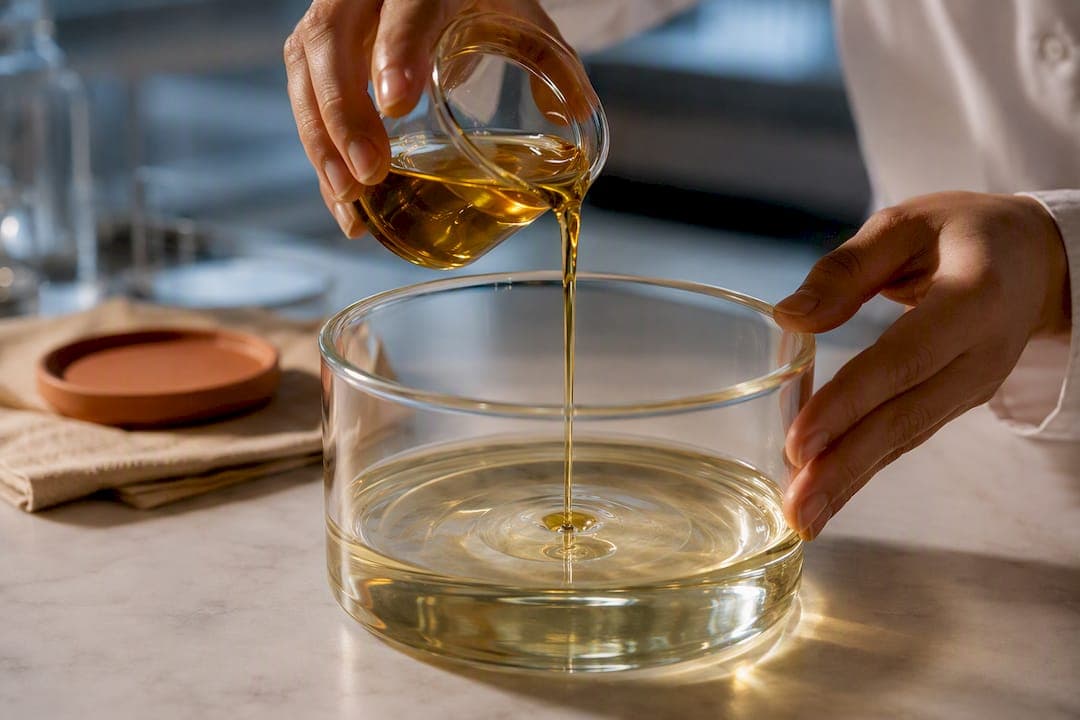
For most facial and body oil formulas, cold-pressed (unrefined) carrier oils deliver the most bioactive value: more tocopherols, carotenoids, and phytosterols reach your skin. Refined oils earn their place when you need a neutral scent, a clear color for fragranced products, or a longer shelf life. The right pick depends on skin type, product format, and how much aroma or color you can tolerate in the final formula. Everything below breaks down that trade-off in practical terms.
TL;DR:
- Cold-pressed oils retain more antioxidants, tocopherols, and phytosterols, providing greater skin benefits but with a shorter shelf life and higher cost.
- Refining removes many beneficial compounds, making oils more stable, odorless, and clear, suitable for fragranced and tinted products.
- The extraction method and refining steps are separate; oils labeled "cold-pressed" can still undergo bleaching or deodorization, reducing their nutrient profile.
- Unrefined oils are better for dry or mature skin, while refined oils are more suitable for sensitive skin and products requiring neutrality or a longer shelf life.
- Buying from reputable suppliers and properly storing oils is essential to prevent rancidity, with natural color and scent serving as quick indicators of freshness.
Table of Contents
- Cold-Pressed vs Refined Oils at a Glance
- How Extraction and Refining Actually Change an Oil
- What Changes at the Molecular Level, and What It Means for Your Skin
- Choosing the Right Oil for Your Skin Type and Product
- A Formulator's Strategy: Stable Base, Potent Boost
- Storage, Shelf Life, and Spotting a Bad Batch
- Environmental Impact of Cold-Pressed and Refined Oil Production
- Are Refined Oils Safe? Residual Solvents and Contaminant Concerns
- Cost and Availability: What You'll Actually Pay and Find
- Kelly's Perspective: Balancing Potency, Stability, and Honesty on the Label
- Yuka+Face: Nutrient-Rich Oils Without the Guesswork
- Sources
- FAQ
Cold-Pressed vs Refined Oils at a Glance
Nutrient density and shelf stability sit at opposite ends of the same seesaw. The more processing an oil goes through, the longer it lasts on your shelf and the fewer active compounds survive to reach your skin.
- Nutrient and antioxidant retention: Cold-pressed oils keep more of their natural tocopherols, carotenoids, and phytosterols; refining strips a meaningful share of these compounds.
- Scent and color: Unrefined oils carry the plant's original aroma and hue, from grassy green hemp seed to deep golden argan. Refined oils are typically deodorized and decolorized.
- Stability: Refined oils oxidize more slowly and resist rancidity longer. Cold-pressed oils oxidize faster once opened, since their own antioxidants get consumed protecting the oil.
- Best use cases: Choose cold-pressed for therapeutic facial oils and serums. Choose refined for fragranced body oils, tinted products, or any formula where a strong base note would compete with added fragrance.
How Extraction and Refining Actually Change an Oil
Cold pressing is mechanical, not chemical. Seeds or nuts get squeezed under pressure, and reputable processors keep temperatures below roughly 120°F (49°C) to avoid degrading heat-sensitive compounds. The result may be filtered to remove solids, but it still carries far more of the plant's natural chemistry than an oil that has gone through full industrial refining.
Refining is a different animal entirely, usually a four-step sequence: degumming removes phospholipids and gums, neutralization strips free fatty acids, bleaching pulls out pigments, and deodorization uses high heat and steam to strip odor compounds. Each step trades a little nutrition for a little more shelf stability and consistency.
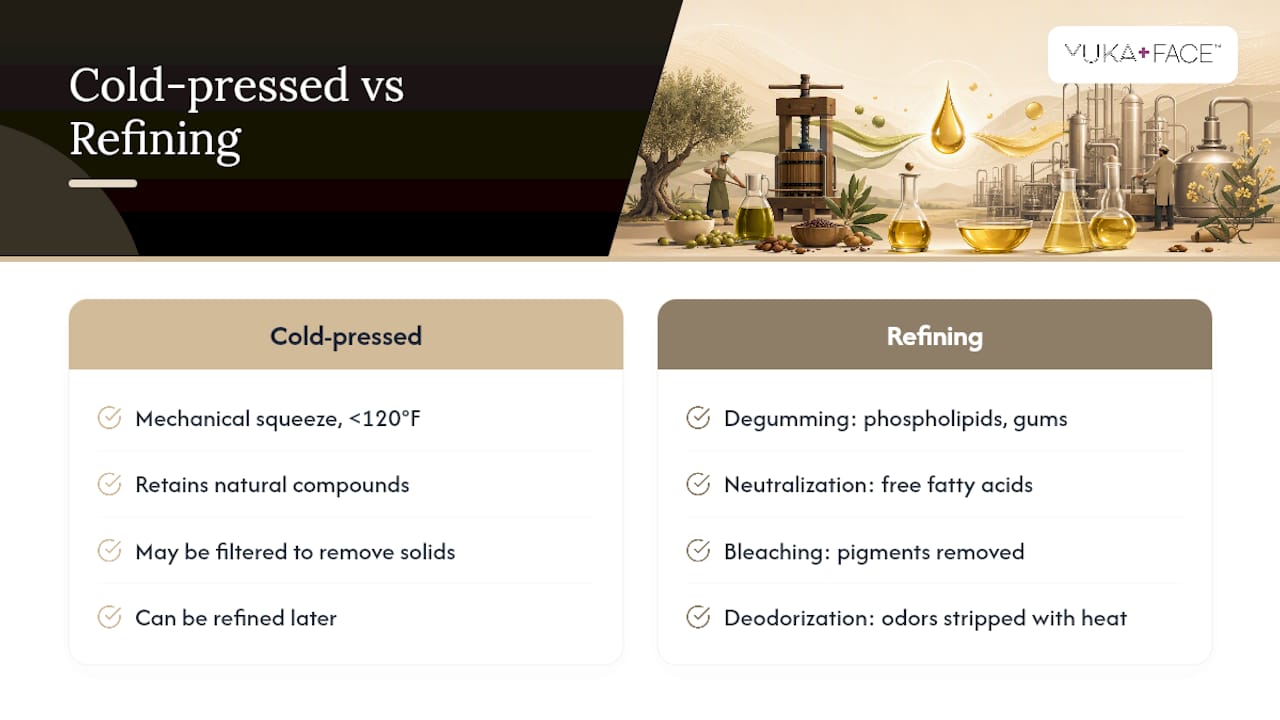
Here's the detail most shoppers miss: "cold-pressed" describes the extraction method, not the finishing process. An oil can be cold-pressed and then still run through bleaching or deodorization afterward, which quietly erases much of the benefit that drew you to the "cold-pressed" label in the first place. If maximum nutrient retention matters to you, look specifically for oils labeled "cold-pressed and unrefined" or simply "unrefined," not cold-pressed alone.
What Changes at the Molecular Level, and What It Means for Your Skin
The fatty acid backbone of an oil, the part that determines whether it's rich in oleic, linoleic, or ricinoleic acid, mostly survives refining intact. What gets lost is everything riding alongside those fatty acids: the minor components that give an oil its personality and much of its skin benefit.
Refining reduces or removes several key compounds:
- Tocopherols (vitamin E): natural antioxidants that help defend skin cells against oxidative stress.
- Carotenoids (provitamin A): pigments tied to skin renewal support, largely responsible for the orange or golden color in unrefined argan and buriti oils.
- Phytosterols: compounds that support barrier function and calm irritation.
- Polyphenols: additional antioxidant compounds concentrated in the plant's original matrix.
Deodorization does the most damage of any single refining step, since the high heat required to strip odor also breaks down heat-sensitive antioxidants and polyunsaturated fatty acids. That matters most for oils marketed on barrier-repair claims. Hemp seed, sunflower, and borage oils, for instance, are valued for linoleic acid and GLA content that supports ceramide synthesis, but the cofactors that help that process actually work are exactly the minor compounds refining removes.
Pro Tip: If a facial oil promises "barrier repair" or "antioxidant defense" but lists a refined oil as its main ingredient, the marketing claim is running ahead of the chemistry. Check the label for "unrefined" before trusting an active-benefit claim.
For dry or mature skin chasing visible antioxidant support, that gap between cold-pressed and refined isn't cosmetic. It shows up in how the product performs.
Choosing the Right Oil for Your Skin Type and Product
Match the oil to the job, not just the ingredient trend. Here's a practical decision path:
- Identify your skin's priority. Dry, mature, or barrier-compromised skin benefits most from unrefined oils rich in tocopherols and phytosterols. Reactive or highly sensitive skin often does better with a refined oil, since trace plant compounds in unrefined versions are a more common trigger for irritation.
- Match the product format. Straight facial oils and targeted serums are where cold-pressed oils earn their premium. Emulsions, lotions, and fragranced body oils usually call for refined bases so added scent isn't fighting the oil's natural aroma.
- Read the label carefully. Look for "unrefined," "virgin," or "cold-pressed and unrefined" if nutrient density is the goal; "refined" or "deodorized" if you need a neutral, versatile base.
- Patch test first. Apply a small amount to your inner forearm and wait 24 hours, especially with unrefined oils, since their broader compound profile carries a slightly higher chance of a reaction in sensitive individuals.
- Plan for storage. Unrefined oils need cooler, darker conditions and shorter use windows than their refined counterparts.
A Formulator's Strategy: Stable Base, Potent Boost
A pattern used across the industry pairs a refined oil as the bulk carrier with a smaller percentage, often 10 to 20 percent, of a cold-pressed oil added for targeted bioactivity. This hybrid approach delivers real nutrient content without sacrificing the shelf stability a finished product needs to survive months on a shelf or in a customer's bathroom.
Pro Tip: When blending, remember that adding unrefined oil also adds oxidation risk. Adjust your preservative system and storage guidance accordingly rather than assuming the base oil's stability profile still applies.
Label integrity matters here too. If you call a product "cold-pressed," the finished formula should actually reflect that, not just the raw material before it went through additional processing.
Storage, Shelf Life, and Spotting a Bad Batch
Unrefined oils generally have a shorter shelf life than refined ones, often measured in months rather than years, and both age faster once opened and exposed to air and light. Store any carrier oil in a cool, dark place in an airtight, ideally dark-glass container.
Trust your senses before you trust a label. A sharp, bitter, or "off" smell, or a color that's turned notably darker or cloudier than when you bought it, signals rancidity. For anyone formulating at volume, a basic peroxide value test can confirm oxidation before it shows up as customer complaints.
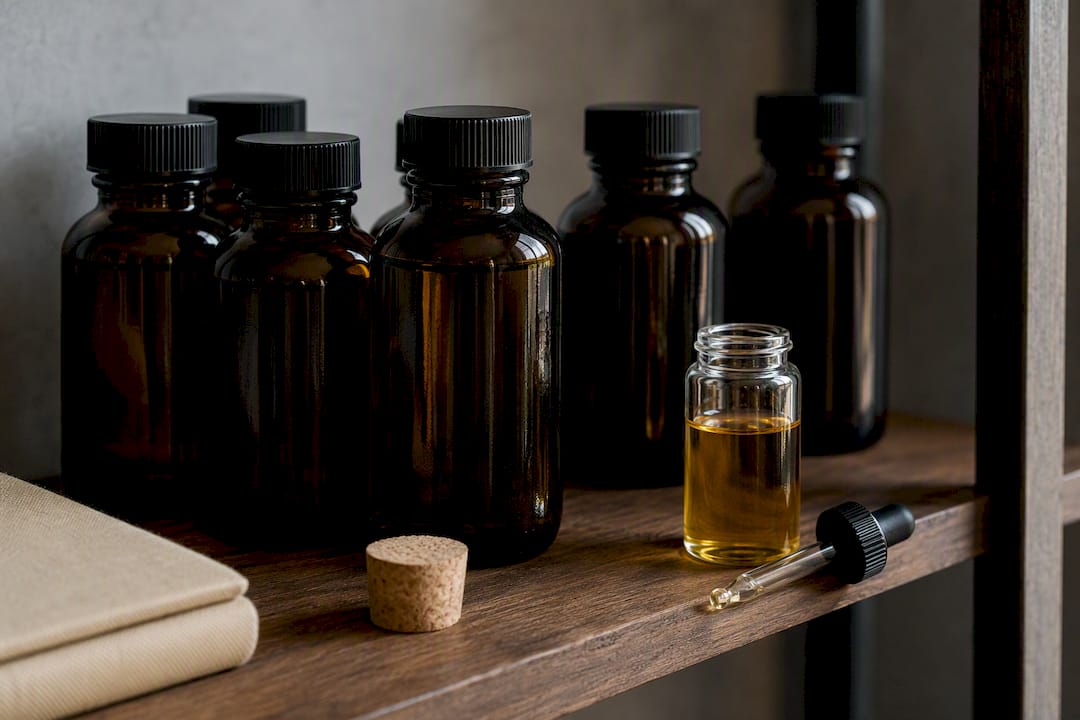
On labeling, color and scent are often your fastest clues. Strong natural pigment, deep orange, green, or gold, paired with a noticeable aroma usually points to unrefined material. Oils that are perfectly clear and essentially odorless have almost always been refined or deodorized, whatever the front label implies.
Environmental Impact of Cold-Pressed and Refined Oil Production
Cold pressing generally uses less energy per batch than full chemical refining, since it skips the heating, solvent, and bleaching stages that drive up a refinery's power draw. It does, however, typically yield less oil per unit of raw material, meaning more acreage or seed stock is needed to hit the same output as a solvent-extraction method.
Refining's environmental footprint comes from a different direction. The degumming and neutralization steps often involve solvents and acids that require careful wastewater treatment, and the energy load from repeated heating cycles during bleaching and deodorization adds up across a production run. Producers who run tighter environmental controls can offset some of that impact, but the process itself is inherently more resource-intensive than mechanical pressing.
Smaller-batch cold pressing also tends to pair naturally with more traceable, often cooperative-sourced supply chains, since the lower-volume, higher-margin unrefined oil market rewards producers who can tell a clear origin story. That's not a universal rule, but it's a pattern worth noting if sourcing transparency matters to you as much as the finished oil's chemistry. Whichever process a brand uses, ask where the raw seed or nut was grown and how it traveled before it reached a press or refinery. That question tells you more about real environmental cost than a "natural" label alone ever will.
Are Refined Oils Safe? Residual Solvents and Contaminant Concerns
Chemical refining, when done to established cosmetic-grade standards, produces oils that are safe for topical use. The neutralization and bleaching steps that concern some consumers are specifically designed to remove impurities, free fatty acids, and pigments, not to introduce new risk.
The legitimate concern centers on process control rather than the refining concept itself. Solvent-based extraction methods used earlier in an oil's production chain can leave trace residues if a supplier cuts corners on post-extraction purification. This is a manufacturing quality issue, tied to a specific producer's standards, not an inherent flaw in refined oils as a category. Reputable cosmetic ingredient suppliers test for residual solvents and publish specification sheets confirming levels fall within accepted safety limits.
For consumers, the practical takeaway is to buy from suppliers or brands that disclose sourcing and testing standards rather than avoiding refined oils outright. For formulators, that means requesting certificates of analysis from raw material suppliers, particularly for any oil that underwent solvent extraction rather than expeller pressing, before the refining stage. Unrefined oils carry their own, different safety consideration: because more of the plant's original compound profile survives, they carry a marginally higher chance of triggering sensitivity in reactive skin, which is why patch testing matters regardless of which oil type you choose.
Cost and Availability: What You'll Actually Pay and Find
Cold-pressed, unrefined oils command a price premium almost across the board, often noticeably more per ounce than their refined counterparts of the same plant source. Lower extraction yields, shorter shelf life that increases waste and turnover costs, and smaller-batch production all feed into that higher price tag.
Refined oils benefit from economies of scale. Higher extraction yields, longer shelf life that reduces spoilage losses, and standardized processing across large production runs keep per-unit costs down, which is part of why refined oils dominate mass-market lotions, cleansers, and fragranced body products.
Availability follows a similar split. Refined oils are easier to source consistently at scale, since batch-to-bath variation is engineered out during processing. Cold-pressed, unrefined oils are more likely to show seasonal or harvest-driven fluctuation in both price and supply, particularly for specialty oils like rosehip or buriti that come from smaller growing regions. If you're formulating commercially, build that variability into your sourcing timeline rather than assuming a cold-pressed oil will always be available at the same price point year over year.
Kelly's Perspective: Balancing Potency, Stability, and Honesty on the Label
The real failure in this category isn't choosing refined over unrefined, or vice versa. It's brands letting "cold-pressed" imply "unrefined" when the two aren't automatically the same thing. Test your oils, know your supply chain, and label what's actually in the bottle. That transparency matters more to your skin than any single extraction method.
— Kelly
Yuka+Face: Nutrient-Rich Oils Without the Guesswork
The formulas are built around the principle that potency and honesty on the label matter more than a buzzword.

If you want to see how that philosophy translates into a finished product, the Vitamin C Glow Oil shows how nutrient-dense botanicals get balanced against real-world stability. For a broader look at how vegan formulation decisions get made, read the guide to vegan skincare, then browse the Yuka+Face shop to find an oil formula suited to your skin type and start building a routine around ingredients you can actually verify.
Sources
- Unrefined vs Refined Plant Oils for Skin: Which One Is Right for You?
- Cold-pressed vs refined carrier oils: what is the difference
FAQ
Is Cold-Pressed Oil Always Better for Skin Than Refined Oil?
Not always. Cold-pressed oils retain more antioxidants and are better for targeted, therapeutic use, but refined oils offer more stability and a neutral scent, which suits fragranced or emulsified products better.
Can a Cold-Pressed Oil Also Be Refined?
Yes. "Cold-pressed" describes only the extraction method, and the oil can still go through bleaching or deodorization afterward. Look for "unrefined" on the label to be certain no additional processing occurred.
Why Do Cold-Pressed Oils Cost More Than Refined Oils?
Lower extraction yields, shorter shelf life, and smaller batch sizes all add cost to unrefined oils, while refined oils benefit from higher yields and standardized, large-scale production.
Are Refined Oils Unsafe Because of Residual Solvents?
Refined oils produced to cosmetic-grade standards are safe; residual solvent risk comes from poor manufacturing controls at specific suppliers, not from refining as a process.
Which Oil Type Should Sensitive Skin Use?
Reactive or highly sensitive skin often tolerates refined oils better, since unrefined oils carry a broader range of natural compounds that can occasionally trigger irritation. A patch test remains the safest first step either way.