
For a radiant, protected complexion, use a daytime antioxidant serum, ideally Vitamin C paired with Vitamin E and ferulic acid, under sunscreen, and support repair at night with a restorative antioxidant serum or a retinoid. That is the whole routine in one sentence. Everything else in this guide is the "why" and "how."
Most people notice a change in tone and texture within several weeks of consistent use, though collagen-related improvements from retinoids take longer, often multiple months.
- AM: Cleanse, apply a Vitamin C serum (Yuka+Face makes one built for this exact step), moisturize, then finish with sunscreen.
- PM: Cleanse, use a retinoid or reparative antioxidant on scheduled nights, then moisturize.
Key Takeaways
An antioxidant rich skincare routine works best when Vitamin C anchors your morning under sunscreen and a retinoid or reparative antioxidant handles overnight repair.
| Point | Details |
|---|---|
| Morning anchor | Apply Vitamin C serum after cleansing, then moisturizer and sunscreen, every morning. |
| Ingredient synergy | Combine Vitamin C, Vitamin E, and ferulic acid for greater stability and free radical protection. |
| Introduce slowly | Add one new active every three nights and patch test anything above moderate strength first. |
| Avoid this pairing | Never combine Vitamin C with benzoyl peroxide in the same routine. |
| Yuka+Face fit | Yuka+Face's Vitamin C Cleansing Oil and Vitamin C serum map directly onto the AM sequence recommended here. |
Table of Contents
- Why an Antioxidant Rich Skincare Routine Matters for Your Skin
- Which Antioxidants Should You Actually Use?
- How Do You Build an Antioxidant Rich Skincare Routine Day and Night?
- What Layering Rules Actually Protect Your Results?
- How Do You Introduce New Antioxidants Without Irritating Your Skin?
- Where Yuka+Face Fits Into an Evidence-Backed Routine
- An Editorial Take on Building an Antioxidant Routine That Actually Holds Up
- Ready to Start Your Antioxidant Routine?
- Sources
- FAQ
Why an Antioxidant Rich Skincare Routine Matters for Your Skin
Free radicals from UV exposure, pollution, and normal metabolism steal electrons from healthy skin cells, damaging collagen and triggering the dullness and fine lines most people blame on age alone. Topical antioxidants donate electrons back, neutralizing that damage before it accumulates.
Research on topical antioxidants in dermatology shows they can lower markers of oxidative stress in skin, and when layered under sunscreen, they improve photoprotection beyond what sunscreen delivers alone. Sunscreen blocks incoming UV rays; antioxidants mop up the free radicals that still slip through. Used together, they cover both sides of the problem.
Beyond sun defense, a well-formulated antioxidant calms inflammation, reinforces the skin barrier, and gradually evens out tone. The NCCIH's breakdown of antioxidants notes that topical and dietary antioxidants work through different mechanisms, so a serum applied to skin is not doing the same job as an orange you ate for breakfast.
What to expect, realistically:
- Weeks 1 to 4: less visible redness, slightly smoother texture
- Weeks 4 to 8: brighter, more even tone
- Months 2 to 4: gradual softening of fine lines if retinoids are part of the mix
Which Antioxidants Should You Actually Use?
Not every antioxidant does the same job, and stacking too many at once without a plan usually backfires. Here's a practical map of the ones worth knowing.
- Vitamin C: the workhorse for brightening and collagen support. Look for a stable formula (L-ascorbic acid at 10 to 20%, or a gentler derivative) and apply it in the morning, where it also boosts your sunscreen's effectiveness.
- Vitamin E: a barrier-supporting antioxidant that also softens and hydrates. It works better paired with Vitamin C than alone, since the two regenerate each other during oxidation.
- Ferulic acid: rarely used solo, but it stabilizes Vitamin C and E formulas and extends their potency, which is why the C+E+ferulic combination shows up repeatedly in dermatology ingredient guides.
- Niacinamide: gentle, well-tolerated by most skin types, and useful for calming inflammation and regulating oil production.
- Retinoids (Vitamin A derivatives): the strongest anti-aging tool here, working by stimulating collagen production rather than neutralizing free radicals directly. They belong at night and need a gradual introduction to avoid peeling and redness.
- Resveratrol and EGCG (green tea): polyphenols with antioxidant and anti-inflammatory properties, often used as supporting players in serums rather than the star ingredient.
Pro Tip: If your skin is new to actives, start with Vitamin C alone for two weeks before adding a retinoid. Judging irritation against a moving baseline makes it nearly impossible to tell which product caused it.
How Do You Build an Antioxidant Rich Skincare Routine Day and Night?
Order matters almost as much as ingredient choice. Apply products from thinnest to thickest texture, and water-based formulas before oil-based ones, so each layer actually absorbs instead of sliding off the last.
Morning sequence:
- Cleanse with a gentle, non-stripping formula. A Vitamin C cleansing oil works well here since it delivers antioxidant exposure without adding a separate step.
- Apply your Vitamin C serum to slightly damp skin.
- Moisturize with something containing Vitamin E for added barrier support.
- Finish with broad-spectrum sunscreen. This step is non-negotiable; skipping it undoes most of what the antioxidant serum just did.
Evening sequence:
- Cleanse thoroughly to remove sunscreen and pollution buildup.
- On scheduled nights, apply a retinoid or gentle exfoliant.
- On off nights, apply a reparative antioxidant serum instead.
- Moisturize to lock in hydration and support overnight repair.
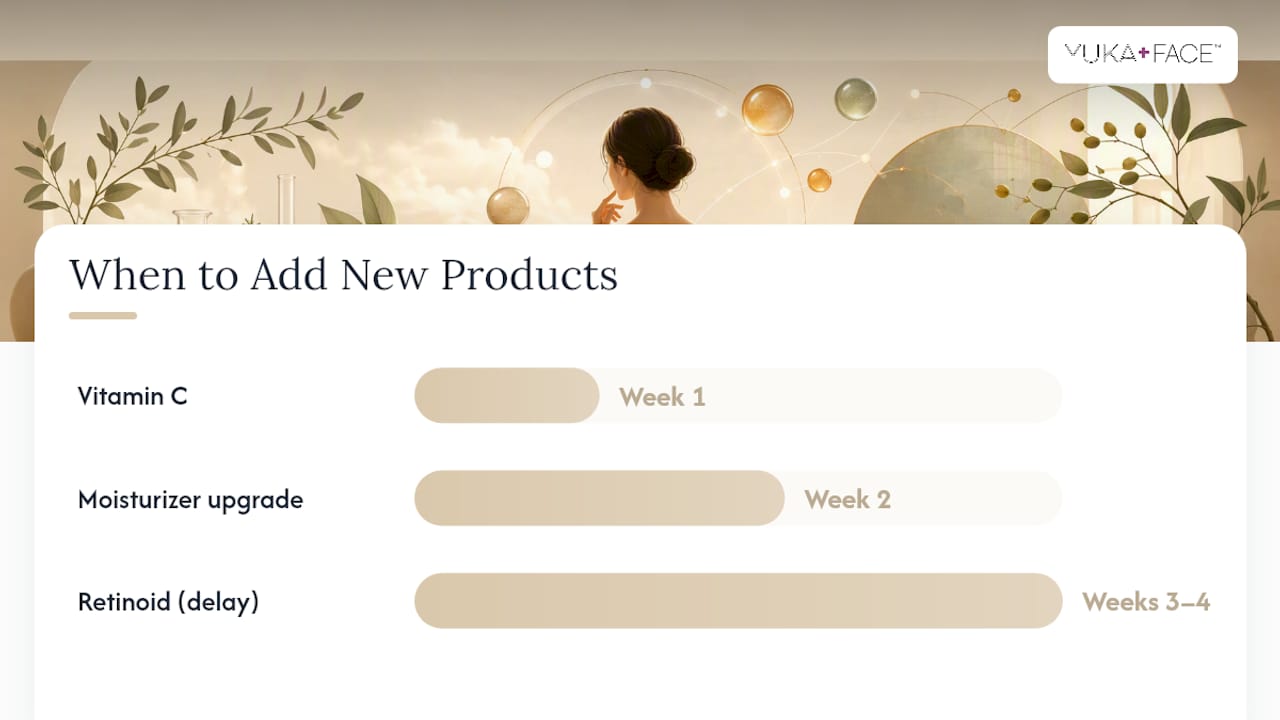
For anyone starting from scratch, spread new products out: introduce Vitamin C in week one, add a moisturizer upgrade in week two, and hold off on a retinoid until week three or four once your skin has adjusted. The morning skincare routine guide walks through this AM sequence in more detail if you want a fuller breakdown.
What Layering Rules Actually Protect Your Results?
Vitamin C performs best in the morning, not just for brightening but because it reinforces your sunscreen's UV defense during the hours you're actually exposed to sunlight. Retinoids, on the other hand, break down in sunlight and work by triggering cell turnover overnight, so pairing them with daytime UV exposure is a wasted, potentially irritating combination.
- Combine Vitamin C, Vitamin E, and ferulic acid for a stability and potency boost over any single ingredient, as commonly recommended in dermatology ingredient guides.
- Never apply Vitamin C alongside benzoyl peroxide. Clinical guidance on ingredient interactions confirms benzoyl peroxide can oxidize and effectively deactivate Vitamin C on contact.
- Be cautious layering strong AHAs or BHAs with high-percentage Vitamin C or retinoids on the same night. The combined acidity can compromise your barrier faster than either ingredient alone.
- Wait several minutes between a water-based serum and a heavier cream so each layer absorbs properly.
Pro Tip: Patch test any new high-strength antioxidant on your inner forearm for 48 hours before applying it to your face. It's a five-minute habit that prevents a week of visible irritation.
How Do You Introduce New Antioxidants Without Irritating Your Skin?
Skin doesn't need every antioxidant at once, and adding several potent actives in the same week is the fastest way to trigger redness, flaking, or breakouts you'll wrongly blame on a single product.
- Patch test first. Apply a small amount to your inner arm or behind your ear and wait 48 hours.
- Introduce one new active every three nights, watching for redness, tightness, or peeling before increasing frequency.
- Once tolerated, build up to nightly use over two to three weeks, per practical guidance on introducing new actives.
- Stop immediately if you notice burning, swelling, or persistent stinging, and see a dermatologist if irritation lasts more than a few days.
- If you're using a Vitamin C formula above 15% or a retinoid above 0.3%, consider professional guidance before starting, especially with sensitive or rosacea-prone skin.
Where Yuka+Face Fits Into an Evidence-Backed Routine
Yuka+Face formulates its antioxidant products around the same ingredients dermatology sources consistently recommend, using vegan, natural ingredient bases rather than synthetic fillers.
- The Vitamin C Cleansing Oil doubles as a gentle first cleanse and an early antioxidant touchpoint before serum application.
- The Vitamin C serum slots directly into the AM sequence outlined above, applied after cleansing and before moisturizer and sunscreen.
- A peptide-rich night serum supports the PM repair step on nights when a retinoid isn't scheduled.
Choosing antioxidants by what your skin actually needs, rather than chasing whichever ingredient trends this month, is the difference between a routine that works and one that just sits in your cabinet.
An Editorial Take on Building an Antioxidant Routine That Actually Holds Up
The conventional advice on antioxidants treats them like a shopping list: buy Vitamin C, buy niacinamide, buy resveratrol, layer them all, done. That approach ignores what the research actually supports, which is that stability and sequencing matter more than ingredient count. A serum with unstable Vitamin C that's oxidized to a dull brown color in the bottle does less for your skin than a well-formulated niacinamide used consistently.

What gets overlooked most is patience with the introduction schedule. People add three new actives in one week, get irritated skin, and conclude "antioxidants don't work for me," when the real issue was pace, not the ingredients themselves.
If you take one thing from this guide, prioritize the AM Vitamin C plus sunscreen pairing before anything else. It's the single change with the clearest evidence behind it, and it protects everything you layer on top of it afterward.
Ready to Start Your Antioxidant Routine?
Yuka+Face is built for exactly the routine outlined above: vegan, cruelty-free antioxidant formulas designed to layer cleanly without synthetic fillers competing for space on your skin. Rather than guessing which Vitamin C concentration or barrier support product actually pairs well together, Yuka+Face's line is formulated to work as a system from cleanse through moisturizer.

If you're ready to put the AM sequence into practice, the morning skincare routine guide walks through product selection step by step, and the vegan skincare philosophy page explains the ingredient sourcing behind every formula. For sensitive or reactive skin types looking for a gentler entry point into antioxidants, nutraceutical support options offer an oral complement worth exploring alongside topical care. Start with the Vitamin C serum this week, and add sunscreen as the non-negotiable final step every single morning.
Sources
For deeper reading, the NCBI review on antioxidants in dermatology and the NCCIH's antioxidant overview cover the science behind topical use. Dermatology-focused ingredient guides, including OTS Dermatology's roundup, informed the ingredient recommendations throughout this guide, alongside Yuka+Face's own product pages.
- Antioxidants in dermatology (PMC5579659) | NCBI
- Antioxidants: In Depth | NCCIH
- 8 scientific ingredients that dermatologists swear by for flawless skin | OTS Dermatology
- Relevant clinical/ingredient interaction guidance (PubMed 35960194)
FAQ
What is the most powerful antioxidant in skincare?
There is no single most powerful antioxidant. Vitamin C leads for brightening and collagen support, but retinoids do more for anti-aging, and niacinamide works best for redness and oil control, so the right choice depends on your specific concern.
What is the 4-2-4 rule in skincare?
There's no established dermatological framework by that name in the research behind this guide, and definitions circulating online vary widely, so it's not something worth building a routine around.
What are the best antioxidants for skincare?
Vitamin C, Vitamin E, ferulic acid, niacinamide, and resveratrol are the most consistently recommended, with Vitamin C plus Vitamin E plus ferulic acid forming one of the most cited combinations for stability and potency.
How do I add antioxidants to my routine without irritation?
Introduce one new active every three nights, patch test anything above moderate strength, and give your skin two to three weeks before adding the next product.
Can I use Yuka+Face products for a full antioxidant routine?
Yes. Yuka+Face's Vitamin C Cleansing Oil and Vitamin C serum cover the morning antioxidant steps, while its peptide-based night serum supports evening repair on non-retinoid nights.