
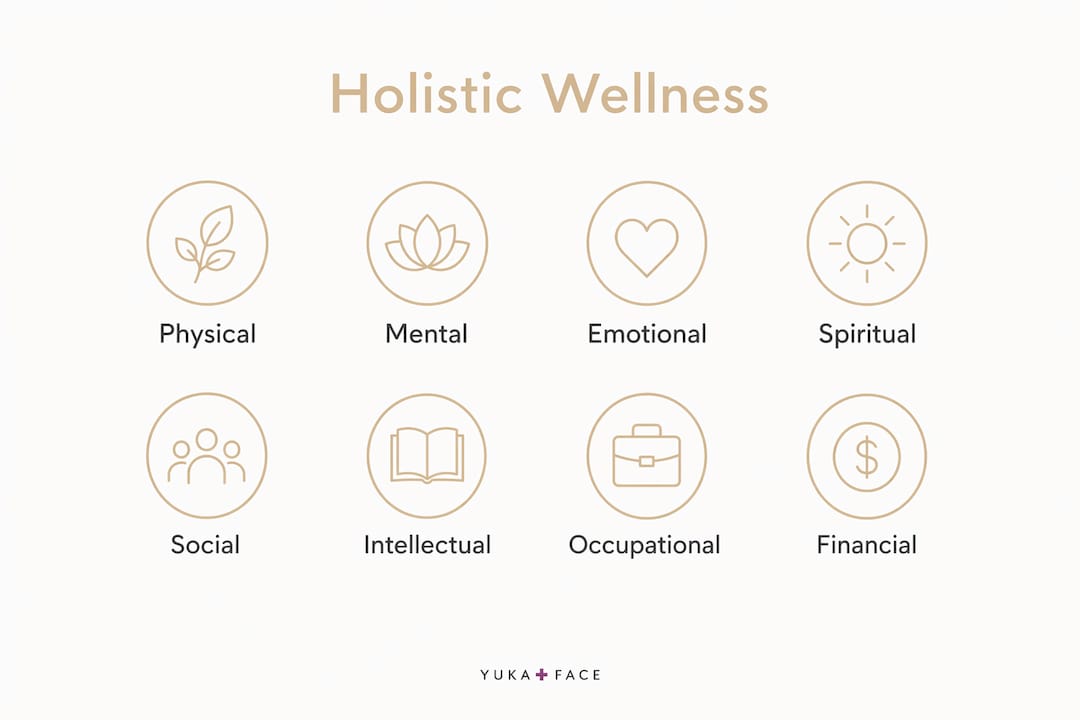
Holistic wellness is an integrated, whole-person approach to health that addresses physical, mental, emotional, social, and spiritual well-being together, not in isolation. Rather than treating symptoms alone, it focuses on root causes and daily lifestyle choices across eight interdependent dimensions: physical, mental, emotional, spiritual, social, intellectual, occupational, and financial health. The goal is not perfect balance across every dimension. It is personal harmony, adapted to your values, circumstances, and capacity.
Key components at a glance:
- Physical: fitness, nutrition, sleep, preventive care
- Mental: stress management, cognitive engagement, emotional resilience
- Emotional: self-awareness, coping skills, healthy expression
- Social: relationships, community, support systems
- Spiritual: meaning, purpose, and personal values
- Intellectual: curiosity, learning, creative engagement
- Occupational: work satisfaction, purpose-driven contribution
- Financial: stability, planning, reduced money-related stress
What does holistic wellness actually cover?
Each dimension of whole-person health carries real weight. Neglecting any one area over time tends to pull the others down with it.
- Physical health covers regular movement, balanced nutrition, adequate sleep (7–9 hours for most adults), and routine preventive screenings. It is the most visible dimension but not the most important one in isolation.
- Mental and emotional health includes stress management, mindfulness practice, and building emotional resilience. Mindfulness meditation has been confirmed in a systematic review published in JAMA Internal Medicine to reduce anxiety, depression, and pain while lowering stress hormone and inflammation markers.
- Social wellness centers on the quality of relationships and community ties. Strong social connections are consistently linked to longer life and better health outcomes.
- Spiritual wellness does not require religious affiliation. NIH research shows that people with a clear sense of meaning and purpose tend to enjoy better health outcomes and stronger resilience under stress.
- Intellectual wellness involves ongoing learning and curiosity. Occupational and financial wellness round out the model, covering work satisfaction and economic stability as genuine health factors.
Core principles that set this approach apart
The Global Wellness Institute defines wellness as a proactive, salutogenic model, meaning it focuses on building health rather than reacting to disease. That framing separates it clearly from conventional care, which typically responds to illness after it appears.
Whole-person health, as described by the National Center for Complementary and Integrative Health, addresses biological, behavioral, social, and environmental factors together, with the aim of restoring resilience and preventing chronic disease across a lifespan. The VA's Whole Health System of Care applies this directly, combining conventional treatment with complementary approaches like acupuncture, yoga, and biofeedback for personalized veteran care.
Personalized care and self-responsibility are central. Holistic wellness requires active participation, with individuals working as equal partners alongside healthcare providers, not passive recipients of treatment. Wellness is also dynamic. It shifts with life circumstances, which means the goal is sustainable personal harmony, not a fixed endpoint.
Pro Tip: Think of your wellness dimensions as interconnected, not competing. Improving sleep quality, for example, tends to improve mood, focus, and even social patience simultaneously.
Common practices within whole-person health
Holistic approaches draw from a wide range of evidence-based and traditional methods, often used in combination with conventional medicine:
- Mind-body practices: meditation, mindfulness, yoga, guided imagery, breathwork
- Manual and body-based therapies: massage therapy, chiropractic care, acupuncture, acupressure
- Energy therapies: reiki, therapeutic touch, biofeedback
- Natural and biological therapies: herbs, supplements, essential oils, whole-food nutrition
- Lifestyle adjustments: sleep hygiene, physical activity, stress reduction routines
- Integrative medicine: combining conventional diagnostics and treatment with complementary approaches
A common misconception is that whole-person health means rejecting conventional medicine. It does not. Most practitioners use these methods alongside standard care, not instead of it. The Institute for Holistic Health Studies at Western Connecticut State University notes that nearly all traditional approaches are used in combination with one another and with conventional medicine for integrated outcomes.
Skin health fits naturally into this picture. What you eat, how you sleep, and how you manage stress all show up on your skin. Nutrient-rich skincare supports this connection from the outside in, while lifestyle choices reinforce it from within.

Careers and professional roles in this field
The holistic wellness field spans a growing range of professional paths, each requiring distinct training and credentials.
- Naturopathic physicians: licensed practitioners who combine conventional diagnostics with natural therapies, nutrition, and lifestyle counseling
- Massage therapists: licensed professionals trained in manual therapy for physical and stress-related conditions
- Integrative medicine practitioners: medical doctors or osteopaths who incorporate complementary approaches into standard clinical care
- Wellness coaches: professionals who support clients in building sustainable lifestyle habits across multiple wellness dimensions
- Health educators and nutritionists: roles focused on preventive health, dietary guidance, and community wellness programs
Careers in holistic wellness emphasize whole-person care, preventive strategies, and the ability to work across traditional and complementary frameworks. Demand is growing as mainstream healthcare systems increasingly integrate these approaches. The VA's Whole Health model and programs like the Ornish Program for Reversing Heart Disease, covered by Medicare, reflect how far this integration has already moved.
Research-supported benefits of whole-person care
The evidence base for whole-person approaches is solid and expanding. Holistic care models show a 4% decrease in hospital costs for chronic pain patients, averaging $898 in savings per hospital admission, alongside improved patient satisfaction and reduced provider burnout.
Mindfulness and yoga reduce measurable stress hormones and inflammation markers, with benefits confirmed across multiple clinical trials. Spirituality, distinct from religion, contributes to longevity and stress resilience. The NCCIH notes that addressing lifestyle factors early, including poor diet, sedentary behavior, chronic stress, and inadequate sleep, can prevent multiple chronic diseases and help restore health before conditions progress.
Programs like the Ornish Program demonstrate that lifestyle-based interventions can reverse the progression of coronary heart disease without drugs or surgery. That is not a fringe claim. It is a Medicare-covered program with a documented clinical track record.
History and origins of whole-person health
The roots of whole-person health reach back thousands of years. Ancient healing traditions in Ayurveda, Traditional Chinese Medicine, and Greek medicine all treated the person as a whole, not as a collection of separate symptoms. Hippocrates, often called the father of Western medicine, emphasized diet, environment, and lifestyle as central to health, not just disease treatment.
The modern wellness movement gained formal shape in the mid-20th century. Halbert Dunn's 1961 work High-Level Wellness introduced the idea that health was not simply the absence of illness but an active, positive state of thriving. The World Health Organization's foundational definition, adopted in 1948, described health as "a state of complete physical, mental and social well-being," which aligned closely with this broader view.
The Global Wellness Institute and organizations like NCCIH have since built on these foundations, formalizing the multidimensional model and grounding it in clinical research.
Challenges and criticisms worth knowing
Whole-person health is not without legitimate critique. The field's breadth creates real quality-control challenges. Not every practice marketed as "wellness" carries the same evidence base, and some therapies lack rigorous clinical trial support.
Standardization is another gap. Wellness dimensions vary by model, credentialing requirements differ widely by state and profession, and the term "holistic" itself is used loosely across industries. Readers should look for practitioners with recognized licensure and training, not just self-applied labels.
Cost and access present barriers too. Integrative and complementary services are often not covered by standard insurance plans, making them harder to access for people without financial flexibility. The evidence-backed programs that do exist, like the VA's Whole Health System, tend to be institution-specific rather than broadly available.
Finally, whole-person health works best as a complement to, not a replacement for, conventional medicine. Treating serious illness with lifestyle practices alone, while ignoring evidence-based medical care, is a genuine risk in some corners of the wellness space.
Yuka+Face and whole-person skin care

Skin care is part of the wellness picture. Yuka+Face products are built on this principle: 100% natural, vegan, and cruelty-free formulas that work with your skin's biology rather than against it. The mindfulness skincare routine from Yuka+Face connects daily skin care with intentional self-care practice. For plant-based options aligned with natural wellness values, the vegan skincare guide is a practical starting point.
Key Takeaways
Whole-person wellness integrates physical, mental, emotional, social, and spiritual health as interdependent dimensions, with the goal of personal harmony rather than uniform perfection.
| Point | Details |
|---|---|
| Eight core dimensions | Physical, mental, emotional, spiritual, social, intellectual, occupational, and financial health all interact. |
| Proactive, not reactive | Wellness focuses on disease prevention and daily lifestyle choices, not symptom treatment after illness appears. |
| Evidence-backed benefits | Holistic care models show a 4% decrease in hospital costs for chronic pain patients, averaging $898 savings per hospital admission, with improved patient satisfaction and reduced provider burnout. |
| Active participation required | Individuals work as equal partners with healthcare providers, not passive recipients of care. |
| Skin is part of the picture | Nutrition, sleep, and stress management directly affect skin health alongside topical care. |
FAQ
What are the 3 core components of holistic wellness?
Physical, mental, and spiritual well-being are the three most commonly cited core components, though most current models expand this to eight dimensions including emotional, social, intellectual, occupational, and financial health.
What are the 8 elements of holistic wellness?
The eight dimensions are physical, mental, emotional, spiritual, social, intellectual, occupational, and financial wellness. Neglecting any one dimension over time tends to affect the others.
How does holistic wellness differ from conventional health care?
Conventional care typically responds to disease after it appears. Whole-person wellness is proactive, addressing lifestyle, environment, and root causes before illness develops, and treating the full person rather than isolated symptoms.
Can holistic practices replace medical treatment?
No. Whole-person approaches work best alongside conventional medicine, not as a substitute. Evidence-backed programs like the Ornish Program and the VA's Whole Health System combine both for better outcomes.