
TL;DR:
- Beauty philosophy, or aesthetics, explores the nature, experience, and value of beauty through objective and subjective perspectives. It emphasizes that beauty links to ethics, metaphysics, and daily life, shaping how people see the world and themselves.
Beauty philosophy is the branch of philosophy that studies the nature, experience, and value of beauty, examining whether it exists in objects themselves or only in the minds of those who perceive it. Known formally as aesthetics, this discipline traces back to 1735 when Alexander Baumgarten coined the term from the Greek aisthesis, meaning perception. Philosophers from Plato and Aristotle to Immanuel Kant have shaped how we understand what defines beauty, why it matters, and how it connects to truth, ethics, and human flourishing. Understanding beauty concepts at this level changes how you see everything from a mountain range to a morning skincare ritual.
What is beauty philosophy and why does it matter?
Beauty philosophy is defined as the systematic study of beauty, aesthetic experience, and the principles that govern taste and sensory perception. Aesthetics emerged in 1735 with Baumgarten, though the questions it addresses stretch back to ancient Greece. The discipline asks not just what is beautiful, but why something registers as beautiful and what that response reveals about human nature.
The importance of beauty philosophy goes beyond art criticism. Beauty appears in science, law, and daily life, not just in galleries or luxury products. A mathematical proof can be elegant. A well-designed product can feel right. Recognizing beauty in these contexts requires a trained eye and a clear framework. That is exactly what beauty philosophy provides.
Plato, Aristotle, Kant, Thomas Aquinas, and Edmund Burke each contributed distinct frameworks for understanding aesthetic experience. Their ideas still shape how designers, artists, ethicists, and even skincare brands think about what it means to create something genuinely beautiful.
What are the main philosophical theories of beauty?
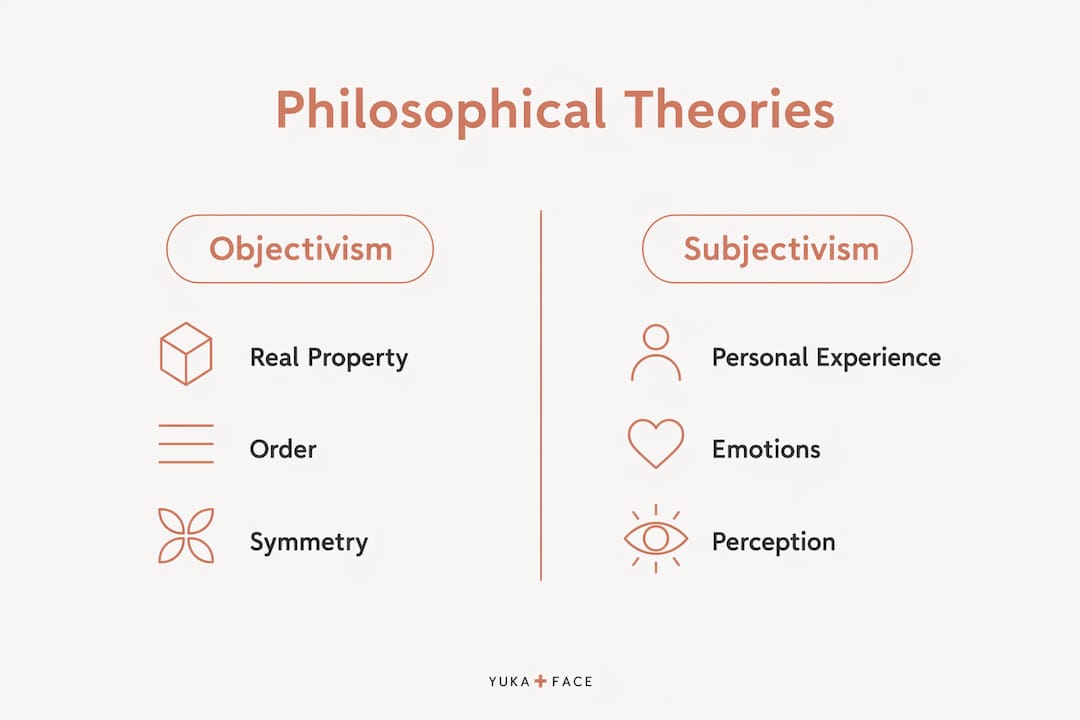
Philosophical theories of beauty split into two primary camps: objectivism and subjectivism. Each answers the question "what defines beauty?" in a fundamentally different way.
Objectivism: beauty in the object
Objectivism holds that beauty is a real property of things, independent of any observer. Aristotle grounded objective beauty in three qualities: order, symmetry, and definiteness. A face, a building, or a piece of music is beautiful because it possesses these measurable properties. This view gives beauty a stable, universal character.

Plato pushed objectivism further. His "ladder of beauty" concept describes a progression from appreciating individual beautiful things to contemplating the eternal Form of Beauty itself. For Plato, beauty is transcendent, not a matter of personal preference. This framework influenced centuries of Western art and architecture, from the proportions of Greek temples to Renaissance painting.
Subjectivism: beauty in the observer
Subjectivism argues that beauty depends on the experience of the person perceiving it. Kant's contribution was more nuanced than simple relativism. He described aesthetic judgment as a "reflective judgment," a response that feels universal but is grounded in the subject's experience rather than the object's properties. Kant believed that when you call something beautiful, you expect others to agree, even though the judgment originates in feeling rather than logic.
| Feature | Objectivism | Subjectivism |
|---|---|---|
| Source of beauty | Properties of the object | Experience of the observer |
| Key thinkers | Aristotle, Plato | Kant, Hume |
| Universality | Beauty is universal and measurable | Beauty feels universal but is personal |
| Criteria | Order, symmetry, definiteness | Reflective judgment, emotional response |
| Implication | Beauty can be taught and verified | Beauty is cultivated through experience |
Pro Tip: When studying aesthetic philosophy, read Kant's "Critique of Judgment" alongside Aristotle's "Poetics." The contrast between their approaches makes both frameworks sharper and easier to apply.
Most contemporary thinkers reject a hard choice between the two positions. The most productive view treats beauty as arising from a relationship between an object's properties and a prepared, attentive observer.
How does beauty relate to the sublime and the ordinary?
Beauty and the sublime are distinct aesthetic categories, and confusing them flattens your understanding of both. Beauty signals harmony and order, while the sublime evokes awe and sometimes fear through vastness or power. Both are central to aesthetic philosophy, but they produce very different experiences.
Ordinary beauty is the pleasure you take in a well-proportioned face, a balanced garden, or a clear melody. It is comfortable and inviting. The sublime, by contrast, overwhelms. Standing at the edge of the Grand Canyon or watching a thunderstorm roll across open water produces something beyond pleasure. Edmund Burke described the sublime as a mix of terror and delight. Kant defined it as the mind's recognition of its own power when confronted with something that exceeds sensory comprehension.
Examples of sublime aesthetic experiences include:
- Natural phenomena: mountain ranges, oceans, volcanic eruptions, vast deserts
- Architecture: the interior of a Gothic cathedral, the scale of the Pyramids of Giza
- Music: the final movement of Beethoven's Ninth Symphony, the opening of Wagner's Das Rheingold
- Scientific scale: the image of a galaxy cluster from the James Webb Space Telescope
The sublime matters to beauty philosophy because it shows that aesthetic experience is not always pleasant. It can be demanding, even unsettling. That complexity is part of what makes aesthetics a serious philosophical discipline rather than a catalog of pretty things.
Pro Tip: To sharpen your sense of the sublime, spend time with art or nature that makes you feel small. Notice the difference between that response and the calm pleasure of ordinary beauty. The gap between them is where aesthetic philosophy lives.
What role does beauty play in ethics and metaphysics?
Beauty is not just an aesthetic concept. Philosophers have long treated it as a transcendental property, meaning it belongs to being itself rather than to any particular category of objects. Thomas Aquinas identified three conditions of beauty: integrity (wholeness), proportion (harmony of parts), and clarity (radiance or intelligibility). For Aquinas, beauty is inseparable from truth and goodness. All three are properties of being, and each implies the others.
This metaphysical view has a practical consequence. Beauty produces contemplative pleasure rather than sensory gratification. The pleasure of eating a good meal is sensory. The pleasure of seeing a perfectly composed photograph is contemplative. You are not consuming the photograph; you are recognizing something in it. That distinction matters because contemplative pleasure connects to moral and intellectual development in a way that sensory pleasure does not.
"The beautiful is that which pleases universally without a concept." — Immanuel Kant, Critique of Judgment
Plato and Aristotle both considered the study of beauty essential to ethics. Plato argued that exposure to beautiful things trains the soul toward goodness. Aristotle connected aesthetic education to the development of practical wisdom. Both saw beauty not as decoration but as a moral force. This is why classical education included music, poetry, and visual art alongside logic and rhetoric.
The metaphysical view also reframes ugliness. In this tradition, ugliness is a philosophical "privation," a lack of form rather than a positive quality. That means every being holds some degree of beauty by virtue of existing at all. This is a radical claim, and it challenges purely commercial or narrow definitions of beauty that treat it as a feature belonging only to certain bodies, products, or social classes.
Beauty's value connects to truth and goodness, functioning historically as a moral anchor rather than a superficial quality. That connection is why beauty philosophy remains relevant in ethics, education, and even in how brands choose to present themselves.
How can we apply beauty philosophy to everyday aesthetic appreciation?
Beauty philosophy is not confined to lecture halls. It translates directly into how you engage with art, nature, and daily routines. Here is a practical framework for applying these ideas:
-
Expand your definition of beauty. Stop limiting beauty to art or physical appearance. A well-reasoned argument, a clean line of code, or a mindful skincare routine can all be genuinely beautiful when approached with attention and care.
-
Distinguish taste from preference. Personal preference is arbitrary. Taste is a faculty that can be trained. Aesthetic education enhances sensibility and appreciation. Visit museums, study design, read criticism. Your responses will become richer and more reliable over time.
-
Practice disinterested attention. True aesthetic experience requires what philosophers call "disinterested" contemplation. You appreciate the thing for what it is, not for what it does for you. Suspend the urge to evaluate, purchase, or compare. Just observe.
-
Recognize beauty in the natural world. Nature was the original subject of aesthetic philosophy. Aristotle studied biological form. Kant used natural beauty as his primary example of aesthetic judgment. Spending time outdoors with genuine attention sharpens your aesthetic sensibility faster than most formal study.
-
Connect beauty to ethics in your choices. If beauty is linked to truth and goodness, then how you consume beauty matters. Ethical skincare choices reflect a philosophical commitment to beauty that goes beyond surface appearance. Choosing products that are vegan, cruelty-free, and natural is itself an aesthetic and ethical statement.
Many people treat taste as purely arbitrary, but taste is a cultivatable faculty, not a fixed personal quirk. That means your capacity for aesthetic appreciation is something you can build deliberately, the same way you build any other form of intelligence.
Key takeaways
Beauty philosophy defines beauty as a property studied through objective and subjective frameworks, with deep roots in ethics, metaphysics, and everyday experience.
| Point | Details |
|---|---|
| Aesthetics is the formal term | Beauty philosophy is formally called aesthetics, coined by Baumgarten in 1735 from the Greek word for perception. |
| Two core theories | Objectivism locates beauty in the object; subjectivism locates it in the observer's reflective judgment. |
| The sublime is distinct | The sublime differs from ordinary beauty by evoking awe and fear, not just harmony and pleasure. |
| Beauty connects to ethics | Aquinas, Plato, and Aristotle all linked beauty to truth and goodness, making it a moral as well as aesthetic concept. |
| Taste can be trained | Aesthetic appreciation is a cultivatable skill, not a fixed preference, and improves through study and attention. |
Why beauty philosophy still shapes how we see ourselves
I have spent years reading across aesthetics, and the single most useful shift in my thinking came from Aquinas, not Kant. The idea that ugliness is a privation, a lack of form rather than a positive quality, changed how I look at aging, imperfection, and the beauty industry's obsession with correction.
Most commercial beauty culture operates on a deficit model. You are not enough; buy this to fix it. Beauty philosophy, taken seriously, inverts that entirely. Every being holds some degree of beauty by virtue of existing. That is not a motivational slogan. It is a metaphysical claim with real consequences for how you treat your skin, your body, and other people.
The practical implication is this: aesthetic appreciation is an act of attention, not acquisition. You do not become more beautiful by accumulating products. You become more attuned to beauty by learning to see it. That distinction matters enormously in a culture that conflates the two constantly.
I also think the sublime is underused as a concept in personal aesthetics. Most people seek comfort and harmony in their beauty routines, which is fine. But the experiences that genuinely change your relationship with beauty tend to be the overwhelming ones. The first time you see a Rothko painting in person. The moment a piece of music breaks something open in you. Those experiences are not comfortable, and they are not supposed to be. They are the sublime doing its work.
The K-beauty movement, for example, draws on a philosophical approach to skincare that treats the routine itself as a contemplative practice, not just a maintenance task. That is beauty philosophy applied, whether or not anyone in the room has read Kant.
— Kelly
Mindful beauty starts with what you put on your skin

Beauty philosophy teaches that genuine beauty connects to truth, goodness, and conscious choice. Yukaface builds that principle into every product. The Yukaface range is 100% vegan, cruelty-free, and formulated with botanical ingredients that support your skin's natural radiance without compromise. No synthetic fillers. No ethical shortcuts. If you want a skincare practice that reflects a real philosophy of beauty, start with the vegan skincare guide and build from there. Yukaface also offers a mindfulness-centered routine for those who want to turn their daily ritual into a genuine act of aesthetic attention.
FAQ
What is beauty philosophy in simple terms?
Beauty philosophy, formally called aesthetics, is the study of what beauty is, where it comes from, and why it matters. It examines whether beauty is a property of objects or a response in the observer.
What is the difference between objectivism and subjectivism in beauty?
Objectivism holds that beauty exists in the object itself, defined by properties like order and symmetry. Subjectivism, associated with Kant, argues that beauty arises from the observer's reflective judgment rather than measurable features.
Who are the key figures in beauty philosophy?
Plato, Aristotle, Immanuel Kant, Thomas Aquinas, and Edmund Burke are the central figures. Each contributed a distinct framework, from Plato's transcendent Forms to Aquinas' three conditions of integrity, proportion, and clarity.
How does the sublime differ from ordinary beauty?
Ordinary beauty produces calm pleasure through harmony and proportion. The sublime, described by Burke and Kant, produces awe and sometimes fear through vastness or power, transcending ordinary aesthetic pleasure.
Can aesthetic taste be learned or improved?
Yes. Taste is a cultivatable faculty, not a fixed personal preference. Study of art, nature, and design refines sensibility over time, making aesthetic responses richer and more discerning.