TL;DR:
- Natural preservatives protect cosmetics using plant, mineral, and microbial ingredients that prevent spoilage without synthetics. They work through pH reduction, water activity control, and antioxidant effects, creating conditions hostile to microbes and oxidation. Combining multiple preservation methods ensures effectiveness, though natural products often have shorter shelf lives and may impact sensory qualities.
Natural preservatives are substances sourced from plants, minerals, or microbes that prevent spoilage and extend the shelf life of cosmetic products without synthetic chemicals. They work through biological and chemical mechanisms recognized by regulatory bodies including the FDA and the European Commission's Scientific Committee on Consumer Safety. Understanding what are natural preservatives, how they function, and why they matter gives you a clearer picture of what goes into the products you apply to your skin every day.
How do natural preservatives work in cosmetic products?
Natural preservatives protect cosmetic formulations through three primary mechanisms: pH reduction, water activity control, and antioxidant activity. Each mechanism targets a different pathway that microbes and oxidative reactions use to degrade a product. Together, they create conditions where bacteria, mold, and yeast cannot survive or multiply.
pH reduction and water activity control are the two most studied mechanisms in natural preservation science. Lowering pH makes the environment acidic and hostile to most pathogens. Reducing water activity removes the moisture microbes need to grow.
A key advantage of plant-derived preservatives is their multi-target antimicrobial action, which reduces the risk of microbial resistance. Synthetic preservatives often attack a single cellular target, making it easier for microbes to adapt. Natural preservatives disrupt multiple systems simultaneously, making resistance far less likely.
Here is how each mechanism applies in a real skincare formulation:
- pH reduction: Ingredients like lactic acid lower the product's pH, creating an acidic barrier that inhibits bacterial growth.
- Water activity control: Humectants and natural salts bind free water molecules, starving microbes of the moisture they need.
- Antioxidant activity: Compounds like vitamin E and green tea extract neutralize free radicals that cause oxidation and rancidity.
- Membrane disruption: Essential oils penetrate and destabilize microbial cell membranes, killing pathogens directly.
Pro Tip: When reading a product label, look for ingredients like rosemary extract, tocopherol (vitamin E), or ferment filtrates. These signal that a formulator has chosen natural preservation over synthetic alternatives.
What are common examples of natural preservatives used in skincare?
The natural preservatives list for cosmetics is broader than most people expect. Sources include plant extracts, fermentation byproducts, and naturally occurring minerals. Each category brings a different preservation profile and suits different product types.

Essential oils from rosemary, thyme, and oregano are among the most studied plant-derived preservatives. Their phenolic compounds deliver strong antimicrobial and antioxidant effects. Rosemary extract, in particular, is widely used in oil-based formulations because it prevents lipid oxidation effectively.
Microbial peptides like nisin and pediocin are natural antimicrobials produced through fermentation. They have established safety records in food applications and show strong potential for cosmetic use. Lactic Acid Bacteria (LAB) fermentation products also fall into this category and are increasingly common in probiotic skincare.
Vitamin E (tocopherol) is one of the most widely used antioxidant preservatives in skincare. It protects oils and emulsions from oxidative breakdown, extending product freshness. It also delivers direct skin benefits, making it a dual-function ingredient.
| Preservative | Source | Primary Function |
|---|---|---|
| Rosemary extract | Plant (Rosmarinus officinalis) | Antioxidant, lipid protection |
| Vitamin E (tocopherol) | Plant oils, wheat germ | Antioxidant, oxidation prevention |
| Lactic acid | Fermentation (LAB) | pH reduction, antimicrobial |
| Nisin | Microbial fermentation | Antimicrobial peptide |
| Tea tree essential oil | Plant (Melaleuca alternifolia) | Broad-spectrum antimicrobial |
GRAS status for Lactic Acid Bacteria and many plant extracts depends on the specific application and regional regulatory context. Formulators must evaluate each ingredient individually rather than assuming blanket safety approval. This is a critical step that separates responsible formulation from marketing-driven shortcuts.
What are the benefits and limitations of natural preservatives?
The benefits of natural preservatives go beyond safety. Consumer demand for clean-label products has shifted the entire cosmetics industry toward plant-derived and fermentation-based preservation. Rising consumer preference for natural ingredients is now one of the primary drivers of formulation decisions at every level of the market. That shift reflects a real change in how people think about what they put on their skin.
The core benefits include:
- Reduced health concerns. Natural preservatives carry fewer associations with skin sensitization and endocrine disruption compared to synthetic alternatives like parabens or formaldehyde releasers.
- Lower microbial resistance risk. Multi-target action means pathogens cannot easily adapt, making natural systems more durable over time.
- Dual-function ingredients. Many natural preservatives, such as vitamin E and green tea extract, also deliver active skin benefits alongside preservation.
- Alignment with vegan and cruelty-free standards. Plant and fermentation-derived preservatives fit naturally within plant-based skincare formulation principles.
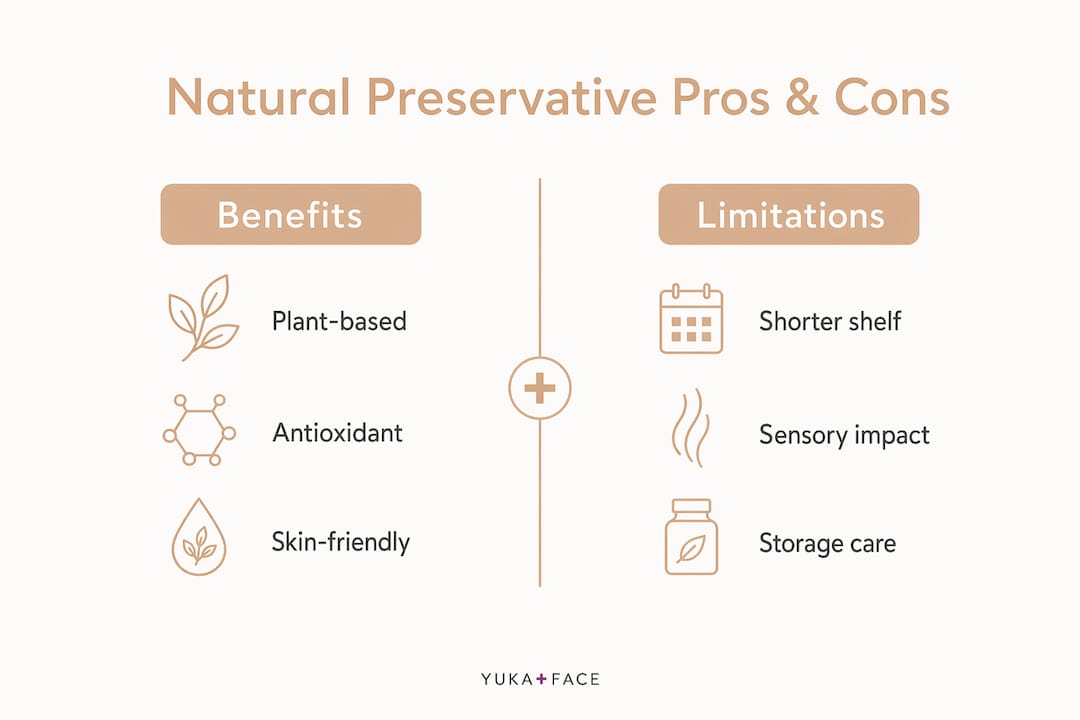
The limitations are real and should not be minimized. Natural preservatives typically produce shorter shelf lives than synthetic options, requiring adjusted storage expectations and more frequent product turnover. That is a practical trade-off that affects both formulators and consumers.
Sensory impact is another genuine challenge. Balancing antimicrobial efficacy with acceptable scent, color, and texture is the hardest problem in natural cosmetic formulation. Essential oils that preserve effectively often have strong aromas that alter a product's sensory profile. Some plant extracts introduce color or viscosity changes that consumers may not expect.
Pro Tip: Check product storage instructions carefully when using naturally preserved skincare. Keeping products away from heat, humidity, and direct sunlight extends their effective life significantly.
How are natural preservatives incorporated into skincare products?
Effective natural preservation rarely relies on a single ingredient. Hurdle technology, which combines multiple mild preservation methods, is the standard approach in well-formulated natural cosmetics. Each method addresses a different vulnerability in the formulation, and together they achieve the protection that a single synthetic preservative might deliver alone.
Advanced delivery systems solve the stability and sensory problems that raw natural preservatives create. Nanoemulsions, microencapsulation, and hydrogels protect active compounds from degradation, improve their distribution through a formula, and reduce the intensity of strong aromas. Microencapsulation, for example, wraps an essential oil in a protective shell that releases the active compound slowly and evenly.
Practical formulation strategies for natural preservation include:
- Combining pH adjustment with antioxidants. Pairing lactic acid with vitamin E addresses both microbial and oxidative threats simultaneously.
- Using encapsulation for volatile oils. Nanoemulsions stabilize essential oils and reduce their sensory impact without reducing antimicrobial activity.
- Matching preservatives to product type. Water-based serums need strong antimicrobial protection. Oil-based products need antioxidant-focused preservation. Choosing the wrong type leaves a formulation vulnerable.
- Controlling water activity through formulation design. Reducing free water content through ingredient selection reduces the need for high preservative concentrations.
- Storing products correctly. Airless pumps and opaque packaging extend the effective life of naturally preserved formulas by limiting oxidation and contamination.
Antimicrobial peptides in organic skincare represent one of the most promising directions in natural preservation. These bioactive compounds offer targeted antimicrobial action with minimal sensory impact, making them well suited for high-performance natural formulations.
Key Takeaways
Natural preservatives work through pH reduction, water activity control, and antioxidant activity, and effective cosmetic formulation combines multiple methods rather than relying on any single ingredient.
| Point | Details |
|---|---|
| Core mechanisms | Natural preservatives work via pH reduction, water activity control, and antioxidant activity. |
| Multi-target action | Plant and fermentation-derived preservatives reduce microbial resistance risk through multi-target antimicrobial effects. |
| Common examples | Rosemary extract, vitamin E, lactic acid, nisin, and tea tree oil are widely used in natural cosmetics. |
| Hurdle technology | Combining multiple mild preservation methods delivers the protection that a single ingredient cannot. |
| Sensory trade-offs | Natural preservatives may affect product scent, color, or shelf life, requiring careful formulation and storage. |
Natural preservation: what the research actually shows
The conversation around natural preservatives often splits into two camps. One side treats them as automatically superior. The other dismisses them as less effective than synthetic options. Both positions miss the point.
What the research shows is more specific. Natural preservatives are genuinely effective when formulators use them correctly, meaning in combination, at the right concentrations, and with the right delivery systems. The hurdle technology approach is not a workaround. It is the correct method for natural preservation, and it produces results that stand up to challenge testing.
What I find most interesting is the role of fermentation-derived preservatives. Lactic Acid Bacteria metabolites and antimicrobial peptides like nisin have decades of food safety data behind them. Their application in cosmetics is still relatively new, but the science is solid. These ingredients represent the clearest path toward natural preservation that matches synthetic performance without the sensory compromises that essential oils sometimes create.
The honest limitation is shelf life. Naturally preserved products do not last as long as synthetically preserved ones under the same conditions. That is a fact, not a failure. It reflects a deliberate choice to prioritize ingredient safety over extended shelf life. Consumers who understand this use their products within the recommended period and store them properly. That is a reasonable trade-off for anyone committed to clean formulation.
The future of natural preservation sits at the intersection of fermentation science, encapsulation technology, and consumer education. Brands that invest in all three will produce naturally preserved products that perform without apology.
— Kelly
Yuka+Face and natural preservation in skincare
Yuka+Face builds every product around the principle that effective skincare does not require synthetic preservatives or harsh chemicals. The brand's formulations use plant-derived and fermentation-based ingredients that protect product integrity while delivering active benefits to the skin.
The vegan skincare guide from Yuka+Face explains how natural and plant-based ingredients work together in a complete routine. For those building a daily regimen around naturally preserved products, the morning skincare routine guide covers product sequencing and ingredient compatibility. Yuka+Face products are formulated for all skin types and ages, with no compromise on purity or performance.
FAQ
What is a natural preservative?
A natural preservative is a substance derived from plants, minerals, or microbes that prevents microbial growth and oxidation in a product. Common examples include rosemary extract, vitamin E, lactic acid, and essential oils.
Are natural preservatives safe for skin?
Natural preservatives are generally recognized as safe when used at appropriate concentrations and evaluated for each specific formulation. Lactic Acid Bacteria derivatives and many plant extracts carry established safety records in both food and cosmetic applications.
How do natural preservatives extend product shelf life?
Natural preservatives extend shelf life by lowering pH, reducing water activity, and neutralizing free radicals that cause oxidation. Combining multiple methods through hurdle technology produces the most reliable protection.
Do natural preservatives work as well as synthetic ones?
Natural preservatives match synthetic performance when formulators use hurdle technology and advanced delivery systems like nanoemulsions and microencapsulation. The trade-off is typically a shorter overall shelf life and more specific storage requirements.
What are examples of natural preservatives in skincare products?
Rosemary extract, tocopherol (vitamin E), lactic acid, tea tree essential oil, and fermentation-derived peptides like nisin are among the most commonly used natural preservatives in cosmetic formulations.