
TL;DR:
- Hyaluronic acid is a naturally occurring molecule that maintains skin hydration and supports tissue repair. Its benefits depend on molecular weight and consistent use over at least 8 to 12 weeks. Proper application and expectations ensure maximum results from both topical and oral hyaluronic acid.
Hyaluronic acid (HA) is defined as a glycosaminoglycan, a naturally occurring molecule found in skin, connective tissue, and synovial fluid. Its primary function is to bind and retain water, keeping skin hydrated, plump, and elastic. The role of hyaluronic acid goes well beyond basic moisturizing. It supports the extracellular matrix, signals cell behavior, and forms the structural foundation of healthy skin. Understanding how it works, what the research confirms, and how to use it correctly separates real results from wasted effort.
How does hyaluronic acid hydrate the skin?
Hyaluronic acid retains moisture by attracting and holding water molecules within the skin's extracellular matrix. This matrix is the structural scaffold between skin cells, and HA is one of its primary components. Without adequate HA, the matrix loses volume and firmness, and skin begins to look dry and lined.

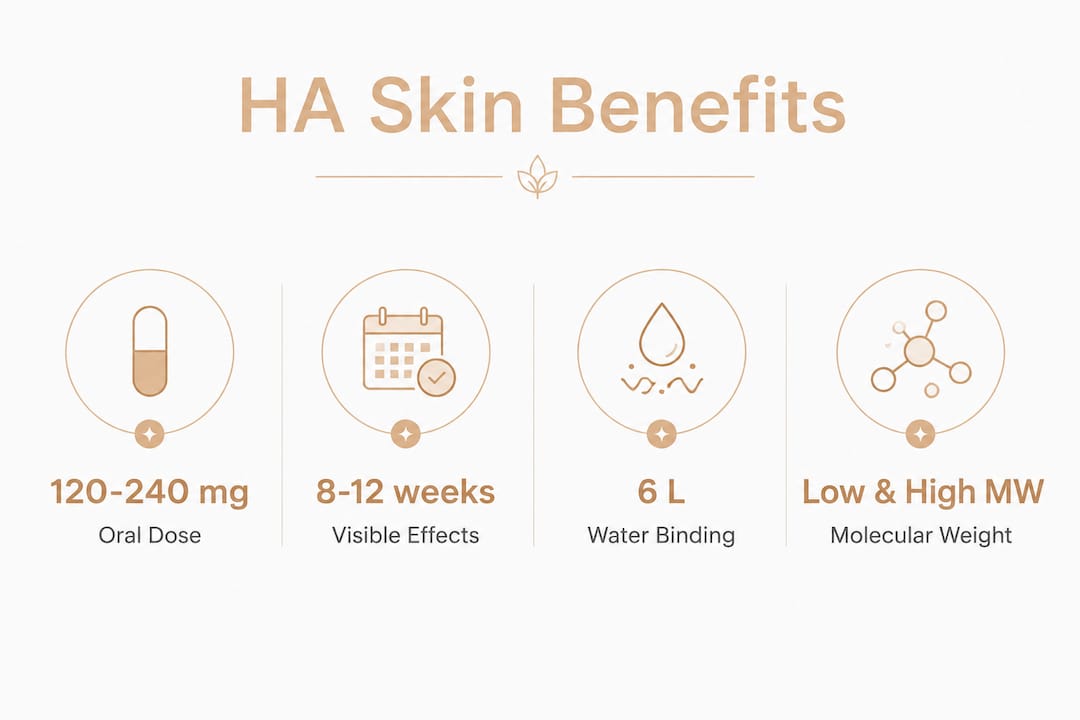
The molecule's water-binding capacity is extraordinary. One gram of HA can hold up to six liters of water. That capacity explains why even small concentrations in a serum or supplement can produce visible hydration effects.
HA does not work as a simple sponge, though. Its biological effects depend heavily on molecular weight, which influences how it interacts with skin cells and receptors. High molecular weight HA forms a film on the skin's surface and reduces water loss. Low molecular weight HA penetrates deeper and triggers cellular responses. Products that combine both forms deliver surface hydration and deeper structural support simultaneously.
At the cellular level, HA acts as a signaling molecule by interacting with CD44 and RHAMM receptors. These receptors regulate cell proliferation and migration, which are processes central to skin repair and regeneration. This is why HA's role extends well beyond hydration into tissue maintenance and wound response.
Key functions of hyaluronic acid in skin biology:
- Water retention: Binds water in the extracellular matrix to maintain skin volume and softness
- Barrier support: High molecular weight HA reinforces the skin's surface barrier against environmental stress
- Cell signaling: CD44 and RHAMM receptor interactions regulate tissue repair and cell turnover
- Structural scaffolding: HA maintains the integrity of the dermal matrix, supporting collagen and elastin fibers
Pro Tip: When reading product labels, look for both "sodium hyaluronate" (low molecular weight, penetrates deeper) and "hyaluronic acid" (higher molecular weight, surface film). Products listing both offer more complete hydration coverage.
What does research say about the benefits of hyaluronic acid for skin?
Clinical research on hyaluronic acid benefits is consistent and growing. The strongest evidence comes from oral supplementation trials and topical application studies conducted over defined periods.
Oral supplementation of 120–240 mg daily produces measurable improvements in skin hydration, elasticity, and wrinkle depth over 8–12 weeks. That timeline matters. Skin cell turnover is slow, and structural changes in the dermis take time to become visible. Expecting results in two weeks sets you up for disappointment.
Beyond skin, HA shows benefits in other tissues. Oral HA alleviates knee osteoarthritis symptoms in some studies over 12 months of consistent use. This confirms that HA's hydrating and structural functions operate systemically, not just at the skin surface. Topical HA also benefits dry eye disease, supported by systematic review and meta-analysis, which reinforces its broad tissue hydration role.
| Benefit | Form | Timeframe |
|---|---|---|
| Skin hydration and elasticity | Oral (120–240 mg/day) | 8–12 weeks |
| Wrinkle depth reduction | Oral or topical | 8–12 weeks |
| Knee osteoarthritis relief | Oral | 12+ months |
| Dry eye symptom relief | Topical (eye drops) | Varies by study |
| Facial volume restoration | Injectable (dermal filler) | Immediate, lasts 6–12 months |
One area where the evidence is weaker: chronic wound healing. Clinical evidence for HA in wound healing remains limited and inconclusive as of 2023. This does not mean HA has no role in wound biology. It means the current data does not support strong clinical claims for that specific application.
Pro Tip: Pair oral HA supplementation with collagen peptides. Research suggests collagen and HA work synergistically in the extracellular matrix, and combining them may amplify results compared to either alone.
How is hyaluronic acid used in skincare products and medical treatments?
Hyaluronic acid reaches the skin through three main routes: topical application, oral supplementation, and injectable fillers. Each route works differently and suits different goals.
-
Topical serums and creams. Topical HA products are the most accessible form. They work by drawing moisture from the environment and the deeper layers of the skin to the surface. They suit daily use and work well for all skin types, including oily and acne-prone skin. For best results, apply topical HA to damp skin and follow immediately with a moisturizer to seal in hydration. Understanding the difference between hydration and moisturizing helps you layer products correctly.
-
Oral supplements. Oral HA reaches the skin through systemic circulation. The effective dose range sits between 120 mg and 240 mg daily for skin benefits. Doses below 0.4g may be ineffective, and doses above 2.7g show no additional benefit. The safe upper limit is approximately 3.6g daily. Staying within the effective range avoids waste and unnecessary risk.
-
Injectable dermal fillers. FDA-approved HA fillers restore facial volume and smooth deep lines. Results typically last 6–12 months before a follow-up treatment is needed. Fillers are biocompatible and dissolvable, which makes them a lower-risk option compared to permanent fillers. However, HA fillers carry real risks, including vascular occlusion and bruising. Expert administration by a qualified medical professional is not optional. Choosing an experienced provider is the single most important safety decision in this category. Readers researching qualified providers can consult resources like this guide to premium skincare brands for regional context.
-
Transdermal delivery formats. Newer delivery technologies aim to improve how HA penetrates the skin barrier. Understanding transdermal delivery in beauty helps consumers evaluate whether advanced formulations justify their price point.
What should you know before adding HA to your routine?
Consistency is the most underrated factor in getting results from hyaluronic acid. Benefits accumulate gradually over a minimum of 6–8 weeks. Stopping and starting a routine resets the clock on visible improvement.
Practical guidance for building an effective HA routine:
- Apply topical HA to damp skin. HA pulls moisture from its environment. On dry skin in a dry climate, it can draw water from deeper skin layers instead of the air, which may cause temporary tightness.
- Use consistently, not occasionally. Daily application or supplementation produces cumulative results. Sporadic use does not.
- Read molecular weight labels. Products listing both sodium hyaluronate and hyaluronic acid deliver layered hydration at the surface and deeper dermis.
- Pair with complementary ingredients. Collagen peptides, vitamin C, and ceramides all support the extracellular matrix and amplify HA's structural benefits.
- Set a realistic timeline. Mark 8 weeks on your calendar before evaluating whether a product is working. Skin biology does not respond to impatience.
- Avoid over-supplementing. Oral doses above 2.7g daily provide no additional benefit and approach the safety ceiling of 3.6g. More is not better.
A well-structured morning skincare routine that incorporates HA as a dedicated hydration step, before SPF and moisturizer, is one of the most effective ways to build consistent use into daily life.
Key Takeaways
Hyaluronic acid delivers measurable skin hydration, elasticity, and structural support when used consistently at the right dose and molecular weight for a minimum of 8 weeks.
| Point | Details |
|---|---|
| Molecular weight matters | Low and high molecular weight HA work at different skin depths; combined forms offer the best results. |
| Oral dosing has a sweet spot | 120–240 mg daily produces skin benefits; doses above 2.7g show no added gain. |
| Results require patience | Visible improvements in hydration and wrinkle depth take 8–12 weeks of consistent use. |
| Injectable HA needs expert hands | FDA-approved fillers last 6–12 months but carry risks like vascular occlusion; choose qualified providers only. |
| HA is more than a moisturizer | CD44 and RHAMM receptor signaling means HA actively supports cell repair, not just surface hydration. |
Why I think most people are using hyaluronic acid wrong
After years of following skincare research and watching product trends come and go, one pattern stands out clearly. Most people treat hyaluronic acid like a quick fix. They apply a serum for two weeks, see no dramatic change, and move on to the next ingredient. That is the wrong approach entirely.
HA is a structural molecule. Its benefits build in the dermis over weeks and months, not days. The research on oral supplementation shows this plainly: 8–12 weeks at a consistent dose is the minimum threshold for measurable change. Topical use follows the same logic. Skin cell turnover takes roughly 28 days in younger adults and longer as we age. You cannot outpace biology.
The second mistake I see constantly is ignoring molecular weight on product labels. A serum listing only "hyaluronic acid" with no molecular weight distinction is likely delivering surface-level hydration at best. The real gains come from layered formulations that address both the surface barrier and the deeper dermis. That distinction is worth paying attention to when you choose products.
The third misconception is that more is always better. The supplementation data is clear: doses above 2.7g daily produce no additional benefit. Spending more on higher-dose supplements does not accelerate results. Consistency within the effective range beats high doses every time.
HA fits naturally into a broader approach to skin health, one that includes sustainable skin hydration practices, complementary ingredients, and realistic expectations. That combination, not any single product, is what produces lasting results.
— Kelly
Yuka+Face and the science of skin hydration
Skin hydration is the foundation of every effective skincare routine. Yuka+Face builds its formulations around that principle, combining botanical research with expert ingredient knowledge to support skin health at every age.

The Yuka+Face approach to hydration and restoration draws on the same science behind hyaluronic acid's proven benefits: consistent, layered care that works with the skin's natural biology rather than against it. All Yuka+Face products are vegan, cruelty-free, and formulated for all skin types. Whether you are building a daily routine or looking to strengthen your skin barrier, the Yuka+Face journal offers practical, evidence-informed guidance to help you get there.
FAQ
What is the role of hyaluronic acid in skin?
Hyaluronic acid binds and retains water in the skin's extracellular matrix, maintaining hydration, elasticity, and structural support. It also interacts with CD44 and RHAMM receptors to regulate cell repair and regeneration.
How long does it take to see results from hyaluronic acid?
Visible improvements in skin hydration and wrinkle depth typically require 8–12 weeks of consistent oral or topical use. Benefits accumulate gradually and do not appear overnight.
What is the correct oral dose of hyaluronic acid for skin?
The effective range for skin benefits is 120–240 mg daily. Doses below 0.4g are likely ineffective, and doses above 2.7g show no additional benefit, with a safety ceiling of approximately 3.6g per day.
Are hyaluronic acid fillers safe?
FDA-approved HA fillers are biocompatible and last 6–12 months, but they carry risks including vascular occlusion and bruising. Safe outcomes depend on administration by a qualified medical professional.
Can hyaluronic acid improve joint health as well as skin?
Yes. Oral HA supplementation shows benefits for knee osteoarthritis symptoms in some studies over 12 months of consistent use, confirming its structural role extends beyond the skin.