
Skin cycling is a rotation over several nights, including exfoliate, renew, and multiple recovery nights, that lets your skin absorb active ingredients on a schedule instead of every day. Spacing out actives gives your skin barrier time to repair between treatments, which usually means fewer red patches and less flaking. Natural formulas fit each night of the cycle, from gentle acids to plant-based renewal ingredients, without synthetic fillers.
TL;DR:
- Sensitive, dry, or eczema-prone skin should extend the recovery phase to five or six nights and prefer bakuchiol over retinol to minimize irritation.
- Oily or acne-prone skin can usually follow a standard four-night cycle, with a potential for stronger BHA use on exfoliation nights, but must monitor for over-drying.
- Natural ingredients like bakuchiol have significant research backing, and using gentle plant-based actives reduces irritation risks compared to synthetic options.
- Proper sun protection with broad-spectrum SPF every morning is crucial, especially after exfoliation and retinoid nights, to prevent damage and hyperpigmentation.
- Introducing one active ingredient at a time and patch testing beforehand helps prevent reactions and ensures personalized, safe skin cycling.
Table of Contents
- How Do You Follow a Natural Skin Cycling Routine Night by Night?
- Which Skin Types Need a Different Cycle Length?
- Which Natural Ingredients Actually Hold Up to Evidence?
- How Long Until You See Results, and What's Actually Safe?
- Two Sample Natural Skin Cycles You Can Copy
- Do Foods and Supplements Actually Support Skin Regeneration?
- Why Simplicity Wins Over Time
- Ready to Build Your Natural Skin Cycling Kit?
- Sources
- FAQ
How Do You Follow a Natural Skin Cycling Routine Night by Night?
The 4-night structure was popularized as a way to organize actives around your skin's own repair timeline. Ohio State Health & Discovery's guide to skin cycling lays out the same basic sequence dermatologists now recommend widely. Here's how each night breaks down.
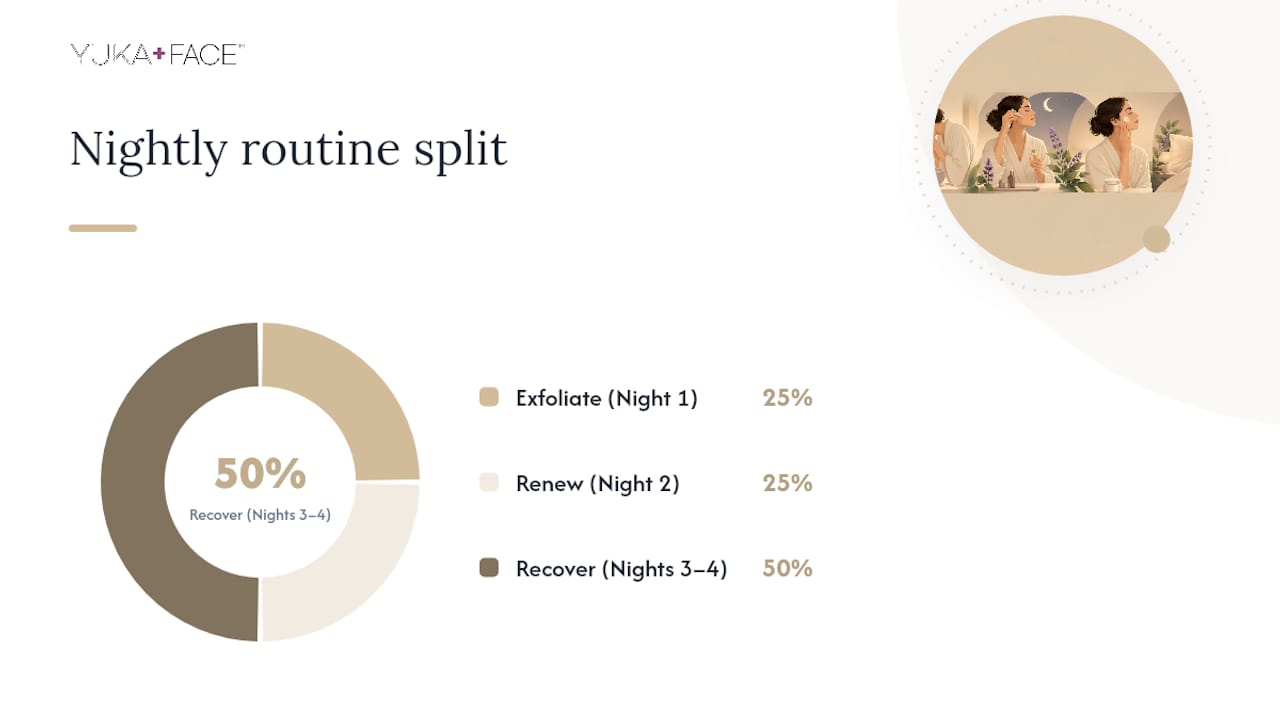
- Night 1: Exfoliate. Cleanse gently, then apply a chemical exfoliant, an AHA, BHA, or PHA, rather than a scrub. Leave-on formulas around pH 3.5 to 4 work at a slow, steady pace; wash-off versions are milder and better for reactive skin. Doing this step occasionally in a week is generally sufficient for most people.
- Night 2: Renew. Cleanse, wait for skin to dry fully, then apply a pea-sized amount of a retinoid or a bakuchiol serum. First-timers should buffer with a thin layer of moisturizer underneath, sometimes called the moisturizer sandwich, to blunt irritation without losing effect.
- Nights 3 and 4: Recover. Skip actives entirely. Layer a hyaluronic acid serum, then a ceramide or niacinamide formula, then a moisturizer. Dry or cold-weather skin can add a light occlusive, like a facial oil, to seal everything in.
- Every morning: Gentle cleanser, an antioxidant serum if you use one, and broad-spectrum SPF 30 or higher. Exfoliants and retinoids thin the outermost skin layer temporarily, so morning sunscreen isn't optional on this routine, it's the step that protects everything else you just did.
If Night 1 or Night 2 leaves your skin tight, pink, or flaky the next morning, don't push through it. Cut that active back to once a cycle, extend the recovery nights, or pause it for a week before trying again.
Pro Tip: Apply retinoid or bakuchiol serum to fully dry skin, not damp skin. Water on the surface helps the active penetrate faster and deeper, which is exactly what triggers irritation in beginners.
Which Skin Types Need a Different Cycle Length?
Skin cycling isn't a fixed schedule for everyone. Dermatology guidance built into the original framework treats it as a starting template you adjust based on how your skin responses, and that flexibility is the entire point of the method, per Ohio State Health & Discovery.
- Sensitive, dry, or eczema-prone skin: Stretch to a 5 or 6 night cycle, adding an extra recovery night before returning to exfoliation. Choose bakuchiol over retinol; it delivers comparable results with less reported irritation.
- Oily or acne-prone skin: A standard 4-night cycle usually works, sometimes with a slightly stronger BHA on exfoliation night. Watch for over-drying, which can trigger more oil production, not less.
- Rosacea: Lean toward PHA exfoliants (gentler than glycolic or salicylic acid) and skip the exfoliation night some weeks entirely.
- Darker skin tones: Irritation from over-exfoliating or over-applying retinoids can trigger post-inflammatory hyperpigmentation that outlasts the original concern. Slower introduction matters more here than skin type alone.
- Mature skin: Prescription retinoids offer more documented results for deep wrinkles, but bakuchiol is a reasonable starting point if retinoids have caused irritation in the past.
Introduce one new active at a time, not two. Give it two full cycles, about two to three weeks, before adding anything else. That pace feels slow, but it's the only way to know which ingredient is actually responsible for a reaction if one shows up.
Which Natural Ingredients Actually Hold Up to Evidence?
Bakuchiol has the strongest research backing of any plant-derived retinol alternative on the market. A gene expression profiling study published in the British Journal of Dermatology found bakuchiol functions similarly to retinol at the cellular level, improving fine lines, pigmentation, and elasticity in clinical testing, with less of the irritation typically reported with synthetic retinoids.
What the research shows: A small open-label study combining bakuchiol or Vigna aconitifolia extract with retinal reported measurable improvements in firmness, wrinkle count, and skin tone within 28 days, with good tolerability across participants. The study on natural retinol analogs and retinal involved a limited sample, so treat the results as a promising early signal rather than a guarantee.
Not every "natural" label deserves your trust, though. The FDA doesn't legally define what "natural" means on a cosmetics label, and the agency's own guidance on cosmetic safety points out that plant-derived ingredients, including many essential oils, can cause contact irritation or phototoxic reactions just as easily as synthetic ones.
Favor these on your ingredient list:
- Bakuchiol for renewal nights
- Niacinamide for barrier support and tone
- Ceramides for recovery-night hydration
- Hyaluronic acid for surface moisture
Use these with more caution:
- Concentrated essential oils (lavender, tea tree, citrus)
- Citrus-derived extracts, which can increase sun sensitivity
Pro Tip: Before introducing any new botanical serum, apply a small amount to your inner forearm and wait 24 to 72 hours. It's a two-minute step that catches most allergic reactions before they reach your face.
Look for labels marked fragrance-free, hypoallergenic, and noncomedogenic. Those three words filter out a large share of the products most likely to cause a reaction.
How Long Until You See Results, and What's Actually Safe?
Sunscreen is not a nice-to-have on this routine. Exfoliants and retinoid-adjacent actives increase how easily UV light damages fresh skin cells, so layering broad-spectrum SPF every single morning, exfoliation night or not, protects the progress you're making on the other three nights.
Most people notice a brighter, smoother texture after a few cycles, typically within a couple of weeks. Deeper changes like fading dark spots or softened fine lines tend to appear after extended use, often several weeks in, with timing varying by skin type and active ingredients used.
If you notice flaking or redness:
- Drop the exfoliation night for one full cycle
- Buffer the renewal night with extra moisturizer underneath
- Add a third recovery night before returning to actives
Consult a dermatologist if you are pregnant or breastfeeding, since some retinoid ingredients carry specific guidance for those groups, or if you're on prescription treatments like tretinoin, isotretinoin, or certain antibiotics that increase sun sensitivity. Persistent burning, swelling, or a rash that spreads beyond the application area is a signal to stop and get it checked, not to push through.
Two Sample Natural Skin Cycles You Can Copy
A gentle cycle and a standard cycle cover most skin types without requiring a dozen different products.
Gentle cycle (sensitive or reactive skin):
- Night 1: B3 Gentle Cleanser, then a mild PHA exfoliant once per cycle
- Night 2: Cleanse, then a bakuchiol serum for renewal
- Nights 3 to 5: Ceramide-rich recovery, extending to three recovery nights if skin still feels tight
Standard cycle (normal or combination skin):
- Night 1: Cleanse, then a slightly stronger AHA exfoliant
- Night 2: Bakuchiol or low-strength retinol
- Nights 3 to 4: Humectant serum followed by a moisturizer, with a light occlusive on colder nights
| Cycle type | Best for | Exfoliation night | Renewal night | Recovery nights |
|---|---|---|---|---|
| Gentle | Sensitive, dry, eczema-prone | Mild PHA, once per cycle | Bakuchiol | 3 nights |
| Standard | Normal, combination | AHA or BHA | Bakuchiol or low-strength retinol | 2 nights |
Every product swap still needs a patch test first, especially if you're moving from a synthetic retinoid to a plant-based one for the first time. Ceramide-focused formulas also do measurable work here: research on ceramide-dominant moisturizers shows they reduce transepidermal water loss more effectively than standard moisturizers, which is exactly what recovery nights are designed to do.
Do Foods and Supplements Actually Support Skin Regeneration?
Skin cycling works on the surface, but regeneration is a whole-body process, and what you eat has a measurable role in it. Omega-3 fatty acids, found in flaxseed, walnuts, and algae-based supplements, support the lipid layer that keeps your barrier intact between actives.
Vitamin C isn't just a serum ingredient. Dietary sources, citrus fruit, bell peppers, kiwi, supply the same collagen-synthesis support your skin needs to recover from exfoliation nights, from the inside.
Zinc deficiency shows up on skin before almost anywhere else, often as slower wound healing and more visible irritation. Pumpkin seeds, lentils, and chickpeas are practical dietary sources if you'd rather not rely on a supplement.
Hydration matters more on cycling nights than people expect. Water intake affects how quickly your skin barrier recovers after an active night, and pairing that with a ceramide-rich moisturizer gives you support from both directions.
None of this replaces topical care, and no food will undo the effects of skipping sunscreen. But a skin cycling routine paired with steady hydration, adequate protein, and a diet that includes zinc and omega-3s tends to show results faster than the topical routine alone.

Why Simplicity Wins Over Time
Fewer active exposures paired with real barrier repair is the whole strategy here, not a compromise version of a "real" routine. Dermatology research on routine complexity backs this up: layering too many actives at once tends to increase irritation and lower adherence, while simpler, consistent routines hold up better over months and years. Natural formulations can absolutely deliver evidence-backed results, bakuchiol's research record proves that, without demanding a nine-step routine to get there. Whatever stage of life your skin is in right now, the same four-night frame flexes to meet it.
— Kelly
Ready to Build Your Natural Skin Cycling Kit?
There are vegan, cruelty-free formulas built around exactly this kind of rotation, gentle enough for recovery nights, effective enough for renewal nights, without synthetic fillers padding the ingredient list.

If your skin runs dry or reactive, start with the dry-skin collection for barrier-focused moisturizers and masks built for recovery nights. If you're assembling a full cycle from scratch, the Yuka+Face shop covers cleansers, toners, serums, and oils for every night of the rotation. Patch-test any new product on your forearm first, and check with a dermatologist before starting if you're managing rosacea, eczema, or a prescription treatment. Browse the full product lineup to map out your own four-night cycle this week.
Sources
- A step-by-step guide on how to ‘skin cycle’ | Ohio State Health & Discovery
- Bakuchiol: a retinol‐like functional compound revealed by gene expression profiling and clinically proven to have anti‐aging effects
- Natural Retinol Analogs Potentiate the Effects of Retinal on Aged and Photodamaged Skin
- FDA on aromatherapy and natural ingredient safety
- Narrative review on ceramide-dominant and barrier-restoring formulations
FAQ
What Is the Best Skin Cycling Routine?
The best routine follows the 4-night structure: exfoliate, renew, recover, recover, then adjust the recovery nights up or down based on how your skin reacts. There's no single "best" version since dermatology guidance treats it as a personalized template, not a fixed formula.
What Is the 4-2-4 Rule in Skincare?
This isn't a standard dermatological term, and definitions circulating online vary widely. The recognized framework is the 4-night skin cycling rotation described above, which some people informally shorthand with different numbers.
Do Dermatologists Recommend Skin Cycling?
Yes, many dermatologists support skin cycling because it spaces out actives to reduce irritation while still delivering results over time. The structure, one exfoliation night, one renewal night, two recovery nights, mirrors how Ohio State Health & Discovery frames it for patients starting active ingredients.
What Is a 7-Day Skin Cycling Routine and How Does It Work?
A weekly version simply repeats the 4-night cycle, sometimes stretching recovery to three nights for sensitive skin. Some people prefer the weekly framing because it maps cleanly onto a Monday to Sunday calendar, though the underlying 4-night logic stays the same.
Does Yuka+Face Sell Products for Each Night of the Cycle?
Yuka+Face carries cleansers, toners, serums, oils, moisturizers, and masks across its shop, covering exfoliation, renewal, and recovery nights with vegan, cruelty-free formulas. Current pricing for individual products is listed on the site rather than fixed here.