
TL;DR:
- Peptide moisturizers signal skin cells to produce collagen, repair tissue, and retain moisture, promoting anti-aging benefits.
- They contain various peptides that stimulate collagen, support healing, and relax muscles to reduce fine lines, especially when combined with hydrating and antioxidant ingredients.
- Consistent use over 4 to 8 weeks enhances skin firmness and texture, making them suitable for nearly all skin types.
A peptide moisturizer is a skincare product formulated with short chains of amino acids that signal skin cells to produce collagen, repair tissue, and retain moisture. Peptides are the industry's standard term for these signaling molecules, and the best peptide creams combine them with hydrating agents and antioxidants for measurable results. Dermatologists recommend peptide moisturizers as foundational anti-aging products because they deliver real benefits with low irritation risk. Whether you are managing dryness, early fine lines, or a compromised skin barrier, a well-formulated peptide moisturizer addresses all three at once.
How do peptide moisturizers work to improve skin health?
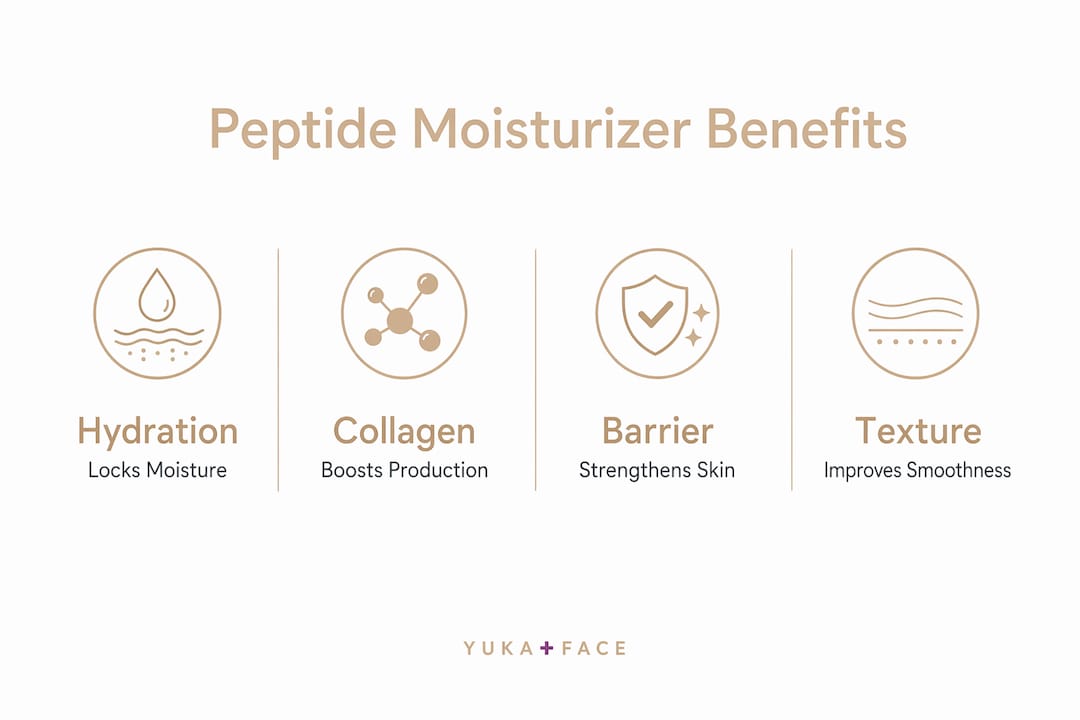
Peptides act as messengers that signal skin cells to produce collagen, relax muscle tension in the skin, and improve overall texture and firmness over time. That signaling function is what separates peptide moisturizers from basic hydrating lotions. A standard moisturizer traps water in the skin. A peptide moisturizer does that and tells your skin to rebuild itself.
Different peptide types serve different functions in a formula:
- Signal peptides (like Palmitoyl Pentapeptide-4, sold as Matrixyl) stimulate collagen and elastin production directly.
- Carrier peptides (like Copper Tripeptide-1) deliver trace minerals to skin cells, supporting wound healing and enzyme activity.
- Neurotransmitter-inhibiting peptides reduce the appearance of expression lines by relaxing facial muscle contractions.
- Enzyme-inhibiting peptides slow the breakdown of existing collagen in the skin matrix.
Most well-formulated products combine two or more of these types. That combination addresses both collagen loss and moisture retention at the same time. Peptides pair well with hyaluronic acid, antioxidants, and vitamins because those ingredients amplify barrier repair while peptides handle the structural work underneath.
Pro Tip: Apply your peptide moisturizer to slightly damp skin. Damp skin absorbs active ingredients faster and more evenly than completely dry skin.
The skin barrier also benefits directly from peptide use. Peptides strengthen the connections between skin cells, reducing water loss and improving resilience against environmental stressors. That is why peptides in organic skincare formulations have grown in popularity. They deliver clinical results without the irritation that comes with stronger actives like retinoids or acids.
What are the key ingredients in effective peptide moisturizers?
The two most clinically validated peptides in skincare are Matrixyl (Palmitoyl Pentapeptide-4) and Copper Tripeptide-1. Matrixyl has decades of published research behind it showing measurable increases in collagen synthesis. Copper Tripeptide-1 supports skin regeneration and has been studied in wound-healing contexts. Effective formulas combine these peptides with encapsulated ferulic acid and botanical extracts for added antioxidant protection.
Supporting ingredients matter as much as the peptides themselves. Hyaluronic acid draws water into the skin and holds it there. Vitamin C brightens and protects against oxidative damage. Ferulic acid stabilizes other antioxidants and extends their effectiveness. When these ingredients appear alongside peptides, the formula works on multiple levels: hydration, repair, and protection simultaneously.
One detail most product labels skip: encapsulation technology. Encapsulation improves stability of sensitive antioxidants like ferulic acid inside a formula, which means the ingredient stays active until it reaches your skin rather than degrading in the bottle. This is a meaningful formulation difference that separates well-engineered products from those that simply list impressive ingredients.
What price range should you expect?
Peptide moisturizers range from $18 to over $200 per 50ml. That is a wide gap, and the price does not always reflect the quality of the peptide complex inside. Higher price often reflects brand positioning rather than formulation depth. Budget-friendly options with validated peptide ingredients exist at the $18–$25 price point and perform comparably to prestige creams in clinical ingredient terms.
Pro Tip: Read the ingredient list, not the marketing copy. If Matrixyl or Copper Tripeptide-1 appears in the first half of the list, the concentration is likely meaningful.
| Formulation feature | What to look for |
|---|---|
| Peptide type | Matrixyl, Copper Tripeptide-1, or named signal peptides |
| Hydration support | Hyaluronic acid, glycerin, or ceramides |
| Antioxidant protection | Ferulic acid, vitamin C, or vitamin E |
| Stability technology | Encapsulated or stabilized actives |
| Texture match | Rich cream for dry skin; gel or lotion for oily skin |
How to integrate a peptide moisturizer into your skincare routine
Routine order determines how much benefit you actually get from a peptide moisturizer. Applying it in the wrong sequence reduces absorption and can neutralize other actives. Follow this order for best results:
- Cleanse. Remove makeup, sunscreen, and surface debris. A clean surface allows actives to penetrate without interference.
- Tone. A toner balances skin pH and prepares the surface for absorption. This step is optional but helpful, especially for oily or combination skin.
- Apply serum (if using). An anti-aging peptide serum goes on before your moisturizer. Serums have smaller molecules that penetrate deeper, so they go first.
- Apply your peptide moisturizer. Apply after cleansing and toning but before heavier creams or facial oils. This is the step where peptides make prolonged contact with the skin.
- Seal with SPF (morning only). Sunscreen is non-negotiable in the morning. UV exposure degrades collagen faster than any other environmental factor.
- Apply facial oil or occlusive (evening only). A facial oil or balm as the final evening step locks in everything underneath it.
For a detailed morning sequence, the Yuka+Face morning routine guide covers layering order with specific timing advice.
Compatibility with other actives
Peptides are compatible with nearly every other skincare active. Dermatologists recommend peptides as a safe pairing with retinoids, vitamin C, and AHAs because peptides do not destabilize those ingredients and do not cause the irritation that stacking two strong actives can trigger. If you use retinol at night, apply it before your peptide moisturizer. The moisturizer then buffers any dryness the retinol causes while continuing its own repair work.
Sensitive and acne-prone skin types benefit from using a hydrating peptide lotion instead of a rich cream. Lighter textures deliver the same peptide benefits without clogging pores or adding excess oil. For guidance on combining actives and hydration, the difference between moisturizing and hydrating is worth understanding before you build your routine.
Visible results from a peptide moisturizer typically appear after 4–8 weeks of consistent daily use. Peptides are a long-term strategy for maintaining skin structure and collagen, not a quick fix. Expecting overnight results leads to abandoning products before they have time to work.
Who should use peptide moisturizers?
Peptide moisturizers suit nearly every skin type. That broad compatibility is one of their most practical advantages over other anti-aging actives.
- Dry skin: A rich peptide cream provides both structural repair and deep moisture. Look for formulas with ceramides or shea butter alongside the peptide complex.
- Oily or combination skin: A lightweight peptide gel or lotion delivers the same collagen-signaling benefits without adding shine or congestion.
- Sensitive skin: Peptides are generally safe for sensitive skin, providing hydration and barrier support without causing breakouts or irritation. They are one of the few anti-aging ingredients that rarely trigger reactions.
- Acne-prone skin: Peptides do not clog pores and do not disrupt the skin microbiome. A non-comedogenic peptide formula supports healing while maintaining moisture balance.
- Mature skin: Peptides address collagen loss directly, making them the most targeted ingredient choice for skin showing firmness loss or deeper lines.
One common myth: peptides are only for older skin. That is not accurate. Starting peptide use in your late 20s or early 30s supports collagen maintenance before significant loss occurs. Prevention is more efficient than correction. Skin rejuvenation at the cellular level, as explained in this overview of skin rejuvenation, starts with consistent ingredient use long before visible aging appears.
Effective peptide moisturizers come in varying textures suited to different skin types and seasons. A rich cream that works well in winter may feel heavy in summer. Switching to a lighter formula during warmer months maintains the benefits without discomfort. For seasonal texture adjustments, the fall skincare transition guide from Yuka+Face covers the practical steps.
Key Takeaways
A peptide moisturizer works by signaling skin cells to produce collagen and repair the barrier, delivering both hydration and structural anti-aging benefits with consistent use.
| Point | Details |
|---|---|
| Peptides signal, not just hydrate | Peptides instruct skin cells to rebuild collagen, going beyond surface-level moisture. |
| Validated peptides to look for | Matrixyl and Copper Tripeptide-1 are the most research-backed peptides in moisturizers. |
| Price does not equal quality | Well-formulated peptide creams exist at the $18–$25 price point with clinically validated ingredients. |
| Apply in the correct routine order | Use peptide moisturizer after cleansing and toning, before oils or sunscreen, for best absorption. |
| Results require consistency | Visible improvements in firmness and texture typically take 4–8 weeks of daily use. |
What I have learned after years of watching peptide skincare evolve
The biggest mistake I see is treating a peptide moisturizer like a serum. People apply a thin layer, expect fast results, and move on when nothing dramatic happens in two weeks. Peptides are not retinol. They do not cause visible peeling or redness that signals "something is working." Their mechanism is quieter and slower, which makes them easy to underestimate.
The second mistake is chasing the most expensive product. I have watched well-formulated budget options outperform prestige creams in ingredient analysis, simply because the budget brand invested in the peptide complex rather than the packaging. The label matters more than the price tag.
What I rarely see discussed: the order in which you introduce peptides into a routine matters. People who add a peptide moisturizer to an already irritated or over-exfoliated skin barrier get less benefit because the barrier cannot absorb actives efficiently. Repair the barrier first with gentle, fragrance-free products. Then introduce peptides. The results are noticeably better.
Patience and ingredient literacy are the two skills that separate people who get real results from peptide skincare from those who cycle through products without progress. Read the list. Give it time. That is the whole strategy.
— Kelly
Yuka+Face and peptide-rich skincare
Yuka+Face builds its formulations on botanical research and science-backed ingredients, including peptide-rich skincare designed for all skin types. Every product is vegan, cruelty-free, and created without compromise on ingredient quality.

For readers building or refining a routine, the Yuka+Face morning skincare guide covers how to layer peptide moisturizers with other actives for daily results. The vegan skincare guide explains how plant-based formulations deliver the same clinical benefits as conventional products. Both are practical starting points for anyone ready to build a consistent, ingredient-focused routine.
FAQ
What does a peptide moisturizer actually do for skin?
A peptide moisturizer signals skin cells to produce collagen, repair the skin barrier, and retain moisture. Over time, this reduces fine lines, improves firmness, and supports overall skin texture.
How long before a peptide moisturizer shows results?
Visible improvements in firmness and texture typically appear after 4–8 weeks of consistent daily use. Peptides work as a long-term strategy for collagen maintenance rather than a rapid fix.
Can you use a peptide moisturizer with retinol?
Yes. Peptides are compatible with retinol and do not destabilize it. Apply retinol first, then layer the peptide moisturizer on top to buffer dryness and continue barrier repair overnight.
Is a peptide moisturizer safe for sensitive skin?
Peptides are well-tolerated by sensitive skin and rarely cause irritation or breakouts. They are one of the safest anti-aging ingredients available for reactive skin types.
Does a higher price mean a better peptide formula?
Not necessarily. Ingredient validation and formulation engineering matter more than brand prestige. Effective peptide moisturizers with clinically validated ingredients exist at accessible price points.