TL;DR:
- Bakuchiol is a plant-derived compound that offers comparable anti-aging effects to retinol without causing irritation. It activates skin renewal pathways, stimulates collagen, and improves skin tone, making it suitable for sensitive and pregnant skin. It outperforms retinol in hyperpigmentation improvement and reduces skin irritation during consistent use.
Bakuchiol is a plant-derived compound extracted from the seeds and leaves of Psoralea corylifolia, a flowering plant used in Ayurvedic and traditional Chinese medicine for centuries. Unlike synthetic retinol, bakuchiol delivers comparable anti-aging effects without the redness, peeling, or photosensitivity that retinoids are known for. Clinical studies back its ability to reduce wrinkles, improve skin tone, and support collagen production. For anyone seeking natural retinol alternatives, especially during pregnancy or with sensitive skin, bakuchiol is one of the most clinically supported options available.
What is bakuchiol and how does it work?
Bakuchiol activates gene expression pathways that closely mirror those triggered by retinol. The key difference is the receptor route. Retinol binds to retinoic acid receptors directly. Bakuchiol triggers similar pathways through structurally distinct mechanisms, which means the skin renewal benefits arrive without the irritation that comes from retinoic acid receptor activation.
The practical result is meaningful. Bakuchiol stimulates collagen synthesis, accelerates skin cell turnover, and supports the skin's natural repair cycle. These are the same three processes that make retinol effective for anti-aging. The difference shows up in tolerability, not in the direction of the results.
Bakuchiol also carries a separate set of benefits that retinol does not. Studies confirm it has antioxidant, anti-inflammatory, and antimicrobial properties that actively improve skin barrier health and reduce redness. This makes it useful not just for aging concerns but also for reactive and acne-prone skin.
Key mechanisms at a glance:
- Collagen stimulation: Signals fibroblasts to produce more collagen, reducing the appearance of fine lines.
- Cell turnover: Speeds up the shedding of old skin cells, improving texture and brightness.
- Antioxidant activity: Neutralizes free radicals that accelerate skin aging.
- Anti-inflammatory action: Calms redness and reduces irritation at the cellular level.
- Antimicrobial properties: Helps control acne-causing bacteria without stripping the skin.
Pro Tip: Apply bakuchiol to slightly damp skin after cleansing. Damp skin absorbs active ingredients more efficiently than completely dry skin.
What are the key bakuchiol benefits for skin health?
Bakuchiol delivers measurable results across multiple skin concerns, not just wrinkles. The clinical evidence is specific and worth knowing before you add it to your routine.
A 12-week clinical study found that both bakuchiol and retinol reduced wrinkle severity by about 20%. Bakuchiol users reported significantly less irritation, including less redness and scaling. That means comparable anti-aging results with a much lower side effect burden.
The pigmentation data is even more striking. In the same trials, 59% of bakuchiol users showed hyperpigmentation improvement within 12 weeks, compared to 44% in the retinol group. Bakuchiol outperformed retinol on skin tone evening, which is a result most people do not expect from a plant-based ingredient.
Here are the core benefits, ranked by clinical support:
- Wrinkle reduction: About 20% reduction in wrinkle severity over 12 weeks, matching retinol outcomes.
- Hyperpigmentation improvement: Outperforms retinol on skin tone evening, with 59% of users showing visible improvement.
- Skin firming: Collagen synthesis support improves elasticity and skin density over time.
- Acne control: Antimicrobial and anti-inflammatory properties reduce breakouts without drying the skin.
- Barrier support: Strengthens the skin barrier rather than compromising it, unlike many retinoids.
- Redness reduction: Anti-inflammatory activity calms reactive skin and reduces visible flushing.
Bakuchiol also suits people who need to avoid vitamin A derivatives entirely. Pregnancy-safe and suitable for women across a wide age range, it provides collagen support during a period when most retinoid options are off the table. That is a gap no other ingredient fills as cleanly.
Bakuchiol vs retinol: which one is right for you?
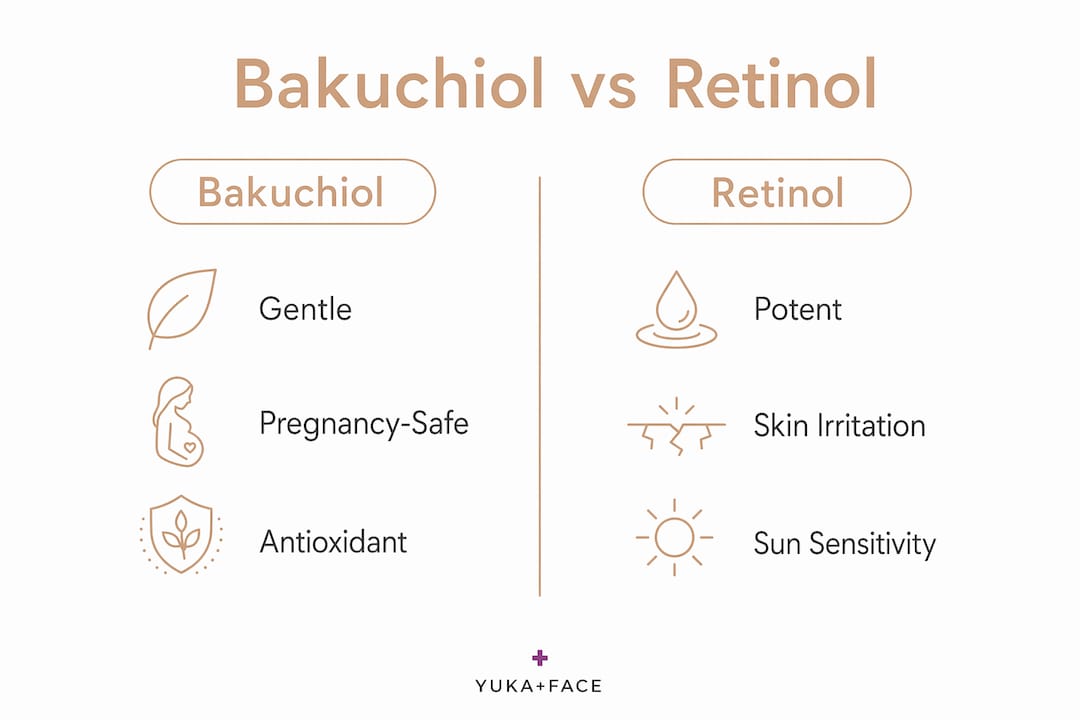
Bakuchiol and retinol target the same skin concerns through different mechanisms. The right choice depends on your skin type, life stage, and the severity of the concerns you want to address.
| Factor | Bakuchiol | Retinol |
|---|---|---|
| Wrinkle reduction | About 20% over 12 weeks | About 20% over 12 weeks |
| Hyperpigmentation | 59% improvement rate | 44% improvement rate |
| Irritation risk | Low. Suitable for sensitive skin | Moderate to high, especially at first |
| Pregnancy safety | Pregnancy-safe | Not recommended |
| Rosacea and reactive skin | Well tolerated | Often triggers flares |
| Potency for severe concerns | Moderate | High, especially prescription tretinoin |
| Sun sensitivity | None | Increases photosensitivity |
| Use timing | AM and PM | Typically PM only |
The comparison makes the decision clearer. For everyday anti-aging maintenance, sensitive skin, or pregnancy, bakuchiol is the stronger practical choice. For severe acne, deep wrinkles, or conditions requiring prescription-strength treatment, dermatologists note that bakuchiol is less potent than tretinoin and is not a substitute for prescription retinoids.
The full bakuchiol vs retinol breakdown covers these trade-offs in more detail if you want to go deeper on the comparison.
Pro Tip: You do not have to choose one or the other. Some people use bakuchiol in the morning and a low-strength retinol at night, getting the antioxidant benefits of bakuchiol during the day while retinol works overnight.
Who should use bakuchiol and how to add it to your routine?
Bakuchiol suits a specific set of people particularly well. Sensitive, reactive, and rosacea-prone skin types benefit most because the ingredient delivers retinol-like results without triggering the irritation those skin types cannot tolerate. Pregnant and breastfeeding women gain access to a clinically supported collagen-boosting ingredient at a time when retinoids are off limits. People new to active skincare also find bakuchiol a lower-risk entry point than starting with retinol.
Practical routine guidance:
- Frequency: Use once or twice daily. Bakuchiol is stable enough for both morning and evening application, unlike retinol.
- Morning pairing: Combine with vitamin C for added antioxidant protection. The two actives complement each other without conflict.
- Evening use: Apply after cleansing and before moisturizer. Follow with a nourishing oil or cream to support the skin barrier.
- Patch test first: Even gentle ingredients can cause reactions on highly reactive skin. Test on the inner arm for 48 hours before full-face use.
- Sun protection: Bakuchiol does not increase photosensitivity, but daily SPF remains non-negotiable for any anti-aging routine.
Common mistakes to avoid:
- Expecting overnight results. Bakuchiol requires consistent use over 8–12 weeks for visible change.
- Overloading the routine. Bakuchiol works well alongside hyaluronic acid, niacinamide, and vitamin C. Avoid layering it with strong acids like glycolic acid in the same application.
- Skipping moisturizer. Even though bakuchiol supports the skin barrier, a good moisturizer locks in the benefits and keeps the skin comfortable.
Pro Tip: If you are building a morning skin care routine from scratch, bakuchiol plus SPF 30 or higher is one of the most effective and low-irritation combinations available for preventive anti-aging.
Understanding how bakuchiol fits into a broader skin barrier care approach helps you get more from the ingredient long term.
Key Takeaways
Bakuchiol is the most clinically supported plant-based alternative to retinol, delivering comparable wrinkle reduction with significantly less irritation and full pregnancy safety.
| Point | Details |
|---|---|
| Wrinkle reduction | Bakuchiol matches retinol at about 20% wrinkle severity reduction over 12 weeks. |
| Pigmentation advantage | 59% of bakuchiol users improved hyperpigmentation vs. 44% with retinol in clinical trials. |
| Pregnancy safety | Bakuchiol is classified as pregnancy-safe, making it the top retinoid alternative for expecting women. |
| Sensitive skin fit | Bakuchiol suits rosacea-prone and reactive skin types that cannot tolerate vitamin A derivatives. |
| Routine flexibility | Bakuchiol can be used morning and evening, unlike retinol which is typically limited to nighttime. |
Bakuchiol in practice: what I have learned from years of natural skincare
The conversation around bakuchiol often gets framed as a straight swap for retinol. That framing sets people up for the wrong expectations. Bakuchiol is not a weaker version of retinol. It is a different tool that happens to produce overlapping results through a gentler pathway.
What I find most valuable about bakuchiol is its role in preventive skincare. Starting in your mid-20s or early 30s, before significant visible aging appears, is where bakuchiol earns its place. At that stage, you do not need prescription-strength intervention. You need consistent collagen support, antioxidant protection, and a product your skin will actually tolerate every day. Bakuchiol delivers all three.
The pigmentation data surprised me. Most people assume brightening is a secondary benefit. The clinical numbers say otherwise. Outperforming retinol on hyperpigmentation improvement is a meaningful result, and it is one that rarely gets the attention it deserves in mainstream skincare coverage.
My honest caution: if you have severe, deep wrinkles or persistent cystic acne, bakuchiol alone is not enough. A dermatologist conversation about prescription tretinoin is the right next step in those cases. Bakuchiol is excellent for maintenance and prevention. It is not a replacement for clinical treatment when clinical treatment is what the skin actually needs.
The broader shift toward plant-based skincare is not just a trend. The clinical data behind ingredients like bakuchiol shows that natural does not mean less effective. It often means better tolerated, which in practice means more consistent use, and consistent use is what actually produces results.
— Kelly
Yuka+Face and plant-based skincare worth knowing
Yuka+Face builds every product around the principle that natural ingredients, backed by botanical research, can deliver real results without compromise.

The Yuka+Face bakuchiol range brings together vegan, cruelty-free formulations designed for all skin types and ages. Whether you are new to plant-based actives or looking to refine an existing routine, the Yuka+Face vegan skincare guide covers the ingredients, routines, and product categories worth knowing. Clean formulations. No synthetic retinoids. No compromise on results.
FAQ
What is bakuchiol exactly?
Bakuchiol is a plant-derived compound from Psoralea corylifolia seeds that activates skin renewal pathways similar to retinol. It reduces wrinkles, improves skin tone, and supports collagen production without vitamin A.
Is bakuchiol safe during pregnancy?
Bakuchiol is classified as pregnancy-safe and is widely recommended as the primary retinoid alternative for pregnant and breastfeeding women. It provides collagen support without the risks associated with vitamin A derivatives.
How long does bakuchiol take to work?
Visible results typically appear after 8–12 weeks of consistent use. Clinical studies used a 12-week period to measure wrinkle reduction and hyperpigmentation improvement.
Can you use bakuchiol with other active ingredients?
Bakuchiol pairs well with vitamin C, hyaluronic acid, and niacinamide. Avoid combining it with strong exfoliating acids like glycolic acid in the same application step.
Is bakuchiol as effective as retinol?
For wrinkle reduction, bakuchiol matches retinol at about 20% improvement over 12 weeks. For hyperpigmentation, bakuchiol outperforms retinol. For severe acne or deep wrinkles, prescription retinoids remain more potent.